Covalent Bonding Chapter 8
The atoms held together by sharing electrons are joined by a  Covalent Bond . Sharing is Caring
2.  Covalent bonds-   Two atoms share one or more pairs of outer-shell electrons.  Oxygen Atom Oxygen Atom Oxygen  Molecule  (O 2 )
Molecules and Molecular Compounds Molecule  is a neutral group of atoms joined together by covalent bonds. Diatomic molecule  is a molecule consisting of two atoms. A compound composed of molecules is called a  molecular compound .
Properties Molecular compounds tend to have relatively lower melting and boiling points than ionic compounds. Many are gases or liquids at room temperature. Most are formed from atoms of two or more nonmetals.
Molecular Formulas A molecular formula is the chemical formula of a molecular compound.  It shows how many atoms of each element a molecule contains. CO 2 Carbon Dioxide 1 Carbon Atom 2 Oxygen Atoms
Ionic Vs. Covalent Bond
Covalent Bonds
Chapter 2  Chemical Principles  Bonding Covalent bonding
So what are covalent bonds?
In covalent bonding, atoms still want to achieve a noble gas configuration (the octet rule).
In covalent bonding, atoms still want to achieve a noble gas configuration (the octet rule).  But rather than losing or gaining electrons, atoms now  share  an electron pair.
In covalent bonding, atoms still want to achieve a noble gas configuration (the octet rule).  But rather than losing or gaining electrons, atoms now  share  an electron pair. The shared electron pair is called a  bonding pair
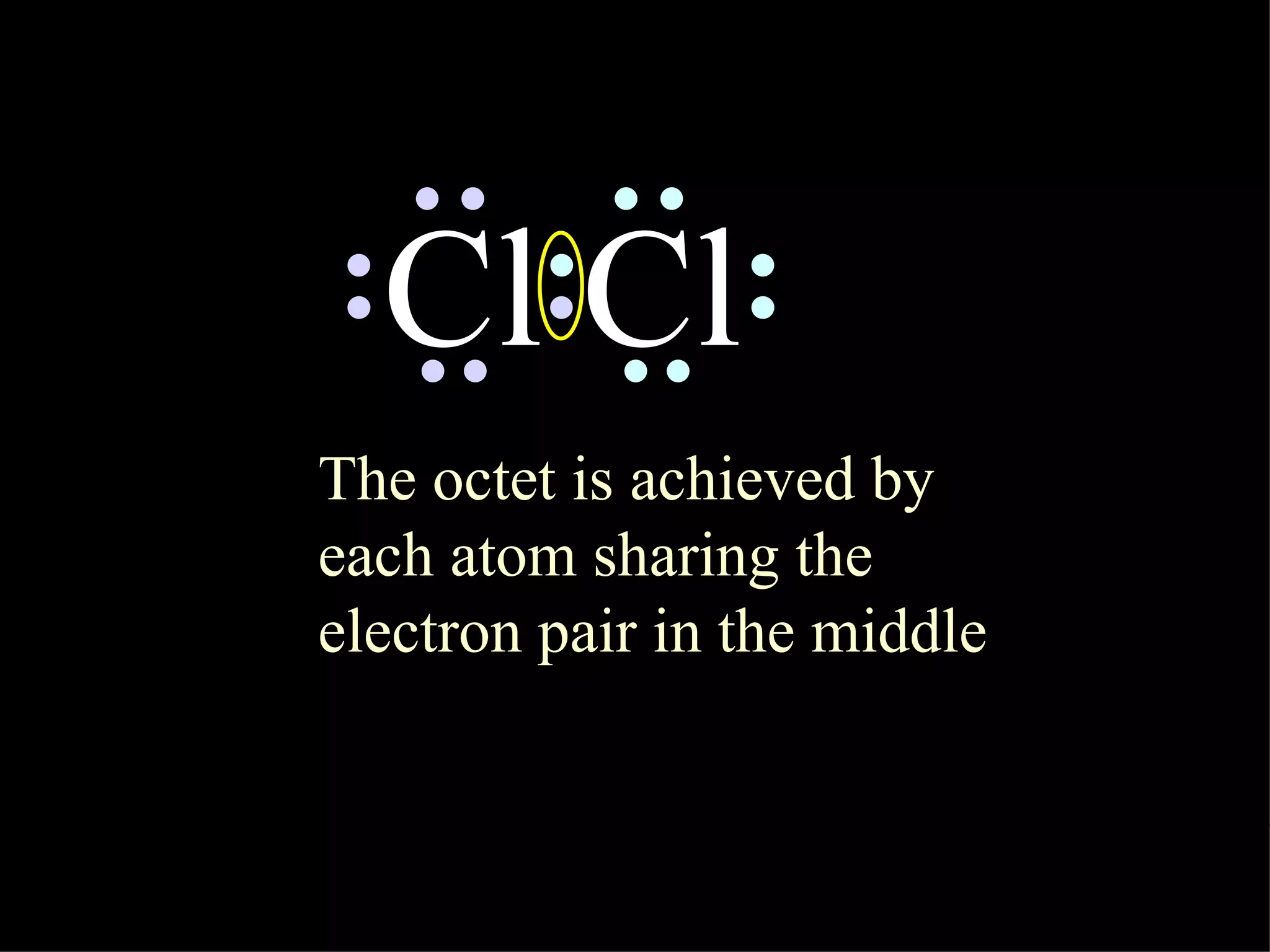
Cl 2 Chlorine forms a covalent bond with itself
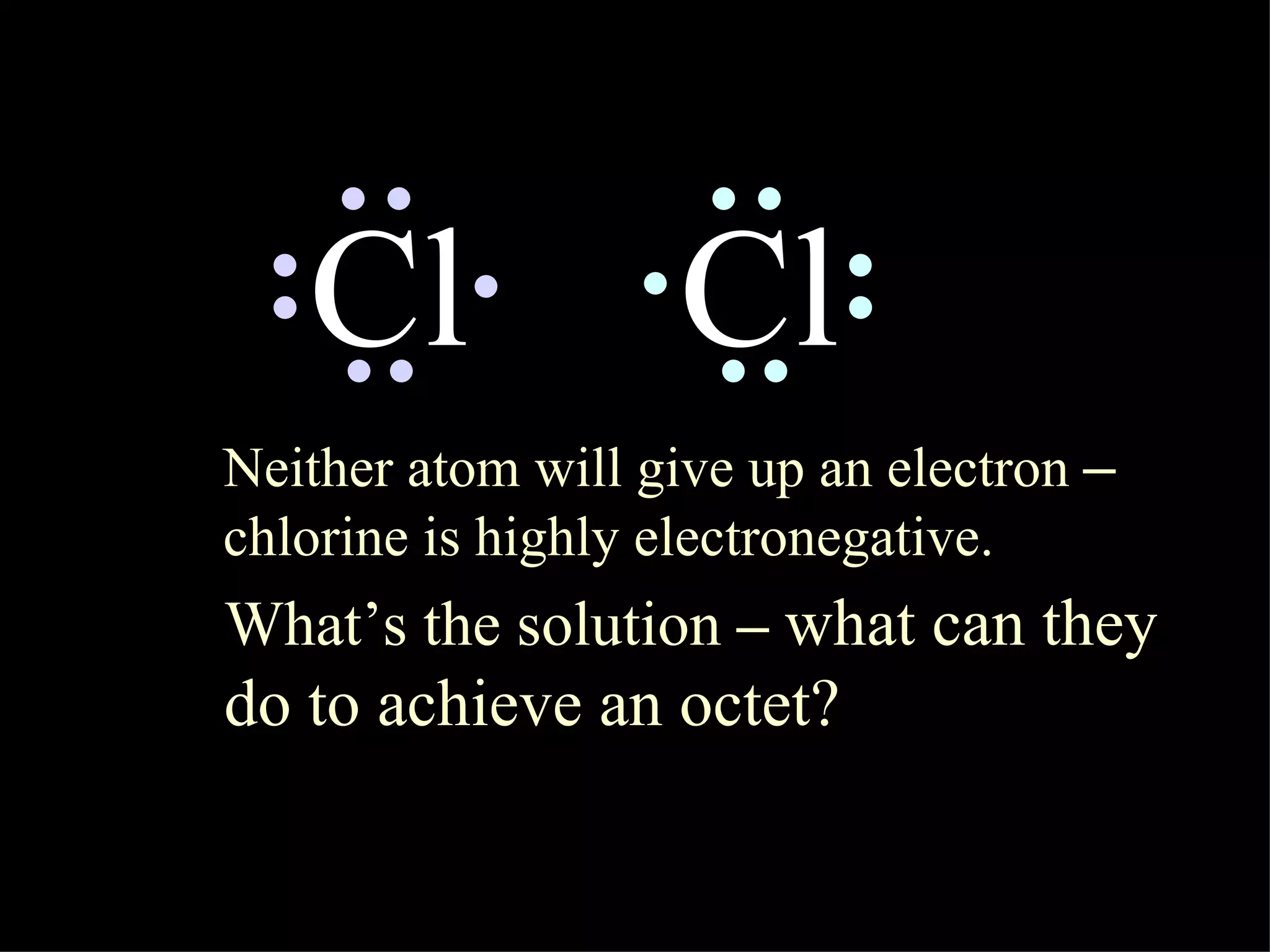
Cl Cl How will two chlorine atoms react?
Cl Cl Each chlorine atom wants to  gain one electron to achieve an octet
Cl Cl Neither atom will give up an electron  – chlorine is highly electronegative. What’s the solution  –   what can they do to achieve an octet?
Cl Cl octet
Cl Cl circle the electrons for each atom that completes their octets octet
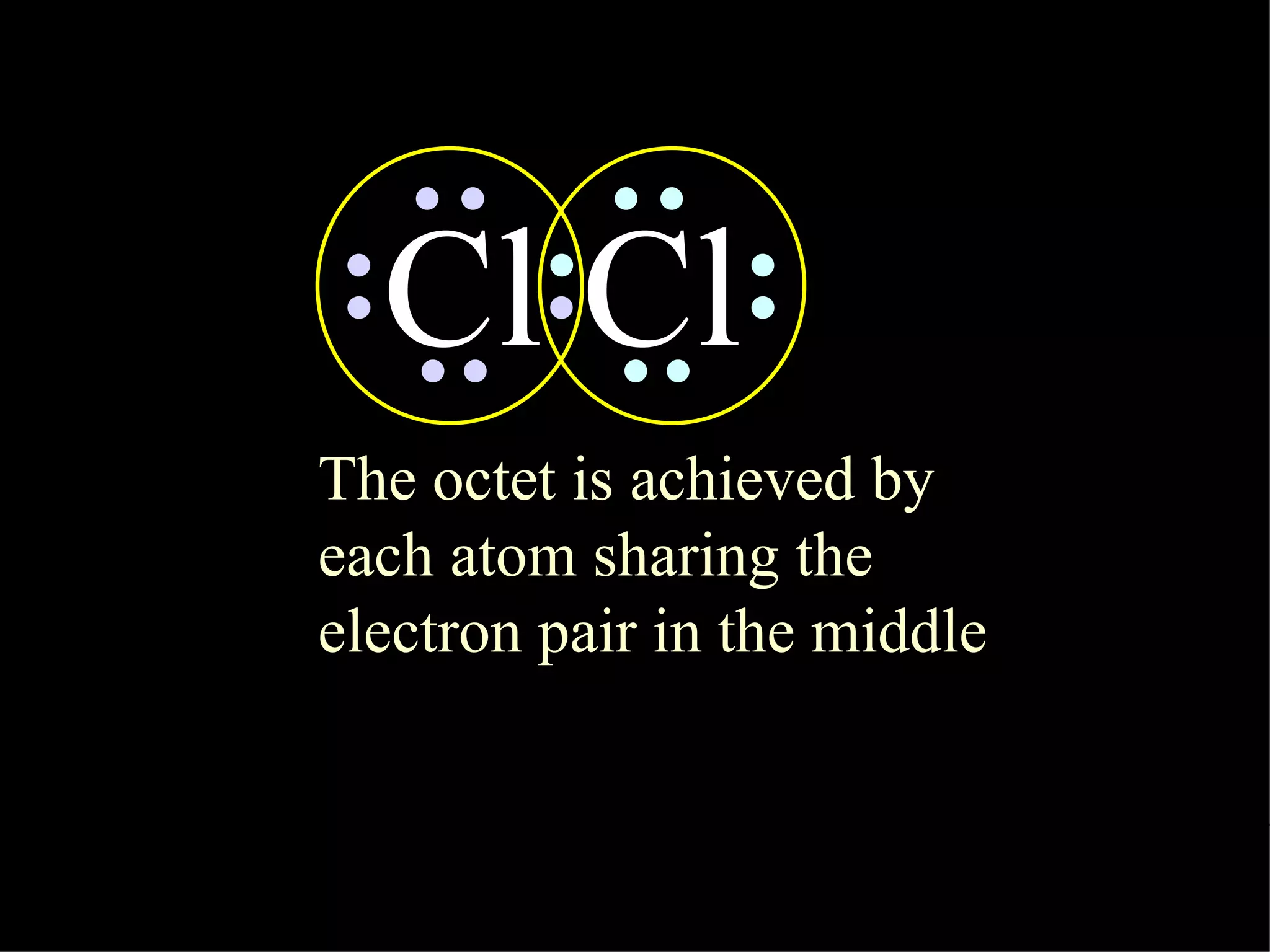
Cl Cl circle the electrons for each atom that completes their octets The octet is achieved by each atom sharing the electron pair in the middle
Cl Cl circle the electrons for each atom that completes their octets This is the bonding pair
Cl Cl circle the electrons for each atom that completes their octets It is a  single  bonding pair
Cl Cl circle the electrons for each atom that completes their octets It is called a   SINGLE BOND
Cl Cl circle the electrons for each atom that completes their octets Single bonds are abbreviated with a dash
Cl Cl circle the electrons for each atom that completes their octets This is the chlorine molecule, Cl 2
O 2 Oxygen is also one of the diatomic molecules
How will two oxygen atoms bond? O O
Each atom has two unpaired electrons O O
O O
O O
Oxygen atoms are highly electronegative. So both atoms want to gain two electrons. O O
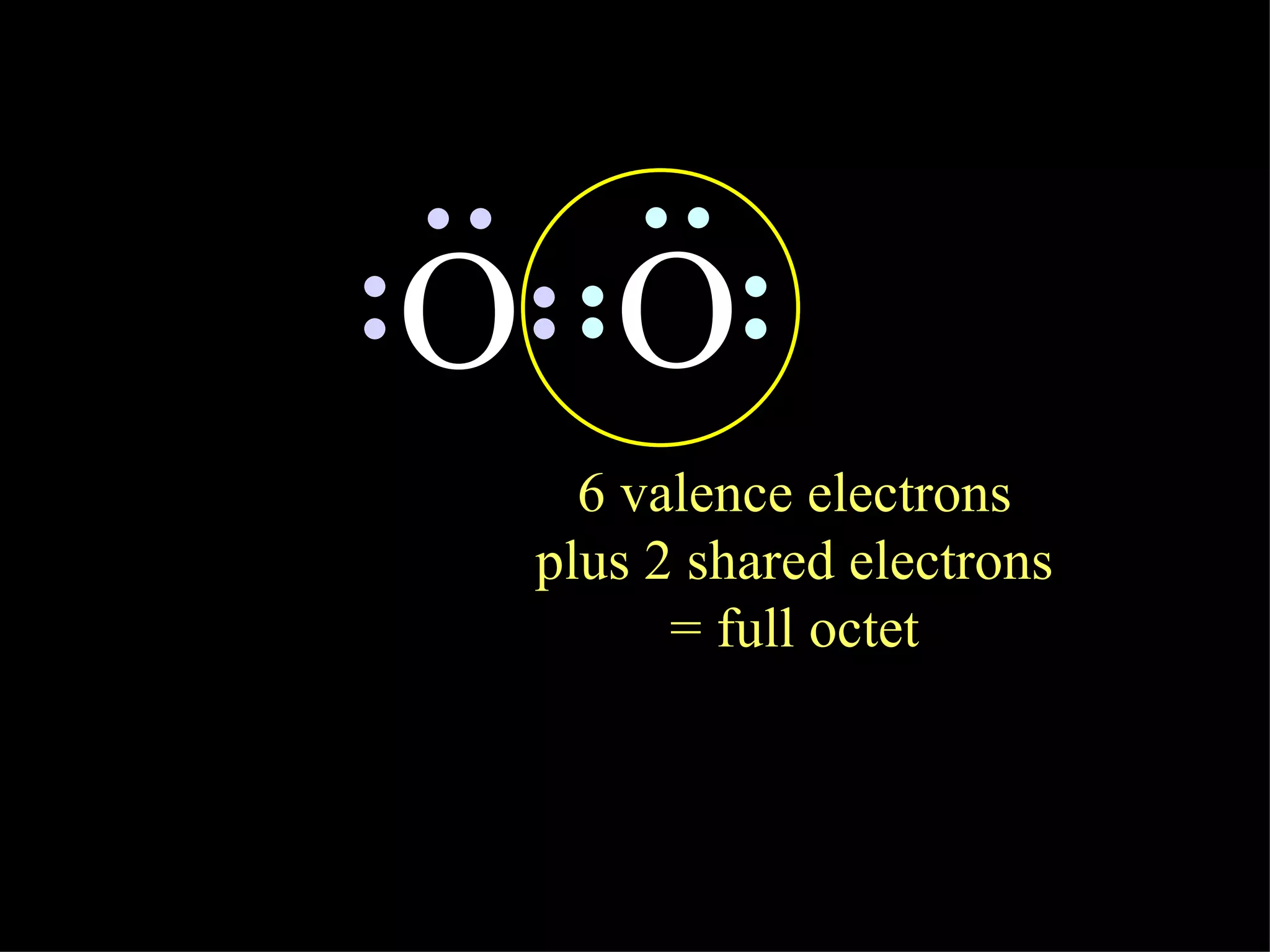
O O Both electron pairs are shared.
6 valence electrons plus 2 shared electrons = full octet O O
two bonding pairs, O O making a  double   bond
For convenience, the double bond  can be shown as two dashes.  O O = O O
This is the oxygen molecule, O 2 O O = this is so  cool!!
Multiple Covalent bonds O O Sharing One Pair of electrons One Covalent Bond Only 7 electrons does  Not meet Octet Rule! Need to share Another pair of  electrons O O Sharing Two Pairs of electrons Two Covalent Bonds A Double Bond A Double Bond can be represented by a double line O O
Multiple Covalent bonds N N N N Sharing Three Pairs of electrons Three Covalent Bonds A Triple Bond A Triple Bond can be represented by a Triple line Nitrogen
Coordinate Covalent Bond both electrons contributed by one atom of pair NH 3   +  H +   ----->  NH 4 + H 2 O  +  H +   ----->  H 3 O +
Coordinate Covalent Bond ammonium ion
Drawing Lewis Dot Structures Predict the location of the atoms Hydrogen is a terminal atom The central atom has the smallest electronegativity. Count the valence electrons. Draw a single covalent bond between the central atom and the surrounding atoms. Subtract the number of electrons in the single covalent bonds from the total number of electrons in 2. Use the remaining electrons to complete the octets of each atom. If the central atom does not have a complete octet then try double or triple bonds.
Drawing Lewis Dot Structures Draw Lewis Dot Structures for: PH 3 H 2 S HCl CCl 4 SiH 4 CH 2 Cl 2
Bond Dissociation Energies The energy required to break the bond between two covalently bonded atoms.
Relate the strength of covalent bonds to bond length The more bonds located between 2 atoms, the shorter the bonds are The shorter a bond is, the stronger it is H – H single bond, not too strong O=O double bonds, stronger N Ξ N triple bonds, strongest
Endothermic/Exothermic In chemical reactions, bonds are broken, then new bonds are formed Endothermic More energy is required to break the old bonds than is released by the formation of new bonds Energy is taken in (colder) Exothermic More energy is released when forming new bonds than is used to break the old bonds Energy is given off (hotter)
Exceptions to Octet Rule NO 2 nitrogen dioxide resonance
Exceptions to Octet Rule PF 5 expanded octet
Exceptions to Octet Rule SF 6 Expanded octet
INTRODUCTION A) Lewis structures do not indicate the three dimensional shape of a molecule. They do not show the arrangement space of the atoms, what we call the molecular geometry or molecular structure. B) Molecules have definite shapes and the shape of a molecule controls some of its chemical and physical properties.
II. Valence Shell Electron Pair Repulsion Theory - VSEPR - predicts the shapes of a number of molecules and polyatomic ions. A) Assumptions of VSEPR Theory 1) Electron pairs in the valence shell of an atom tend to orient themselves so that the total energy is minimized. This means that:  the electrons will approach the nucleus as close as possible yet take positions as far away from each other as possible to minimize _______________ .
2) Because lone pairs of electrons are spread out more broadly than bond pairs, repulsions are greatest between two lone pairs,  intermediate between a lone pair and a bond pair , and weakest between two bonding pairs of electrons. 3) Repulsive forces decrease rapidly with increasing interpair angle - greatest at 90 o , much weaker at 120 o , and very weak at 180 o . B) What are the  ideal arrangements  of electron pairs to minimize repulsions?
Bond Formation A bond can result from an   overlap   of atomic orbitals on neighboring atoms.   Overlap of H (1s) and Cl (2p) Note that each atom has a single, unpaired electron. Cl H H Cl •• • • •• •• • • •• +
Double and even triple bonds are commonly observed for C, N, P, O, and S H 2 CO SO 3 C 2 F 4
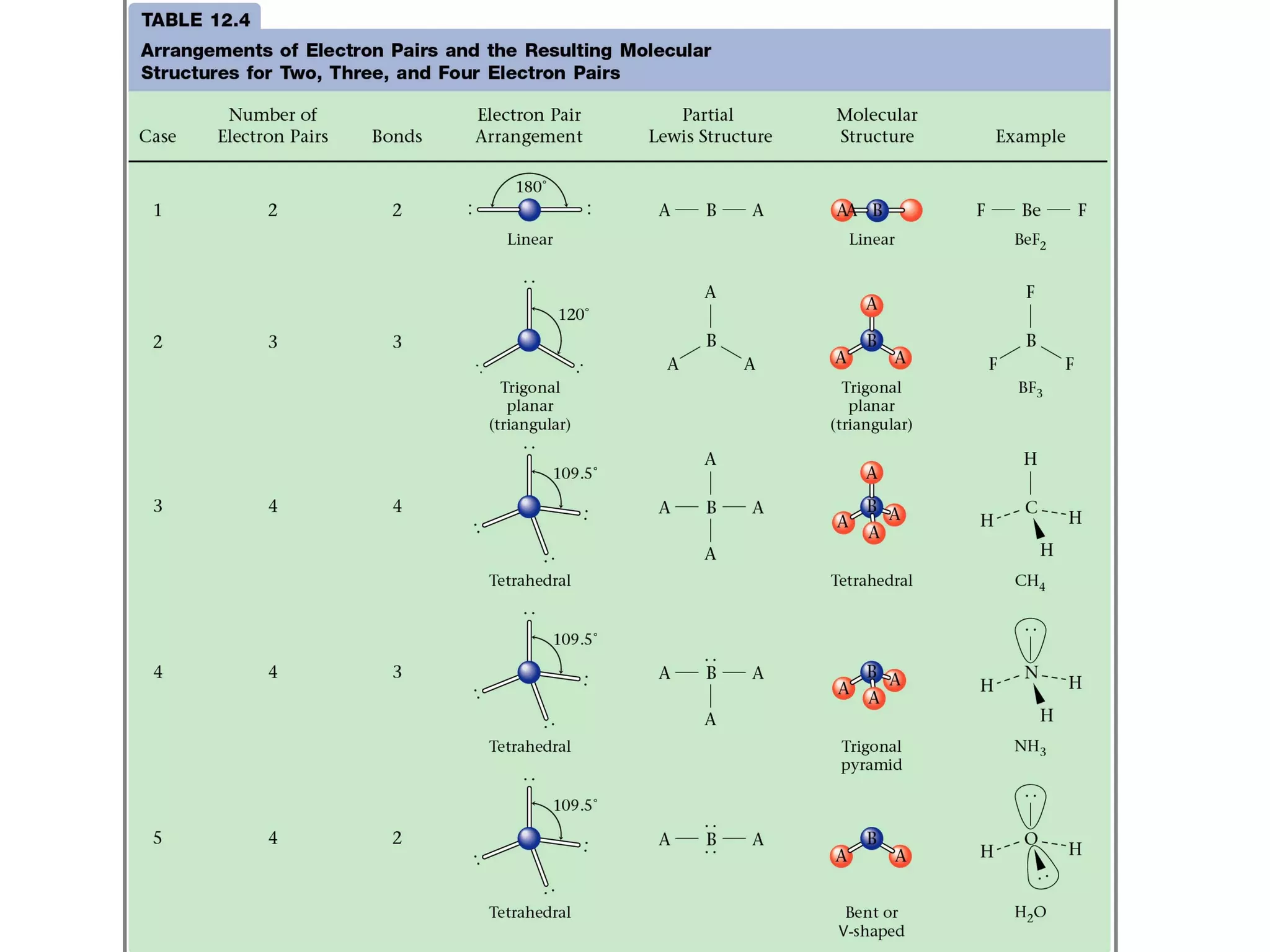
Some Common Geometries Linear Trigonal Planar Tetrahedral
 
 
Structure Determination by VSEPR Water, H 2 O The electron pair geometry is  TETRAHEDRAL The molecular geometry is  BENT . 2 bond pairs 2 lone pairs
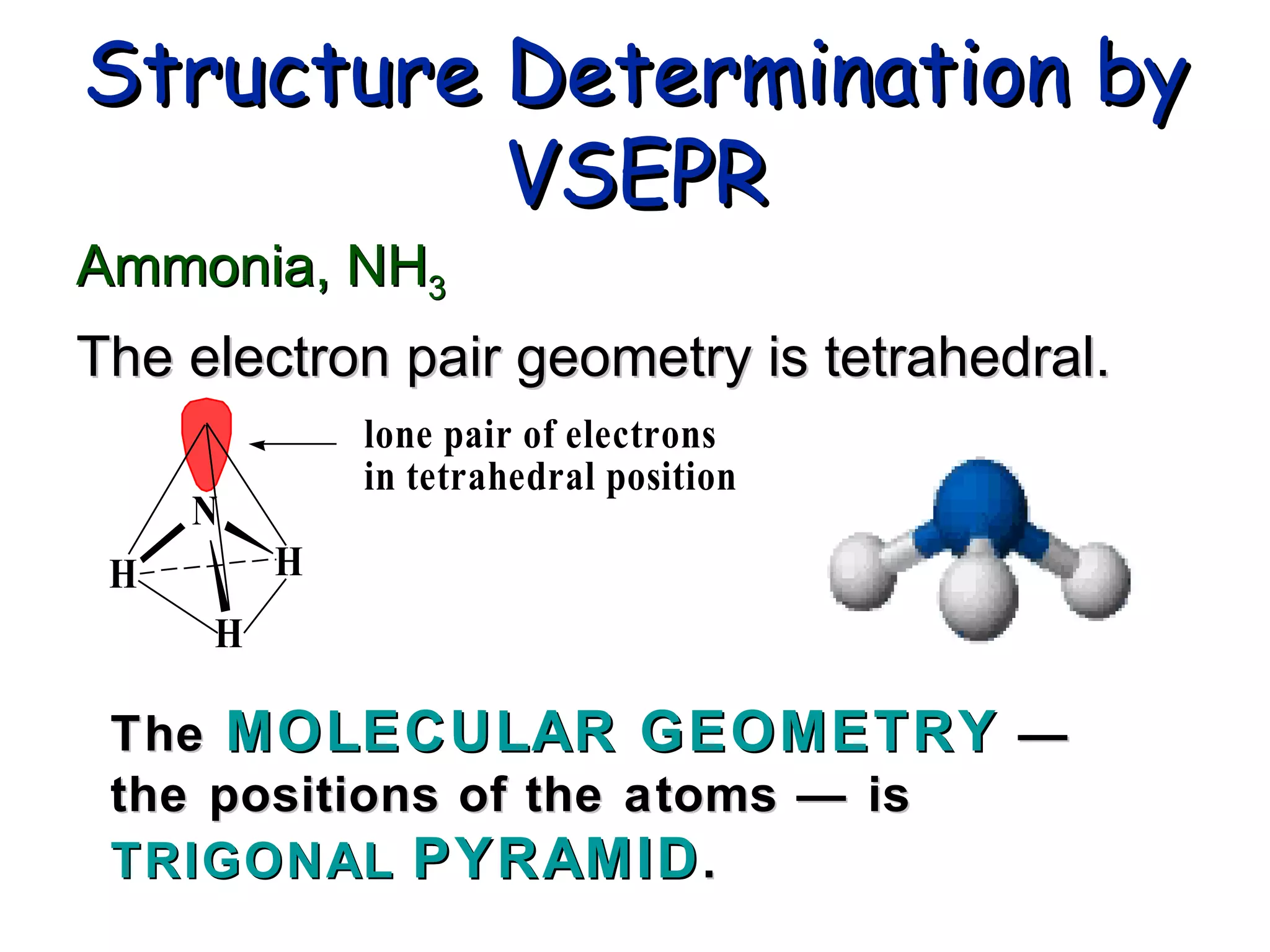
Structure Determination by VSEPR Ammonia, NH 3 The electron pair geometry is tetrahedral. The  MOLECULAR GEOMETRY  — the positions of the atoms — is  TRIGONAL  PYRAMID .
Bond Polarity HCl is  POLAR  because it has a positive end and a negative end. (difference in electronegativity) Cl has a greater share in bonding electrons than does H. Cl has slight negative charge  (-  )  and H has slight positive charge  (+   )
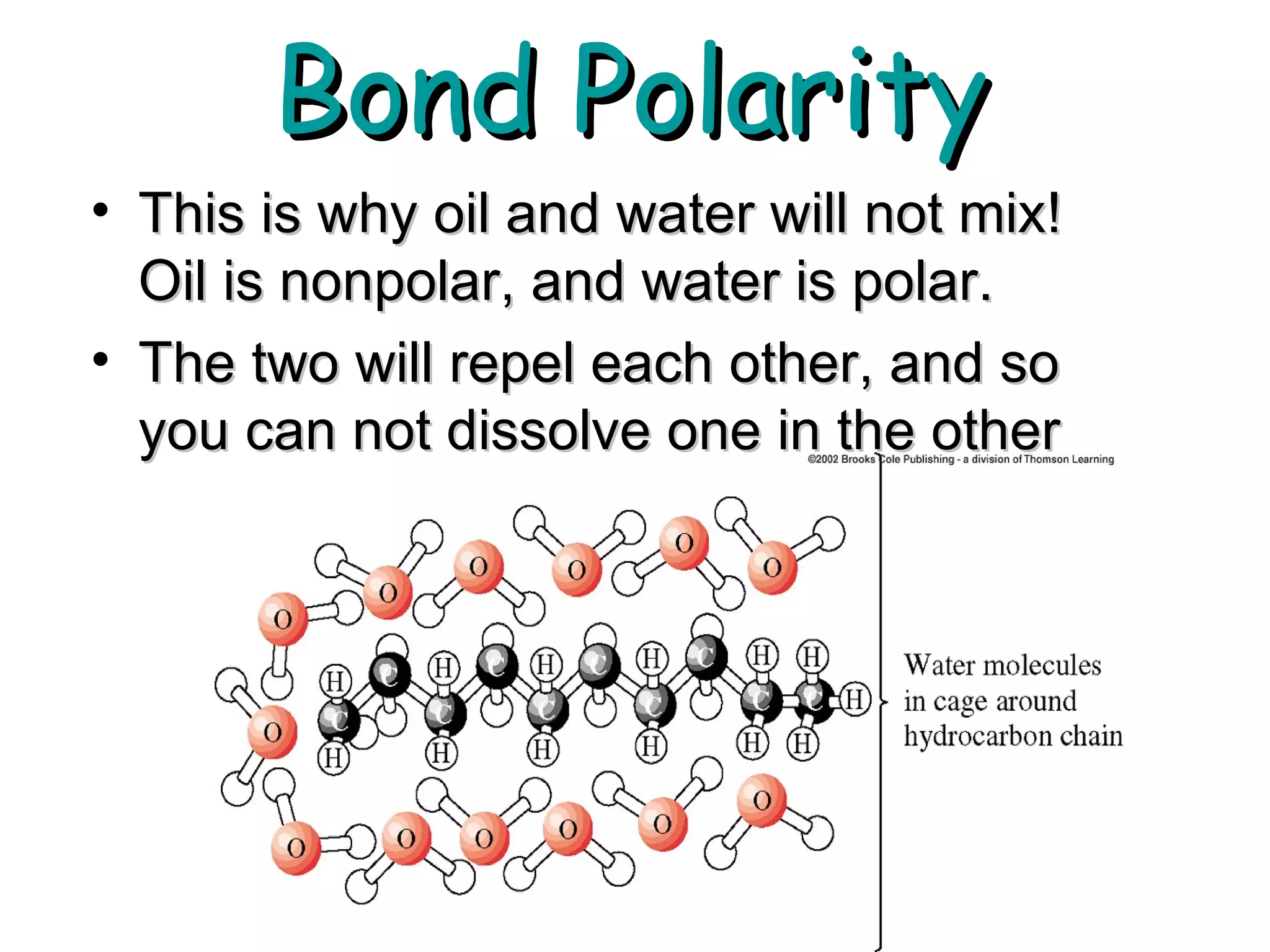
This is why oil and water will not mix!  Oil is nonpolar, and water is polar. The two will repel each other, and so you can not dissolve one in the other Bond Polarity
Bond Polarity “ Like Dissolves Like” Polar dissolves Polar Nonpolar dissolves Nonpolar
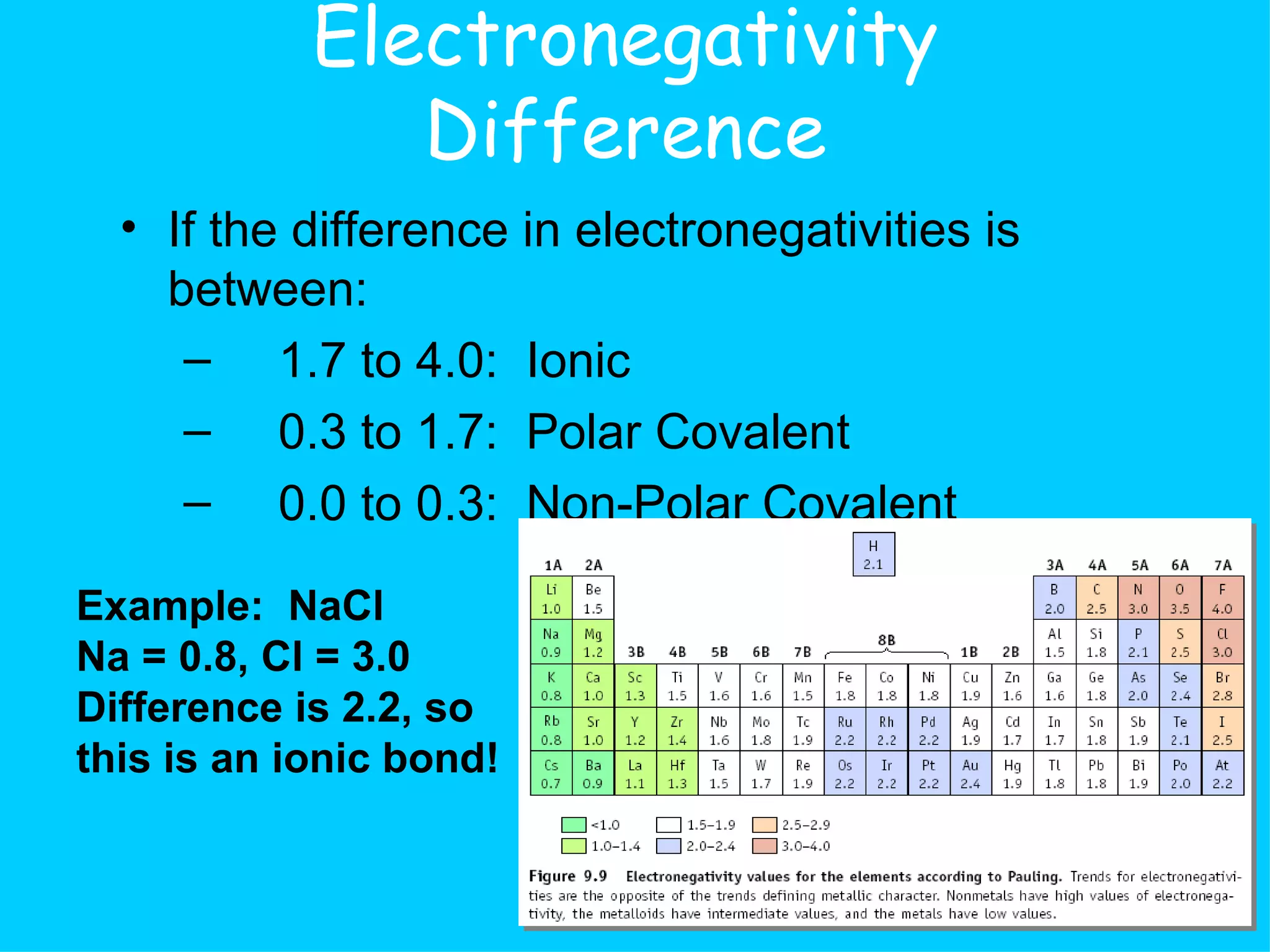
Electronegativity Difference If the difference in electronegativities is between: 1.7 to 4.0:  Ionic 0.3 to 1.7:  Polar Covalent 0.0 to 0.3:  Non-Polar Covalent Example:  NaCl Na = 0.8, Cl = 3.0 Difference is 2.2, so this is an ionic bond!
Diatomic Elements These elements do not exist as a single atom; they always appear as pairs When atoms turn into ions, this NO LONGER HAPPENS! Hydrogen Nitrogen Oxygen Fluorine Chlorine Bromine Iodine Remember:  BrINClHOF
Polar Covalent Bonds: Unevenly matched, but willing to share.
Van der Waals Forces   Small, weak interactions  between  molecules  
Van der Waals Forces   Intermolecular: between molecules (not a bond)   Intramolecular: bonds within molecules (stronger)
3 Types of Van der Waals Forces 1)      dipole-dipole 2)      dipole-induced dipole 3)  dispersion
Dipole-Dipole Two  polar  molecules align so that   + and   - are matched (electrostatic attraction) Ex: ethane (C 2 H 6 ) vs. fluromethane (CH 3 F) Occurs when polar molecules are attracted to one another. The slightly region of a polar molecule is weakly attracted to the slightly positive region of another polar molecule. Similar to but much weaker than ionic bonds.
Dispersion Forces The weakest of all molecular interactions, are caused by the motion of electrons. Dispersion is the ONLY intermolecular attraction that occurs between  non-polar molecules
Review Dipole – between two polar molecules Dispersion- between two non-polar molecules
Hydrogen Bonding STRONGEST  Intermolecular Force!! A special type of dipole-dipole attraction Bonds form due to the polarity of water. Ice Liquid
Hydrogen Bonding con’t Hydrogen bonds keep water in the liquid phase over a wider range of temperatures than is found for any other molecule of its size
How many drops can you get on a penny?  Water? Why is there a difference??? Water has strong Hydrogen Bonds and TTE has weaker intermolecular forces http://www.msnucleus.org/membership/html/k-6/wc/water/1/images/penny.jpg
How is surface tension affected by soap? Breaks the surface tension! http://www.chemistryland.com/CHM107/Water/SoapDisruptsWater.jpg http://www.chemistry.nus.edu.sg/2500/micelle.jpg
Intermolecular Attractions and Molecular Properties The physical properties of a compound depend on the type of bonding it displays-in particular, on whether it is ionic or covalent. Network Solids are solids in which all of the atoms are covalently bonded together. Melting a network solid would require breaking covalent bonds throughout the solid. Diamond does not melt; rather it vaporizes to a gas at 3500 degrees Celsius and above.
Review of Chemical Bonds There are 3 forms of bonding: _________ —complete  transfer  of 1 or more electrons from one atom to another (one loses, the other gains) forming oppositely charged ions that attract one another _________ — some valence electrons  shared  between atoms _________  – holds atoms of a metal together Most bonds are somewhere in between ionic and covalent.
Review of Valence Electrons Number of valence electrons of a main (A) group atom = Group number
Review of Valence Electrons Remember from the electron chapter that valence electrons are the electrons in the OUTERMOST energy level… that’s why we did all those electron configurations! B is 1s 2  2s 2  2p 1 ; so the outer energy level is 2, and there are 2+1 = 3 electrons in level 2.  These are the valence electrons! Br is  [Ar] 4s 2  3d 10  4p 5 How many valence electrons are present?
Bond and Lone Pairs Valence electrons are distributed as shared or   BOND PAIRS  and unshared or   LONE PAIRS. This is called a  LEWIS  structure. • •• • •• H Cl lone pair (LP) shared or bond pair

Chapter 8 Covalent Bonds

  • 1.
  • 2.
    The atoms heldtogether by sharing electrons are joined by a Covalent Bond . Sharing is Caring
  • 3.
    2. Covalentbonds- Two atoms share one or more pairs of outer-shell electrons. Oxygen Atom Oxygen Atom Oxygen Molecule (O 2 )
  • 4.
    Molecules and MolecularCompounds Molecule is a neutral group of atoms joined together by covalent bonds. Diatomic molecule is a molecule consisting of two atoms. A compound composed of molecules is called a molecular compound .
  • 5.
    Properties Molecular compoundstend to have relatively lower melting and boiling points than ionic compounds. Many are gases or liquids at room temperature. Most are formed from atoms of two or more nonmetals.
  • 6.
    Molecular Formulas Amolecular formula is the chemical formula of a molecular compound. It shows how many atoms of each element a molecule contains. CO 2 Carbon Dioxide 1 Carbon Atom 2 Oxygen Atoms
  • 7.
  • 8.
  • 9.
    Chapter 2 Chemical Principles Bonding Covalent bonding
  • 10.
    So what arecovalent bonds?
  • 11.
    In covalent bonding,atoms still want to achieve a noble gas configuration (the octet rule).
  • 12.
    In covalent bonding,atoms still want to achieve a noble gas configuration (the octet rule). But rather than losing or gaining electrons, atoms now share an electron pair.
  • 13.
    In covalent bonding,atoms still want to achieve a noble gas configuration (the octet rule). But rather than losing or gaining electrons, atoms now share an electron pair. The shared electron pair is called a bonding pair
  • 14.
    Cl 2 Chlorineforms a covalent bond with itself
  • 15.
    Cl Cl Howwill two chlorine atoms react?
  • 16.
    Cl Cl Eachchlorine atom wants to gain one electron to achieve an octet
  • 17.
    Cl Cl Neitheratom will give up an electron – chlorine is highly electronegative. What’s the solution – what can they do to achieve an octet?
  • 18.
    Cl Cl Neitheratom will give up an electron – chlorine is highly electronegative. What’s the solution – what can they do to achieve an octet?
  • 19.
  • 20.
    Cl Cl circlethe electrons for each atom that completes their octets octet
  • 21.
    Cl Cl circlethe electrons for each atom that completes their octets The octet is achieved by each atom sharing the electron pair in the middle
  • 22.
    Cl Cl circlethe electrons for each atom that completes their octets The octet is achieved by each atom sharing the electron pair in the middle
  • 23.
    Cl Cl circlethe electrons for each atom that completes their octets This is the bonding pair
  • 24.
    Cl Cl circlethe electrons for each atom that completes their octets It is a single bonding pair
  • 25.
    Cl Cl circlethe electrons for each atom that completes their octets It is called a SINGLE BOND
  • 26.
    Cl Cl circlethe electrons for each atom that completes their octets Single bonds are abbreviated with a dash
  • 27.
    Cl Cl circlethe electrons for each atom that completes their octets This is the chlorine molecule, Cl 2
  • 28.
    O 2 Oxygenis also one of the diatomic molecules
  • 29.
    How will twooxygen atoms bond? O O
  • 30.
    Each atom hastwo unpaired electrons O O
  • 31.
  • 32.
  • 33.
    Oxygen atoms arehighly electronegative. So both atoms want to gain two electrons. O O
  • 34.
    O O Bothelectron pairs are shared.
  • 35.
    6 valence electronsplus 2 shared electrons = full octet O O
  • 36.
    6 valence electronsplus 2 shared electrons = full octet O O
  • 37.
    two bonding pairs,O O making a double bond
  • 38.
    For convenience, thedouble bond can be shown as two dashes. O O = O O
  • 39.
    This is theoxygen molecule, O 2 O O = this is so cool!!
  • 40.
    Multiple Covalent bondsO O Sharing One Pair of electrons One Covalent Bond Only 7 electrons does Not meet Octet Rule! Need to share Another pair of electrons O O Sharing Two Pairs of electrons Two Covalent Bonds A Double Bond A Double Bond can be represented by a double line O O
  • 41.
    Multiple Covalent bondsN N N N Sharing Three Pairs of electrons Three Covalent Bonds A Triple Bond A Triple Bond can be represented by a Triple line Nitrogen
  • 42.
    Coordinate Covalent Bondboth electrons contributed by one atom of pair NH 3 + H + -----> NH 4 + H 2 O + H + -----> H 3 O +
  • 43.
  • 44.
    Drawing Lewis DotStructures Predict the location of the atoms Hydrogen is a terminal atom The central atom has the smallest electronegativity. Count the valence electrons. Draw a single covalent bond between the central atom and the surrounding atoms. Subtract the number of electrons in the single covalent bonds from the total number of electrons in 2. Use the remaining electrons to complete the octets of each atom. If the central atom does not have a complete octet then try double or triple bonds.
  • 45.
    Drawing Lewis DotStructures Draw Lewis Dot Structures for: PH 3 H 2 S HCl CCl 4 SiH 4 CH 2 Cl 2
  • 46.
    Bond Dissociation EnergiesThe energy required to break the bond between two covalently bonded atoms.
  • 47.
    Relate the strengthof covalent bonds to bond length The more bonds located between 2 atoms, the shorter the bonds are The shorter a bond is, the stronger it is H – H single bond, not too strong O=O double bonds, stronger N Ξ N triple bonds, strongest
  • 48.
    Endothermic/Exothermic In chemicalreactions, bonds are broken, then new bonds are formed Endothermic More energy is required to break the old bonds than is released by the formation of new bonds Energy is taken in (colder) Exothermic More energy is released when forming new bonds than is used to break the old bonds Energy is given off (hotter)
  • 49.
    Exceptions to OctetRule NO 2 nitrogen dioxide resonance
  • 50.
    Exceptions to OctetRule PF 5 expanded octet
  • 51.
    Exceptions to OctetRule SF 6 Expanded octet
  • 52.
    INTRODUCTION A) Lewisstructures do not indicate the three dimensional shape of a molecule. They do not show the arrangement space of the atoms, what we call the molecular geometry or molecular structure. B) Molecules have definite shapes and the shape of a molecule controls some of its chemical and physical properties.
  • 53.
    II. Valence ShellElectron Pair Repulsion Theory - VSEPR - predicts the shapes of a number of molecules and polyatomic ions. A) Assumptions of VSEPR Theory 1) Electron pairs in the valence shell of an atom tend to orient themselves so that the total energy is minimized. This means that: the electrons will approach the nucleus as close as possible yet take positions as far away from each other as possible to minimize _______________ .
  • 54.
    2) Because lonepairs of electrons are spread out more broadly than bond pairs, repulsions are greatest between two lone pairs, intermediate between a lone pair and a bond pair , and weakest between two bonding pairs of electrons. 3) Repulsive forces decrease rapidly with increasing interpair angle - greatest at 90 o , much weaker at 120 o , and very weak at 180 o . B) What are the ideal arrangements of electron pairs to minimize repulsions?
  • 55.
    Bond Formation Abond can result from an overlap of atomic orbitals on neighboring atoms. Overlap of H (1s) and Cl (2p) Note that each atom has a single, unpaired electron. Cl H H Cl •• • • •• •• • • •• +
  • 56.
    Double and eventriple bonds are commonly observed for C, N, P, O, and S H 2 CO SO 3 C 2 F 4
  • 57.
    Some Common GeometriesLinear Trigonal Planar Tetrahedral
  • 58.
  • 59.
  • 60.
    Structure Determination byVSEPR Water, H 2 O The electron pair geometry is TETRAHEDRAL The molecular geometry is BENT . 2 bond pairs 2 lone pairs
  • 61.
    Structure Determination byVSEPR Ammonia, NH 3 The electron pair geometry is tetrahedral. The MOLECULAR GEOMETRY — the positions of the atoms — is TRIGONAL PYRAMID .
  • 62.
    Bond Polarity HClis POLAR because it has a positive end and a negative end. (difference in electronegativity) Cl has a greater share in bonding electrons than does H. Cl has slight negative charge (-  ) and H has slight positive charge (+  )
  • 63.
    This is whyoil and water will not mix! Oil is nonpolar, and water is polar. The two will repel each other, and so you can not dissolve one in the other Bond Polarity
  • 64.
    Bond Polarity “Like Dissolves Like” Polar dissolves Polar Nonpolar dissolves Nonpolar
  • 65.
    Electronegativity Difference Ifthe difference in electronegativities is between: 1.7 to 4.0: Ionic 0.3 to 1.7: Polar Covalent 0.0 to 0.3: Non-Polar Covalent Example: NaCl Na = 0.8, Cl = 3.0 Difference is 2.2, so this is an ionic bond!
  • 66.
    Diatomic Elements Theseelements do not exist as a single atom; they always appear as pairs When atoms turn into ions, this NO LONGER HAPPENS! Hydrogen Nitrogen Oxygen Fluorine Chlorine Bromine Iodine Remember: BrINClHOF
  • 67.
    Polar Covalent Bonds:Unevenly matched, but willing to share.
  • 68.
    Van der WaalsForces Small, weak interactions between molecules  
  • 69.
    Van der WaalsForces Intermolecular: between molecules (not a bond)   Intramolecular: bonds within molecules (stronger)
  • 70.
    3 Types ofVan der Waals Forces 1)     dipole-dipole 2)     dipole-induced dipole 3) dispersion
  • 71.
    Dipole-Dipole Two polar molecules align so that  + and  - are matched (electrostatic attraction) Ex: ethane (C 2 H 6 ) vs. fluromethane (CH 3 F) Occurs when polar molecules are attracted to one another. The slightly region of a polar molecule is weakly attracted to the slightly positive region of another polar molecule. Similar to but much weaker than ionic bonds.
  • 72.
    Dispersion Forces Theweakest of all molecular interactions, are caused by the motion of electrons. Dispersion is the ONLY intermolecular attraction that occurs between non-polar molecules
  • 73.
    Review Dipole –between two polar molecules Dispersion- between two non-polar molecules
  • 74.
    Hydrogen Bonding STRONGEST Intermolecular Force!! A special type of dipole-dipole attraction Bonds form due to the polarity of water. Ice Liquid
  • 75.
    Hydrogen Bonding con’tHydrogen bonds keep water in the liquid phase over a wider range of temperatures than is found for any other molecule of its size
  • 76.
    How many dropscan you get on a penny? Water? Why is there a difference??? Water has strong Hydrogen Bonds and TTE has weaker intermolecular forces http://www.msnucleus.org/membership/html/k-6/wc/water/1/images/penny.jpg
  • 77.
    How is surfacetension affected by soap? Breaks the surface tension! http://www.chemistryland.com/CHM107/Water/SoapDisruptsWater.jpg http://www.chemistry.nus.edu.sg/2500/micelle.jpg
  • 78.
    Intermolecular Attractions andMolecular Properties The physical properties of a compound depend on the type of bonding it displays-in particular, on whether it is ionic or covalent. Network Solids are solids in which all of the atoms are covalently bonded together. Melting a network solid would require breaking covalent bonds throughout the solid. Diamond does not melt; rather it vaporizes to a gas at 3500 degrees Celsius and above.
  • 79.
    Review of ChemicalBonds There are 3 forms of bonding: _________ —complete transfer of 1 or more electrons from one atom to another (one loses, the other gains) forming oppositely charged ions that attract one another _________ — some valence electrons shared between atoms _________ – holds atoms of a metal together Most bonds are somewhere in between ionic and covalent.
  • 80.
    Review of ValenceElectrons Number of valence electrons of a main (A) group atom = Group number
  • 81.
    Review of ValenceElectrons Remember from the electron chapter that valence electrons are the electrons in the OUTERMOST energy level… that’s why we did all those electron configurations! B is 1s 2 2s 2 2p 1 ; so the outer energy level is 2, and there are 2+1 = 3 electrons in level 2. These are the valence electrons! Br is [Ar] 4s 2 3d 10 4p 5 How many valence electrons are present?
  • 82.
    Bond and LonePairs Valence electrons are distributed as shared or BOND PAIRS and unshared or LONE PAIRS. This is called a LEWIS structure. • •• • •• H Cl lone pair (LP) shared or bond pair