Ionic Compounds
and Bonding
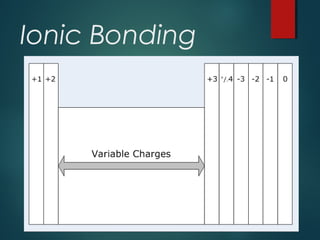
Ionic Bonding
Ionic Bonding occurs between metals
and nonmetals.
Electrons are transferred from the metal
atoms to the nonmetal atoms.
The driving force behind ionic bonds is
that cations (+ ion) give up electrons
and anions (- ions) accept electrons to
make Noble Gas Configurations
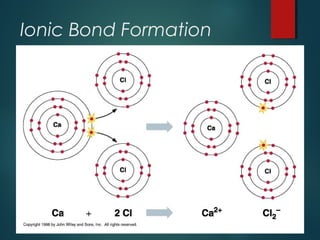
Ionic Bond Formation
Check your Bohr models to see how
many electrons an element will
want to lose or gain. Mark each
family.
The resulting electrostatic forces are
what hold the two ions together.
Total charges on an ionic
compound are equal but opposite.
Ionic Bonding
Ionic Bond Formation
Draw what happens
when sodium reacts with
chlorine to form sodium
chloride
DRAW THE DOT AND CROSS DIAGRAM TOO.
Naming Ionic Compounds
1. Always name the cation (positively charged ion)
first, the anion (negatively charged ion) second
2. Use the name of the cation without any
alterations.
3. Use the root and “-ide” to the end for anions
4. For the transition metals, use brackets and
Roman Numerals after the name to denote its
charge
Examples
LiI
BeBr2
Aluminum Sulfide
FeCl2
Iron (III) Chloride
Lithium Iodide
Beryllium Bromide
Al2S3
Iron (II) Chloride
FeCl3
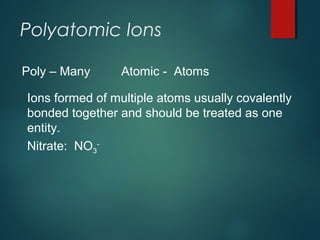
Polyatomic Ions
Poly – Many Atomic - Atoms
Ions formed of multiple atoms usually covalently
bonded together and should be treated as one
entity.
Nitrate: NO3
-
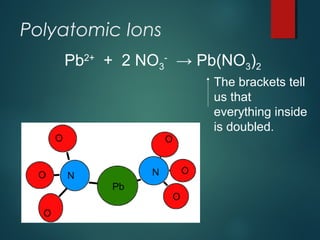
Polyatomic Ions
Pb2+
+ 2 NO3
-
→ Pb(NO3)2
The brackets tell
us that
everything inside
is doubled.
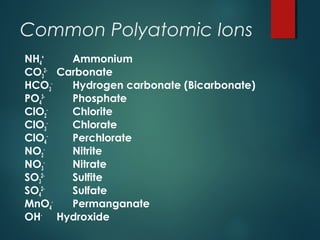
Common Polyatomic Ions
NH4
+
Ammonium
CO3
2-
Carbonate
HCO3
-
Hydrogen carbonate (Bicarbonate)
PO4
3-
Phosphate
ClO2
-
Chlorite
ClO3
-
Chlorate
ClO4
-
Perchlorate
NO2
-
Nitrite
NO3
-
Nitrate
SO3
2-
Sulfite
SO4
2-
Sulfate
MnO4
-
Permanganate
OH-
Hydroxide
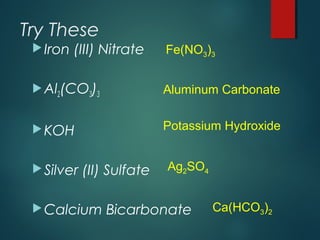
Try These
Iron (III) Nitrate
Al2(CO3)3
KOH
Silver (II) Sulfate
Calcium Bicarbonate
Fe(NO3)3
Aluminum Carbonate
Potassium Hydroxide
Ag2SO4
Ca(HCO3)2
Ionic Bonding
Properties:
Solids at room temperature
Due to strong electrostatic
interactions between the cation (+
ion) and anion (- ion).
Tend to have high melting points
Typically quite hard
Ionic Bonding
Properties (cont’d)
Poor conductors in solid state
The electrons are being taken up in the
bonding
Great conductors when molten or
aqueous
When the ions dissociate the electrons are
free to move and pass the charge
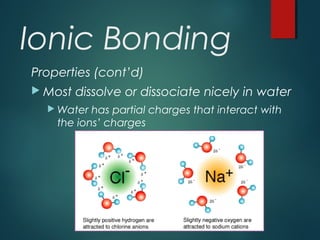
Ionic Bonding
Properties (cont’d)
 Most dissolve or dissociate nicely in water
 Water has partial charges that interact with
the ions’ charges
Interaction with water:
Click here to watch video.
Ionic Structure
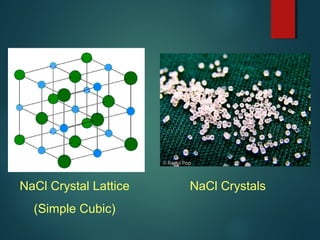
Ionic compounds join together to
form Crystal Lattice Structures
The atoms arrange themselves in
such a way that gives the structure
stability
NaCl Crystal Lattice
(Simple Cubic)
NaCl Crystals
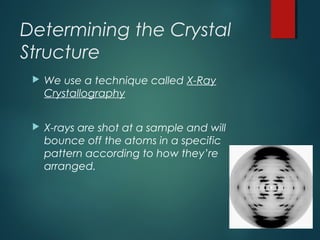
Determining the Crystal
Structure
 We use a technique called X-Ray
Crystallography
 X-rays are shot at a sample and will
bounce off the atoms in a specific
pattern according to how they’re
arranged.
Click to watch video.
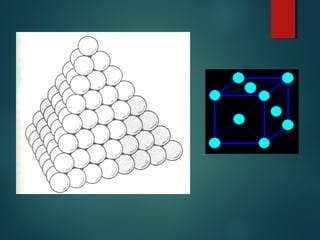
Crystal Structures
A lot depends on the size of the ions.
Na+
is relatively small compared to
Cl-
so it can slip in between the Cl-
ions and form a simple cubic
structure.
Cs+
, however, is about the same size
as Cl-
so it’s more like packing ping-
pong balls.
Ionic Compounds and Bonding

Ionic Compounds and Bonding

  • 1.
  • 2.
    Ionic Bonding Ionic Bondingoccurs between metals and nonmetals. Electrons are transferred from the metal atoms to the nonmetal atoms. The driving force behind ionic bonds is that cations (+ ion) give up electrons and anions (- ions) accept electrons to make Noble Gas Configurations
  • 3.
    Ionic Bond Formation Checkyour Bohr models to see how many electrons an element will want to lose or gain. Mark each family. The resulting electrostatic forces are what hold the two ions together. Total charges on an ionic compound are equal but opposite.
  • 4.
  • 5.
  • 6.
    Draw what happens whensodium reacts with chlorine to form sodium chloride DRAW THE DOT AND CROSS DIAGRAM TOO.
  • 7.
    Naming Ionic Compounds 1.Always name the cation (positively charged ion) first, the anion (negatively charged ion) second 2. Use the name of the cation without any alterations. 3. Use the root and “-ide” to the end for anions 4. For the transition metals, use brackets and Roman Numerals after the name to denote its charge
  • 8.
    Examples LiI BeBr2 Aluminum Sulfide FeCl2 Iron (III)Chloride Lithium Iodide Beryllium Bromide Al2S3 Iron (II) Chloride FeCl3
  • 9.
    Polyatomic Ions Poly –Many Atomic - Atoms Ions formed of multiple atoms usually covalently bonded together and should be treated as one entity. Nitrate: NO3 -
  • 10.
    Polyatomic Ions Pb2+ + 2NO3 - → Pb(NO3)2 The brackets tell us that everything inside is doubled.
  • 11.
    Common Polyatomic Ions NH4 + Ammonium CO3 2- Carbonate HCO3 - Hydrogencarbonate (Bicarbonate) PO4 3- Phosphate ClO2 - Chlorite ClO3 - Chlorate ClO4 - Perchlorate NO2 - Nitrite NO3 - Nitrate SO3 2- Sulfite SO4 2- Sulfate MnO4 - Permanganate OH- Hydroxide
  • 12.
    Try These Iron (III)Nitrate Al2(CO3)3 KOH Silver (II) Sulfate Calcium Bicarbonate Fe(NO3)3 Aluminum Carbonate Potassium Hydroxide Ag2SO4 Ca(HCO3)2
  • 13.
    Ionic Bonding Properties: Solids atroom temperature Due to strong electrostatic interactions between the cation (+ ion) and anion (- ion). Tend to have high melting points Typically quite hard
  • 14.
    Ionic Bonding Properties (cont’d) Poorconductors in solid state The electrons are being taken up in the bonding Great conductors when molten or aqueous When the ions dissociate the electrons are free to move and pass the charge
  • 15.
    Ionic Bonding Properties (cont’d) Most dissolve or dissociate nicely in water  Water has partial charges that interact with the ions’ charges
  • 16.
    Interaction with water: Clickhere to watch video.
  • 17.
    Ionic Structure Ionic compoundsjoin together to form Crystal Lattice Structures The atoms arrange themselves in such a way that gives the structure stability
  • 18.
    NaCl Crystal Lattice (SimpleCubic) NaCl Crystals
  • 19.
    Determining the Crystal Structure We use a technique called X-Ray Crystallography  X-rays are shot at a sample and will bounce off the atoms in a specific pattern according to how they’re arranged.
  • 20.
  • 21.
    Crystal Structures A lotdepends on the size of the ions. Na+ is relatively small compared to Cl- so it can slip in between the Cl- ions and form a simple cubic structure. Cs+ , however, is about the same size as Cl- so it’s more like packing ping- pong balls.