Chemical Bonding: Ionic,
  Covalent, and Metallic
                  By: Sakina Haji
                           Pd. 6
What is a Chemical Bond?
 A chemical bond holds two atoms together.

 It is formed by the attraction of a positive and a
  negative ion or by the attraction of a positive nucleus to
  negative electrons.

 Atoms form chemical bonds to get eight valence
  electrons, to complete the octet rule and to become
  stable.

 3 types: Ionic, Covalent, and Metallic
Ionic Bonds
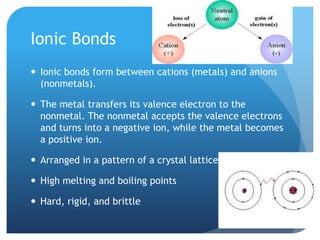
 Ionic bonds form between cations (metals) and anions
  (nonmetals).

 The metal transfers its valence electron to the
  nonmetal. The nonmetal accepts the valence electrons
  and turns into a negative ion, while the metal becomes
  a positive ion.

 Arranged in a pattern of a crystal lattice

 High melting and boiling points

 Hard, rigid, and brittle
Ionic Bonds: Energy
 The formation of ionic compounds is exothermic.

 The energy required to separate ions is called the
  lattice energy. The more negative the lattice
  energy, the stronger the force of attraction.

 Lattice energy of smaller compounds is more negative
  than that of larger compounds because the nucleus
  holds the valence electrons more closely together.
Covalent Bonds
 Instead of transferring electrons, atoms share electrons.

 If one pair of electrons are shared, a single bond is
  formed (Group 17 elements form single bonds).

 If multiple pairs of electrons are shared, double and
  triple bonds can be formed (carbon, nitrogen, oxygen,
  and sulfur usually form multiple bonds).
Covalent Bonds: Sigma vs. Pi
 Single covalent bonds are called sigma bonds. Occurs
  when the electron pair is shared in an area centered
  between the two atoms. A sigma bond results if the
  valence atomic orbitals overlap end to end.

 A pi bond is formed when parallel orbitals overlap to
  share electrons. The shared electron pair occupies the
  space above and below the place where the atoms are
  joined.

 A double bond has one sigma and one pi bond. A triple
  bond has one sigma bond and two pi bonds.
Covalent Bonds: Energy
 Bond length: Distance between the atoms

 Bond dissociation energy: Amount of energy required to
  bread a covalent bond

 The smaller the bond length, the greater the bond
  dissociation energy, and vice versa.
Covalent vs. Ionic
Metallic Bonds
 When metals bond together to complete the octet rule.

 All metal atoms contribute their valence electrons to
  form a sea of electrons. Electrons are free to move b/w
  the atoms.
Metallic Bonding: Alloys
 An alloy is a mixture of elements that has metallic
  properties.

 Properties of alloys are different from those of the
  elements in it.

 Alloys most commonly forms when elements involved
  are similar in size or the atoms of one element are
  considerably smaller than the atoms of the other.

 There are two types of alloys, substitutional and
  interstitial.
Metallic Bonds: Energy
 Metallic bonds are weak and little energy is needed to
  break the bonds. Therefore, they have high melting
  points

 Because the electrons are mobile, they transfer heat
  more efficiently and, therefore, are better conductors.
Conclusion
 Elements bond to become stable.
 Elements bond to have 8 valence electrons.
 3 types of bonds: Ionic, Covalent, Metallic
 In ionic bonds, one element gives its electrons to
  another element.
 Covalent bonds are the strongest bonds. Elements share
  electrons.
 Metallic bonds are the weakest bonds. Elements are in a
  sea of electrons

Chemical bonding

  • 1.
    Chemical Bonding: Ionic, Covalent, and Metallic By: Sakina Haji Pd. 6
  • 2.
    What is aChemical Bond?  A chemical bond holds two atoms together.  It is formed by the attraction of a positive and a negative ion or by the attraction of a positive nucleus to negative electrons.  Atoms form chemical bonds to get eight valence electrons, to complete the octet rule and to become stable.  3 types: Ionic, Covalent, and Metallic
  • 3.
    Ionic Bonds  Ionicbonds form between cations (metals) and anions (nonmetals).  The metal transfers its valence electron to the nonmetal. The nonmetal accepts the valence electrons and turns into a negative ion, while the metal becomes a positive ion.  Arranged in a pattern of a crystal lattice  High melting and boiling points  Hard, rigid, and brittle
  • 4.
    Ionic Bonds: Energy The formation of ionic compounds is exothermic.  The energy required to separate ions is called the lattice energy. The more negative the lattice energy, the stronger the force of attraction.  Lattice energy of smaller compounds is more negative than that of larger compounds because the nucleus holds the valence electrons more closely together.
  • 5.
    Covalent Bonds  Insteadof transferring electrons, atoms share electrons.  If one pair of electrons are shared, a single bond is formed (Group 17 elements form single bonds).  If multiple pairs of electrons are shared, double and triple bonds can be formed (carbon, nitrogen, oxygen, and sulfur usually form multiple bonds).
  • 6.
    Covalent Bonds: Sigmavs. Pi  Single covalent bonds are called sigma bonds. Occurs when the electron pair is shared in an area centered between the two atoms. A sigma bond results if the valence atomic orbitals overlap end to end.  A pi bond is formed when parallel orbitals overlap to share electrons. The shared electron pair occupies the space above and below the place where the atoms are joined.  A double bond has one sigma and one pi bond. A triple bond has one sigma bond and two pi bonds.
  • 7.
    Covalent Bonds: Energy Bond length: Distance between the atoms  Bond dissociation energy: Amount of energy required to bread a covalent bond  The smaller the bond length, the greater the bond dissociation energy, and vice versa.
  • 8.
  • 9.
    Metallic Bonds  Whenmetals bond together to complete the octet rule.  All metal atoms contribute their valence electrons to form a sea of electrons. Electrons are free to move b/w the atoms.
  • 10.
    Metallic Bonding: Alloys An alloy is a mixture of elements that has metallic properties.  Properties of alloys are different from those of the elements in it.  Alloys most commonly forms when elements involved are similar in size or the atoms of one element are considerably smaller than the atoms of the other.  There are two types of alloys, substitutional and interstitial.
  • 11.
    Metallic Bonds: Energy Metallic bonds are weak and little energy is needed to break the bonds. Therefore, they have high melting points  Because the electrons are mobile, they transfer heat more efficiently and, therefore, are better conductors.
  • 12.
    Conclusion  Elements bondto become stable.  Elements bond to have 8 valence electrons.  3 types of bonds: Ionic, Covalent, Metallic  In ionic bonds, one element gives its electrons to another element.  Covalent bonds are the strongest bonds. Elements share electrons.  Metallic bonds are the weakest bonds. Elements are in a sea of electrons