Welcome to our presentation:
Presentation Topic:
 Ionic Bond
Covalent Bond
Hydrogen Bond
IONIC BONDING:
Ionic bonds are a type of chemical
bond based on electrostatic forces
between two oppositely-charged ions.
 It is basically the transfer
of one electron from one
atom to another
Characteristics of Ionic bonding:
 It is formed by transfer of electron
 It is formed between a metal and a nonmetal atom
 Consists of electrostic force between (+) and (-) ions
Mechanism of Ionic bond:
According to the octet theory when an atom takes part in a chemical bonding it
tends to be more stable like the Nobel gas . For that they need to fill with 8 electrons
at its valance shell. As Ionic bond made by the transfer of electrons ,the atoms
which took part in the bonding neither it will lose electron or gain electron. Metals
have 2-3 electrons at valance shell it is easy for them lose electron & non metal are
very suitable at electron gaining. After losing electron the metal turns into (+) ion
and after gaining electron non metal become (-) ion. The electrostic force between
(+) and (-) ions create the Ionic bonding.
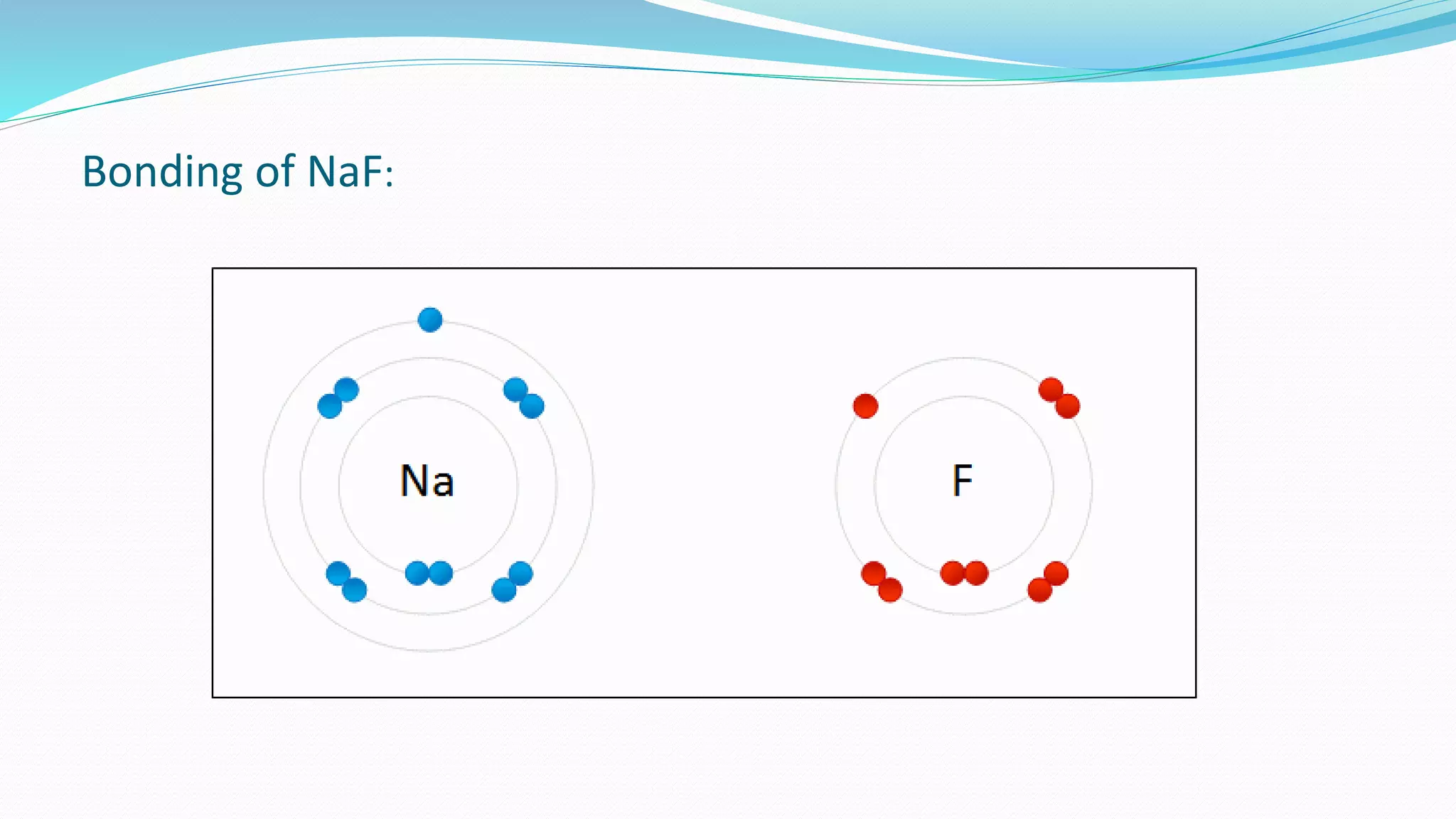
Bonding of NaF:
In real life we can see this example:
Covalent bond:
This type of chemical bonding is made of Sharing of
electrons among the atoms.
The Sharing of electrons equal among the atoms.
Characteristics of Covalent bonding:
It is made by sharing of electron
It is formed between non-metal atoms
It is consists of a shared pair of electrons between atoms
Mechanism of covalent bonding:
In covalent bonding atoms still want to achieve a noble
gas configuration. But rather than losing or gaining
electrons atoms now share an electron pair. The shared
electron pair is called a bonding pair electrons.
Chlorine molecule Cl2
Molecules have no overall electric charge
Molecular or covalent compounds are usually gases or liquids –
they have low melting points and low boiling points
Forces between molecules very weak
Forces (bonds) between atoms in the molecule very strong
Each outer shell has 8 electrons
Electrons shared
It can be shown as:
Hydrogen bonds
A hydrogen atom covalently bonded to an
electronegative atom … N, O or F.
.
A lone pair of electrons on the
electronegative atom takes part in bonding
with Hydrogen
Types of Hydrogen bond:
 Intramolecular Hydrogen bond:
It occurs with in one single molecule.Example:
C2H4(OH)2
Intermolecular Hydrogen bond:
It occurs Between separate
molecules.Example:NH3,H2O
Factors preventing Hydrogen bonding
Electronegativity
Atom Size
Hydrogen bonds In Water:
Ionic bond,covalent bond and hydrogen bond

Ionic bond,covalent bond and hydrogen bond

  • 1.
    Welcome to ourpresentation: Presentation Topic:  Ionic Bond Covalent Bond Hydrogen Bond
  • 2.
    IONIC BONDING: Ionic bondsare a type of chemical bond based on electrostatic forces between two oppositely-charged ions.  It is basically the transfer of one electron from one atom to another
  • 3.
    Characteristics of Ionicbonding:  It is formed by transfer of electron  It is formed between a metal and a nonmetal atom  Consists of electrostic force between (+) and (-) ions Mechanism of Ionic bond: According to the octet theory when an atom takes part in a chemical bonding it tends to be more stable like the Nobel gas . For that they need to fill with 8 electrons at its valance shell. As Ionic bond made by the transfer of electrons ,the atoms which took part in the bonding neither it will lose electron or gain electron. Metals have 2-3 electrons at valance shell it is easy for them lose electron & non metal are very suitable at electron gaining. After losing electron the metal turns into (+) ion and after gaining electron non metal become (-) ion. The electrostic force between (+) and (-) ions create the Ionic bonding.
  • 4.
  • 5.
    In real lifewe can see this example:
  • 6.
    Covalent bond: This typeof chemical bonding is made of Sharing of electrons among the atoms. The Sharing of electrons equal among the atoms.
  • 7.
    Characteristics of Covalentbonding: It is made by sharing of electron It is formed between non-metal atoms It is consists of a shared pair of electrons between atoms Mechanism of covalent bonding: In covalent bonding atoms still want to achieve a noble gas configuration. But rather than losing or gaining electrons atoms now share an electron pair. The shared electron pair is called a bonding pair electrons.
  • 8.
    Chlorine molecule Cl2 Moleculeshave no overall electric charge Molecular or covalent compounds are usually gases or liquids – they have low melting points and low boiling points Forces between molecules very weak Forces (bonds) between atoms in the molecule very strong Each outer shell has 8 electrons Electrons shared
  • 9.
    It can beshown as:
  • 10.
    Hydrogen bonds A hydrogenatom covalently bonded to an electronegative atom … N, O or F. . A lone pair of electrons on the electronegative atom takes part in bonding with Hydrogen
  • 11.
    Types of Hydrogenbond:  Intramolecular Hydrogen bond: It occurs with in one single molecule.Example: C2H4(OH)2 Intermolecular Hydrogen bond: It occurs Between separate molecules.Example:NH3,H2O
  • 12.
    Factors preventing Hydrogenbonding Electronegativity Atom Size
  • 13.