Chapter 8.1
Electrons and Energy Levels
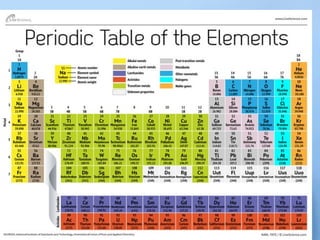
Periodic Table
• Shows:
– Elements
– Atomic Number
– State of matter at room temperature
– Atomic (average) Mass
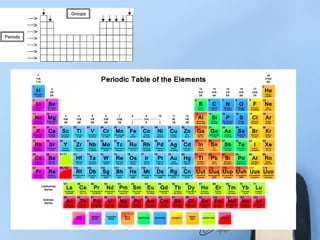
Periods and Groups
•
•
•
•

Period = Rows
Groups = Columns
Lists elements in order of atomic number
Atomic number increases as you move from
left to right
• Elements in each group have similar chemical
properties and react with other elements in
similar ways
Metals, Nonmetals, and Metalloids
• Metals

– Often shiny
– good conductors of electricity and thermal energy
– Easily pulled into wires and hammered into sheets

• Metalloids

– Have properties in common with both metals and
nonmetals
– Often used as semiconductors in electronic devices

• Nonmetals

– Poor conductors of thermal energy and electricity
– Most are gases at room temperature
– Solid form tends to be brittle
Atoms Bonds
• Pure elements are rare to find
• Atoms of different elements chemically
combine and form compounds.
• Compounds make up all living and nonliving
things
• Chemical bonds hold together different
elements in chemical compounds
• A chemical bond is a force that holds two or
more atoms together
Electron Number and Arrangement
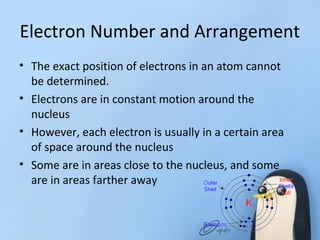
• The exact position of electrons in an atom cannot
be determined.
• Electrons are in constant motion around the
nucleus
• However, each electron is usually in a certain area
of space around the nucleus
• Some are in areas close to the nucleus, and some
are in areas farther away
Electrons and Energy
• Different electrons in an atom have different
amounts of energy.
• An electron moves around the nucleus at a
distance that corresponds to its amount of
energy
• Areas of space in which electrons move around
the nucleus are called energy levels
• Electrons closet to the nucleus have the least
amount of energy
– They are at the lowest energy level
– Only 2 electrons can be in the lowest energy level
Electrons and Bonding
• Negatively charged electrons have a similar
attraction to the positively charged nucleus of an
atom (like a magnet)
• The electrons in the energy levels closest to the
nucleus of the same atom have a strong attraction
to that nucleus
• Electrons farther from that nucleus are weakly
attracted to it.

– These outermost electrons can easily be attracted to the
nucleus of the other atoms

• This attraction between the positive nucleus of one
atom and the negative electrons of another is what
causes a chemical bond.
Valence Electrons
• Electrons farthest from their nucleus are easily
attracted to the nuclei of nearby atoms.
• These outermost electrons are the only electrons that
can form chemical bonds
– This is because these electrons are exposed to the nuclei
of other atoms

• A valence electron is an outermost electron of an atom
that participated in chemical bonding.
• Valence electrons have the most energy of all
electrons in an atom.
Valence Electrons
• The number of valence electrons in each atom of
an element can help determine the type and the
number of bonds it can form.
• The periodic table can tell you how many valence
electrons an atom has.
• Except for Helium, elements in certain groups
have the same number of valence electrons
• In groups 1,2, 13-18, the number of valence
electrons is shown by the ones digits of the
group.
– So, elements in group 18 have 8 valence electrons.
Electron Dot Diagrams
• In 1916, an America Chemist named Gilbert Lewis
developed the electron dot diagram.
• The electron dot diagram is a model that represents
valence electrons in an atom as dots around the element’s
chemical symbol
• It can help you predict how an atom will bond with other
atoms
• The dots represent the valence electron
• Some dots pair up, others do not
• The number of unpaired dots is often the number of bonds
an atom can form
• See Figure 5, pg 271
Valence Electrons
• Remember that each element in a group has the same
number of valence electrons.
• SO, every element in a group has the same number of dots
in its electron dot diagram
• Atoms with 8 valence electrons do not easily react with
other atoms
– They are chemically stable

• Atoms that have 1-7 valence electrons are reactive of
chemically unstable

– They easily bond with other atoms and form chemically stable
compounds

• Atoms of H and He have only one energy level

– These atoms are chemically stable with two valence electrons
Noble Gases
• Elements in Group 18 are called noble gases
• With the exception of He, noble gases have
eight valence electrons and are chemically
stable.
• Chemically stable atoms do not easily react, or
form bonds, with other atoms
Stable and Unstable Atoms
• Atoms with unpaired dots in their electron dot
diagram are reactive, or chemically unstable.
• For example, N has 5 valence electrons are 3 of
them are unpaired.
– It is reactive and will become more stable by forming
chemical bonds with other atoms

• When an atom forms a bond, it gains, loses, or
shares valence electrons with other atoms.
• By forming bonds, atoms become more
chemically stable
Chapter 8.1: Electrons and Energy Levels

Chapter 8.1: Electrons and Energy Levels

  • 1.
  • 2.
    Periodic Table • Shows: –Elements – Atomic Number – State of matter at room temperature – Atomic (average) Mass
  • 4.
    Periods and Groups • • • • Period= Rows Groups = Columns Lists elements in order of atomic number Atomic number increases as you move from left to right • Elements in each group have similar chemical properties and react with other elements in similar ways
  • 6.
    Metals, Nonmetals, andMetalloids • Metals – Often shiny – good conductors of electricity and thermal energy – Easily pulled into wires and hammered into sheets • Metalloids – Have properties in common with both metals and nonmetals – Often used as semiconductors in electronic devices • Nonmetals – Poor conductors of thermal energy and electricity – Most are gases at room temperature – Solid form tends to be brittle
  • 8.
    Atoms Bonds • Pureelements are rare to find • Atoms of different elements chemically combine and form compounds. • Compounds make up all living and nonliving things • Chemical bonds hold together different elements in chemical compounds • A chemical bond is a force that holds two or more atoms together
  • 9.
    Electron Number andArrangement • The exact position of electrons in an atom cannot be determined. • Electrons are in constant motion around the nucleus • However, each electron is usually in a certain area of space around the nucleus • Some are in areas close to the nucleus, and some are in areas farther away
  • 10.
    Electrons and Energy •Different electrons in an atom have different amounts of energy. • An electron moves around the nucleus at a distance that corresponds to its amount of energy • Areas of space in which electrons move around the nucleus are called energy levels • Electrons closet to the nucleus have the least amount of energy – They are at the lowest energy level – Only 2 electrons can be in the lowest energy level
  • 12.
    Electrons and Bonding •Negatively charged electrons have a similar attraction to the positively charged nucleus of an atom (like a magnet) • The electrons in the energy levels closest to the nucleus of the same atom have a strong attraction to that nucleus • Electrons farther from that nucleus are weakly attracted to it. – These outermost electrons can easily be attracted to the nucleus of the other atoms • This attraction between the positive nucleus of one atom and the negative electrons of another is what causes a chemical bond.
  • 14.
    Valence Electrons • Electronsfarthest from their nucleus are easily attracted to the nuclei of nearby atoms. • These outermost electrons are the only electrons that can form chemical bonds – This is because these electrons are exposed to the nuclei of other atoms • A valence electron is an outermost electron of an atom that participated in chemical bonding. • Valence electrons have the most energy of all electrons in an atom.
  • 16.
    Valence Electrons • Thenumber of valence electrons in each atom of an element can help determine the type and the number of bonds it can form. • The periodic table can tell you how many valence electrons an atom has. • Except for Helium, elements in certain groups have the same number of valence electrons • In groups 1,2, 13-18, the number of valence electrons is shown by the ones digits of the group. – So, elements in group 18 have 8 valence electrons.
  • 17.
    Electron Dot Diagrams •In 1916, an America Chemist named Gilbert Lewis developed the electron dot diagram. • The electron dot diagram is a model that represents valence electrons in an atom as dots around the element’s chemical symbol • It can help you predict how an atom will bond with other atoms • The dots represent the valence electron • Some dots pair up, others do not • The number of unpaired dots is often the number of bonds an atom can form • See Figure 5, pg 271
  • 20.
    Valence Electrons • Rememberthat each element in a group has the same number of valence electrons. • SO, every element in a group has the same number of dots in its electron dot diagram • Atoms with 8 valence electrons do not easily react with other atoms – They are chemically stable • Atoms that have 1-7 valence electrons are reactive of chemically unstable – They easily bond with other atoms and form chemically stable compounds • Atoms of H and He have only one energy level – These atoms are chemically stable with two valence electrons
  • 21.
    Noble Gases • Elementsin Group 18 are called noble gases • With the exception of He, noble gases have eight valence electrons and are chemically stable. • Chemically stable atoms do not easily react, or form bonds, with other atoms
  • 22.
    Stable and UnstableAtoms • Atoms with unpaired dots in their electron dot diagram are reactive, or chemically unstable. • For example, N has 5 valence electrons are 3 of them are unpaired. – It is reactive and will become more stable by forming chemical bonds with other atoms • When an atom forms a bond, it gains, loses, or shares valence electrons with other atoms. • By forming bonds, atoms become more chemically stable