LECTURE 2
Covalent Bonding
IB Chemistry Power Points
Topic 4
Bonding
www.pedagogics.ca
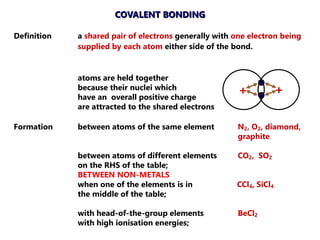
Definition a shared pair of electrons generally with one electron being
supplied by each atom either side of the bond.
atoms are held together
because their nuclei which
have an overall positive charge
are attracted to the shared electrons
Formation between atoms of the same element N2, O2, diamond,
graphite
between atoms of different elements CO2, SO2
on the RHS of the table;
BETWEEN NON-METALS
when one of the elements is in CCl4, SiCl4
the middle of the table;
with head-of-the-group elements BeCl2
with high ionisation energies;
COVALENT BONDING
+ +
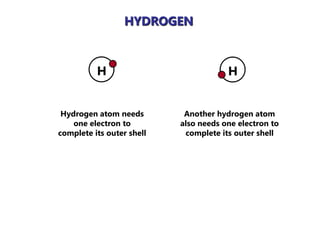
HYDROGEN
Another hydrogen atom
also needs one electron to
complete its outer shell
Hydrogen atom needs
one electron to
complete its outer shell
H
H
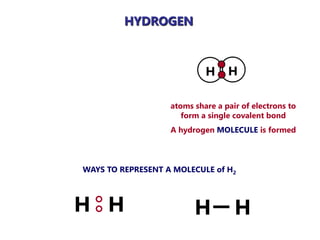
HYDROGEN
H H
atoms share a pair of electrons to
form a single covalent bond
A hydrogen MOLECULE is formed
H H
H
H
WAYS TO REPRESENT A MOLECULE of H2
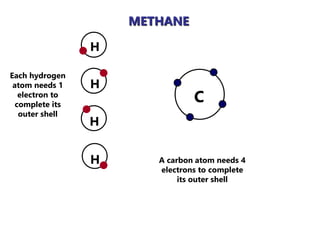
METHANE
C
Each hydrogen
atom needs 1
electron to
complete its
outer shell
A carbon atom needs 4
electrons to complete
its outer shell
H
H
H
H
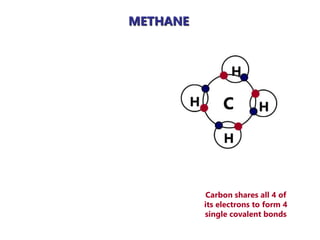
METHANE
Carbon shares all 4 of
its electrons to form 4
single covalent bonds
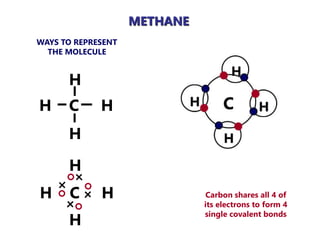
METHANE
Carbon shares all 4 of
its electrons to form 4
single covalent bonds
H C H
H
H
H C H
H
H
WAYS TO REPRESENT
THE MOLECULE
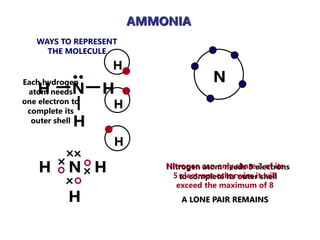
AMMONIA
N
Each hydrogen
atom needs
one electron to
complete its
outer shell
Nitrogen atom needs 3 electrons
to complete its outer shell
Nitrogen can only share 3 of its
5 electrons otherwise it will
exceed the maximum of 8
A LONE PAIR REMAINS
H
H
H
H N H
H
H N H
H
WAYS TO REPRESENT
THE MOLECULE
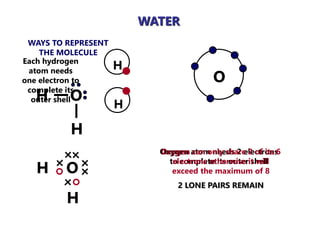
WATER
O
Each hydrogen
atom needs
one electron to
complete its
outer shell
Oxygen atom needs 2 electrons
to complete its outer shell
Oxygen can only share 2 of its 6
electrons otherwise it will
exceed the maximum of 8
2 LONE PAIRS REMAIN
H
H
H O
H
H O
H
WAYS TO REPRESENT
THE MOLECULE
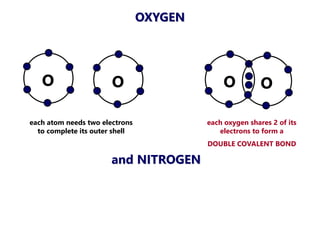
OXYGEN
O
each atom needs two electrons
to complete its outer shell
each oxygen shares 2 of its
electrons to form a
DOUBLE COVALENT BOND
O O O
and NITROGEN
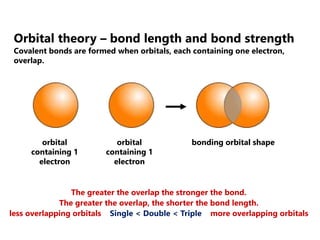
Orbital theory – bond length and bond strength
Covalent bonds are formed when orbitals, each containing one electron,
overlap.
The greater the overlap the stronger the bond.
The greater the overlap, the shorter the bond length.
less overlapping orbitals Single < Double < Triple more overlapping orbitals
orbital
containing 1
electron
orbital
containing 1
electron
bonding orbital shape
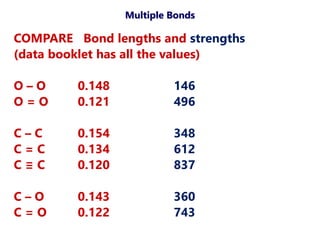
COMPARE Bond lengths and strengths
(data booklet has all the values)
O – O 0.148 146
O = O 0.121 496
C – C 0.154 348
C = C 0.134 612
C ≡ C 0.120 837
C – O 0.143 360
C = O 0.122 743
Multiple Bonds
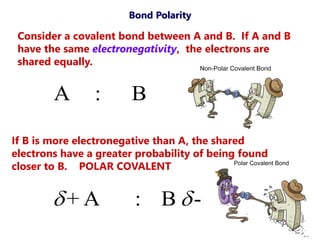
Bond Polarity
A : B
Consider a covalent bond between A and B. If A and B
have the same electronegativity, the electrons are
shared equally.
If B is more electronegative than A, the shared
electrons have a greater probability of being found
closer to B. POLAR COVALENT
+ A : B -
 
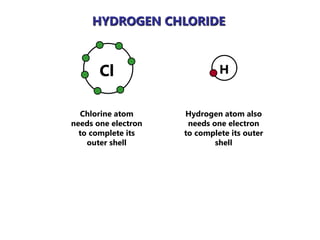
HYDROGEN CHLORIDE
Cl H
Hydrogen atom also
needs one electron
to complete its outer
shell
Chlorine atom
needs one electron
to complete its
outer shell
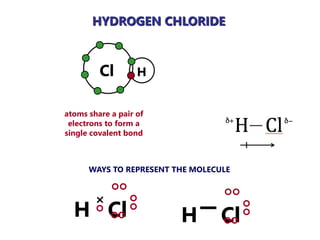
HYDROGEN CHLORIDE
Cl H
atoms share a pair of
electrons to form a
single covalent bond
H Cl
H Cl
WAYS TO REPRESENT THE MOLECULE
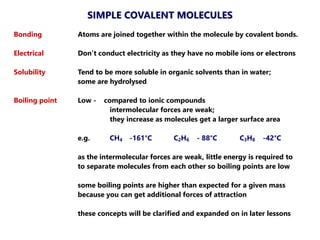
Bonding Atoms are joined together within the molecule by covalent bonds.
Electrical Don’t conduct electricity as they have no mobile ions or electrons
Solubility Tend to be more soluble in organic solvents than in water;
some are hydrolysed
Boiling point Low - compared to ionic compounds
intermolecular forces are weak;
they increase as molecules get a larger surface area
e.g. CH4 -161°C C2H6 - 88°C C3H8 -42°C
as the intermolecular forces are weak, little energy is required to
to separate molecules from each other so boiling points are low
some boiling points are higher than expected for a given mass
because you can get additional forces of attraction
these concepts will be clarified and expanded on in later lessons
SIMPLE COVALENT MOLECULES
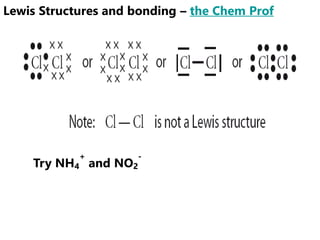
Try NH4
+
and NO2
-
Lewis Structures and bonding – the Chem Prof
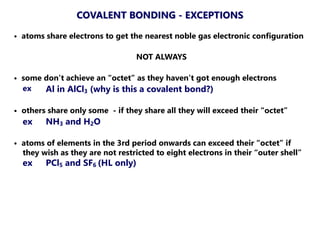
• atoms share electrons to get the nearest noble gas electronic configuration
NOT ALWAYS
• some don’t achieve an “octet” as they haven’t got enough electrons
ex Al in AlCl3 (why is this a covalent bond?)
• others share only some - if they share all they will exceed their “octet”
ex NH3 and H2O
• atoms of elements in the 3rd period onwards can exceed their “octet” if
they wish as they are not restricted to eight electrons in their “outer shell”
ex PCl5 and SF6 (HL only)
COVALENT BONDING - EXCEPTIONS

2016 topic 4.1 bonding - ionic

  • 1.
    LECTURE 2 Covalent Bonding IBChemistry Power Points Topic 4 Bonding www.pedagogics.ca
  • 3.
    Definition a sharedpair of electrons generally with one electron being supplied by each atom either side of the bond. atoms are held together because their nuclei which have an overall positive charge are attracted to the shared electrons Formation between atoms of the same element N2, O2, diamond, graphite between atoms of different elements CO2, SO2 on the RHS of the table; BETWEEN NON-METALS when one of the elements is in CCl4, SiCl4 the middle of the table; with head-of-the-group elements BeCl2 with high ionisation energies; COVALENT BONDING + +
  • 4.
    HYDROGEN Another hydrogen atom alsoneeds one electron to complete its outer shell Hydrogen atom needs one electron to complete its outer shell H H
  • 5.
    HYDROGEN H H atoms sharea pair of electrons to form a single covalent bond A hydrogen MOLECULE is formed H H H H WAYS TO REPRESENT A MOLECULE of H2
  • 6.
    METHANE C Each hydrogen atom needs1 electron to complete its outer shell A carbon atom needs 4 electrons to complete its outer shell H H H H
  • 7.
    METHANE Carbon shares all4 of its electrons to form 4 single covalent bonds
  • 8.
    METHANE Carbon shares all4 of its electrons to form 4 single covalent bonds H C H H H H C H H H WAYS TO REPRESENT THE MOLECULE
  • 9.
    AMMONIA N Each hydrogen atom needs oneelectron to complete its outer shell Nitrogen atom needs 3 electrons to complete its outer shell Nitrogen can only share 3 of its 5 electrons otherwise it will exceed the maximum of 8 A LONE PAIR REMAINS H H H H N H H H N H H WAYS TO REPRESENT THE MOLECULE
  • 10.
    WATER O Each hydrogen atom needs oneelectron to complete its outer shell Oxygen atom needs 2 electrons to complete its outer shell Oxygen can only share 2 of its 6 electrons otherwise it will exceed the maximum of 8 2 LONE PAIRS REMAIN H H H O H H O H WAYS TO REPRESENT THE MOLECULE
  • 11.
    OXYGEN O each atom needstwo electrons to complete its outer shell each oxygen shares 2 of its electrons to form a DOUBLE COVALENT BOND O O O and NITROGEN
  • 12.
    Orbital theory –bond length and bond strength Covalent bonds are formed when orbitals, each containing one electron, overlap. The greater the overlap the stronger the bond. The greater the overlap, the shorter the bond length. less overlapping orbitals Single < Double < Triple more overlapping orbitals orbital containing 1 electron orbital containing 1 electron bonding orbital shape
  • 13.
    COMPARE Bond lengthsand strengths (data booklet has all the values) O – O 0.148 146 O = O 0.121 496 C – C 0.154 348 C = C 0.134 612 C ≡ C 0.120 837 C – O 0.143 360 C = O 0.122 743 Multiple Bonds
  • 14.
    Bond Polarity A :B Consider a covalent bond between A and B. If A and B have the same electronegativity, the electrons are shared equally. If B is more electronegative than A, the shared electrons have a greater probability of being found closer to B. POLAR COVALENT + A : B -  
  • 15.
    HYDROGEN CHLORIDE Cl H Hydrogenatom also needs one electron to complete its outer shell Chlorine atom needs one electron to complete its outer shell
  • 16.
    HYDROGEN CHLORIDE Cl H atomsshare a pair of electrons to form a single covalent bond H Cl H Cl WAYS TO REPRESENT THE MOLECULE
  • 17.
    Bonding Atoms arejoined together within the molecule by covalent bonds. Electrical Don’t conduct electricity as they have no mobile ions or electrons Solubility Tend to be more soluble in organic solvents than in water; some are hydrolysed Boiling point Low - compared to ionic compounds intermolecular forces are weak; they increase as molecules get a larger surface area e.g. CH4 -161°C C2H6 - 88°C C3H8 -42°C as the intermolecular forces are weak, little energy is required to to separate molecules from each other so boiling points are low some boiling points are higher than expected for a given mass because you can get additional forces of attraction these concepts will be clarified and expanded on in later lessons SIMPLE COVALENT MOLECULES
  • 18.
    Try NH4 + and NO2 - LewisStructures and bonding – the Chem Prof
  • 19.
    • atoms shareelectrons to get the nearest noble gas electronic configuration NOT ALWAYS • some don’t achieve an “octet” as they haven’t got enough electrons ex Al in AlCl3 (why is this a covalent bond?) • others share only some - if they share all they will exceed their “octet” ex NH3 and H2O • atoms of elements in the 3rd period onwards can exceed their “octet” if they wish as they are not restricted to eight electrons in their “outer shell” ex PCl5 and SF6 (HL only) COVALENT BONDING - EXCEPTIONS