Combining Elements
• Most elements are not found by themselves
in nature
- Usually they are found combined with other
elements
• Compound: Two or more elements
chemically combined
- The properties of a compound are very different
from the properties of the elements that make up
the compound
- Ex. Na and Cl are very different from NaCl
Chemical Formulas
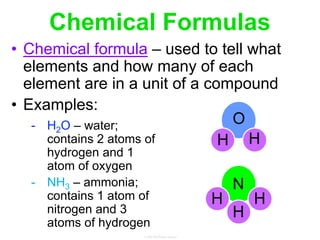
• Chemical formula – used to tell what
elements and how many of each
element are in a unit of a compound
• Examples:
- H2O – water;
contains 2 atoms of
hydrogen and 1
atom of oxygen
- NH3 – ammonia;
contains 1 atom of
nitrogen and 3
atoms of hydrogen
O
H H
N
H
H
H
Forming Compounds
Why do elements form compounds?
• To be STABLE!
- All elements want to be stable.
- Octet Rule: Atoms will gain, lose, or share
electrons in order to have 8 electrons in their
outer energy shell
• Stability = full/complete outer energy level of
valence electrons.
- 8 for every element except Hydrogen and Helium
Forming Compounds
Sodium has 1 valence e-
If it loses that 1 e- its
outermost energy level will be
FULL and it will be STABLE
Chlorine has 7 valence e-
If it gains 1 e- its
outermost energy level will be
FULL and it will be STABLE
This is how the bond happens to form NaCl (table salt)
Would elements ever not benefit from
forming compounds?
• YES if they are already stable  which the
noble gases are!
- This is why noble gases are nonreactive.
- Their outermost energy levels are already full!
Would elements ever not benefit from
forming compounds?
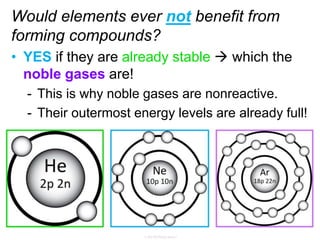
• YES if they are already stable  which the
noble gases are!
- This is why noble gases are nonreactive.
- Their outermost energy levels are already full!
Bonds
• When atoms gain, lose or share electrons in
order to become stable, they form chemical
bonds
– Chemical bonds: a force that holds atoms
together in a substance
- There are many types of bonds that can form, and not
all bonds are created equal. We will start by looking at
ionic bonds.
• Ionic bonds: when atoms transfer electrons
in order to be stable.
- Usually between a metal and a nonmetal
- Results in the formation of ions
Ionic Bonds
• Ions: atoms or molecules that have a charge
due to having lost or gained electrons
– Cations: positively
charged ions; atoms
or molecules that
have lost e-
• Usually metals
Ionic Bonds
• Ions: atoms or molecules that have a charge
due to having lost or gained electrons
– Cations: positively
charged ions; atoms
or molecules that
have lost e-
• Usually metals
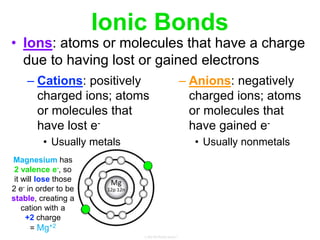
Magnesium has
2 valence e-, so
it will lose those
2 e- in order to be
stable, creating a
cation with a
+2 charge
= Mg+2
Ionic Bonds
• Ions: atoms or molecules that have a charge
due to having lost or gained electrons
– Cations: positively
charged ions; atoms
or molecules that
have lost e-
• Usually metals
Magnesium has
2 valence e-, so
it will lose those
2 e- in order to be
stable, creating a
cation with a
+2 charge
= Mg+2
– Anions: negatively
charged ions; atoms
or molecules that
have gained e-
• Usually nonmetals
Ionic Bonds
• Ions: atoms or molecules that have a charge
due to having lost or gained electrons
– Cations: positively
charged ions; atoms
or molecules that
have lost e-
• Usually metals
Magnesium has
2 valence e-, so
it will lose those
2 e- in order to be
stable, creating a
cation with a
+2 charge
= Mg+2
– Anions: negatively
charged ions; atoms
or molecules that
have gained e-
• Usually nonmetals
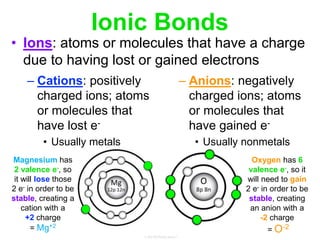
Oxygen has 6
valence e-, so it
will need to gain
2 e- in order to be
stable, creating
an anion with a
-2 charge
= O-2
Ion Examples:
Example #1: What ion will Lithium form?
Lithium has 1 valence e-, so it will lose that 1 e- in
order to be stable, creating a cation with a
+1 charge = Li+1
Ion Examples:
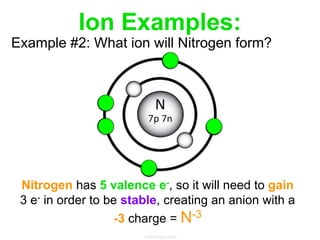
Example #2: What ion will Nitrogen form?
Nitrogen has 5 valence e-, so it will need to gain
3 e- in order to be stable, creating an anion with a
-3 charge = N-3
Ions
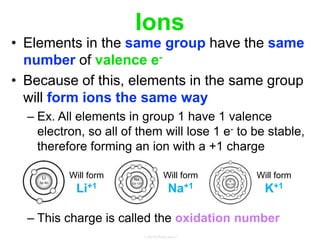
• Elements in the same group have the same
number of valence e-
• Because of this, elements in the same group
will form ions the same way
– Ex. All elements in group 1 have 1 valence
electron, so all of them will lose 1 e- to be stable,
therefore forming an ion with a +1 charge
– This charge is called the oxidation number
Will form
Li+1
Will form
Na+1
Will form
K+1
Oxidation Numbers
• Oxidation numbers: the charge of an ion
within a compound
– Written as a superscript to the right of the symbol
• Group 1 elements have 1 valence e-  +1 charge
• Group 2 elements have 2 valence e-  +2 charge
Skip groups 3-12 transition metals
• Group 13 elements have 3 valence e-  +3 charge
• Group 14 elements have 4 valence e-  +/- 4 charge
• Group 15 elements have 5 valence e-  -3 charge
• Group 16 elements have 6 valence e-  -2 charge
• Group 17 elements have 7 valence e-  -1 charge
Electron Dot Diagrams
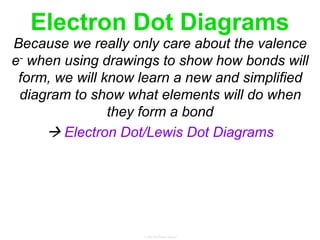
Because we really only care about the valence
e- when using drawings to show how bonds will
form, we will know learn a new and simplified
diagram to show what elements will do when
they form a bond
 Electron Dot/Lewis Dot Diagrams
Electron Dot Diagrams
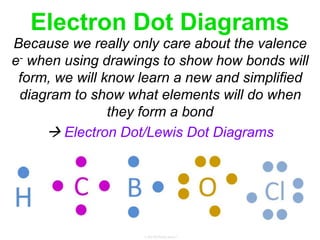
Because we really only care about the valence
e- when using drawings to show how bonds will
form, we will know learn a new and simplified
diagram to show what elements will do when
they form a bond
 Electron Dot/Lewis Dot Diagrams
Electron Dot Diagrams
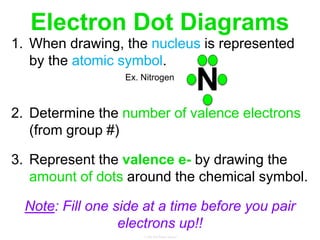
1. When drawing, the nucleus is represented
by the atomic symbol.
2. Determine the number of valence electrons
(from group #)
3. Represent the valence e- by drawing the
amount of dots around the chemical symbol.
Note: Fill one side at a time before you pair
electrons up!!
N
Ex. Nitrogen
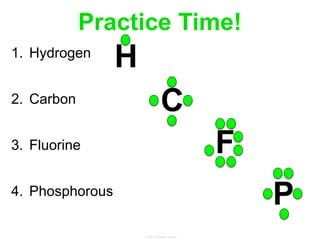
Practice Time!
1. Hydrogen
2. Carbon
3. Fluorine
4. Phosphorous
H
C
F
P
Using Electron Dot Diagrams
to show Bond Formation
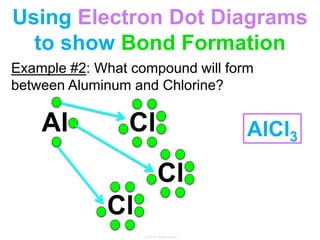
1. Draw the electron dot structures of the
elements.
2. Transfer electrons (using an arrow) from the
metal to the nonmetal.
3. Add elements as needed.
4. Continue transferring until all atoms are
stable.
5. Write the chemical formula using subscripts to
show how many of each element were
needed.
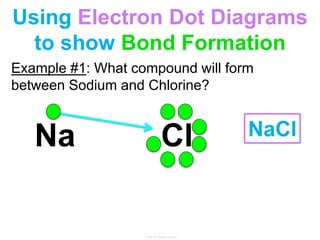
Using Electron Dot Diagrams
to show Bond Formation
Example #1: What compound will form
between Sodium and Chlorine?
Na Cl NaCl
Using Electron Dot Diagrams
to show Bond Formation
Example #2: What compound will form
between Aluminum and Chlorine?
Al AlCl3
Cl
Cl
Cl
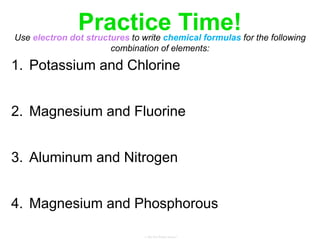
Practice Time!
1. Potassium and Chlorine
2. Magnesium and Fluorine
3. Aluminum and Nitrogen
4. Magnesium and Phosphorous
Use electron dot structures to write chemical formulas for the following
combination of elements:
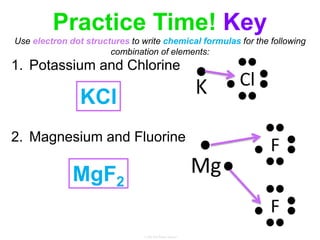
Practice Time! Key
Use electron dot structures to write chemical formulas for the following
combination of elements:
1. Potassium and Chlorine
2. Magnesium and Fluorine
KCl
MgF2
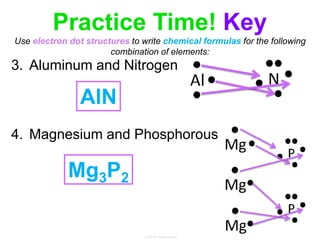
Practice Time! Key
Use electron dot structures to write chemical formulas for the following
combination of elements:
3. Aluminum and Nitrogen
4. Magnesium and Phosphorous
AlN
Mg3P2

Concept 1 Notes - Stability and Bonding.pptx

  • 2.
    Combining Elements • Mostelements are not found by themselves in nature - Usually they are found combined with other elements • Compound: Two or more elements chemically combined - The properties of a compound are very different from the properties of the elements that make up the compound - Ex. Na and Cl are very different from NaCl
  • 3.
    Chemical Formulas • Chemicalformula – used to tell what elements and how many of each element are in a unit of a compound • Examples: - H2O – water; contains 2 atoms of hydrogen and 1 atom of oxygen - NH3 – ammonia; contains 1 atom of nitrogen and 3 atoms of hydrogen O H H N H H H
  • 4.
    Forming Compounds Why doelements form compounds? • To be STABLE! - All elements want to be stable. - Octet Rule: Atoms will gain, lose, or share electrons in order to have 8 electrons in their outer energy shell • Stability = full/complete outer energy level of valence electrons. - 8 for every element except Hydrogen and Helium
  • 5.
    Forming Compounds Sodium has1 valence e- If it loses that 1 e- its outermost energy level will be FULL and it will be STABLE Chlorine has 7 valence e- If it gains 1 e- its outermost energy level will be FULL and it will be STABLE This is how the bond happens to form NaCl (table salt)
  • 6.
    Would elements evernot benefit from forming compounds? • YES if they are already stable  which the noble gases are! - This is why noble gases are nonreactive. - Their outermost energy levels are already full!
  • 7.
    Would elements evernot benefit from forming compounds? • YES if they are already stable  which the noble gases are! - This is why noble gases are nonreactive. - Their outermost energy levels are already full!
  • 8.
    Bonds • When atomsgain, lose or share electrons in order to become stable, they form chemical bonds – Chemical bonds: a force that holds atoms together in a substance - There are many types of bonds that can form, and not all bonds are created equal. We will start by looking at ionic bonds. • Ionic bonds: when atoms transfer electrons in order to be stable. - Usually between a metal and a nonmetal - Results in the formation of ions
  • 9.
    Ionic Bonds • Ions:atoms or molecules that have a charge due to having lost or gained electrons – Cations: positively charged ions; atoms or molecules that have lost e- • Usually metals
  • 10.
    Ionic Bonds • Ions:atoms or molecules that have a charge due to having lost or gained electrons – Cations: positively charged ions; atoms or molecules that have lost e- • Usually metals Magnesium has 2 valence e-, so it will lose those 2 e- in order to be stable, creating a cation with a +2 charge = Mg+2
  • 11.
    Ionic Bonds • Ions:atoms or molecules that have a charge due to having lost or gained electrons – Cations: positively charged ions; atoms or molecules that have lost e- • Usually metals Magnesium has 2 valence e-, so it will lose those 2 e- in order to be stable, creating a cation with a +2 charge = Mg+2 – Anions: negatively charged ions; atoms or molecules that have gained e- • Usually nonmetals
  • 12.
    Ionic Bonds • Ions:atoms or molecules that have a charge due to having lost or gained electrons – Cations: positively charged ions; atoms or molecules that have lost e- • Usually metals Magnesium has 2 valence e-, so it will lose those 2 e- in order to be stable, creating a cation with a +2 charge = Mg+2 – Anions: negatively charged ions; atoms or molecules that have gained e- • Usually nonmetals Oxygen has 6 valence e-, so it will need to gain 2 e- in order to be stable, creating an anion with a -2 charge = O-2
  • 13.
    Ion Examples: Example #1:What ion will Lithium form? Lithium has 1 valence e-, so it will lose that 1 e- in order to be stable, creating a cation with a +1 charge = Li+1
  • 14.
    Ion Examples: Example #2:What ion will Nitrogen form? Nitrogen has 5 valence e-, so it will need to gain 3 e- in order to be stable, creating an anion with a -3 charge = N-3
  • 15.
    Ions • Elements inthe same group have the same number of valence e- • Because of this, elements in the same group will form ions the same way – Ex. All elements in group 1 have 1 valence electron, so all of them will lose 1 e- to be stable, therefore forming an ion with a +1 charge – This charge is called the oxidation number Will form Li+1 Will form Na+1 Will form K+1
  • 16.
    Oxidation Numbers • Oxidationnumbers: the charge of an ion within a compound – Written as a superscript to the right of the symbol • Group 1 elements have 1 valence e-  +1 charge • Group 2 elements have 2 valence e-  +2 charge Skip groups 3-12 transition metals • Group 13 elements have 3 valence e-  +3 charge • Group 14 elements have 4 valence e-  +/- 4 charge • Group 15 elements have 5 valence e-  -3 charge • Group 16 elements have 6 valence e-  -2 charge • Group 17 elements have 7 valence e-  -1 charge
  • 17.
    Electron Dot Diagrams Becausewe really only care about the valence e- when using drawings to show how bonds will form, we will know learn a new and simplified diagram to show what elements will do when they form a bond  Electron Dot/Lewis Dot Diagrams
  • 18.
    Electron Dot Diagrams Becausewe really only care about the valence e- when using drawings to show how bonds will form, we will know learn a new and simplified diagram to show what elements will do when they form a bond  Electron Dot/Lewis Dot Diagrams
  • 19.
    Electron Dot Diagrams 1.When drawing, the nucleus is represented by the atomic symbol. 2. Determine the number of valence electrons (from group #) 3. Represent the valence e- by drawing the amount of dots around the chemical symbol. Note: Fill one side at a time before you pair electrons up!! N Ex. Nitrogen
  • 20.
    Practice Time! 1. Hydrogen 2.Carbon 3. Fluorine 4. Phosphorous H C F P
  • 21.
    Using Electron DotDiagrams to show Bond Formation 1. Draw the electron dot structures of the elements. 2. Transfer electrons (using an arrow) from the metal to the nonmetal. 3. Add elements as needed. 4. Continue transferring until all atoms are stable. 5. Write the chemical formula using subscripts to show how many of each element were needed.
  • 22.
    Using Electron DotDiagrams to show Bond Formation Example #1: What compound will form between Sodium and Chlorine? Na Cl NaCl
  • 23.
    Using Electron DotDiagrams to show Bond Formation Example #2: What compound will form between Aluminum and Chlorine? Al AlCl3 Cl Cl Cl
  • 24.
    Practice Time! 1. Potassiumand Chlorine 2. Magnesium and Fluorine 3. Aluminum and Nitrogen 4. Magnesium and Phosphorous Use electron dot structures to write chemical formulas for the following combination of elements:
  • 25.
    Practice Time! Key Useelectron dot structures to write chemical formulas for the following combination of elements: 1. Potassium and Chlorine 2. Magnesium and Fluorine KCl MgF2
  • 26.
    Practice Time! Key Useelectron dot structures to write chemical formulas for the following combination of elements: 3. Aluminum and Nitrogen 4. Magnesium and Phosphorous AlN Mg3P2

Editor's Notes

  • #21 Have students try to draw each of these in their notes. Then I’d draw names and have one person come up for each drawing and sketch it on the board. Finally I would click through and show the correct answers on the slide.
  • #25 Have students try to draw each of these in their notes. Walk around and monitor as they do so. Then I’d draw names and have one person come up for each drawing and sketch it on the board. Finally I would click through and show the correct answers on the slide.