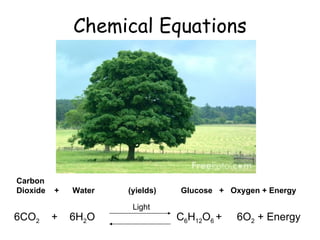
Chemical Equations 6CO 2  +  6H 2 O  Carbon  Dioxide  +  Water  (yields)  Glucose  +  Oxygen   + Energy C 6 H 12 O 6  +  6O 2  + Energy Light
Goals: To learn how to balance chemical equations To understand the Law of Conservation of Mass.
Describing Chemical Reactions Cellular phone messages make use of symbols and abbreviations to express ideas in shorter form. Similarly, chemists often use chemical equations in place of words.
Chemical Equations What does the information from the first slide represent? C 6 H 12 O 6  + 6O 2  + Energy Light 6CO 2  + 6H 2 O The substances that undergo a change are called the  REACTANTS.  They are written before the “yields” arrows. The new substances that are formed are called the  PRODUCTS  and are written after the arrows.
Practice Write a chemical equation showing the formation of carbon dioxide from carbon and oxygen. Write a chemical equation showing the formation of water from hydrogen and oxygen. Write a chemical equation showing the formation of table salt from sodium and chlorine.
Conservation of Mass Created by Antoine Lavoisier, this law states that: mass is neither created nor destroyed in a chemical reaction.  the total mass of the products must always equal the total mass of the reactants. the total number of atoms on one side of the equation MUST equal the total number of atoms on the other side.
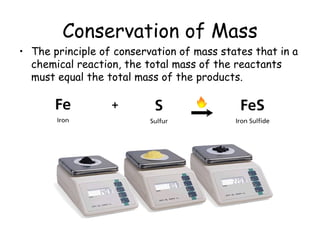
Conservation of Mass The principle of conservation of mass states that in a chemical reaction, the total mass of the reactants must equal the total mass of the products.
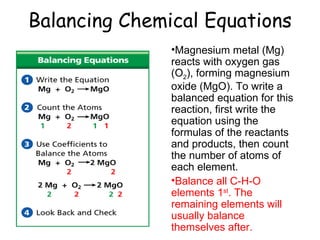
Balancing Chemical Equations Magnesium metal (Mg) reacts with oxygen gas (O 2 ), forming magnesium oxide (MgO). To write a balanced equation for this reaction, first write the equation using the formulas of the reactants and products, then count the number of atoms of each element. Balance all C-H-O elements 1 st . The remaining elements will usually balance themselves after.
Practice The Burning of Hydrazine  Balance the equation and then explain: N 2 H 4  +  O 2  =  N 2  +  H 2 O What are the reactants? What are the products? How many molecules of each element or compound are needed for this reaction to take place?

Chemical equations

  • 1.
    Chemical Equations 6CO2 + 6H 2 O Carbon Dioxide + Water (yields) Glucose + Oxygen + Energy C 6 H 12 O 6 + 6O 2 + Energy Light
  • 2.
    Goals: To learnhow to balance chemical equations To understand the Law of Conservation of Mass.
  • 3.
    Describing Chemical ReactionsCellular phone messages make use of symbols and abbreviations to express ideas in shorter form. Similarly, chemists often use chemical equations in place of words.
  • 4.
    Chemical Equations Whatdoes the information from the first slide represent? C 6 H 12 O 6 + 6O 2 + Energy Light 6CO 2 + 6H 2 O The substances that undergo a change are called the REACTANTS. They are written before the “yields” arrows. The new substances that are formed are called the PRODUCTS and are written after the arrows.
  • 5.
    Practice Write achemical equation showing the formation of carbon dioxide from carbon and oxygen. Write a chemical equation showing the formation of water from hydrogen and oxygen. Write a chemical equation showing the formation of table salt from sodium and chlorine.
  • 6.
    Conservation of MassCreated by Antoine Lavoisier, this law states that: mass is neither created nor destroyed in a chemical reaction. the total mass of the products must always equal the total mass of the reactants. the total number of atoms on one side of the equation MUST equal the total number of atoms on the other side.
  • 7.
    Conservation of MassThe principle of conservation of mass states that in a chemical reaction, the total mass of the reactants must equal the total mass of the products.
  • 8.
    Balancing Chemical EquationsMagnesium metal (Mg) reacts with oxygen gas (O 2 ), forming magnesium oxide (MgO). To write a balanced equation for this reaction, first write the equation using the formulas of the reactants and products, then count the number of atoms of each element. Balance all C-H-O elements 1 st . The remaining elements will usually balance themselves after.
  • 9.
    Practice The Burningof Hydrazine Balance the equation and then explain: N 2 H 4 + O 2 = N 2 + H 2 O What are the reactants? What are the products? How many molecules of each element or compound are needed for this reaction to take place?