Chemical Properties
Goals: To describe chemical properties of matter. To learn the clues that indicate that a chemical change has taken place. To distinguish between chemical and physical changes.
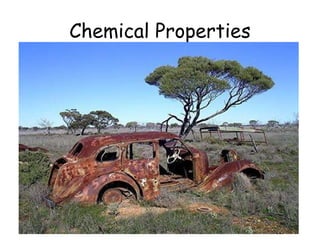
Access Prior Knowledge: What caused the car in the first slide to rust?
What is a chemical property? The ability to produce a change in the composition of matter. They can be observed only when one substance in a sample of matter is changed into another substance. Ex.-whenever something is burned, that substance becomes something completely different.   The ability to burn is a chemical property.
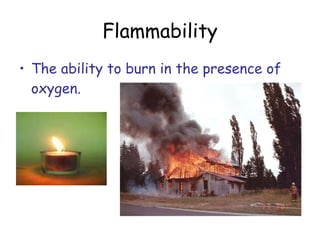
Flammability The ability to burn in the presence of oxygen.
Reactivity How easily a substance combines chemically with another substance.   Oxygen easily reacts with many other elements. What other element is oxygen reacting with in this photo?
How Can You Recognize Chemical Changes? A change in color  – Ex. The green patina on an old copper roof. Production of a Gas  – Ex. Using baking powder and water in a cake mix. CO 2  is produced which helps the cake rise. Formation of a Precipitate  – (any solid that forms and separates from a liquid). Ex. Adding vinegar to milk causes the proteins to clump together.
 
Can you think of physical changes that exhibit these  clues also?
Is a change in color always an indicator of a chemical change?
Is the formation of a gas always an indicator of a chemical change?
Physical v. Chemical Changes Before you decide whether a chemical change has actually taken place, ask yourself this question:  Are different substances present after the change takes place?  If not, it is a physical change (the composition of the matter stays the same).

Chemical properties

  • 1.
  • 2.
    Goals: To describechemical properties of matter. To learn the clues that indicate that a chemical change has taken place. To distinguish between chemical and physical changes.
  • 3.
    Access Prior Knowledge:What caused the car in the first slide to rust?
  • 4.
    What is achemical property? The ability to produce a change in the composition of matter. They can be observed only when one substance in a sample of matter is changed into another substance. Ex.-whenever something is burned, that substance becomes something completely different. The ability to burn is a chemical property.
  • 5.
    Flammability The abilityto burn in the presence of oxygen.
  • 6.
    Reactivity How easilya substance combines chemically with another substance. Oxygen easily reacts with many other elements. What other element is oxygen reacting with in this photo?
  • 7.
    How Can YouRecognize Chemical Changes? A change in color – Ex. The green patina on an old copper roof. Production of a Gas – Ex. Using baking powder and water in a cake mix. CO 2 is produced which helps the cake rise. Formation of a Precipitate – (any solid that forms and separates from a liquid). Ex. Adding vinegar to milk causes the proteins to clump together.
  • 8.
  • 9.
    Can you thinkof physical changes that exhibit these clues also?
  • 10.
    Is a changein color always an indicator of a chemical change?
  • 11.
    Is the formationof a gas always an indicator of a chemical change?
  • 12.
    Physical v. ChemicalChanges Before you decide whether a chemical change has actually taken place, ask yourself this question: Are different substances present after the change takes place? If not, it is a physical change (the composition of the matter stays the same).