Investigating Atoms and Atomic Theory Students should be able to: Describe the particle theory of matter. PS.2a Use the Bohr model to differentiate among the three basic particles in the atom (proton, neutron, and electron) and their charges, relative masses, and locations. PS.3 Compare the Bohr atomic model to the electron cloud model with respect to their ability to represent accurately the structure of the atom.PS.3
Atomos: Not to Be Cut The History of Atomic Theory
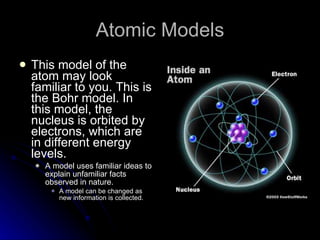
Atomic Models This model of the atom may look familiar to you. This is the Bohr model. In this model, the nucleus is orbited by electrons, which are  in different energy levels.  A model uses familiar ideas to explain unfamiliar facts observed in nature. A model can be changed as new information is collected.
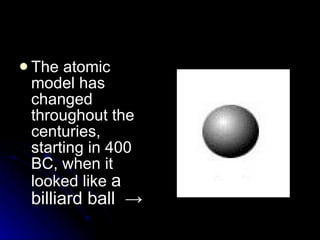
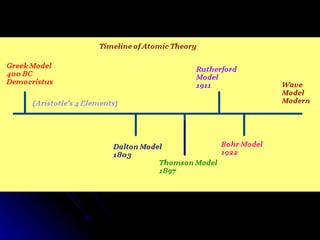
The atomic model has changed throughout the centuries, starting in 400 BC, when it looked like  a billiard ball  ->
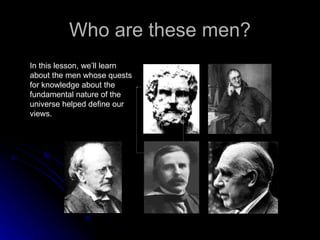
Who are these men? In this lesson, we’ll learn about the men whose quests for knowledge about the fundamental nature of the universe helped define our views.
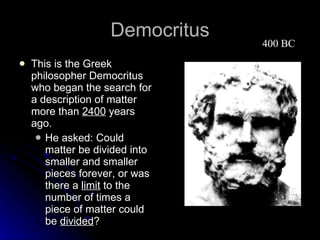
Democritus This is the Greek philosopher Democritus who began the search for a description of matter more than  2400  years ago. He asked: Could matter be divided into smaller and smaller pieces forever, or was there a  limit  to the number of times a piece of matter could be  divided ?  400 BC
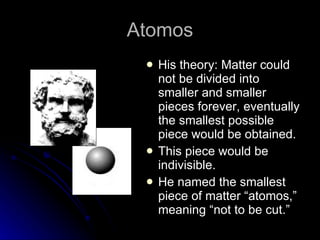
Atomos His theory: Matter could not be divided into smaller and smaller pieces forever, eventually the smallest possible piece would be obtained. This piece would be indivisible. He named the smallest piece of matter “atomos,” meaning “not to be cut.”
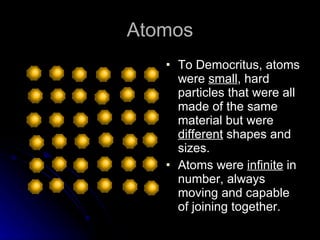
Atomos To Democritus, atoms were  small , hard particles that were all made of the same material but were  different  shapes and sizes. Atoms were  infinite  in number, always moving and capable of joining together.
This theory was ignored and forgotten for more than  2000  years!
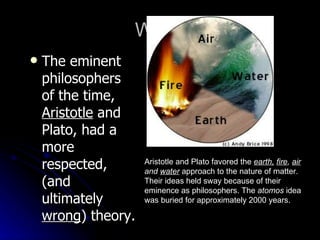
Why? The eminent philosophers of the time,  Aristotle  and Plato, had a more respected, (and ultimately  wrong ) theory. Aristotle and Plato favored the  earth,   fire ,  air  and  water   approach to the nature of matter. Their ideas held sway because of their eminence as philosophers. The  atomos  idea was buried for approximately 2000 years.
 
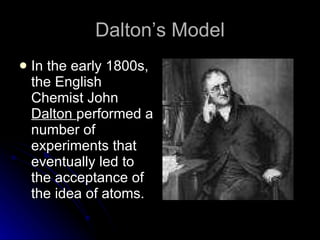
Dalton’s Model In the early 1800s, the English Chemist John  Dalton  performed a number of experiments that eventually led to the acceptance of the idea of atoms.
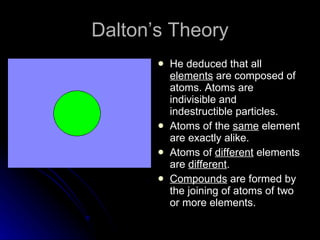
Dalton’s Theory He deduced that all  elements  are composed of atoms. Atoms are indivisible and indestructible particles. Atoms of the  same  element are exactly alike. Atoms of  different  elements are  different . Compounds  are formed by the joining of atoms of two or more elements.
. This theory became one of the  foundations of modern chemistry.
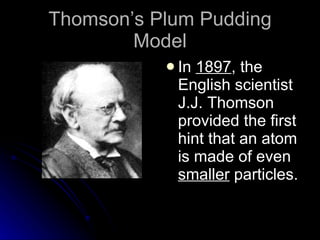
Thomson’s Plum Pudding Model In  1897 , the English scientist J.J. Thomson provided the first hint that an atom is made of even  smaller  particles.
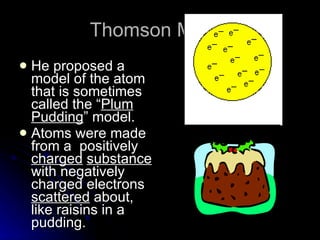
Thomson Model He proposed a model of the atom that is sometimes called the “ Plum   Pudding ” model.  Atoms were made from a  positively  charged   substance  with negatively  charged electrons  scattered  about, like raisins in a pudding.
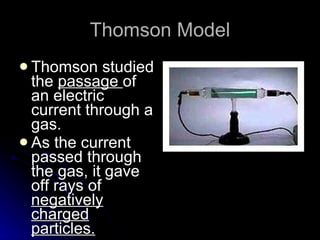
Thomson Model Thomson studied the  passage  of an electric current through a gas. As the current passed through the gas, it gave off rays of  negatively charged particles.
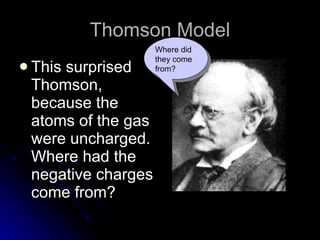
Thomson Model This surprised Thomson, because the atoms of the gas were uncharged. Where had the negative charges come from? Where did they come from?
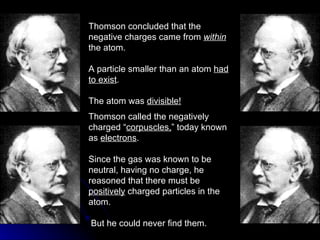
Thomson concluded that the negative charges came from  within   the atom. A particle smaller than an atom  had to exist . The atom was  divisible! Thomson called the negatively charged “ corpuscles, ” today known as  electrons . Since the gas was known to be neutral, having no charge, he reasoned that there must be  positively  charged particles in the atom. But he could never find them.
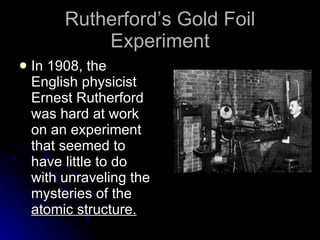
Rutherford’s Gold Foil Experiment In 1908, the English physicist Ernest Rutherford was hard at work on an experiment that seemed to have little to do with unraveling the mysteries of the  atomic structure.
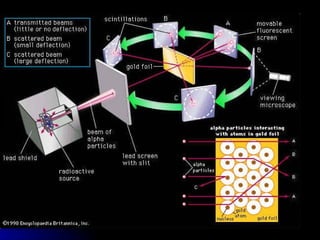
Rutherford’s experiment Involved firing a stream of tiny  positively charged  particles at a thin sheet of  gold foil  (2000 atoms thick)
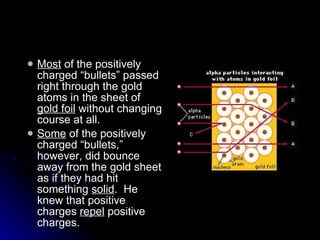
Most  of the positively charged “bullets” passed right through the gold atoms in the sheet of  gold foil  without changing course at all. Some  of the positively charged “bullets,” however, did bounce away from the gold sheet as if they had hit something  solid .  He knew that positive charges  repel  positive charges.
 
http://chemmovies.unl.edu/ChemAnime/RUTHERFD/RUTHERFD.html http://chemmovies.unl.edu/ChemAnime/RUTHERFD/RUTHERFD.html
This could only mean that the gold atoms in the sheet were mostly  open space . Atoms were  not  a pudding filled with a positively charged material. Rutherford concluded that an atom had a  small, dense, positively charged center  that  repelled  his positively charged “bullets.” He called the center of the atom the “ nucleus ” The nucleus is  tiny  compared to the atom as a whole.
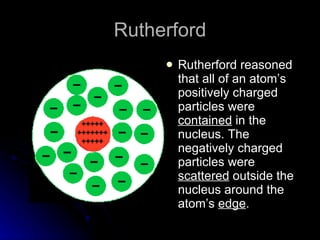
Rutherford Rutherford reasoned that all of an atom’s positively charged particles were  contained  in the nucleus. The negatively charged particles were  scattered  outside the nucleus around the atom’s  edge .
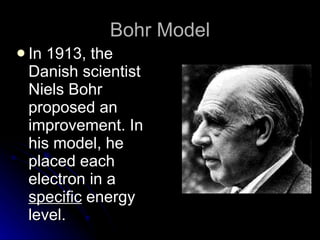
Bohr Model In 1913, the Danish scientist Niels Bohr proposed an improvement. In his model, he placed each electron in a  specific  energy level.
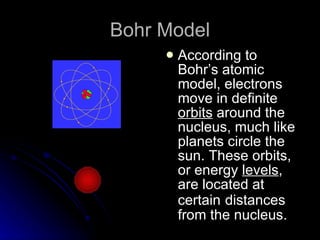
Bohr Model According to Bohr’s atomic model, electrons move in definite  orbits  around the nucleus, much like planets circle the sun. These orbits, or energy  levels , are located at certain   distances from the nucleus.
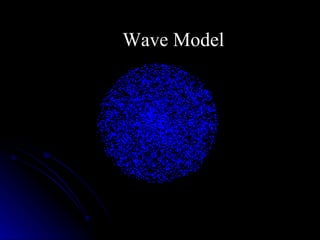
Wave Model
The Wave Model Today’s atomic model is based on the principles of  wave   mechanics . According to the theory of wave mechanics, electrons  do not move  about an atom in a  definite path,  like the planets around the sun.
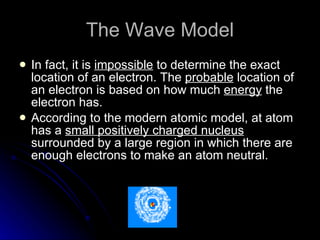
The Wave Model In fact, it is  impossible  to determine the exact location of an electron. The  probable  location of an electron is based on how much  energy  the electron has. According to the modern atomic model, at atom has a  small positively charged nucleus  surrounded by a large region in which there are enough electrons to make an atom neutral.
Electron Cloud: A space in which electrons are likely to be found. Electrons  whirl  about the nucleus billions of times in one second They are not moving around in  random  patterns. Location of electrons depends upon how much  energy  the electron has.
Electron Cloud: Depending on their energy they are locked into a certain area in the cloud. Electrons with the  lowest  energy are found in the energy level  closest  to the nucleus Electrons with the  highest  energy are found in the  outermost  energy levels, farther from the nucleus.
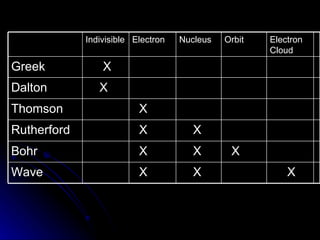
X X X Wave X X X Bohr X X Rutherford X Thomson X Dalton X Greek Electron Cloud Orbit Nucleus Electron Indivisible

Atomos

  • 1.
    Investigating Atoms andAtomic Theory Students should be able to: Describe the particle theory of matter. PS.2a Use the Bohr model to differentiate among the three basic particles in the atom (proton, neutron, and electron) and their charges, relative masses, and locations. PS.3 Compare the Bohr atomic model to the electron cloud model with respect to their ability to represent accurately the structure of the atom.PS.3
  • 2.
    Atomos: Not toBe Cut The History of Atomic Theory
  • 3.
    Atomic Models Thismodel of the atom may look familiar to you. This is the Bohr model. In this model, the nucleus is orbited by electrons, which are in different energy levels. A model uses familiar ideas to explain unfamiliar facts observed in nature. A model can be changed as new information is collected.
  • 4.
    The atomic modelhas changed throughout the centuries, starting in 400 BC, when it looked like a billiard ball ->
  • 5.
    Who are thesemen? In this lesson, we’ll learn about the men whose quests for knowledge about the fundamental nature of the universe helped define our views.
  • 6.
    Democritus This isthe Greek philosopher Democritus who began the search for a description of matter more than 2400 years ago. He asked: Could matter be divided into smaller and smaller pieces forever, or was there a limit to the number of times a piece of matter could be divided ? 400 BC
  • 7.
    Atomos His theory:Matter could not be divided into smaller and smaller pieces forever, eventually the smallest possible piece would be obtained. This piece would be indivisible. He named the smallest piece of matter “atomos,” meaning “not to be cut.”
  • 8.
    Atomos To Democritus,atoms were small , hard particles that were all made of the same material but were different shapes and sizes. Atoms were infinite in number, always moving and capable of joining together.
  • 9.
    This theory wasignored and forgotten for more than 2000 years!
  • 10.
    Why? The eminentphilosophers of the time, Aristotle and Plato, had a more respected, (and ultimately wrong ) theory. Aristotle and Plato favored the earth, fire , air and water approach to the nature of matter. Their ideas held sway because of their eminence as philosophers. The atomos idea was buried for approximately 2000 years.
  • 11.
  • 12.
    Dalton’s Model Inthe early 1800s, the English Chemist John Dalton performed a number of experiments that eventually led to the acceptance of the idea of atoms.
  • 13.
    Dalton’s Theory Hededuced that all elements are composed of atoms. Atoms are indivisible and indestructible particles. Atoms of the same element are exactly alike. Atoms of different elements are different . Compounds are formed by the joining of atoms of two or more elements.
  • 14.
    . This theorybecame one of the foundations of modern chemistry.
  • 15.
    Thomson’s Plum PuddingModel In 1897 , the English scientist J.J. Thomson provided the first hint that an atom is made of even smaller particles.
  • 16.
    Thomson Model Heproposed a model of the atom that is sometimes called the “ Plum Pudding ” model. Atoms were made from a positively charged substance with negatively charged electrons scattered about, like raisins in a pudding.
  • 17.
    Thomson Model Thomsonstudied the passage of an electric current through a gas. As the current passed through the gas, it gave off rays of negatively charged particles.
  • 18.
    Thomson Model Thissurprised Thomson, because the atoms of the gas were uncharged. Where had the negative charges come from? Where did they come from?
  • 19.
    Thomson concluded thatthe negative charges came from within the atom. A particle smaller than an atom had to exist . The atom was divisible! Thomson called the negatively charged “ corpuscles, ” today known as electrons . Since the gas was known to be neutral, having no charge, he reasoned that there must be positively charged particles in the atom. But he could never find them.
  • 20.
    Rutherford’s Gold FoilExperiment In 1908, the English physicist Ernest Rutherford was hard at work on an experiment that seemed to have little to do with unraveling the mysteries of the atomic structure.
  • 21.
    Rutherford’s experiment Involvedfiring a stream of tiny positively charged particles at a thin sheet of gold foil (2000 atoms thick)
  • 22.
    Most ofthe positively charged “bullets” passed right through the gold atoms in the sheet of gold foil without changing course at all. Some of the positively charged “bullets,” however, did bounce away from the gold sheet as if they had hit something solid . He knew that positive charges repel positive charges.
  • 23.
  • 24.
  • 25.
    This could onlymean that the gold atoms in the sheet were mostly open space . Atoms were not a pudding filled with a positively charged material. Rutherford concluded that an atom had a small, dense, positively charged center that repelled his positively charged “bullets.” He called the center of the atom the “ nucleus ” The nucleus is tiny compared to the atom as a whole.
  • 26.
    Rutherford Rutherford reasonedthat all of an atom’s positively charged particles were contained in the nucleus. The negatively charged particles were scattered outside the nucleus around the atom’s edge .
  • 27.
    Bohr Model In1913, the Danish scientist Niels Bohr proposed an improvement. In his model, he placed each electron in a specific energy level.
  • 28.
    Bohr Model Accordingto Bohr’s atomic model, electrons move in definite orbits around the nucleus, much like planets circle the sun. These orbits, or energy levels , are located at certain distances from the nucleus.
  • 29.
  • 30.
    The Wave ModelToday’s atomic model is based on the principles of wave mechanics . According to the theory of wave mechanics, electrons do not move about an atom in a definite path, like the planets around the sun.
  • 31.
    The Wave ModelIn fact, it is impossible to determine the exact location of an electron. The probable location of an electron is based on how much energy the electron has. According to the modern atomic model, at atom has a small positively charged nucleus surrounded by a large region in which there are enough electrons to make an atom neutral.
  • 32.
    Electron Cloud: Aspace in which electrons are likely to be found. Electrons whirl about the nucleus billions of times in one second They are not moving around in random patterns. Location of electrons depends upon how much energy the electron has.
  • 33.
    Electron Cloud: Dependingon their energy they are locked into a certain area in the cloud. Electrons with the lowest energy are found in the energy level closest to the nucleus Electrons with the highest energy are found in the outermost energy levels, farther from the nucleus.
  • 34.
    X X XWave X X X Bohr X X Rutherford X Thomson X Dalton X Greek Electron Cloud Orbit Nucleus Electron Indivisible