Atom – the smallest unit of matter “indivisible”
Helium
atom
electron shells
a) Atomic number = number of Electrons
b) Electrons vary in the amount of energy
they possess, and they occur at certain
energy levels or electron shells.
a) Electron shells determine how an atom
behaves when it encounters other atoms
Electrons are placed in shells
according to rules:
1) The 1st shell can hold up to two electrons,
and each shell thereafter can hold up to 8
electrons.
Octet Rule = atoms tend to gain, lose or share electrons so
as to have 8 electrons
C would like to
N would like to
O would like to
Gain 4 electrons
Gain 3 electrons
Gain 2 electrons
Why are electrons important?
1) Elements have different electron
configurations
 different electron configurations mean
different levels of bonding
Electron Dot Structures
Symbols of atoms with dots to represent the valence-
shell electrons
1 2 13 14 15 16 17 18
H•
He:
• • • • • • • • • • •
Li•
Be• •
B • •
C • •
N • •
O •
: F •
:Ne :
• • • • • • • •
• • • • • • • • • • •
Na•
Mg• •
Al• •
Si• •
P• •
S•
:Cl •
:Ar :
• • • • • • • •
Chemical bonds: an attempt to fill electron shells
1. Ionic bonds –
2. Covalent bonds –
3. Metallic bonds
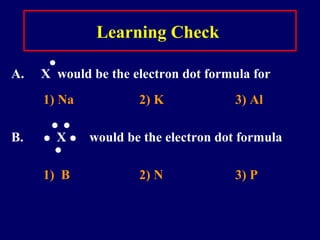
Learning Check

A. X would be the electron dot formula for
1) Na 2) K 3) Al
 
B.  X  would be the electron dot formula

1) B 2) N 3) P
IONIC BOND
bond formed between
two ions by the
transfer of electrons
Formation of Ions from Metals
Ionic compounds result when metals react with
nonmetals
Metals lose electrons to match the number of valence
electrons of their nearest noble gas
Positive ions form when the number of electrons are
less than the number of protons
Group 1 metals → ion 1+
Group 2 metals → ion 2+
• Group 13 metals → ion 3+
Formation of Sodium Ion
Sodium atom Sodium ion
Na •
– e−
→ Na +
2-8-1 2-8 ( = Ne)
11 p+
11 p+
11 e-
10 e-
0 1+
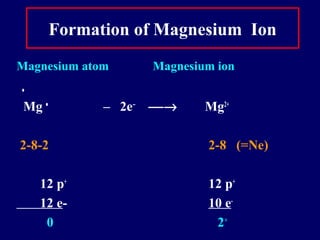
Formation of Magnesium Ion
Magnesium atom Magnesium ion
•
Mg •
– 2e−
→ Mg2+
2-8-2 2-8 (=Ne)
12 p+
12 p+
12 e- 10 e-
0 2+
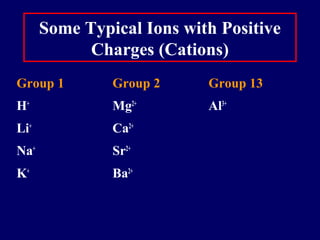
Some Typical Ions with Positive
Charges (Cations)
Group 1 Group 2 Group 13
H+
Mg2+
Al3+
Li+
Ca2+
Na+
Sr2+
K+
Ba2+
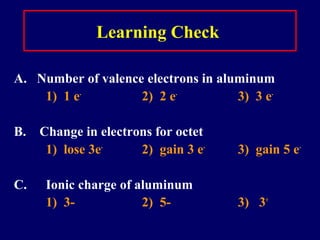
Learning Check
A. Number of valence electrons in aluminum
1) 1 e-
2) 2 e-
3) 3 e-
B. Change in electrons for octet
1) lose 3e-
2) gain 3 e-
3) gain 5 e-
C. Ionic charge of aluminum
1) 3- 2) 5- 3) 3+
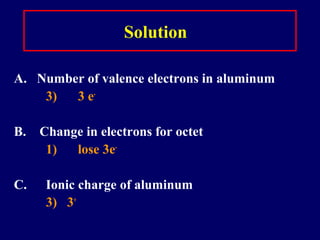
Solution
A. Number of valence electrons in aluminum
3) 3 e-
B. Change in electrons for octet
1) lose 3e-
C. Ionic charge of aluminum
3) 3+
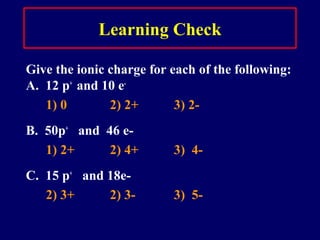
Learning Check
Give the ionic charge for each of the following:
A. 12 p+
and 10 e-
1) 0 2) 2+ 3) 2-
B. 50p+
and 46 e-
1) 2+ 2) 4+ 3) 4-
C. 15 p+
and 18e-
2) 3+ 2) 3- 3) 5-
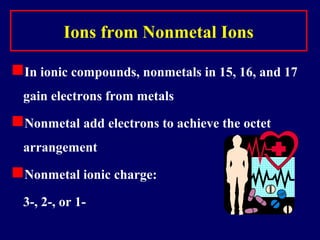
Ions from Nonmetal Ions
In ionic compounds, nonmetals in 15, 16, and 17
gain electrons from metals
Nonmetal add electrons to achieve the octet
arrangement
Nonmetal ionic charge:
3-, 2-, or 1-
Fluoride Ion
unpaired electron octet
• • • • 1 -
: F •
+ e−
: F :
• • • •
2-7 2-8 (= Ne)
9 p+ 9 p+
9 e- 10 e-
0 1 -
ionic charge
Ionic Bond
• Between atoms of metals and nonmetals
with very different electronegativity
• Bond formed by transfer of electrons
• Produce charged ions all states. Conductors
and have high melting point.
• Examples; NaCl, CaCl2, K2O
Ionic Bonds: One Big Greedy Thief Dog!
1). Ionic bond – electron from Na is transferred to Cl,
this causes a charge imbalance in each atom. The Na
becomes (Na+) and the Cl becomes (Cl-), charged
particles or ions.
COVALENT BOND
bond formed by the
sharing of electrons
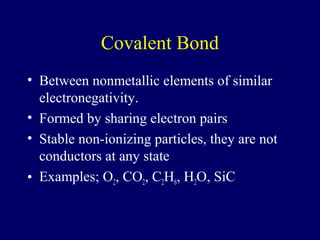
Covalent Bond
• Between nonmetallic elements of similar
electronegativity.
• Formed by sharing electron pairs
• Stable non-ionizing particles, they are not
conductors at any state
• Examples; O2, CO2, C2H6, H2O, SiC
Bonds in all the
polyatomic ions
and diatomics
are all covalent
bonds
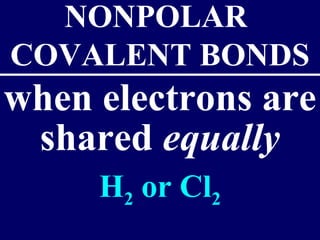
when electrons are
shared equally
NONPOLAR
COVALENT BONDS
H2 or Cl2
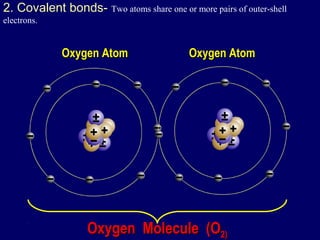
2. Covalent bonds- Two atoms share one or more pairs of outer-shell
electrons.
Oxygen AtomOxygen Atom Oxygen AtomOxygen Atom
Oxygen Molecule (OOxygen Molecule (O22))
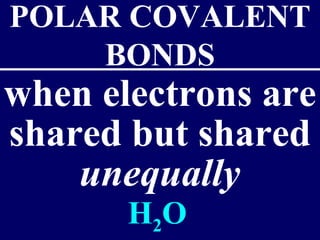
when electrons are
shared but shared
unequally
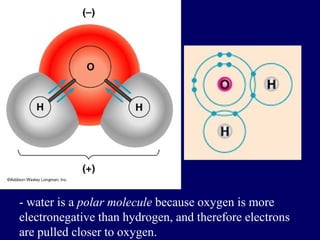
POLAR COVALENT
BONDS
H2O
Polar Covalent Bonds: Unevenly
matched, but willing to share.
- water is a polar molecule because oxygen is more
electronegative than hydrogen, and therefore electrons
are pulled closer to oxygen.
METALLIC BOND
bond found in
metals; holds metal
atoms together
very strongly
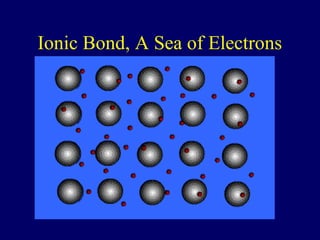
Metallic Bond
• Formed between atoms of metallic elements
• Electron cloud around atoms
• Good conductors at all states, lustrous, very
high melting points
• Examples; Na, Fe, Al, Au, Co
Metallic Bonds: Mellow dogs with plenty
of bones to go around.
Ionic Bond, A Sea of Electrons
Metals Form Alloys
Metals do not combine with metals. They form
Alloys which is a solution of a metal in a metal.
Examples are steel, brass, bronze and pewter.
Formula Weights
• Formula weight is the sum of the atomic
masses.
• Example- CO2
• Mass, C + O + O
12.011 + 15.994 + 15.994
43.999
Practice
• Compute the mass of the following compounds
round to nearest tenth & state type of bond:
• NaCl;
• 23 + 35 = 58; Ionic Bond
• C2H6;
• 24 + 6 = 30; Covalent Bond
• Na(CO3)2;
• 23 + 2(12 + 3x16) = 123; Ionic & Covalent
Chembond
Chembond

Chembond

  • 2.
    Atom – thesmallest unit of matter “indivisible” Helium atom
  • 3.
    electron shells a) Atomicnumber = number of Electrons b) Electrons vary in the amount of energy they possess, and they occur at certain energy levels or electron shells. a) Electron shells determine how an atom behaves when it encounters other atoms
  • 4.
    Electrons are placedin shells according to rules: 1) The 1st shell can hold up to two electrons, and each shell thereafter can hold up to 8 electrons.
  • 5.
    Octet Rule =atoms tend to gain, lose or share electrons so as to have 8 electrons C would like to N would like to O would like to Gain 4 electrons Gain 3 electrons Gain 2 electrons
  • 6.
    Why are electronsimportant? 1) Elements have different electron configurations  different electron configurations mean different levels of bonding
  • 8.
    Electron Dot Structures Symbolsof atoms with dots to represent the valence- shell electrons 1 2 13 14 15 16 17 18 H• He: • • • • • • • • • • • Li• Be• • B • • C • • N • • O • : F • :Ne : • • • • • • • • • • • • • • • • • • • Na• Mg• • Al• • Si• • P• • S• :Cl • :Ar : • • • • • • • •
  • 9.
    Chemical bonds: anattempt to fill electron shells 1. Ionic bonds – 2. Covalent bonds – 3. Metallic bonds
  • 10.
    Learning Check  A. Xwould be the electron dot formula for 1) Na 2) K 3) Al   B.  X  would be the electron dot formula  1) B 2) N 3) P
  • 11.
    IONIC BOND bond formedbetween two ions by the transfer of electrons
  • 12.
    Formation of Ionsfrom Metals Ionic compounds result when metals react with nonmetals Metals lose electrons to match the number of valence electrons of their nearest noble gas Positive ions form when the number of electrons are less than the number of protons Group 1 metals → ion 1+ Group 2 metals → ion 2+ • Group 13 metals → ion 3+
  • 13.
    Formation of SodiumIon Sodium atom Sodium ion Na • – e− → Na + 2-8-1 2-8 ( = Ne) 11 p+ 11 p+ 11 e- 10 e- 0 1+
  • 14.
    Formation of MagnesiumIon Magnesium atom Magnesium ion • Mg • – 2e− → Mg2+ 2-8-2 2-8 (=Ne) 12 p+ 12 p+ 12 e- 10 e- 0 2+
  • 15.
    Some Typical Ionswith Positive Charges (Cations) Group 1 Group 2 Group 13 H+ Mg2+ Al3+ Li+ Ca2+ Na+ Sr2+ K+ Ba2+
  • 16.
    Learning Check A. Numberof valence electrons in aluminum 1) 1 e- 2) 2 e- 3) 3 e- B. Change in electrons for octet 1) lose 3e- 2) gain 3 e- 3) gain 5 e- C. Ionic charge of aluminum 1) 3- 2) 5- 3) 3+
  • 17.
    Solution A. Number ofvalence electrons in aluminum 3) 3 e- B. Change in electrons for octet 1) lose 3e- C. Ionic charge of aluminum 3) 3+
  • 18.
    Learning Check Give theionic charge for each of the following: A. 12 p+ and 10 e- 1) 0 2) 2+ 3) 2- B. 50p+ and 46 e- 1) 2+ 2) 4+ 3) 4- C. 15 p+ and 18e- 2) 3+ 2) 3- 3) 5-
  • 19.
    Ions from NonmetalIons In ionic compounds, nonmetals in 15, 16, and 17 gain electrons from metals Nonmetal add electrons to achieve the octet arrangement Nonmetal ionic charge: 3-, 2-, or 1-
  • 20.
    Fluoride Ion unpaired electronoctet • • • • 1 - : F • + e− : F : • • • • 2-7 2-8 (= Ne) 9 p+ 9 p+ 9 e- 10 e- 0 1 - ionic charge
  • 21.
    Ionic Bond • Betweenatoms of metals and nonmetals with very different electronegativity • Bond formed by transfer of electrons • Produce charged ions all states. Conductors and have high melting point. • Examples; NaCl, CaCl2, K2O
  • 23.
    Ionic Bonds: OneBig Greedy Thief Dog!
  • 24.
    1). Ionic bond– electron from Na is transferred to Cl, this causes a charge imbalance in each atom. The Na becomes (Na+) and the Cl becomes (Cl-), charged particles or ions.
  • 26.
    COVALENT BOND bond formedby the sharing of electrons
  • 27.
    Covalent Bond • Betweennonmetallic elements of similar electronegativity. • Formed by sharing electron pairs • Stable non-ionizing particles, they are not conductors at any state • Examples; O2, CO2, C2H6, H2O, SiC
  • 29.
    Bonds in allthe polyatomic ions and diatomics are all covalent bonds
  • 30.
    when electrons are sharedequally NONPOLAR COVALENT BONDS H2 or Cl2
  • 31.
    2. Covalent bonds-Two atoms share one or more pairs of outer-shell electrons. Oxygen AtomOxygen Atom Oxygen AtomOxygen Atom Oxygen Molecule (OOxygen Molecule (O22))
  • 32.
    when electrons are sharedbut shared unequally POLAR COVALENT BONDS H2O
  • 33.
    Polar Covalent Bonds:Unevenly matched, but willing to share.
  • 34.
    - water isa polar molecule because oxygen is more electronegative than hydrogen, and therefore electrons are pulled closer to oxygen.
  • 35.
    METALLIC BOND bond foundin metals; holds metal atoms together very strongly
  • 36.
    Metallic Bond • Formedbetween atoms of metallic elements • Electron cloud around atoms • Good conductors at all states, lustrous, very high melting points • Examples; Na, Fe, Al, Au, Co
  • 37.
    Metallic Bonds: Mellowdogs with plenty of bones to go around.
  • 38.
    Ionic Bond, ASea of Electrons
  • 39.
    Metals Form Alloys Metalsdo not combine with metals. They form Alloys which is a solution of a metal in a metal. Examples are steel, brass, bronze and pewter.
  • 40.
    Formula Weights • Formulaweight is the sum of the atomic masses. • Example- CO2 • Mass, C + O + O 12.011 + 15.994 + 15.994 43.999
  • 41.
    Practice • Compute themass of the following compounds round to nearest tenth & state type of bond: • NaCl; • 23 + 35 = 58; Ionic Bond • C2H6; • 24 + 6 = 30; Covalent Bond • Na(CO3)2; • 23 + 2(12 + 3x16) = 123; Ionic & Covalent