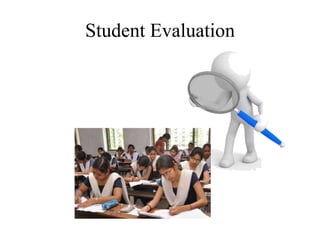

-Student evaluation
- Teacher evaluation
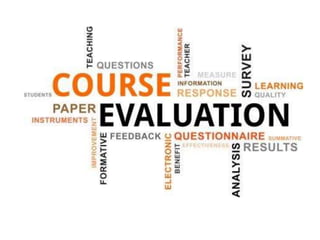
- Course evaluation
Nirmala Roberts
India
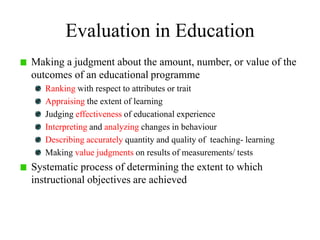
Evaluation in Education
Making a judgment about the amount, number, or value of the
outcomes of an educational programme
Ranking with respect to attributes or trait
Appraising the extent of learning
Judging effectiveness of educational experience
Interpreting and analyzing changes in behaviour
Describing accurately quantity and quality of teaching- learning
Making value judgments on results of measurements/ tests
Systematic process of determining the extent to which
instructional objectives are achieved
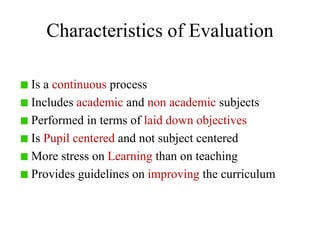
Characteristics of Evaluation
Is a continuous process
Includes academic and non academic subjects
Performed in terms of laid down objectives
Is Pupil centered and not subject centered
More stress on Learning than on teaching
Provides guidelines on improving the curriculum
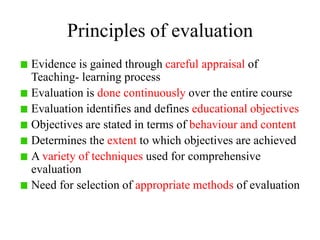
Principles of evaluation
Evidence is gained through careful appraisal of
Teaching- learning process
Evaluation is done continuously over the entire course
Evaluation identifies and defines educational objectives
Objectives are stated in terms of behaviour and content
Determines the extent to which objectives are achieved
A variety of techniques used for comprehensive
evaluation
Need for selection of appropriate methods of evaluation
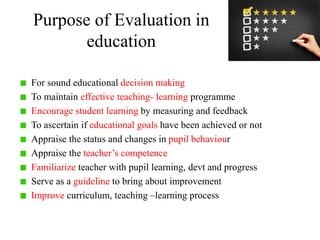
Purpose of Evaluation in
education
For sound educational decision making
To maintain effective teaching- learning programme
Encourage student learning by measuring and feedback
To ascertain if educational goals have been achieved or not
Appraise the status and changes in pupil behaviour
Appraise the teacher’s competence
Familiarize teacher with pupil learning, devt and progress
Serve as a guideline to bring about improvement
Improve curriculum, teaching –learning process
Purpose of Evaluation in Education
To formulate objectives, designing of learning
experiences & assessment of learner performance.
To make improvement in teaching and
curriculum.
To ensure accountability to the society, parents,
and to the education system.
Student Evaluation
Scope of Evaluation in education
Emphasizes devt of improved techniques of assessing
Stresses on student’s growth and development
Identifies pupil’s strength/ weakness
Baseline for guidance and counseling
Devt of attitudes, interests, creativity, skills
Devt of tools, techniques and curriculum
Placement/ promotion in jobs
Methods of Evaluation
Goal, Process and Outcome based
Formative and Summative method
Assessment of Knowledge, skill and Attitude
Goal, Process and Outcome based
Evaluation
Goal based - Measures if objectives have been
achieved
 SMART (Specific, Measurable, Achievable,
Relevant, Time bound)
Process based- Analyses strengths and weaknesses
Outcome based – Examines broader impact (greater
good)
Formative and Summative Evaluation
Formative –
An ongoing assessment when the course is in progress
Monitors learning progress & provides continuous
feedback to student and teacher
Summative –
Done at the end of a course of instruction
Assigns a grade for student achievement
Provides insight into prior or existing initiatives
Identifies any needed changes
…….Criticism?
K, S, A evaluation
Assessment of knowledge – Essay type/ Short
answer questions, MCQs, viva-voce
Assessment of skills – Checklist, anecdotes,
practical exam, OSCE
Assessment of attitude – Rating scales
(descriptive, numerical, graphical)
…..Criticism?
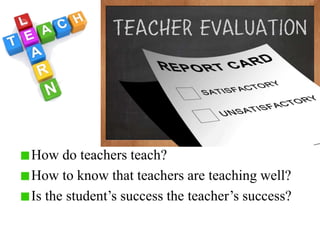
How do teachers teach?
How to know that teachers are teaching well?
Is the student’s success the teacher’s success?
Why evaluate teachers?
Encourage and enable teachers and students to take
co-responsibility for the quality T/ L experience
To create and sustain a responsive learning
environment
Ensure excellence in T/L that’s fosters holistic
student success
Encourages improvement through reflective practice
Types of Teacher Evaluation
(used also for student evaluation)
Placement Evaluation: To place the ✓ person
in the ✓ place
Formative Evaluation
Diagnostic Evaluation
Summative Evaluation
Norm-Referenced and Criterion-Referenced
Evaluation
Benefits of Teacher evaluation
Improves teaching and learning experiences for all
concerned
Promotes professional development
Provides students with –
Opportunity to make constructive criticism
‘Voice’ to develop and maintain effective
curriculum
Benefits of Teacher evaluation
Provides data to –
Benchmark teaching & learning quality by the laid
down standards
Individual teacher for self improvement
To make curricular decisions
Evidence for teachers as indicators of good
teaching
Methods of Teacher evaluation
Ratings/ review by - Peers, students, parents,
administrators, community
Reflections on -
Advising & mentoring
Classroom instruction
Courses developed or re-designed.
Instructional materials, course textbooks, etc.
Innovative teaching.
Pedagogical research.
Self reflection/ ratings
Analysis of agreed-on student learning evidence
Course evaluation
Process of data collection and analysis to assess the
extent to which course learning outcomes are met by
students within a course.
The tool - A paper or electronic questionnaire seeking
written or selected responses to a series of questions
in order to evaluate the instruction of a given course
Course evaluation
Performed by – Curriculum committee
Done as – Formative and Summative
Provides inputs for Curriculum Revision
Criticism –
Not taken seriously by students
Do not provide meaningful feedback
Student bias  Teachers' personality, looks,
disabilities, gender and ethnicity, special
preferences
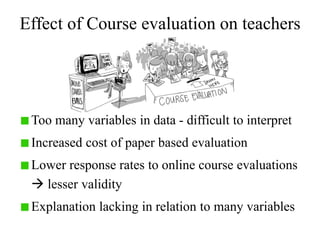
Effect of Course evaluation on teachers
Too many variables in data - difficult to interpret
Increased cost of paper based evaluation
Lower response rates to online course evaluations
 lesser validity
Explanation lacking in relation to many variables
Effect of Course evaluation on teachers
Not well understood by many students -
 Leads to ‘dumbing down’ of educational stds.
 Hence not to be used for faculty hires,
retentions, promotions, and tenure
Humiliating for instructors
Demeaning to efforts for higher stds in general
 Evaluation in Education.pptx

Evaluation in Education.pptx

  • 1.
    -Student evaluation - Teacherevaluation - Course evaluation Nirmala Roberts India
  • 2.
    Evaluation in Education Makinga judgment about the amount, number, or value of the outcomes of an educational programme Ranking with respect to attributes or trait Appraising the extent of learning Judging effectiveness of educational experience Interpreting and analyzing changes in behaviour Describing accurately quantity and quality of teaching- learning Making value judgments on results of measurements/ tests Systematic process of determining the extent to which instructional objectives are achieved
  • 3.
    Characteristics of Evaluation Isa continuous process Includes academic and non academic subjects Performed in terms of laid down objectives Is Pupil centered and not subject centered More stress on Learning than on teaching Provides guidelines on improving the curriculum
  • 4.
    Principles of evaluation Evidenceis gained through careful appraisal of Teaching- learning process Evaluation is done continuously over the entire course Evaluation identifies and defines educational objectives Objectives are stated in terms of behaviour and content Determines the extent to which objectives are achieved A variety of techniques used for comprehensive evaluation Need for selection of appropriate methods of evaluation
  • 5.
    Purpose of Evaluationin education For sound educational decision making To maintain effective teaching- learning programme Encourage student learning by measuring and feedback To ascertain if educational goals have been achieved or not Appraise the status and changes in pupil behaviour Appraise the teacher’s competence Familiarize teacher with pupil learning, devt and progress Serve as a guideline to bring about improvement Improve curriculum, teaching –learning process
  • 6.
    Purpose of Evaluationin Education To formulate objectives, designing of learning experiences & assessment of learner performance. To make improvement in teaching and curriculum. To ensure accountability to the society, parents, and to the education system.
  • 7.
  • 8.
    Scope of Evaluationin education Emphasizes devt of improved techniques of assessing Stresses on student’s growth and development Identifies pupil’s strength/ weakness Baseline for guidance and counseling Devt of attitudes, interests, creativity, skills Devt of tools, techniques and curriculum Placement/ promotion in jobs
  • 9.
    Methods of Evaluation Goal,Process and Outcome based Formative and Summative method Assessment of Knowledge, skill and Attitude
  • 10.
    Goal, Process andOutcome based Evaluation Goal based - Measures if objectives have been achieved  SMART (Specific, Measurable, Achievable, Relevant, Time bound) Process based- Analyses strengths and weaknesses Outcome based – Examines broader impact (greater good)
  • 11.
    Formative and SummativeEvaluation Formative – An ongoing assessment when the course is in progress Monitors learning progress & provides continuous feedback to student and teacher Summative – Done at the end of a course of instruction Assigns a grade for student achievement Provides insight into prior or existing initiatives Identifies any needed changes …….Criticism?
  • 12.
    K, S, Aevaluation Assessment of knowledge – Essay type/ Short answer questions, MCQs, viva-voce Assessment of skills – Checklist, anecdotes, practical exam, OSCE Assessment of attitude – Rating scales (descriptive, numerical, graphical) …..Criticism?
  • 13.
    How do teachersteach? How to know that teachers are teaching well? Is the student’s success the teacher’s success?
  • 14.
    Why evaluate teachers? Encourageand enable teachers and students to take co-responsibility for the quality T/ L experience To create and sustain a responsive learning environment Ensure excellence in T/L that’s fosters holistic student success Encourages improvement through reflective practice
  • 15.
    Types of TeacherEvaluation (used also for student evaluation) Placement Evaluation: To place the ✓ person in the ✓ place Formative Evaluation Diagnostic Evaluation Summative Evaluation Norm-Referenced and Criterion-Referenced Evaluation
  • 16.
    Benefits of Teacherevaluation Improves teaching and learning experiences for all concerned Promotes professional development Provides students with – Opportunity to make constructive criticism ‘Voice’ to develop and maintain effective curriculum
  • 17.
    Benefits of Teacherevaluation Provides data to – Benchmark teaching & learning quality by the laid down standards Individual teacher for self improvement To make curricular decisions Evidence for teachers as indicators of good teaching
  • 18.
    Methods of Teacherevaluation Ratings/ review by - Peers, students, parents, administrators, community Reflections on - Advising & mentoring Classroom instruction Courses developed or re-designed. Instructional materials, course textbooks, etc. Innovative teaching. Pedagogical research. Self reflection/ ratings Analysis of agreed-on student learning evidence
  • 20.
    Course evaluation Process ofdata collection and analysis to assess the extent to which course learning outcomes are met by students within a course. The tool - A paper or electronic questionnaire seeking written or selected responses to a series of questions in order to evaluate the instruction of a given course
  • 21.
    Course evaluation Performed by– Curriculum committee Done as – Formative and Summative Provides inputs for Curriculum Revision Criticism – Not taken seriously by students Do not provide meaningful feedback Student bias  Teachers' personality, looks, disabilities, gender and ethnicity, special preferences
  • 22.
    Effect of Courseevaluation on teachers Too many variables in data - difficult to interpret Increased cost of paper based evaluation Lower response rates to online course evaluations  lesser validity Explanation lacking in relation to many variables
  • 23.
    Effect of Courseevaluation on teachers Not well understood by many students -  Leads to ‘dumbing down’ of educational stds.  Hence not to be used for faculty hires, retentions, promotions, and tenure Humiliating for instructors Demeaning to efforts for higher stds in general