ACHIEVEMENT TEST
Presented by :
Surekha V S
Assistant Professor in Commerce Education
SVTEC Akkikkavu
Meaning
Achievement tests are designed to measure the
knowledge and skills students learned in school or to
determine the academic progress they have made over
a period of time.
Achievement tests evaluate the effectiveness of a
schools and teachers, or identify the appropriate
academic placement for a student—i.e., what courses
or programs may be deemed most suitable, or what
forms of academic support they may need
Achievement tests are “backward-looking” because it
measure how well students have learned what they
were expected to learn.
Any test designed to assess the achievement in any subject
with regard to a set of pre- determined objectives is called an
achievement test.
Definition
Any test that measures the
accomplishments of an individual
after a period of training or learning
N M DOWNIE
“The type of ability test that
describes what a person has
learn to do”
Thorndike & Hagen
Characteristics of a good achievement test
 Reliability
 Validity
 Ease in administration
 Cost
 Time
 Acceptability
 Specificity
 Precise & clear
Construction of an Achievement Test
• Plan for the test
• Design for the test
• Preparation of
• Writing of items
• Preparation of scoring key & marking scheme
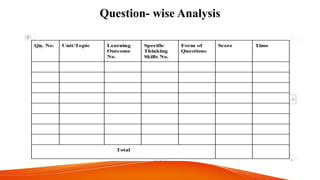
• Question- wise Analysis
Plan for the test
Paper setter consider :
 What he/ she intends to measure/ find out
 Learing outcomes
 Maximum time & marks
 Nature of the test
• Preliminary Details:
• Name of the Student Teacher :
• Name of the School :
• Standard & Division :
• Subject :
• Unit :
• Duration :
• Date :
• Learning Outcomes :
• Thinking Skills :
Design for the test
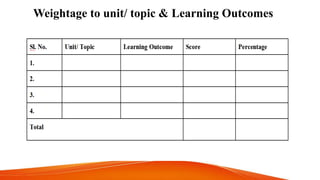
• Weigtage to unit/ topic & learning outcomes
• Weightage to Thinking Skills
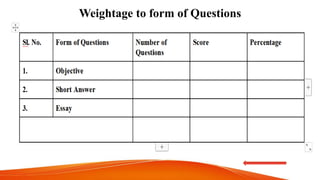
• Weightage to form of questions
Weightage to unit/ topic & Learning Outcomes
Weightage to Thinking Skills
Weightage to form of Questions
Preparation of Scoring key & Marking Scheme
Marking Sheme
Question- wise Analysis
THANK YOU

Achievement test

  • 1.
    ACHIEVEMENT TEST Presented by: Surekha V S Assistant Professor in Commerce Education SVTEC Akkikkavu
  • 2.
    Meaning Achievement tests aredesigned to measure the knowledge and skills students learned in school or to determine the academic progress they have made over a period of time.
  • 3.
    Achievement tests evaluatethe effectiveness of a schools and teachers, or identify the appropriate academic placement for a student—i.e., what courses or programs may be deemed most suitable, or what forms of academic support they may need
  • 4.
    Achievement tests are“backward-looking” because it measure how well students have learned what they were expected to learn.
  • 5.
    Any test designedto assess the achievement in any subject with regard to a set of pre- determined objectives is called an achievement test.
  • 6.
    Definition Any test thatmeasures the accomplishments of an individual after a period of training or learning N M DOWNIE
  • 7.
    “The type ofability test that describes what a person has learn to do” Thorndike & Hagen
  • 8.
    Characteristics of agood achievement test  Reliability  Validity  Ease in administration  Cost  Time  Acceptability  Specificity  Precise & clear
  • 9.
    Construction of anAchievement Test • Plan for the test • Design for the test • Preparation of • Writing of items • Preparation of scoring key & marking scheme • Question- wise Analysis
  • 10.
    Plan for thetest Paper setter consider :  What he/ she intends to measure/ find out  Learing outcomes  Maximum time & marks  Nature of the test
  • 11.
    • Preliminary Details: •Name of the Student Teacher : • Name of the School : • Standard & Division : • Subject : • Unit : • Duration : • Date : • Learning Outcomes : • Thinking Skills :
  • 12.
    Design for thetest • Weigtage to unit/ topic & learning outcomes • Weightage to Thinking Skills • Weightage to form of questions
  • 13.
    Weightage to unit/topic & Learning Outcomes
  • 14.
  • 15.
    Weightage to formof Questions
  • 17.
    Preparation of Scoringkey & Marking Scheme
  • 18.
  • 19.
  • 20.