The document discusses various types of objective achievement tests, including multiple choice, true/false, and short answer tests, outlining their characteristics, merits, and limitations. It highlights the importance of constructing effective test items and provides guidelines for doing so, emphasizing the reliability and objectivity of these tests while acknowledging their constraints in assessing complex learning outcomes. The document serves as a comprehensive resource for educators on educational assessment practices.
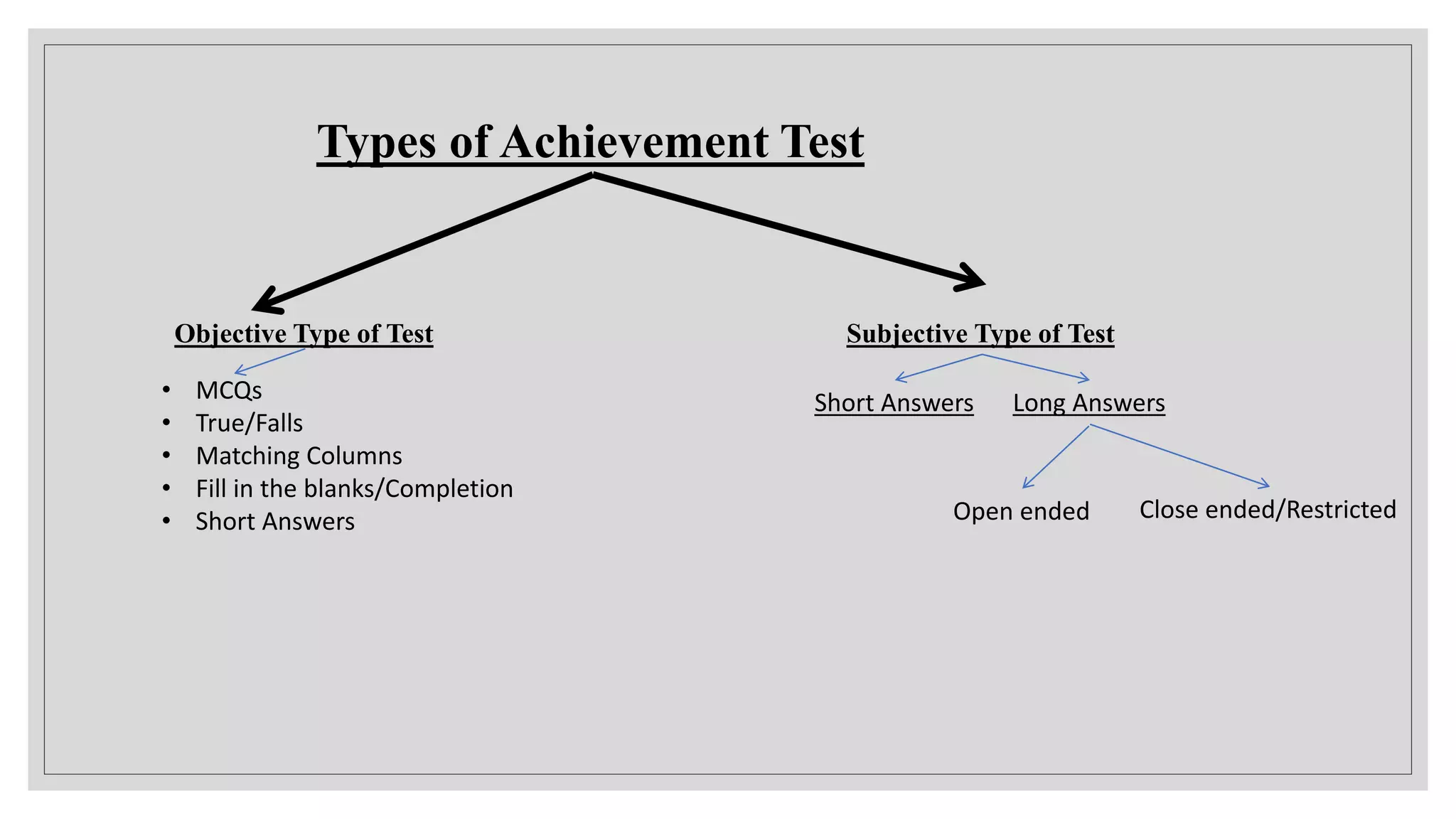
Types of AchievementTest
Objective Type of Test Subjective Type of Test
• MCQs
• True/Falls
• Matching Columns
• Fill in the blanks/Completion
• Short Answers
Short Answers Long Answers
Open ended Close ended/Restricted
3.
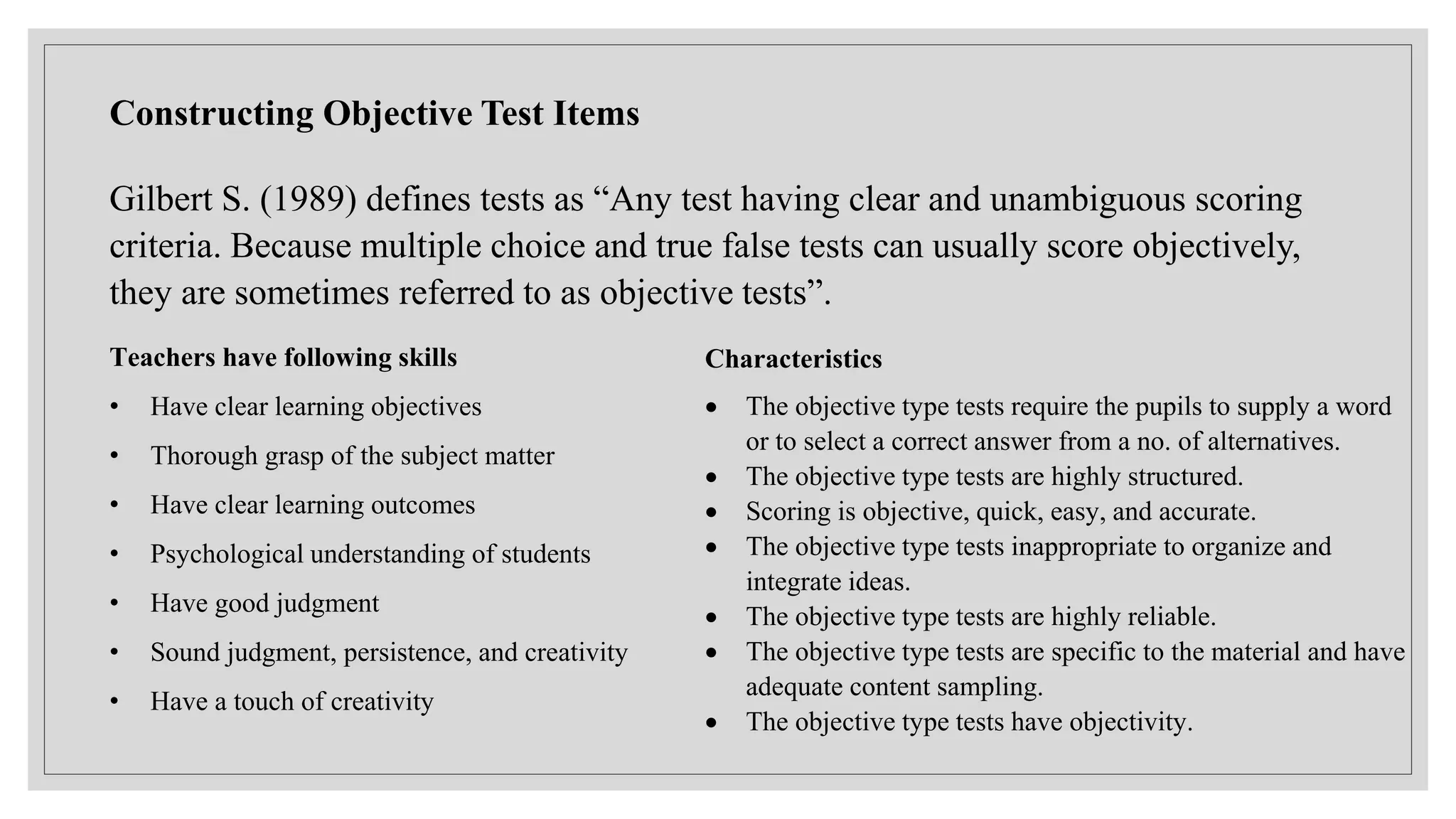
Constructing Objective TestItems
Gilbert S. (1989) defines tests as “Any test having clear and unambiguous scoring
criteria. Because multiple choice and true false tests can usually score objectively,
they are sometimes referred to as objective tests”.
Characteristics
The objective type tests require the pupils to supply a word
or to select a correct answer from a no. of alternatives.
The objective type tests are highly structured.
Scoring is objective, quick, easy, and accurate.
The objective type tests inappropriate to organize and
integrate ideas.
The objective type tests are highly reliable.
The objective type tests are specific to the material and have
adequate content sampling.
The objective type tests have objectivity.
Teachers have following skills
• Have clear learning objectives
• Thorough grasp of the subject matter
• Have clear learning outcomes
• Psychological understanding of students
• Have good judgment
• Sound judgment, persistence, and creativity
• Have a touch of creativity
4.
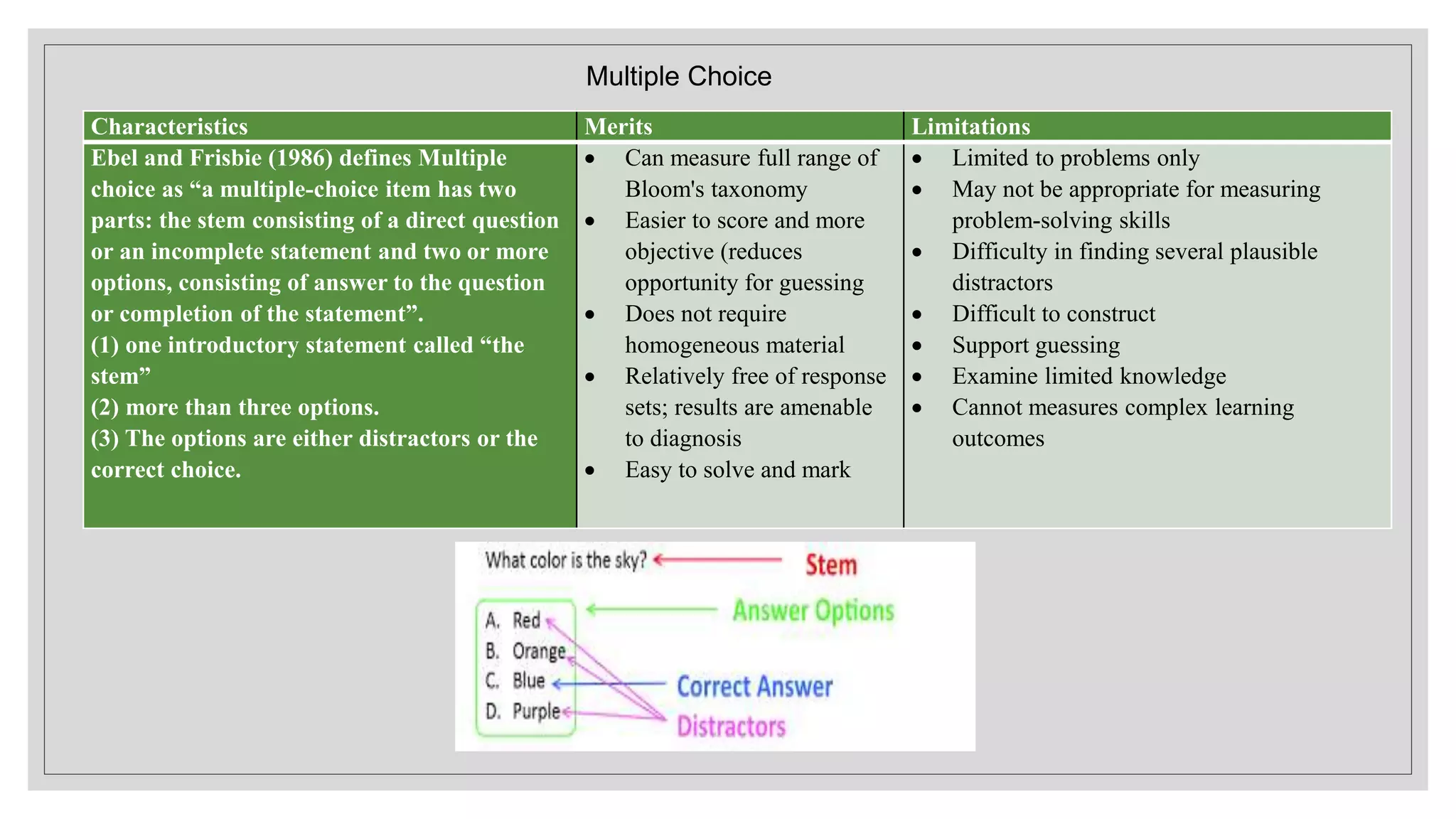
Characteristics Merits Limitations
Ebeland Frisbie (1986) defines Multiple
choice as “a multiple-choice item has two
parts: the stem consisting of a direct question
or an incomplete statement and two or more
options, consisting of answer to the question
or completion of the statement”.
(1) one introductory statement called “the
stem”
(2) more than three options.
(3) The options are either distractors or the
correct choice.
Can measure full range of
Bloom's taxonomy
Easier to score and more
objective (reduces
opportunity for guessing
Does not require
homogeneous material
Relatively free of response
sets; results are amenable
to diagnosis
Easy to solve and mark
Limited to problems only
May not be appropriate for measuring
problem-solving skills
Difficulty in finding several plausible
distractors
Difficult to construct
Support guessing
Examine limited knowledge
Cannot measures complex learning
outcomes
Multiple Choice
5.
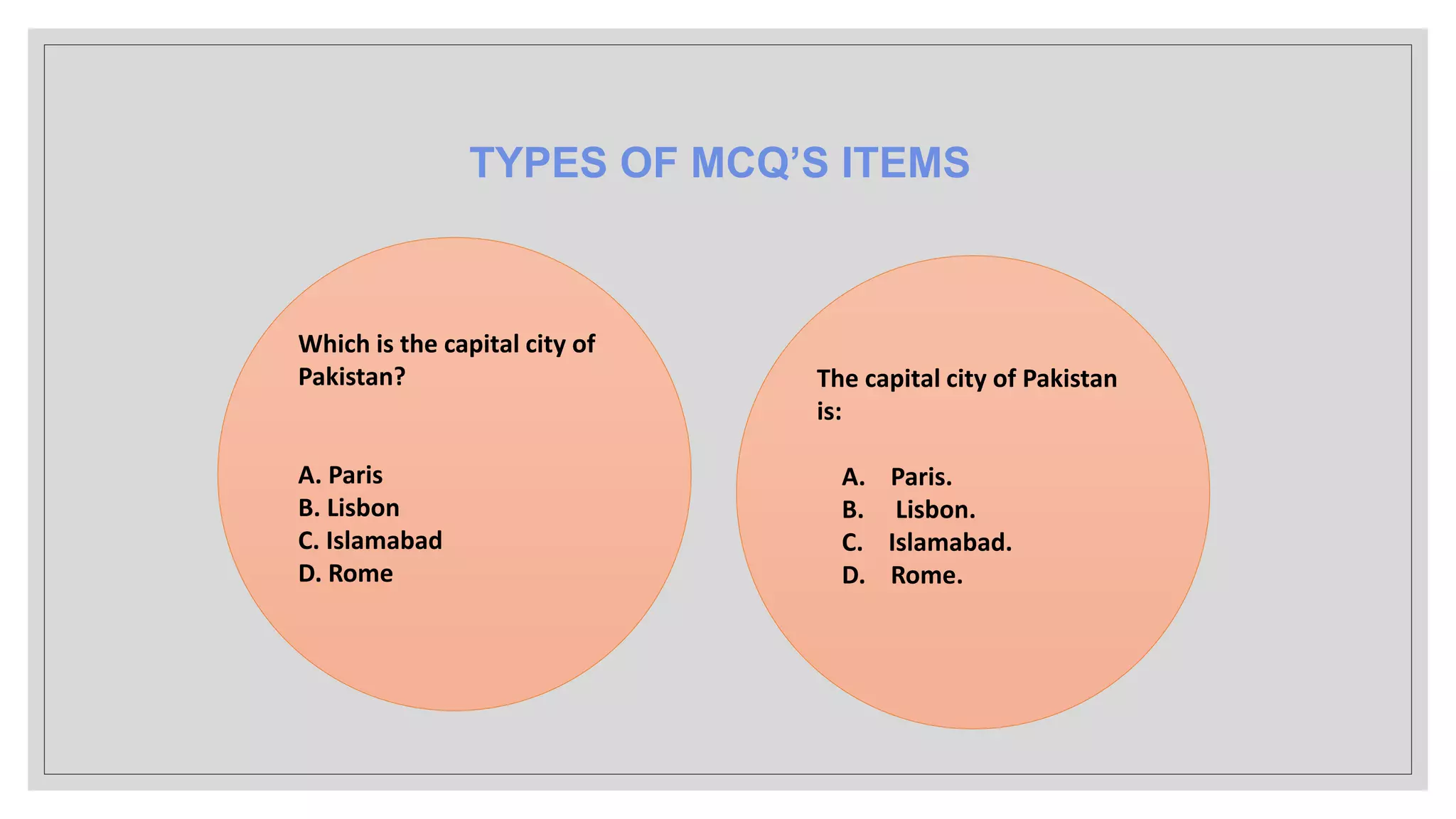
TYPES OF MCQ’SITEMS
Which is the capital city of
Pakistan?
A. Paris
B. Lisbon
C. Islamabad
D. Rome
The capital city of Pakistan
is:
A. Paris.
B. Lisbon.
C. Islamabad.
D. Rome.
6.
Characteristics Merits Limitations
NormanE. Gronlund (1985) stated that
“short answer item is a supply test item that
can be answered by the examinee to respond
to the item with a word, short phrase,
number, or a symbol”.
It can be used to measure all levels of
Bloom's taxonomy
Is typically used to measure the recall of
information.
It is supply type test.
It is in the form of question.
It stands between essay type and object
type test items.
It measures simple learning outcomes.
It measures problem solving ability.
Reduces guessing
Easy to construct
Measures partial
knowledge
It is good to assess lower
level of learning.
Unsuitable for measuring complex learning
outcomes
Difficulty of scoring dependent on
student's level of writing (legibility,
spelling, sentence construction)
Scoring is based on subjectivity
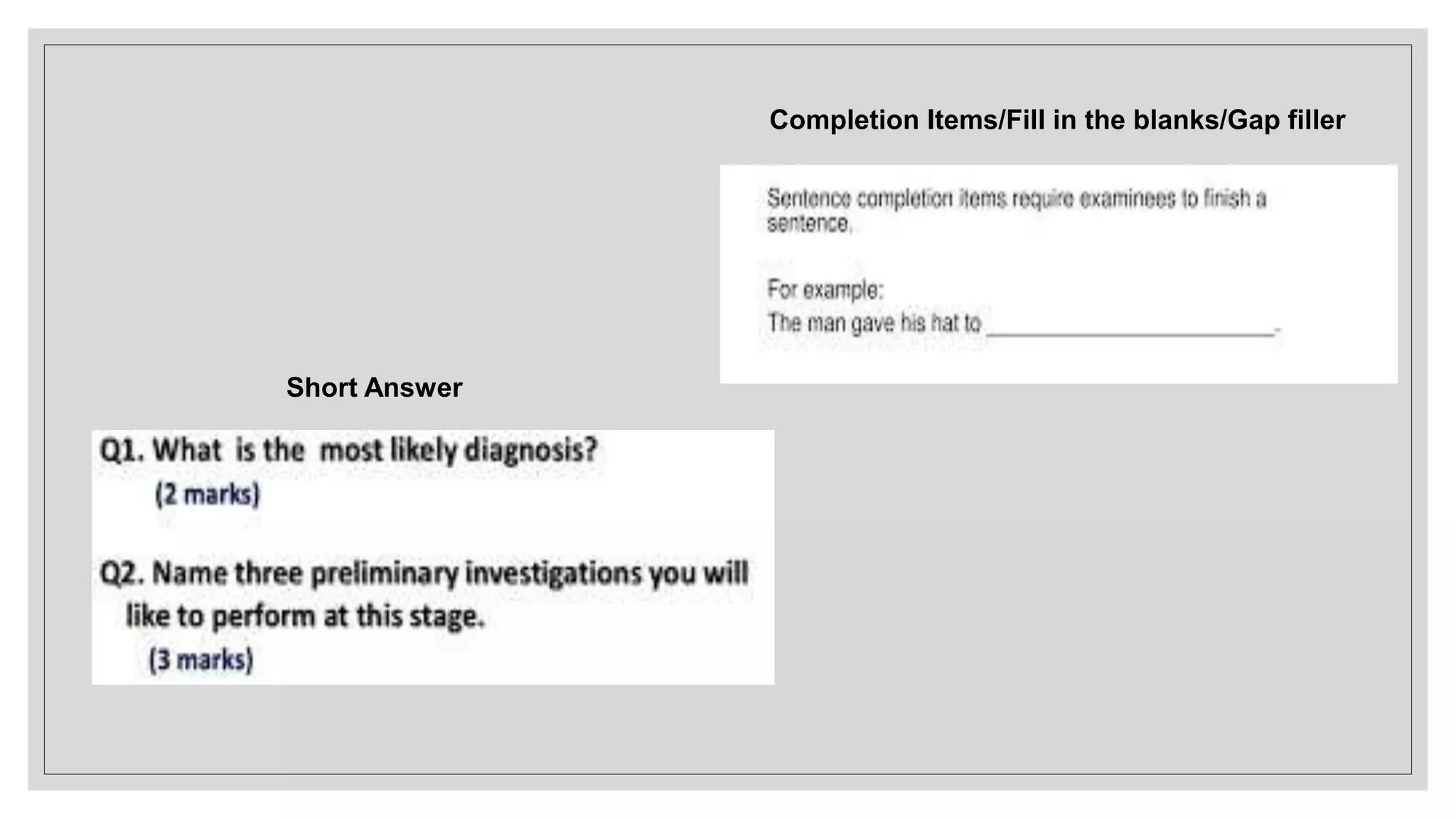
Short Answer / Completion Items
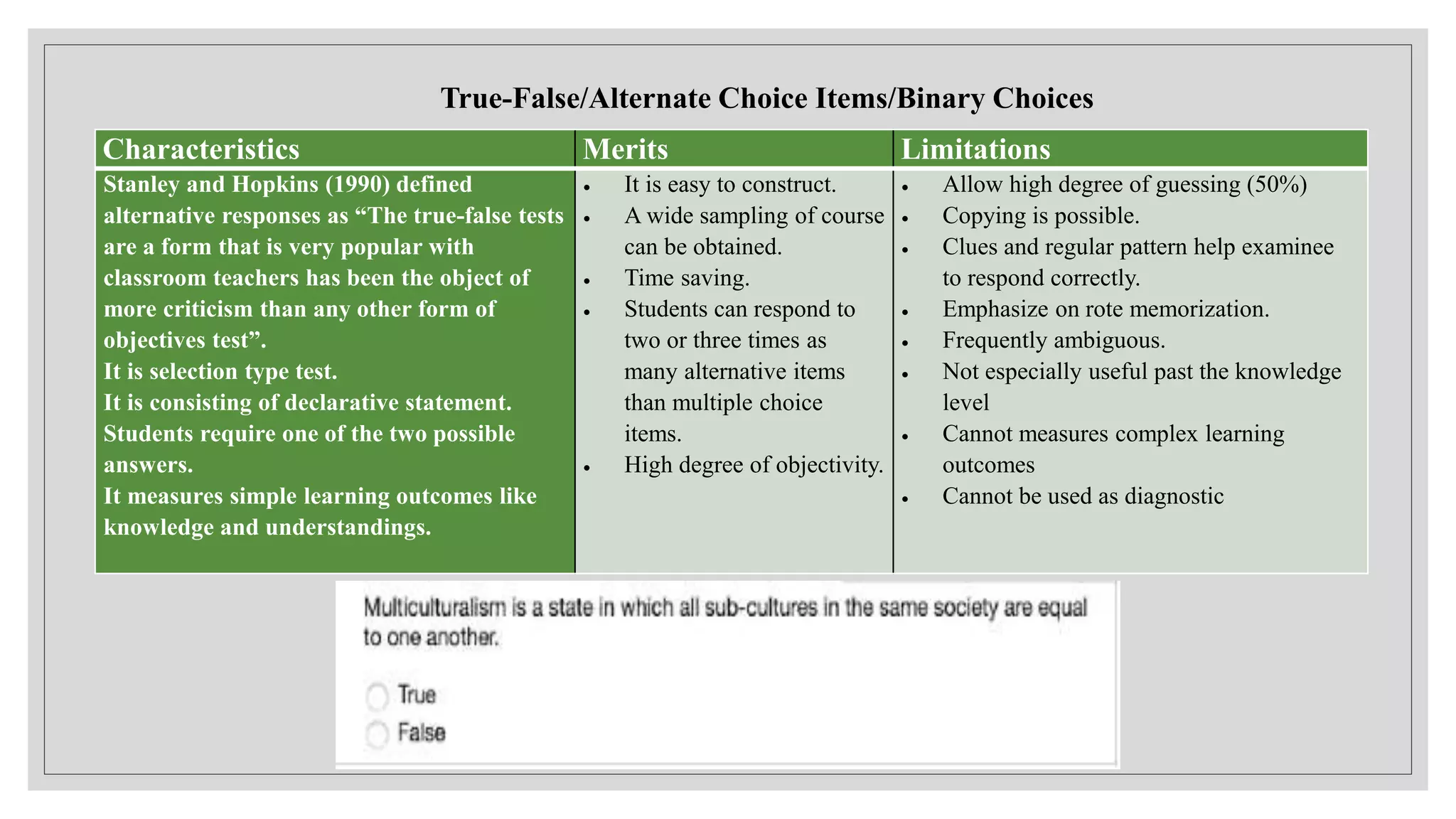
Characteristics Merits Limitations
Stanleyand Hopkins (1990) defined
alternative responses as “The true-false tests
are a form that is very popular with
classroom teachers has been the object of
more criticism than any other form of
objectives test”.
It is selection type test.
It is consisting of declarative statement.
Students require one of the two possible
answers.
It measures simple learning outcomes like
knowledge and understandings.
It is easy to construct.
A wide sampling of course
can be obtained.
Time saving.
Students can respond to
two or three times as
many alternative items
than multiple choice
items.
High degree of objectivity.
Allow high degree of guessing (50%)
Copying is possible.
Clues and regular pattern help examinee
to respond correctly.
Emphasize on rote memorization.
Frequently ambiguous.
Not especially useful past the knowledge
level
Cannot measures complex learning
outcomes
Cannot be used as diagnostic
True-False/Alternate Choice Items/Binary Choices
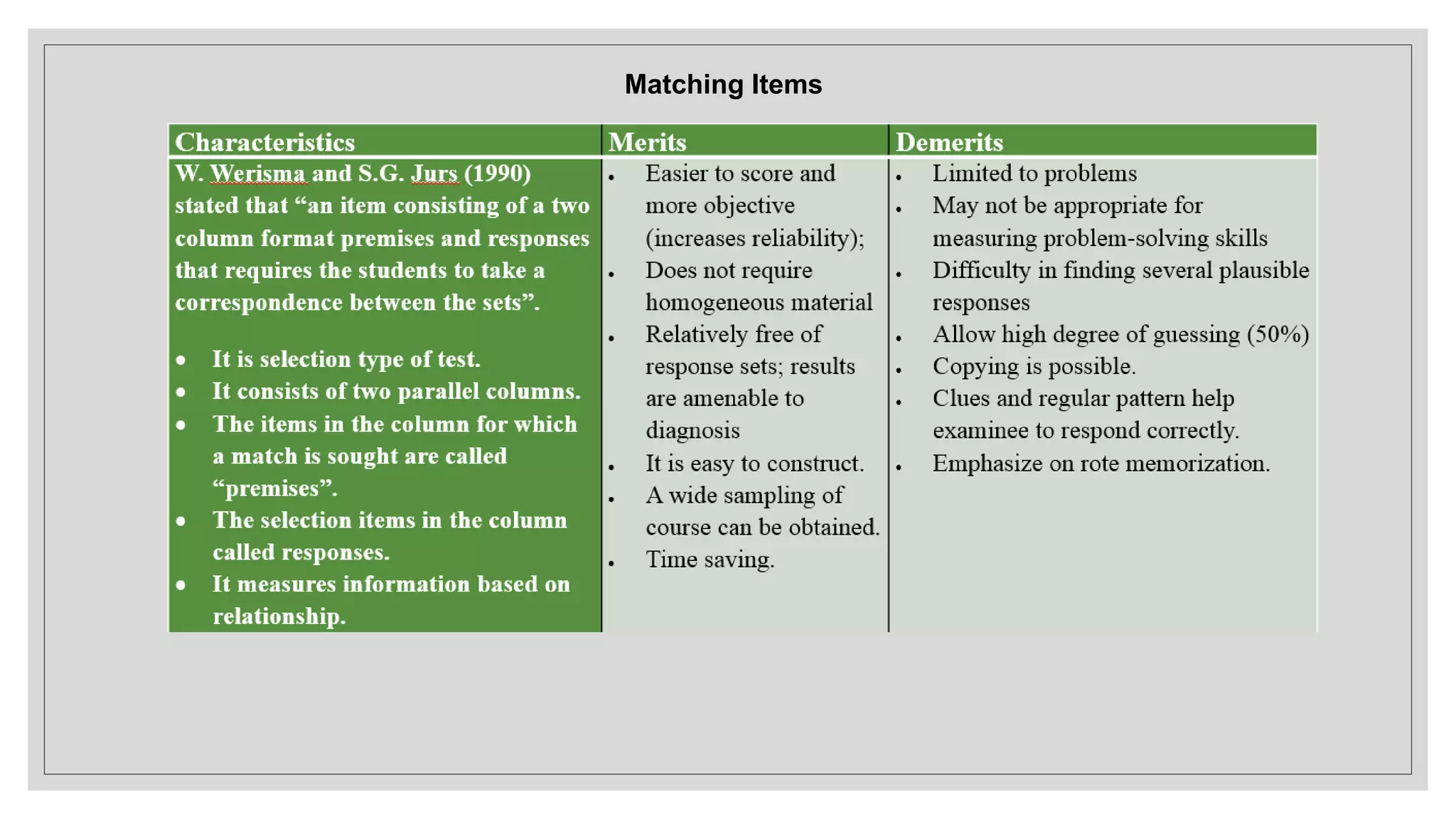
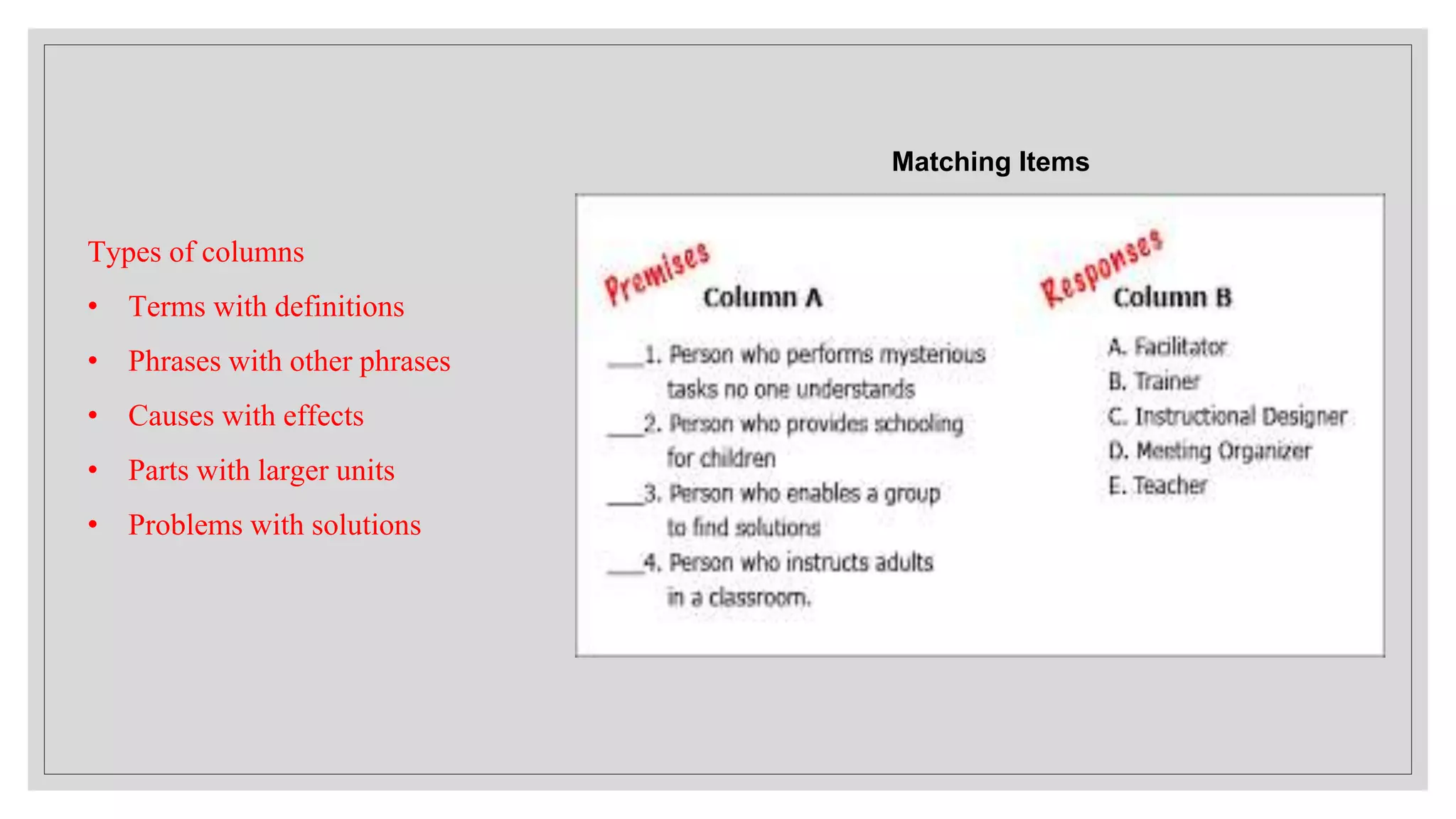
Matching Items
Types ofcolumns
• Terms with definitions
• Phrases with other phrases
• Causes with effects
• Parts with larger units
• Problems with solutions
11.
Rules to constructfor objective type test
1. Select relevant material to the objectives of the course
2. Select material that is appropriate to the students' curricular experience and reading
level
3. Select material that is new to the students
4. Select material that is brief but meaningful
5. Revise material for clarity, conciseness and greater interpretive value
6. Construct test items that require analysis and interpretation of the introductory
material
7. Make the length of test items roughly proportional to the length of the introductory
material
8. In constructing test items for an interpretive exercise, observe all pertinent
suggestions for constructing other objective test items
12.
Advantages of objectivetype test
1. Ability to measure interpretation of written materials
2. Ability to measure more complex learning outcomes
3. Greater depth and breadth can be obtained in the
measurement
4. Minimizes the influence of irrelevant information
5. Forces students to use only the mental processes called
for
6. Can measure separate aspects of the problem-solving
process
7. Can be scored objectively and not affected by personal
opinion
8. A large sampling of course content is possible, by
including large numbers of items.
9. High reliability is possible when constructed well.
10. Due to lack of choices students cover whole syllabus.
Limitations of objective type test
1. Difficulty in constructing items and finding
appropriate introductory material
2. Introductory material may rely too heavily on
reading ability
3. Measures separate aspects, not the whole problem-
solving process
4. Limited to outcomes at the recognition level.
5. The objective type tests inappropriate to organize
and integrate ideas.
6. Subject to guessing
7. The preparation of items demand training.
8. The writing ability, high complex learning, and
students’ analyzing ability cannot be assessed.
13.
Evaluating Objective TestItems
When evaluating test items, check to see that:
1. There are no spelling or grammatical errors
2. The formatting makes the test easier to take
3. There are no unnecessary clues in the stem
4. The reading / writing levels are appropriate
5. The items / questions have student appeal
6. The items / questions are free of superfluous material
7. There are no tricky phrases or clauses
14.
Title Lorem Ipsum
LOREMIPSUM DOLOR SIT
AMET, CONSECTETUER
ADIPISCING ELIT.
NUNC VIVERRA IMPERDIET
ENIM. FUSCE EST. VIVAMUS A
TELLUS.
PELLENTESQUE HABITANT
MORBI TRISTIQUE SENECTUS
ET NETUS.