






EVALUATION TOOLS
DR.V.S.SUMI
Assistant Professor
MANUU,Hyderabad
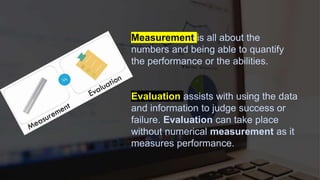
Measurement is all about the
numbers and being able to quantify
the performance or the abilities.
Evaluation assists with using the data
and information to judge success or
failure. Evaluation can take place
without numerical measurement as it
measures performance.
Evaluation
The collection of, analysis and
interpretation of information
about any aspect of a
programme of education or
training as part of a recognised
process of judging its
effectiveness, its efficiency and
any other outcomes it may have
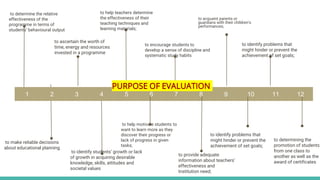
to determine the relative
effectiveness of the
programme in terms of
students’ behavioural output
to make reliable decisions
about educational planning
to help motivate students to
want to learn more as they
discover their progress or
lack of progress in given
tasks;
to encourage students to
develop a sense of discipline and
systematic study habits
to provide adequate
information about teachers’
effectiveness and
Institution need;
to acquaint parents or
guardians with their children’s
performances;
1 2 3 4 5 6 7 8 9 10 11 12
to ascertain the worth of
time, energy and resources
invested in a programme
to identify students’ growth or lack
of growth in acquiring desirable
knowledge, skills, attitudes and
societal values
to help teachers determine
the effectiveness of their
teaching techniques and
learning materials;
to identify problems that
might hinder or prevent the
achievement of set goals;
to identify problems that
might hinder or prevent the
achievement of set goals;
to determining the
promotion of students
from one class to
another as well as the
award of certificates
PURPOSE OF EVALUATION
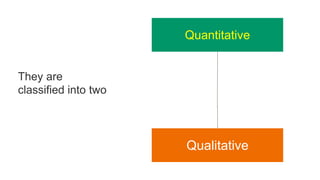
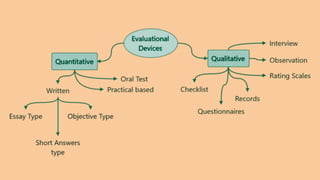
They are
classified into two
Quantitative
Qualitative
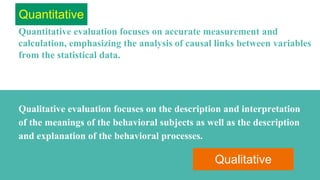
Qualitative evaluation focuses on the description and interpretation
of the meanings of the behavioral subjects as well as the description
and explanation of the behavioral processes.
Quantitative evaluation focuses on accurate measurement and
calculation, emphasizing the analysis of causal links between variables
from the statistical data.
Quantitative
Qualitative
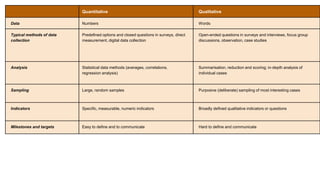
Quantitative Qualitative
Data Numbers Words
Typical methods of data
collection
Predefined options and closed questions in surveys, direct
measurement, digital data collection
Open-ended questions in surveys and interviews, focus group
discussions, observation, case studies
Analysis Statistical data methods (averages, correlations,
regression analysis)
Summarisation, reduction and scoring; in-depth analysis of
individual cases
Sampling Large, random samples Purposive (deliberate) sampling of most interesting cases
Indicators Specific, measurable, numeric indicators Broadly defined qualitative indicators or questions
Milestones and targets Easy to define and to communicate Hard to define and communicate
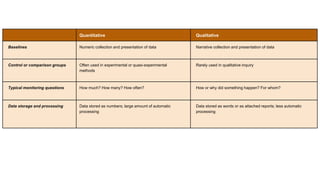
Quantitative Qualitative
Baselines Numeric collection and presentation of data Narrative collection and presentation of data
Control or comparison groups Often used in experimental or quasi-experimental
methods
Rarely used in qualitative inquiry
Typical monitoring questions How much? How many? How often? How or why did something happen? For whom?
Data storage and processing Data stored as numbers; large amount of automatic
processing
Data stored as words or as attached reports; less automatic
processing
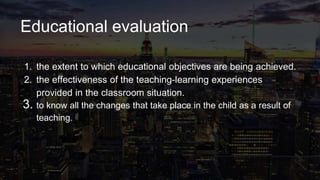
Educational evaluation
1. the extent to which educational objectives are being achieved.
2. the effectiveness of the teaching-learning experiences
provided in the classroom situation.
3. to know all the changes that take place in the child as a result of
teaching.
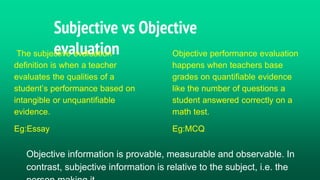
Subjective vs Objective
evaluation
The subjective evaluation
definition is when a teacher
evaluates the qualities of a
student’s performance based on
intangible or unquantifiable
evidence.
Eg:Essay
Objective performance evaluation
happens when teachers base
grades on quantifiable evidence
like the number of questions a
student answered correctly on a
math test.
Eg:MCQ
Objective information is provable, measurable and observable. In
contrast, subjective information is relative to the subject, i.e. the
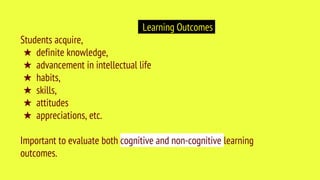
Learning Outcomes
Students acquire,
★ definite knowledge,
★ advancement in intellectual life
★ habits,
★ skills,
★ attitudes
★ appreciations, etc.
Important to evaluate both cognitive and non-cognitive learning
outcomes.
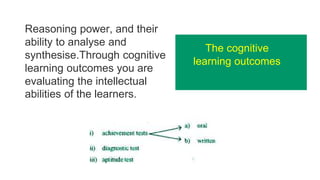
Reasoning power, and their
ability to analyse and
synthesise.Through cognitive
learning outcomes you are
evaluating the intellectual
abilities of the learners.
The cognitive
learning outcomes
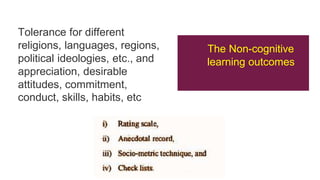
Tolerance for different
religions, languages, regions,
political ideologies, etc., and
appreciation, desirable
attitudes, commitment,
conduct, skills, habits, etc
The Non-cognitive
learning outcomes
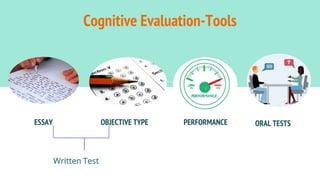
Cognitive Evaluation-Tools
ORAL TESTS
ESSAY OBJECTIVE TYPE PERFORMANCE
Written Test
Written evaluation techniques/devices
● Most commonly used tool of evaluation.
● Various types of written tests are conducted throughout
the academic session.
● Written tests are tests administered on paper or on a
computer.
● Here student appearing for the written test have to
provide answers by writing or typing in the space given
or on a separate sheet.
Written examination -type of tests
Essay Test
Essay type test students give responses to many questions of the curriculum in some
fixed devotion in the form of essay. This type of tests is commonly employed to check
the power of memorization, expression, recognition, etc. So these tests are used to
measure the levels of interpretation and evaluation of the student.
Essay Test MERITS
1. Essay type tests are easy to construct. Here question papers are short, can be prepared in a small time
frame and at a low cost.
2. These tests are suitable for all subjects.
3. Through essay type tests students can express their original ideas.
4. Essay types tests are very simple information, conduct and operation.
5. The mental abilities like thinking, reasoning, expression, and criticism, etc. can only be measured by essay
type questions.
6. Through essay type tests, the writing style of the students can be developed.
7. Here students are free to express their ideas in a logical way.
8. Essay type tests inspire students for extensive study.
Essay Test DEMERITS
1. The essay type tests look at clearly defined objectives.
2. It promotes cramming and rote memorization.
3. The scores of there tests show variations and the results are also not consistent.
4. The personal views, opinions, ideas, etc. of examiner and examinee affect the response of a particular
answer as well as evaluation.
5. Sometimes these tests become time-consuming.
6. Proper evaluation is not possible by these tests.
7. Candidate with good handwriting sometimes gets more marks than the one who gives an exact and
accurate answer in bad handwriting.
8. Evaluation of these tests is a hard, lengthy and difficult task in which let of time is wasted.
Objective Tests
● Objective type questions are answered by just writing one or two words, or numerals, fill in the
blanks, choosing one cut of multiple responses given, etc.
● In objective tests, the achievement of subjective knowledge of pupils, their aptitude, attitudes,
interests, intelligence, etc are measured.
● These tests have objectivity and their measurements will not effect scorability of the pupils.
● Since the answers to these types of questions even one and the same, therefore it is quite reliable,
objective, valid and can not vary.
Objective Tests
Types
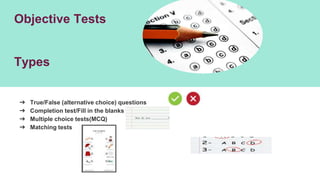
➔ True/False (alternative choice) questions
➔ Completion test/Fill in the blanks
➔ Multiple choice tests(MCQ)
➔ Matching tests
Performance Tests/
Practical Based
Performance assessment, also known as alternative or authentic
assessment, is a form of testing that requires students to perform a task rather
than select an answer from a ready-made list. It requires students to use high-
level thinking to perform, create, or produce something with transferable real-world
application.
Eg:Drawing, Debate, completing a task
Oral Tests
● The oral exam (also oral test or viva voce) is a practice in many schools and
disciplines, where an examiner poses questions to the student in spoken form.
The student has to answer the question in such a way as to demonstrate
sufficient knowledge of the subject in order to pass the exam.
● Many programs require students to finish the program by taking an oral exam
or a combination of oral and exams in order to show how well a student has
comprehended the material studied in the program.
Oral Tests
● Schools use oral exams just to test knowledge, but the ability to respond on
the spot. Sometimes the oral exam is offered in schools as an alternative to a
written exam for students with a learning disability, like dysgraphia,
developmental coordination disorder, or non-verbal learning disorder. Often
the parents of the students have to request that the oral exam be given to their
child in lieu of the written exam.
Non-Cognitive Evaluation-Tools
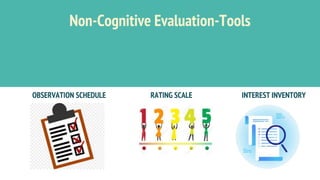
OBSERVATION SCHEDULE RATING SCALE INTEREST INVENTORY
OBSERVATION SCHEDULE
Observation schedule is a
method in which data in the
field is collected with the help
of observation by observer.
Types of observation method
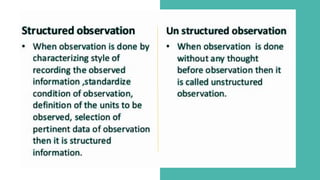
• Structured and unstructured
observation
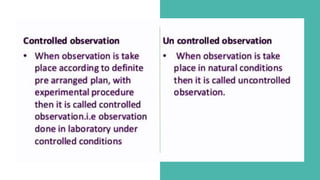
• Controlled and uncontrolled
observation
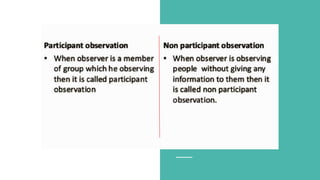
• Participant and non
participant observation.
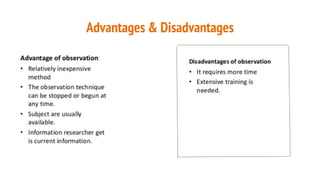
Advantages & Disadvantages
RATING SCALE
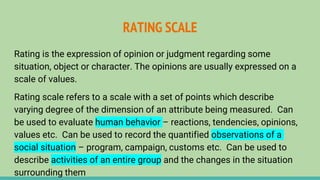
Rating is the expression of opinion or judgment regarding some
situation, object or character. The opinions are usually expressed on a
scale of values.
Rating scale refers to a scale with a set of points which describe
varying degree of the dimension of an attribute being measured. Can
be used to evaluate human behavior – reactions, tendencies, opinions,
values etc. Can be used to record the quantified observations of a
social situation – program, campaign, customs etc. Can be used to
describe activities of an entire group and the changes in the situation
surrounding them
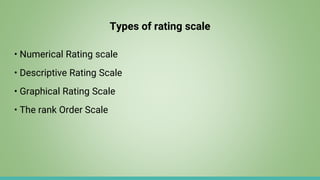
Types of rating scale
• Numerical Rating scale
• Descriptive Rating Scale
• Graphical Rating Scale
• The rank Order Scale
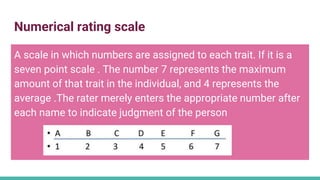
Numerical rating scale
A scale in which numbers are assigned to each trait. If it is a
seven point scale . The number 7 represents the maximum
amount of that trait in the individual, and 4 represents the
average .The rater merely enters the appropriate number after
each name to indicate judgment of the person
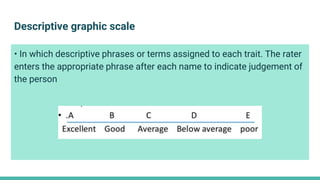
Descriptive graphic scale
• In which descriptive phrases or terms assigned to each trait. The rater
enters the appropriate phrase after each name to indicate judgement of
the person
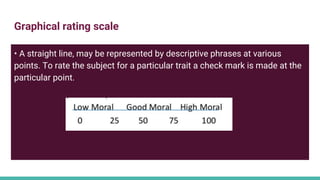
Graphical rating scale
• A straight line, may be represented by descriptive phrases at various
points. To rate the subject for a particular trait a check mark is made at the
particular point.
The rank order rating scale
• In this type the judge is simply required to place the people being rated in
a rank order from high to low on the attitude or opinion in question. A given
individual’s scale position is given in relation to other people in the sample.
The units of the scale are unequal.
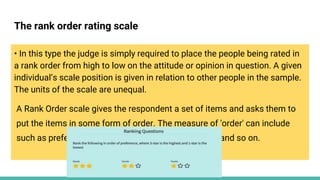
A Rank Order scale gives the respondent a set of items and asks them to
put the items in some form of order. The measure of 'order' can include
such as preference, importance, liking, effectiveness and so on.
Aptitude test
An aptitude test is a way for employers to assess a candidate's abilities through
a variety of different testing formats. Aptitude tests will test your ability to
perform tasks and react to situations at work. This includes problem-solving,
prioritisation and numerical skills, amongst other things.
An aptitude test is designed to assess what a person is capable of doing or
to predict what a person is able to learn or do given the right education and
instruction. It represents a person's level of competency to perform a certain
type of task.
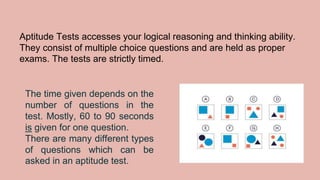
Aptitude Tests accesses your logical reasoning and thinking ability.
They consist of multiple choice questions and are held as proper
exams. The tests are strictly timed.
The time given depends on the
number of questions in the
test. Mostly, 60 to 90 seconds
is given for one question.
There are many different types
of questions which can be
asked in an aptitude test.
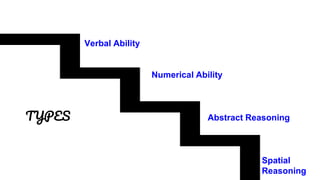
Verbal Ability
Numerical Ability
Abstract Reasoning
Spatial
Reasoning
TYPES
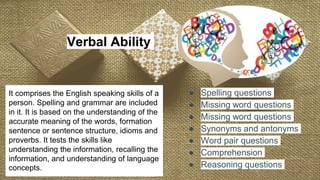
It comprises the English speaking skills of a
person. Spelling and grammar are included
in it. It is based on the understanding of the
accurate meaning of the words, formation
sentence or sentence structure, idioms and
proverbs. It tests the skills like
understanding the information, recalling the
information, and understanding of language
concepts.
Verbal Ability
● Spelling questions
● Missing word questions
● Synonyms and antonyms
● Word pair questions
● Comprehension
● Reasoning questions
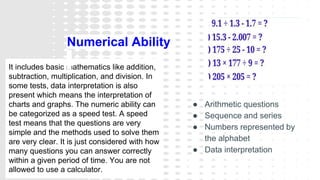
It includes basic mathematics like addition,
subtraction, multiplication, and division. In
some tests, data interpretation is also
present which means the interpretation of
charts and graphs. The numeric ability can
be categorized as a speed test. A speed
test means that the questions are very
simple and the methods used to solve them
are very clear. It is just considered with how
many questions you can answer correctly
within a given period of time. You are not
allowed to use a calculator.
Numerical Ability
● Arithmetic questions
● Sequence and series
● Numbers represented by
the alphabet
● Data interpretation
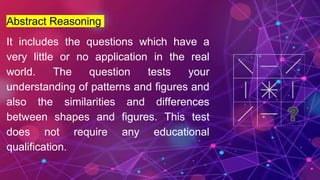
Abstract Reasoning
It includes the questions which have a
very little or no application in the real
world. The question tests your
understanding of patterns and figures and
also the similarities and differences
between shapes and figures. This test
does not require any educational
qualification.
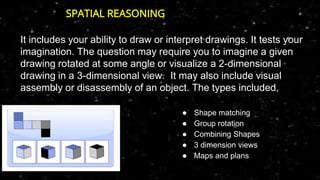
It includes your ability to draw or interpret drawings. It tests your
imagination. The question may require you to imagine a given
drawing rotated at some angle or visualize a 2-dimensional
drawing in a 3-dimensional view. It may also include visual
assembly or disassembly of an object. The types included,
● Shape matching
● Group rotation
● Combining Shapes
● 3 dimension views
● Maps and plans
SPATIAL REASONING
ADVANTAGES
measure of the abilities of a person
Placement Purpose: If a job requires
some specific skill or some
particular trait in the person, it is
evaluated by aptitude tests.
Choosing a Career: The result of the
aptitude test tells us about the skills
or abilities of a person. This result is
of great help in choosing a career. A
person will get to know what he is
good at and he should choose a
career accordingly.
Academic Improvement: If a
student takes an aptitude test, it
will directly or indirectly tell him
his strong and weak subject. The
student can, therefore, work on
his weak subjects and improve
them.
Thank you
Feedback
email:drsumi@manuu.edu.in

Evaluation tools and techniques

  • 1.
  • 2.
    Measurement is allabout the numbers and being able to quantify the performance or the abilities. Evaluation assists with using the data and information to judge success or failure. Evaluation can take place without numerical measurement as it measures performance.
  • 3.
    Evaluation The collection of,analysis and interpretation of information about any aspect of a programme of education or training as part of a recognised process of judging its effectiveness, its efficiency and any other outcomes it may have
  • 4.
    to determine therelative effectiveness of the programme in terms of students’ behavioural output to make reliable decisions about educational planning to help motivate students to want to learn more as they discover their progress or lack of progress in given tasks; to encourage students to develop a sense of discipline and systematic study habits to provide adequate information about teachers’ effectiveness and Institution need; to acquaint parents or guardians with their children’s performances; 1 2 3 4 5 6 7 8 9 10 11 12 to ascertain the worth of time, energy and resources invested in a programme to identify students’ growth or lack of growth in acquiring desirable knowledge, skills, attitudes and societal values to help teachers determine the effectiveness of their teaching techniques and learning materials; to identify problems that might hinder or prevent the achievement of set goals; to identify problems that might hinder or prevent the achievement of set goals; to determining the promotion of students from one class to another as well as the award of certificates PURPOSE OF EVALUATION
  • 5.
    They are classified intotwo Quantitative Qualitative
  • 6.
    Qualitative evaluation focuseson the description and interpretation of the meanings of the behavioral subjects as well as the description and explanation of the behavioral processes. Quantitative evaluation focuses on accurate measurement and calculation, emphasizing the analysis of causal links between variables from the statistical data. Quantitative Qualitative
  • 7.
    Quantitative Qualitative Data NumbersWords Typical methods of data collection Predefined options and closed questions in surveys, direct measurement, digital data collection Open-ended questions in surveys and interviews, focus group discussions, observation, case studies Analysis Statistical data methods (averages, correlations, regression analysis) Summarisation, reduction and scoring; in-depth analysis of individual cases Sampling Large, random samples Purposive (deliberate) sampling of most interesting cases Indicators Specific, measurable, numeric indicators Broadly defined qualitative indicators or questions Milestones and targets Easy to define and to communicate Hard to define and communicate
  • 8.
    Quantitative Qualitative Baselines Numericcollection and presentation of data Narrative collection and presentation of data Control or comparison groups Often used in experimental or quasi-experimental methods Rarely used in qualitative inquiry Typical monitoring questions How much? How many? How often? How or why did something happen? For whom? Data storage and processing Data stored as numbers; large amount of automatic processing Data stored as words or as attached reports; less automatic processing
  • 9.
    Educational evaluation 1. theextent to which educational objectives are being achieved. 2. the effectiveness of the teaching-learning experiences provided in the classroom situation. 3. to know all the changes that take place in the child as a result of teaching.
  • 10.
    Subjective vs Objective evaluation Thesubjective evaluation definition is when a teacher evaluates the qualities of a student’s performance based on intangible or unquantifiable evidence. Eg:Essay Objective performance evaluation happens when teachers base grades on quantifiable evidence like the number of questions a student answered correctly on a math test. Eg:MCQ Objective information is provable, measurable and observable. In contrast, subjective information is relative to the subject, i.e. the
  • 11.
    Learning Outcomes Students acquire, ★definite knowledge, ★ advancement in intellectual life ★ habits, ★ skills, ★ attitudes ★ appreciations, etc. Important to evaluate both cognitive and non-cognitive learning outcomes.
  • 12.
    Reasoning power, andtheir ability to analyse and synthesise.Through cognitive learning outcomes you are evaluating the intellectual abilities of the learners. The cognitive learning outcomes
  • 13.
    Tolerance for different religions,languages, regions, political ideologies, etc., and appreciation, desirable attitudes, commitment, conduct, skills, habits, etc The Non-cognitive learning outcomes
  • 15.
    Cognitive Evaluation-Tools ORAL TESTS ESSAYOBJECTIVE TYPE PERFORMANCE Written Test
  • 16.
    Written evaluation techniques/devices ●Most commonly used tool of evaluation. ● Various types of written tests are conducted throughout the academic session. ● Written tests are tests administered on paper or on a computer. ● Here student appearing for the written test have to provide answers by writing or typing in the space given or on a separate sheet.
  • 17.
  • 18.
    Essay Test Essay typetest students give responses to many questions of the curriculum in some fixed devotion in the form of essay. This type of tests is commonly employed to check the power of memorization, expression, recognition, etc. So these tests are used to measure the levels of interpretation and evaluation of the student.
  • 19.
    Essay Test MERITS 1.Essay type tests are easy to construct. Here question papers are short, can be prepared in a small time frame and at a low cost. 2. These tests are suitable for all subjects. 3. Through essay type tests students can express their original ideas. 4. Essay types tests are very simple information, conduct and operation. 5. The mental abilities like thinking, reasoning, expression, and criticism, etc. can only be measured by essay type questions. 6. Through essay type tests, the writing style of the students can be developed. 7. Here students are free to express their ideas in a logical way. 8. Essay type tests inspire students for extensive study.
  • 20.
    Essay Test DEMERITS 1.The essay type tests look at clearly defined objectives. 2. It promotes cramming and rote memorization. 3. The scores of there tests show variations and the results are also not consistent. 4. The personal views, opinions, ideas, etc. of examiner and examinee affect the response of a particular answer as well as evaluation. 5. Sometimes these tests become time-consuming. 6. Proper evaluation is not possible by these tests. 7. Candidate with good handwriting sometimes gets more marks than the one who gives an exact and accurate answer in bad handwriting. 8. Evaluation of these tests is a hard, lengthy and difficult task in which let of time is wasted.
  • 21.
    Objective Tests ● Objectivetype questions are answered by just writing one or two words, or numerals, fill in the blanks, choosing one cut of multiple responses given, etc. ● In objective tests, the achievement of subjective knowledge of pupils, their aptitude, attitudes, interests, intelligence, etc are measured. ● These tests have objectivity and their measurements will not effect scorability of the pupils. ● Since the answers to these types of questions even one and the same, therefore it is quite reliable, objective, valid and can not vary.
  • 22.
    Objective Tests Types ➔ True/False(alternative choice) questions ➔ Completion test/Fill in the blanks ➔ Multiple choice tests(MCQ) ➔ Matching tests
  • 23.
    Performance Tests/ Practical Based Performanceassessment, also known as alternative or authentic assessment, is a form of testing that requires students to perform a task rather than select an answer from a ready-made list. It requires students to use high- level thinking to perform, create, or produce something with transferable real-world application. Eg:Drawing, Debate, completing a task
  • 24.
    Oral Tests ● Theoral exam (also oral test or viva voce) is a practice in many schools and disciplines, where an examiner poses questions to the student in spoken form. The student has to answer the question in such a way as to demonstrate sufficient knowledge of the subject in order to pass the exam. ● Many programs require students to finish the program by taking an oral exam or a combination of oral and exams in order to show how well a student has comprehended the material studied in the program.
  • 25.
    Oral Tests ● Schoolsuse oral exams just to test knowledge, but the ability to respond on the spot. Sometimes the oral exam is offered in schools as an alternative to a written exam for students with a learning disability, like dysgraphia, developmental coordination disorder, or non-verbal learning disorder. Often the parents of the students have to request that the oral exam be given to their child in lieu of the written exam.
  • 26.
  • 27.
    OBSERVATION SCHEDULE Observation scheduleis a method in which data in the field is collected with the help of observation by observer.
  • 28.
    Types of observationmethod • Structured and unstructured observation • Controlled and uncontrolled observation • Participant and non participant observation.
  • 32.
  • 33.
    RATING SCALE Rating isthe expression of opinion or judgment regarding some situation, object or character. The opinions are usually expressed on a scale of values. Rating scale refers to a scale with a set of points which describe varying degree of the dimension of an attribute being measured. Can be used to evaluate human behavior – reactions, tendencies, opinions, values etc. Can be used to record the quantified observations of a social situation – program, campaign, customs etc. Can be used to describe activities of an entire group and the changes in the situation surrounding them
  • 34.
    Types of ratingscale • Numerical Rating scale • Descriptive Rating Scale • Graphical Rating Scale • The rank Order Scale
  • 35.
    Numerical rating scale Ascale in which numbers are assigned to each trait. If it is a seven point scale . The number 7 represents the maximum amount of that trait in the individual, and 4 represents the average .The rater merely enters the appropriate number after each name to indicate judgment of the person
  • 36.
    Descriptive graphic scale •In which descriptive phrases or terms assigned to each trait. The rater enters the appropriate phrase after each name to indicate judgement of the person
  • 37.
    Graphical rating scale •A straight line, may be represented by descriptive phrases at various points. To rate the subject for a particular trait a check mark is made at the particular point.
  • 38.
    The rank orderrating scale • In this type the judge is simply required to place the people being rated in a rank order from high to low on the attitude or opinion in question. A given individual’s scale position is given in relation to other people in the sample. The units of the scale are unequal. A Rank Order scale gives the respondent a set of items and asks them to put the items in some form of order. The measure of 'order' can include such as preference, importance, liking, effectiveness and so on.
  • 39.
    Aptitude test An aptitudetest is a way for employers to assess a candidate's abilities through a variety of different testing formats. Aptitude tests will test your ability to perform tasks and react to situations at work. This includes problem-solving, prioritisation and numerical skills, amongst other things. An aptitude test is designed to assess what a person is capable of doing or to predict what a person is able to learn or do given the right education and instruction. It represents a person's level of competency to perform a certain type of task.
  • 40.
    Aptitude Tests accessesyour logical reasoning and thinking ability. They consist of multiple choice questions and are held as proper exams. The tests are strictly timed. The time given depends on the number of questions in the test. Mostly, 60 to 90 seconds is given for one question. There are many different types of questions which can be asked in an aptitude test.
  • 41.
    Verbal Ability Numerical Ability AbstractReasoning Spatial Reasoning TYPES
  • 42.
    It comprises theEnglish speaking skills of a person. Spelling and grammar are included in it. It is based on the understanding of the accurate meaning of the words, formation sentence or sentence structure, idioms and proverbs. It tests the skills like understanding the information, recalling the information, and understanding of language concepts. Verbal Ability ● Spelling questions ● Missing word questions ● Missing word questions ● Synonyms and antonyms ● Word pair questions ● Comprehension ● Reasoning questions
  • 43.
    It includes basicmathematics like addition, subtraction, multiplication, and division. In some tests, data interpretation is also present which means the interpretation of charts and graphs. The numeric ability can be categorized as a speed test. A speed test means that the questions are very simple and the methods used to solve them are very clear. It is just considered with how many questions you can answer correctly within a given period of time. You are not allowed to use a calculator. Numerical Ability ● Arithmetic questions ● Sequence and series ● Numbers represented by the alphabet ● Data interpretation
  • 44.
    Abstract Reasoning It includesthe questions which have a very little or no application in the real world. The question tests your understanding of patterns and figures and also the similarities and differences between shapes and figures. This test does not require any educational qualification.
  • 45.
    It includes yourability to draw or interpret drawings. It tests your imagination. The question may require you to imagine a given drawing rotated at some angle or visualize a 2-dimensional drawing in a 3-dimensional view. It may also include visual assembly or disassembly of an object. The types included, ● Shape matching ● Group rotation ● Combining Shapes ● 3 dimension views ● Maps and plans SPATIAL REASONING
  • 46.
    ADVANTAGES measure of theabilities of a person Placement Purpose: If a job requires some specific skill or some particular trait in the person, it is evaluated by aptitude tests. Choosing a Career: The result of the aptitude test tells us about the skills or abilities of a person. This result is of great help in choosing a career. A person will get to know what he is good at and he should choose a career accordingly. Academic Improvement: If a student takes an aptitude test, it will directly or indirectly tell him his strong and weak subject. The student can, therefore, work on his weak subjects and improve them.
  • 47.