Blood transfusion therapy RENE PSA MENDOZA, MD, MHSA Associate Professor, Department of Surgery FEU-NRMF Institute of Medicine
Functions and Properties of Blood A vehicular organ that perfuses all other organs  Blood and interstitial fluid deliver nutrients to cells and remove wastes Hemostatic governors are carried to and from appropriate sites
Functions of Blood Transport: suspended cells include rbc that carry O2 Platelets that contributes to the hemostatic process chemicals dissolved in plasma (nutrients, waste, hormones, etc) metabolic heat for disposal
Functions of Blood Regulation:   plasma contains pH buffers plasma water absorbs heat plasma solutes maintain osmolality
Functions of Blood Protection:   plasma precursor proteins form blood clot when stimulated suspended wbc attack bacteria and viruses ( body’s defense ) plasma contains antibodies and opsonins for immunity
Fluid compartments ICF ECF Interstitial  Plasma Capillary Membrane Cell Membrane ~ 15% of  body weight ~ 40% of  body weight ~ 5% of  body weight
Blood volume plasma   + cells and cell fragments  ~ 5% ~ 2-3% of body weight  +
Banked Whole blood No components have been removed. consists of red blood cells, white blood cells and platelets in plasma   can be stored for 5 weeks
Banked Whole blood Transfusions of whole blood are  rarely required. stored in the refrigerator , the platelets are useless and factors V and VIII are greatly reduced.
Banked Whole blood transfusion of whole blood may be necessary  certain types of major surgery  ACUTE BLOOD LOSS > 15% major trauma such as a car accident or gunshot wound requiring emergency surgery
Changes in rbc  Reduction  pH from 7.00 to 6.68 2,3 DPG Intracellular ADP oxygen transport Poor source  Platelets clotting factors V and VIII
Changes in rbc Increase levels  Lactic acid from 20 to 150mg/dl Potassium concentration to 32 mEq/dl Ammonium concentration from  50 to 680 mg/dl Hemolysis is insignificant
Fresh whole blood Blood that is administered within 24 hours of its donation Rarely indicated Poor source of platelets and factor VIII
Blood Component Therapy The process of transfusing only that  portion of the blood needed by the patient  It allows a single unit (one pint) of donated blood to benefit more than one patient Red blood cells and platelets are the most frequently transfused blood components
Packed red cells The red cells from a donor unit, diluted with plasma to a hematocrit of about 75%.  Volume is about 200 mL.  Storing red cells (just above freezing) allows survival for 42 days but unfortunately decreases 2,3-DPG ruins the platelets and neutrophils.
Packed red cells Red blood cells contain hemoglobin carries oxygen throughout the body. Essentially provides oxygen-carrying capacity  Product of choice for most clinical situations  
Packed red cells Recent advances have made it possible to store red blood cells for up to 42 days.   Indications acute trauma before surgery  people with anemia who are having surgery
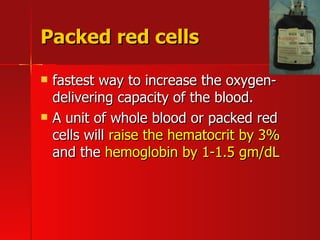
Packed red cells fastest way to increase the oxygen-delivering capacity of the blood.  A unit of whole blood or packed red cells will  raise the hematocrit by 3%  and the  hemoglobin by 1-1.5 gm/dL
Frozen red cells reduces the risk of infusing antigens, or foreign bodies, that the body might regard as potentially dangerous Previously sensitized patients Not available for use in emergency situations Rbc viability is improved ADP and 2,3 DPG maintained
Platelet concentrates Component: platelets, 50 ml plasma cellular components that help in the clotting process.   Platelets are stored for up to five days at room temperature.
Platelet concentrates Indication used if there is a platelet disorder  when massive blood loss has occurred
Platelet concentrates Platelets must be stored at room temperature, so are good only for 5 days or less. One unit will usually raise the platelet count 5-10k/microliter.  Check one hour after transfusion.  If the platelet count does not increase as expected (“refractoriness”), suspect DIC or immune platelet destruction (anti-HLA).
Fresh frozen plasma From freshly donated blood Source of vit k- dependent clotting factors Only source of factor V
Fresh Frozen Plasma Indication For coagulopathy and deficient clotting factors 1 unit FFP = 3% increase in CF levels At least 30% to ensure adequate coagulation
Cryoprecipitated antihemophilic factor an antihemophilic concentrate prepared from plasma and is rich in clotting factors   used in people with hemophilia, von Willebrand's disease or other major coagulation abnormalities to prevent or control bleeding
Cryoprecipitated antihemophilic factor Its contents are the major portion of the Factor VIII, von Willebrand factor, fibrinogen, Factor XIII and fibronectin present in  freshly drawn and separated plasma .
Replacement therapy Serologic compatibility A, B, O and Rh groups  Crossmatching Donors’ red cell and Recipients’ sera Major crossmatch
Serologic compatibility
Rh groups Rh negative recipients should be transfused with Rh negative blood Rh negative group  –  15% of the population Limited supply
A 50M pedestrian was hit by a car while crossing Commonwealth Ave.  He sustained blunt trauma to the pelvis and an open femoral fracture on the L. At the ER, BP 90/50  HR 110 RR 28  with an estimated blood loss of 1L. The initial resuscitation fluid is A. Whole blood B. packed RBC C. Plain Lactated Ringers D. Dextran
After 2L of crystalloids, the BP 90/60 HR 120  RR 32. The SROD decided to give blood. What is the best blood product to administer? A. Fresh Whole Blood B. packed RBC C. plasma expanders  D. platelets
Parameter Class I Class II Class III Class IV blood loss in mL <= 750 mL 750 − 1,500 mL 1,500 − 2,000 mL >= 2,000 mL blood loss as % TBV <= 15% 15 − 30% 30 − 40% >= 40% pulse > 100 > 100 > 120 >= 140 blood pressure normal normal decreased decreased capillary refill normal delayed delayed delayed respirations 14 − 20 20 − 30 30 − 40 > 35 urine output >= 30 mL/h 20 − 30 mL/h 5 − 10 mL/h minimal mental status slightly anxious mildly anxious anxious and confused confused and lethargic
A CT scan of abdomen was done with findings of Grade 2 renal injury, L with incomplete fracture, L iliac.  He underwent ORIF, L femur and placed on complete bed rest. He was transfused 2 ‘u’ WB and 4 ‘u’ pRBC.  What are the possible complications of blood transfusion?
Risks from a unit of ordinary red cells Non-hemolytic febrile transfusion reaction:  1-5% Minor allergic:  1-2% Real anaphylaxis:  maybe 1 in ~20,000; fatality rate unknown
Transfusion reactions Hemolytic Reactions   Allergic Reactions Febrile Reactions   Bacterial Contamination   Circulatory Overload   Hypothermia
Transfusion reactions Alloimmunization  Graft Versus Host Disease (GVHD) Transfusion related acute lung injury (TRALI)
Allergic / urticarial transfusion reactions most common usually due to allergies to specific proteins in the donor’s plasma  can be avoided with future transfusions by pretreatment with antihistamines or steroids.
Allergic / urticarial transfusion reactions Some get “hay fever / hives / wheezing” from transfusions you can continue the transfusion when they are better and in the future, pre-treat with an antihistamine.
Allergic / urticarial transfusion reactions For severe (anaphylaxis), RBC’s and platelets are washed to remove all plasma indicated.  Very fast, spectacular illness after transfusion only a few mL.  IgA deficiency should be considered in the case of anaphylactic reactions.
Hemolytic Reactions transfusion of an incompatible blood component.  Most are due to naturally occurring antibodies in the ABO antigen system and Rh groups may cause hemoglobin induced renal failure and a consumptive coagulopathy (DIC).
Immediate hemolytic transfusion reaction 1 in ~25,000 units; fatality rate 10%  A disaster, almost always preventable.  Most often due to  ABO mismatch due to a clerical error  (i.e., the wrong blood and/or the wrong recipient).
Clinical presentation fever, hypotension, nausea, vomiting, tachycardia, dyspnea, chest or back pain, flushing and severe anxiety  pain at the infusion site  Post-op site:  diffuse bleeding   hypotension
Intravascular destruction of RBC Hemoglobinemia free hemoglobin in the serum Hemoglobinuria  may be noted and, may be the  first sign of hemolysis  Clinical presentation
Renal toxicity Precipitation of free hemoglobin in the tubules Acute tubular necrosis
DIC In the circulation, Ag-Ab complexes Activates complement system,  factor XII DIC
Treatment Stop the transfusion  Keep the vein open by running in saline Draw your post-transfusion samples check the urine for hemoglobin notify the blood bank Save the untransfused blood.  Give mannitol to keep the kidneys open monitor for DIC. fluids, diuresis and transfusion support for bleeding
patient’s identification checked.. repeat crossmatch, bacterial culture most errors are clerical or due to misidentification of a patient at the bedside.  mislabelled specimen sent to the blood bank  A fatal hemolytic transfusion reaction occurs about once in 100,000 transfusions
DO NOT ASSUME IT IS SOMEONE ELSE'S RESPONSIBILITY TO CHECK!
Laboratory criteria  Free hemoglobin > 5mg/dl Serum haptoglobulin of > 50 mg/dl Serologic criteria INCOMPATIBILITY OF THE DONOR THE RECIPIENT Positive Coombs’ test
Delayed hemolytic transfusion reactions  1 in ~6000; fatality rate 0.1%  previously sensitized to an antigen through transfusion or pregnancy can result in symptomatic or asymptomatic hemolysis several days (2-10 days) after a subsequent transfusion
Delayed hemolytic transfusion reactions Not preventable.  A new antibody or anamnestic response has probably developed.
Clinical presentation Extravascular hemolysis, mild anemia, indirect hemoglobinemia These present with flu-like symptoms recurrent anemia and jaundice
Delayed hemolytic transfusion reactions Most frequent: Transfusion of Rh positive red blood cells to an Rh negative woman of childbearing age can result in sensitization and hemolytic disease of the newborn in future pregnancies.
Febrile nonhemolytic transfusion reaction Defined to be a rise in temperature of 1  ° C or more and >=38  ° C, within 24 hours of transfusion without evidence of a hemolytic transfusion reaction.  due to cytokines in the blood itself and/or produced in the patient from sensitivity to the HLA molecules on platelets and white cells.
Febrile transfusion reactions usually occur due to sensitization to antigens on cell components, particularly leukocytes. chills and a temperature rise 60-90 mins after transfusion
Bacterial contamination  Rare Acquired from contaminated collection bags Poor cleaning of donor’s skin reactions are quite severe with high fever rigors and/or other systemic symptoms such as hypotension, nausea or vomiting.
Bacterial contamination Gram – organisms, Pseudomonas sp., Coliforms and Yersinia  Pseudomonas sp can grow at 4 °C   Are the most common Don’t transfuse the  green  or  purple  units.
Bacterial contamination Platelets (kept at room temperature during their 5-day shelf life) are a great culture medium especially for skin staphylococci from the venipuncture
Bacterial contamination Transfusion should be stopped and the bag sent for gram stain and culture.  The Blood Center should be notified.  The patient should have blood cultures obtained and, if appropriate, IV antibiotic therapy begun
Transfusion Related Acute Lung Injury (TRALI) “ noncardiogenic pulmonary edema” Defined to be ARDS within 6 hours of a transfusion with no other clear cause  occurs when donor plasma contains an antibody, usually against the patient's HLA or leukocyte specific antigens.
Transfusion Related Acute Lung Injury (TRALI) 1 in 1000; fatality rate <1% with estimates varying widely  The cause is apparently antibodies in the donor plasma against the patient’s neutrophils (which, in the sick, are marginated in the lung vessels).  The donor antibodies cause these neutrophils to release toxic products and thus produce ARDS.
Clinical presentation dyspnea, hypotension and fever typically begin 30 minutes to 6 hours after transfusion  chest x-ray shows diffuse non-specific infiltrates , “white out”
Treatment Therapy is primarily supportive  Ventillatory support may be required for several days before resolution..  The Blood Center should be notified so that the donor may be tested for antibodies against the patient
Electrolyte toxicity (i.e., potassium) A real danger for newborns one may prefer washed red cells. If hemolyzed blood is administered (i.e., the blood was left on the radiator or the warmer was too hot), the result will be  catastrophic .
Hypothermia Red cells and fresh frozen plasma are chilly.  An extra blanket is much safer than an electric warming coil even “the special warmers for blood that don’t go over 104o F / 40o C.
Overtransfusion  Rapid infusion of blood Plasma expanders, iv fluids Regulate BT 2-4 hrs each bag CVP diuresis
Transmission of diseases Malaria, Chagas’, syphilis Transmitted BT CMV Hepatitis C and HIV-1 Dramatically decreased Better antibody and nucleic acid screening 1 per 1,000,000 units Hepatitis B 1 per 100,000 units
Transmission of diseases Hepatitis A Very rare, no asymptomatic carrier state “ Pathogen in-activation system” Reduces infectious levels of all viruses and bacteria transmissible by transfusion
Pathogen Inactivation Technology for platelets and plasma  use the small molecule amotosalen HCl  which penetrates cells and pathogens and targets DNA and RNA.   Once docked inside DNA and RNA, amotosalen is activated by ultraviolet light to form a chemical crosslink that locks-up the strands of nucleic acid,  blocking replication .   for red cells uses a different molecule  (S-303)  that forms crosslinks when activated by a change in pH. 
Pathogen Inactivation Technology Treated pathogens are inactivated by the process and can no longer multiply and cause disease.
Pathogen Inactivation Technology
Indications for blood replacement Improve in Oxygen-carrying capacity Volume replacement Replacement of clotting factors
What are the indications for RBC transfusion in the critically ill surgical patient? No single measure can replace good clinical judgement as the basis for decision-making regarding perioperative transfusion Mild-to-mod anemia does not contribute to perioperative morbidity
..  indications for RBC transfusion  “ Universal trigger”  70g/dL for a healthy low risk patient 10g/dL for patients with cardiopulmonary disease Wound healing and postop infection is not influenced by normovolemic anemia Transfusion should not be considered substitute for good surgical and anesthetic technique
Volume replacement Most common indication for Blood transfusion Acute blood loss Measures of hgb and hct Misleading in acute bleeding Normal in spite of severely contracted blood volume
Blood loss of 1L in a healthy adult Venous hct falls by 3% in the first hour 5% at 24 hours 6% at 48 hours 8% at 72 hours
The theoretical “ transfusion trigger ,” or the critical point at which a physician decides to transfuse a patient
RBC Infusion   Rarely for Hgb>10g/dL Usually for Hgb <7g/dL Decision based on risk for complications related to inadequate oxygenation
Platelet Infusion   Rarely for PLT>100,000 Usually for PLT<50,000 For PLT between 50,000 and 100,000 decision based on assessment of risk
FFP Infusion   Microvascular bleeding present and PT or PTT is 1.5 times normal In the absence of lab results: After transfusion of 1 total blood volume
Transfusion indications
PACKED RED CELLS Hemoglobin less than 7 gm/dL Preoperative hemoglobin less than 9 gm/dL and operative procedures or other clinical situations associated with major predictable blood loss Symptomatic anemia in a normovolemic patient Acute loss of at least 15% of estimated blood volume with evidence of inadequate oxygen delivery following volume resuscitation
FRESH FROZEN PLASMA PT or PTT greater than 1.5 times the mean of the reference range (PT>16, PTT>39) in a non-bleeding patient scheduled to undergo surgery or invasive procedure Massive transfusion (more than 1 blood volume or 10 units) and coag tests are not yet available Emergency reversal of coumadin anticoagulation Coagulation factor deficiency
PLATELETS Platelet count less than 20,000 in a non-bleeding patient with failure of platelet production Platelet count less than 50,000 and impending surgery or invasive procedure, patient actively bleeding, or outpatient Patients during or after open heart surgery or intra-aortic balloon pump with diffuse bleeding Massive transfusion (more than 1 blood volume or 10 units) when platelet counts are not available Qualitative platelet defect (bleeding time greater than 9 minutes) with bleeding
Platelet concentrates Transfusion Guidelines: Platelet count < 20,000/mm3 Platelet count <50,000/mm3  if with microvascular bleeding Complicated surgeries with >10 units of blood transfused, with signs of microvascular bleeding Documented platelet dysfunction(prolonged BT, abnormal plt function tests)
CRYOPRECIPITATE Fibrinogen less than 100 mg/dL Fibrinogen less than 120 mg/dL with diffuse bleeding Von Willebrand disease or hemophilia unresponsive to desmopressin (DDAVP) and no appropriate factor concentrates available Uremic bleeding if desmopressin is ineffective Factor XIII deficiency
major indication for whole blood transfusion some cases of cardiac surgery  massive hemorrhage when more than 10 units of red blood cells are required in any 24-hour period
Massive transfusion Death by exsanguination has been described as the loss of 150 mL of blood per minute, which results in loss of half the blood volume in 20 minutes It has also been classified as blood loss of more than 5,000 mL 10 units of blood transfused within 24 hours
Massive transfusion replacement of one entire blood volume within 24 hours 50% blood volume replacement within 3 hours transfusion of more than 20 units of erythrocytes  requiring 4 units of blood within an hour with anticipation of ongoing usage
Massive transfusion Most MTPs call for the use of uncrossmatched type O negative (O-) blood as the first-line infusion preference.
O negative blood universality and timely availability from hospital blood banks  when used during massive exsanguination is potential problems with crossmatching and incompatibility later in the patient’s hospital stay  more than 4 units
O+ blood It has been shown to be generally safe and can help prevent blood shortages  administer to men and postmenopausal women  To woman of childbearing age can result in sensitization
Massive transfusion complications Coagulopathy is caused by a dilutional effect on the host's clotting factors and platelets, as well as the lack of platelets and clotting factors in packed red blood cells.  Volume overload  Hypothermia
Massive transfusion complications Hyperkalemia  may be caused by lysis of stored red cells  Metabolic acidosis  and hypokalemia may be caused by the transfusion of a large amount of citrated cells.  Hypocalcemia due to citrate toxicity  may occur in those with hepatic failure, congestive heart failure (CHF), or other low-output states.  It is increasingly uncommon with the use of component therapy.
Massive transfusion complications Use of blood from multiple donors increases the risk of hemolytic reactions as a consequence on incompatibility
Transfusion options Type-specific, non-cross-matched blood May be used in emergencies O-negative, type-specific is equally safe Also called the “ universal transfusion product ” Hemoglobin solutions Autologous tansfusion hemodilution
Methods of administering blood Rate depends on patient’s status Intravenous Intraperitoneal 90% enters the circulation Absorbtion for atleast a week Medullary cavity
Methods of administering blood
Special concern Jehovah’s Witnesses cannot accept donor packed red cells, platelets, white cells or plasma, and cannot accept autologous or cell-cycled intraoperative transfusion. The sect leadership used to be militantly anti-immunization, anti-germ theory, and anti-transplantation as well
Blood transfusion therapy Raymund AG Ong, MD FPCS FPALES  Department of Surgery FEU-NRMF Medical Center

Blood Transfusion

  • 1.
    Blood transfusion therapyRENE PSA MENDOZA, MD, MHSA Associate Professor, Department of Surgery FEU-NRMF Institute of Medicine
  • 2.
    Functions and Propertiesof Blood A vehicular organ that perfuses all other organs Blood and interstitial fluid deliver nutrients to cells and remove wastes Hemostatic governors are carried to and from appropriate sites
  • 3.
    Functions of BloodTransport: suspended cells include rbc that carry O2 Platelets that contributes to the hemostatic process chemicals dissolved in plasma (nutrients, waste, hormones, etc) metabolic heat for disposal
  • 4.
    Functions of BloodRegulation: plasma contains pH buffers plasma water absorbs heat plasma solutes maintain osmolality
  • 5.
    Functions of BloodProtection: plasma precursor proteins form blood clot when stimulated suspended wbc attack bacteria and viruses ( body’s defense ) plasma contains antibodies and opsonins for immunity
  • 6.
    Fluid compartments ICFECF Interstitial Plasma Capillary Membrane Cell Membrane ~ 15% of body weight ~ 40% of body weight ~ 5% of body weight
  • 7.
    Blood volume plasma + cells and cell fragments ~ 5% ~ 2-3% of body weight +
  • 8.
    Banked Whole bloodNo components have been removed. consists of red blood cells, white blood cells and platelets in plasma can be stored for 5 weeks
  • 9.
    Banked Whole bloodTransfusions of whole blood are rarely required. stored in the refrigerator , the platelets are useless and factors V and VIII are greatly reduced.
  • 10.
    Banked Whole bloodtransfusion of whole blood may be necessary certain types of major surgery ACUTE BLOOD LOSS > 15% major trauma such as a car accident or gunshot wound requiring emergency surgery
  • 11.
    Changes in rbc Reduction pH from 7.00 to 6.68 2,3 DPG Intracellular ADP oxygen transport Poor source Platelets clotting factors V and VIII
  • 12.
    Changes in rbcIncrease levels Lactic acid from 20 to 150mg/dl Potassium concentration to 32 mEq/dl Ammonium concentration from 50 to 680 mg/dl Hemolysis is insignificant
  • 13.
    Fresh whole bloodBlood that is administered within 24 hours of its donation Rarely indicated Poor source of platelets and factor VIII
  • 14.
    Blood Component TherapyThe process of transfusing only that portion of the blood needed by the patient It allows a single unit (one pint) of donated blood to benefit more than one patient Red blood cells and platelets are the most frequently transfused blood components
  • 15.
    Packed red cellsThe red cells from a donor unit, diluted with plasma to a hematocrit of about 75%. Volume is about 200 mL. Storing red cells (just above freezing) allows survival for 42 days but unfortunately decreases 2,3-DPG ruins the platelets and neutrophils.
  • 16.
    Packed red cellsRed blood cells contain hemoglobin carries oxygen throughout the body. Essentially provides oxygen-carrying capacity Product of choice for most clinical situations  
  • 17.
    Packed red cellsRecent advances have made it possible to store red blood cells for up to 42 days.  Indications acute trauma before surgery people with anemia who are having surgery
  • 18.
    Packed red cellsfastest way to increase the oxygen-delivering capacity of the blood. A unit of whole blood or packed red cells will raise the hematocrit by 3% and the hemoglobin by 1-1.5 gm/dL
  • 19.
    Frozen red cellsreduces the risk of infusing antigens, or foreign bodies, that the body might regard as potentially dangerous Previously sensitized patients Not available for use in emergency situations Rbc viability is improved ADP and 2,3 DPG maintained
  • 20.
    Platelet concentrates Component:platelets, 50 ml plasma cellular components that help in the clotting process.  Platelets are stored for up to five days at room temperature.
  • 21.
    Platelet concentrates Indicationused if there is a platelet disorder when massive blood loss has occurred
  • 22.
    Platelet concentrates Plateletsmust be stored at room temperature, so are good only for 5 days or less. One unit will usually raise the platelet count 5-10k/microliter. Check one hour after transfusion. If the platelet count does not increase as expected (“refractoriness”), suspect DIC or immune platelet destruction (anti-HLA).
  • 23.
    Fresh frozen plasmaFrom freshly donated blood Source of vit k- dependent clotting factors Only source of factor V
  • 24.
    Fresh Frozen PlasmaIndication For coagulopathy and deficient clotting factors 1 unit FFP = 3% increase in CF levels At least 30% to ensure adequate coagulation
  • 25.
    Cryoprecipitated antihemophilic factoran antihemophilic concentrate prepared from plasma and is rich in clotting factors  used in people with hemophilia, von Willebrand's disease or other major coagulation abnormalities to prevent or control bleeding
  • 26.
    Cryoprecipitated antihemophilic factorIts contents are the major portion of the Factor VIII, von Willebrand factor, fibrinogen, Factor XIII and fibronectin present in freshly drawn and separated plasma .
  • 27.
    Replacement therapy Serologiccompatibility A, B, O and Rh groups Crossmatching Donors’ red cell and Recipients’ sera Major crossmatch
  • 28.
  • 29.
    Rh groups Rhnegative recipients should be transfused with Rh negative blood Rh negative group – 15% of the population Limited supply
  • 30.
    A 50M pedestrianwas hit by a car while crossing Commonwealth Ave. He sustained blunt trauma to the pelvis and an open femoral fracture on the L. At the ER, BP 90/50 HR 110 RR 28 with an estimated blood loss of 1L. The initial resuscitation fluid is A. Whole blood B. packed RBC C. Plain Lactated Ringers D. Dextran
  • 31.
    After 2L ofcrystalloids, the BP 90/60 HR 120 RR 32. The SROD decided to give blood. What is the best blood product to administer? A. Fresh Whole Blood B. packed RBC C. plasma expanders D. platelets
  • 32.
    Parameter Class IClass II Class III Class IV blood loss in mL <= 750 mL 750 − 1,500 mL 1,500 − 2,000 mL >= 2,000 mL blood loss as % TBV <= 15% 15 − 30% 30 − 40% >= 40% pulse > 100 > 100 > 120 >= 140 blood pressure normal normal decreased decreased capillary refill normal delayed delayed delayed respirations 14 − 20 20 − 30 30 − 40 > 35 urine output >= 30 mL/h 20 − 30 mL/h 5 − 10 mL/h minimal mental status slightly anxious mildly anxious anxious and confused confused and lethargic
  • 33.
    A CT scanof abdomen was done with findings of Grade 2 renal injury, L with incomplete fracture, L iliac. He underwent ORIF, L femur and placed on complete bed rest. He was transfused 2 ‘u’ WB and 4 ‘u’ pRBC. What are the possible complications of blood transfusion?
  • 34.
    Risks from aunit of ordinary red cells Non-hemolytic febrile transfusion reaction: 1-5% Minor allergic: 1-2% Real anaphylaxis: maybe 1 in ~20,000; fatality rate unknown
  • 35.
    Transfusion reactions HemolyticReactions Allergic Reactions Febrile Reactions Bacterial Contamination Circulatory Overload Hypothermia
  • 36.
    Transfusion reactions Alloimmunization Graft Versus Host Disease (GVHD) Transfusion related acute lung injury (TRALI)
  • 37.
    Allergic / urticarialtransfusion reactions most common usually due to allergies to specific proteins in the donor’s plasma can be avoided with future transfusions by pretreatment with antihistamines or steroids.
  • 38.
    Allergic / urticarialtransfusion reactions Some get “hay fever / hives / wheezing” from transfusions you can continue the transfusion when they are better and in the future, pre-treat with an antihistamine.
  • 39.
    Allergic / urticarialtransfusion reactions For severe (anaphylaxis), RBC’s and platelets are washed to remove all plasma indicated. Very fast, spectacular illness after transfusion only a few mL. IgA deficiency should be considered in the case of anaphylactic reactions.
  • 40.
    Hemolytic Reactions transfusionof an incompatible blood component. Most are due to naturally occurring antibodies in the ABO antigen system and Rh groups may cause hemoglobin induced renal failure and a consumptive coagulopathy (DIC).
  • 41.
    Immediate hemolytic transfusionreaction 1 in ~25,000 units; fatality rate 10% A disaster, almost always preventable. Most often due to ABO mismatch due to a clerical error (i.e., the wrong blood and/or the wrong recipient).
  • 42.
    Clinical presentation fever,hypotension, nausea, vomiting, tachycardia, dyspnea, chest or back pain, flushing and severe anxiety pain at the infusion site Post-op site: diffuse bleeding hypotension
  • 43.
    Intravascular destruction ofRBC Hemoglobinemia free hemoglobin in the serum Hemoglobinuria may be noted and, may be the first sign of hemolysis Clinical presentation
  • 44.
    Renal toxicity Precipitationof free hemoglobin in the tubules Acute tubular necrosis
  • 45.
    DIC In thecirculation, Ag-Ab complexes Activates complement system, factor XII DIC
  • 46.
    Treatment Stop thetransfusion Keep the vein open by running in saline Draw your post-transfusion samples check the urine for hemoglobin notify the blood bank Save the untransfused blood. Give mannitol to keep the kidneys open monitor for DIC. fluids, diuresis and transfusion support for bleeding
  • 47.
    patient’s identification checked..repeat crossmatch, bacterial culture most errors are clerical or due to misidentification of a patient at the bedside. mislabelled specimen sent to the blood bank A fatal hemolytic transfusion reaction occurs about once in 100,000 transfusions
  • 48.
    DO NOT ASSUMEIT IS SOMEONE ELSE'S RESPONSIBILITY TO CHECK!
  • 49.
    Laboratory criteria Free hemoglobin > 5mg/dl Serum haptoglobulin of > 50 mg/dl Serologic criteria INCOMPATIBILITY OF THE DONOR THE RECIPIENT Positive Coombs’ test
  • 50.
    Delayed hemolytic transfusionreactions 1 in ~6000; fatality rate 0.1% previously sensitized to an antigen through transfusion or pregnancy can result in symptomatic or asymptomatic hemolysis several days (2-10 days) after a subsequent transfusion
  • 51.
    Delayed hemolytic transfusionreactions Not preventable. A new antibody or anamnestic response has probably developed.
  • 52.
    Clinical presentation Extravascularhemolysis, mild anemia, indirect hemoglobinemia These present with flu-like symptoms recurrent anemia and jaundice
  • 53.
    Delayed hemolytic transfusionreactions Most frequent: Transfusion of Rh positive red blood cells to an Rh negative woman of childbearing age can result in sensitization and hemolytic disease of the newborn in future pregnancies.
  • 54.
    Febrile nonhemolytic transfusionreaction Defined to be a rise in temperature of 1 ° C or more and >=38 ° C, within 24 hours of transfusion without evidence of a hemolytic transfusion reaction. due to cytokines in the blood itself and/or produced in the patient from sensitivity to the HLA molecules on platelets and white cells.
  • 55.
    Febrile transfusion reactionsusually occur due to sensitization to antigens on cell components, particularly leukocytes. chills and a temperature rise 60-90 mins after transfusion
  • 56.
    Bacterial contamination Rare Acquired from contaminated collection bags Poor cleaning of donor’s skin reactions are quite severe with high fever rigors and/or other systemic symptoms such as hypotension, nausea or vomiting.
  • 57.
    Bacterial contamination Gram– organisms, Pseudomonas sp., Coliforms and Yersinia Pseudomonas sp can grow at 4 °C Are the most common Don’t transfuse the green or purple units.
  • 58.
    Bacterial contamination Platelets(kept at room temperature during their 5-day shelf life) are a great culture medium especially for skin staphylococci from the venipuncture
  • 59.
    Bacterial contamination Transfusionshould be stopped and the bag sent for gram stain and culture. The Blood Center should be notified. The patient should have blood cultures obtained and, if appropriate, IV antibiotic therapy begun
  • 60.
    Transfusion Related AcuteLung Injury (TRALI) “ noncardiogenic pulmonary edema” Defined to be ARDS within 6 hours of a transfusion with no other clear cause occurs when donor plasma contains an antibody, usually against the patient's HLA or leukocyte specific antigens.
  • 61.
    Transfusion Related AcuteLung Injury (TRALI) 1 in 1000; fatality rate <1% with estimates varying widely The cause is apparently antibodies in the donor plasma against the patient’s neutrophils (which, in the sick, are marginated in the lung vessels). The donor antibodies cause these neutrophils to release toxic products and thus produce ARDS.
  • 62.
    Clinical presentation dyspnea,hypotension and fever typically begin 30 minutes to 6 hours after transfusion chest x-ray shows diffuse non-specific infiltrates , “white out”
  • 63.
    Treatment Therapy isprimarily supportive Ventillatory support may be required for several days before resolution.. The Blood Center should be notified so that the donor may be tested for antibodies against the patient
  • 64.
    Electrolyte toxicity (i.e.,potassium) A real danger for newborns one may prefer washed red cells. If hemolyzed blood is administered (i.e., the blood was left on the radiator or the warmer was too hot), the result will be catastrophic .
  • 65.
    Hypothermia Red cellsand fresh frozen plasma are chilly. An extra blanket is much safer than an electric warming coil even “the special warmers for blood that don’t go over 104o F / 40o C.
  • 66.
    Overtransfusion Rapidinfusion of blood Plasma expanders, iv fluids Regulate BT 2-4 hrs each bag CVP diuresis
  • 67.
    Transmission of diseasesMalaria, Chagas’, syphilis Transmitted BT CMV Hepatitis C and HIV-1 Dramatically decreased Better antibody and nucleic acid screening 1 per 1,000,000 units Hepatitis B 1 per 100,000 units
  • 68.
    Transmission of diseasesHepatitis A Very rare, no asymptomatic carrier state “ Pathogen in-activation system” Reduces infectious levels of all viruses and bacteria transmissible by transfusion
  • 69.
    Pathogen Inactivation Technologyfor platelets and plasma use the small molecule amotosalen HCl which penetrates cells and pathogens and targets DNA and RNA.  Once docked inside DNA and RNA, amotosalen is activated by ultraviolet light to form a chemical crosslink that locks-up the strands of nucleic acid, blocking replication .  for red cells uses a different molecule (S-303) that forms crosslinks when activated by a change in pH. 
  • 70.
    Pathogen Inactivation TechnologyTreated pathogens are inactivated by the process and can no longer multiply and cause disease.
  • 71.
  • 72.
    Indications for bloodreplacement Improve in Oxygen-carrying capacity Volume replacement Replacement of clotting factors
  • 73.
    What are theindications for RBC transfusion in the critically ill surgical patient? No single measure can replace good clinical judgement as the basis for decision-making regarding perioperative transfusion Mild-to-mod anemia does not contribute to perioperative morbidity
  • 74.
    .. indicationsfor RBC transfusion “ Universal trigger” 70g/dL for a healthy low risk patient 10g/dL for patients with cardiopulmonary disease Wound healing and postop infection is not influenced by normovolemic anemia Transfusion should not be considered substitute for good surgical and anesthetic technique
  • 75.
    Volume replacement Mostcommon indication for Blood transfusion Acute blood loss Measures of hgb and hct Misleading in acute bleeding Normal in spite of severely contracted blood volume
  • 76.
    Blood loss of1L in a healthy adult Venous hct falls by 3% in the first hour 5% at 24 hours 6% at 48 hours 8% at 72 hours
  • 77.
    The theoretical “transfusion trigger ,” or the critical point at which a physician decides to transfuse a patient
  • 78.
    RBC Infusion Rarely for Hgb>10g/dL Usually for Hgb <7g/dL Decision based on risk for complications related to inadequate oxygenation
  • 79.
    Platelet Infusion Rarely for PLT>100,000 Usually for PLT<50,000 For PLT between 50,000 and 100,000 decision based on assessment of risk
  • 80.
    FFP Infusion Microvascular bleeding present and PT or PTT is 1.5 times normal In the absence of lab results: After transfusion of 1 total blood volume
  • 81.
  • 82.
    PACKED RED CELLSHemoglobin less than 7 gm/dL Preoperative hemoglobin less than 9 gm/dL and operative procedures or other clinical situations associated with major predictable blood loss Symptomatic anemia in a normovolemic patient Acute loss of at least 15% of estimated blood volume with evidence of inadequate oxygen delivery following volume resuscitation
  • 83.
    FRESH FROZEN PLASMAPT or PTT greater than 1.5 times the mean of the reference range (PT>16, PTT>39) in a non-bleeding patient scheduled to undergo surgery or invasive procedure Massive transfusion (more than 1 blood volume or 10 units) and coag tests are not yet available Emergency reversal of coumadin anticoagulation Coagulation factor deficiency
  • 84.
    PLATELETS Platelet countless than 20,000 in a non-bleeding patient with failure of platelet production Platelet count less than 50,000 and impending surgery or invasive procedure, patient actively bleeding, or outpatient Patients during or after open heart surgery or intra-aortic balloon pump with diffuse bleeding Massive transfusion (more than 1 blood volume or 10 units) when platelet counts are not available Qualitative platelet defect (bleeding time greater than 9 minutes) with bleeding
  • 85.
    Platelet concentrates TransfusionGuidelines: Platelet count < 20,000/mm3 Platelet count <50,000/mm3 if with microvascular bleeding Complicated surgeries with >10 units of blood transfused, with signs of microvascular bleeding Documented platelet dysfunction(prolonged BT, abnormal plt function tests)
  • 86.
    CRYOPRECIPITATE Fibrinogen lessthan 100 mg/dL Fibrinogen less than 120 mg/dL with diffuse bleeding Von Willebrand disease or hemophilia unresponsive to desmopressin (DDAVP) and no appropriate factor concentrates available Uremic bleeding if desmopressin is ineffective Factor XIII deficiency
  • 87.
    major indication forwhole blood transfusion some cases of cardiac surgery massive hemorrhage when more than 10 units of red blood cells are required in any 24-hour period
  • 88.
    Massive transfusion Deathby exsanguination has been described as the loss of 150 mL of blood per minute, which results in loss of half the blood volume in 20 minutes It has also been classified as blood loss of more than 5,000 mL 10 units of blood transfused within 24 hours
  • 89.
    Massive transfusion replacementof one entire blood volume within 24 hours 50% blood volume replacement within 3 hours transfusion of more than 20 units of erythrocytes requiring 4 units of blood within an hour with anticipation of ongoing usage
  • 90.
    Massive transfusion MostMTPs call for the use of uncrossmatched type O negative (O-) blood as the first-line infusion preference.
  • 91.
    O negative blooduniversality and timely availability from hospital blood banks when used during massive exsanguination is potential problems with crossmatching and incompatibility later in the patient’s hospital stay more than 4 units
  • 92.
    O+ blood Ithas been shown to be generally safe and can help prevent blood shortages administer to men and postmenopausal women To woman of childbearing age can result in sensitization
  • 93.
    Massive transfusion complicationsCoagulopathy is caused by a dilutional effect on the host's clotting factors and platelets, as well as the lack of platelets and clotting factors in packed red blood cells. Volume overload Hypothermia
  • 94.
    Massive transfusion complicationsHyperkalemia may be caused by lysis of stored red cells Metabolic acidosis and hypokalemia may be caused by the transfusion of a large amount of citrated cells. Hypocalcemia due to citrate toxicity may occur in those with hepatic failure, congestive heart failure (CHF), or other low-output states. It is increasingly uncommon with the use of component therapy.
  • 95.
    Massive transfusion complicationsUse of blood from multiple donors increases the risk of hemolytic reactions as a consequence on incompatibility
  • 96.
    Transfusion options Type-specific,non-cross-matched blood May be used in emergencies O-negative, type-specific is equally safe Also called the “ universal transfusion product ” Hemoglobin solutions Autologous tansfusion hemodilution
  • 97.
    Methods of administeringblood Rate depends on patient’s status Intravenous Intraperitoneal 90% enters the circulation Absorbtion for atleast a week Medullary cavity
  • 98.
  • 99.
    Special concern Jehovah’sWitnesses cannot accept donor packed red cells, platelets, white cells or plasma, and cannot accept autologous or cell-cycled intraoperative transfusion. The sect leadership used to be militantly anti-immunization, anti-germ theory, and anti-transplantation as well
  • 100.
    Blood transfusion therapyRaymund AG Ong, MD FPCS FPALES Department of Surgery FEU-NRMF Medical Center