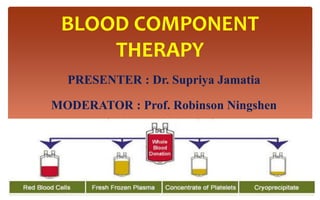
BLOOD COMPONENT
THERAPY
PRESENTER : Dr. Supriya Jamatia
MODERATOR : Prof. Robinson Ningshen
 Allows optimal use of limited community resource
 First animal to human transfusion on 1667 by Denis
 Landsteiner description of blood group on 1901
 Direct transfusion by means of arterio-venous anastomosis on 1917
Introduction
Transfusing only the portion of the blood
needed by the patient is called blood
component therapy
 Red blood cell  Oxygenation of tissues
 Platelets  Prevention or cessation of bleeding
 Fresh frozen plasma  Cessation of bleeding
 Cryoprecipitate  Cessation of bleeding
 Cryoprecipitate-poor plasma  Plasma exchange
 Granulocytes  Treatment of infection
 Frozen blood cells  Storage of rare blood
 Leukocyte-depleted red cells  Prevention of reaction and certain diseases
Component and Medical use
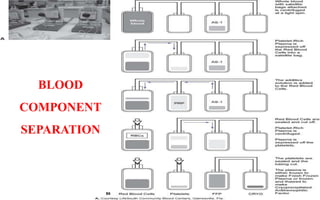
BLOOD
COMPONENT
SEPARATION
 Maintain viability and function
 Prevent physical changes
 Minimize bacterial contamination
Goals Of Blood Collection
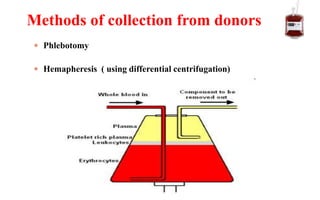
 Phlebotomy
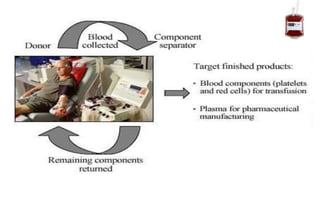
 Hemapheresis ( using differential centrifugation)
Methods of collection from donors
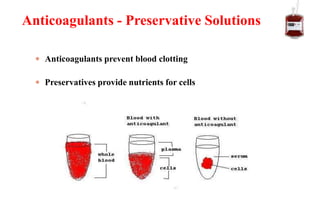
 Anticoagulants prevent blood clotting
 Preservatives provide nutrients for cells
Anticoagulants - Preservative Solutions
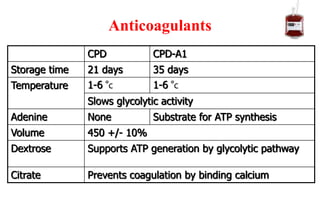
Anticoagulants
CPD CPD-A1
Storage time 21 days 35 days
Temperature 1-6 °c 1-6 °c
Slows glycolytic activity
Adenine None Substrate for ATP synthesis
Volume 450 +/- 10%
Dextrose Supports ATP generation by glycolytic pathway
Citrate Prevents coagulation by binding calcium
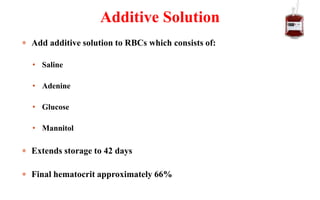
 Add additive solution to RBCs which consists of:
• Saline
• Adenine
• Glucose
• Mannitol
 Extends storage to 42 days
 Final hematocrit approximately 66%
Additive Solution
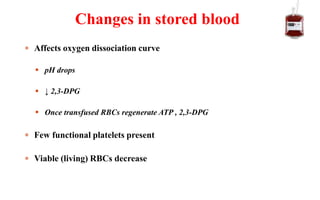
 Affects oxygen dissociation curve
 pH drops
 ↓ 2,3-DPG
 Once transfused RBCs regenerate ATP , 2,3-DPG
 Few functional platelets present
 Viable (living) RBCs decrease
Changes in stored blood
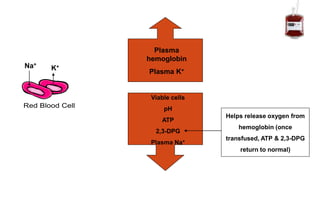
Plasma
hemoglobin
Plasma K+
Viable cells
pH
ATP
2,3-DPG
Plasma Na+
Helps release oxygen from
hemoglobin (once
transfused, ATP & 2,3-DPG
return to normal)
K+Na+
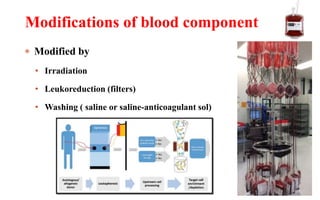
 Modified by
• Irradiation
• Leukoreduction (filters)
• Washing ( saline or saline-anticoagulant sol)
Modifications of blood component
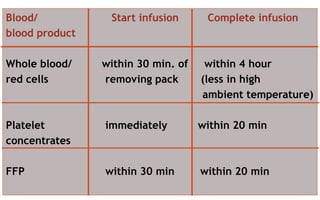
Blood/ Start infusion Complete infusion
blood product
Whole blood/ within 30 min. of within 4 hour
red cells removing pack (less in high
ambient temperature)
Platelet immediately within 20 min
concentrates
FFP within 30 min within 20 min
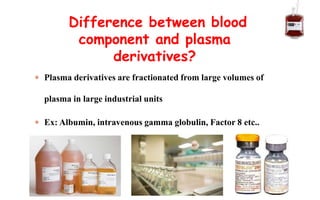
 Plasma derivatives are fractionated from large volumes of
plasma in large industrial units
 Ex: Albumin, intravenous gamma globulin, Factor 8 etc..
Difference between blood
component and plasma
derivatives?
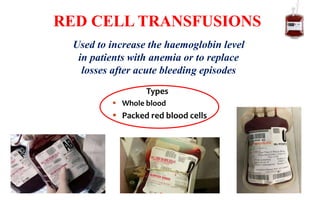
Types
 Whole blood
 Packed red blood cells
RED CELL TRANSFUSIONS
Used to increase the haemoglobin level
in patients with anemia or to replace
losses after acute bleeding episodes
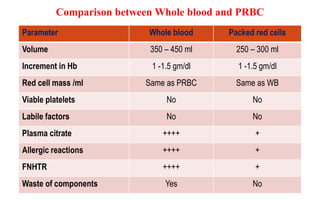
Comparison between Whole blood and PRBC
Parameter Whole blood Packed red cells
Volume 350 – 450 ml 250 – 300 ml
Increment in Hb 1 -1.5 gm/dl 1 -1.5 gm/dl
Red cell mass /ml Same as PRBC Same as WB
Viable platelets No No
Labile factors No No
Plasma citrate ++++ +
Allergic reactions ++++ +
FNHTR ++++ +
Waste of components Yes No
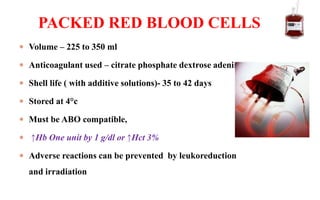
 Volume – 225 to 350 ml
 Anticoagulant used – citrate phosphate dextrose adenine
 Shell life ( with additive solutions)- 35 to 42 days
 Stored at 4°c
 Must be ABO compatible,
 ↑Hb One unit by 1 g/dl or ↑Hct 3%
 Adverse reactions can be prevented by leukoreduction
and irradiation
PACKED RED BLOOD CELLS
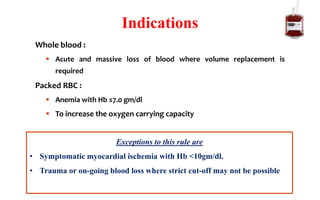
Whole blood :
 Acute and massive loss of blood where volume replacement is
required
Packed RBC :
 Anemia with Hb ≤7.0 gm/dl
 To increase the oxygen carrying capacity
Indications
Exceptions to this rule are
• Symptomatic myocardial ischemia with Hb <10gm/dl.
• Trauma or on-going blood loss where strict cut-off may not be possible
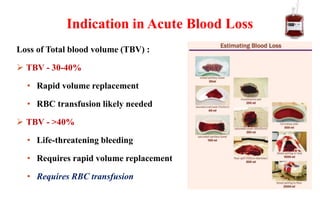
Loss of Total blood volume (TBV) :
 TBV - 30-40%
• Rapid volume replacement
• RBC transfusion likely needed
 TBV - >40%
• Life-threatening bleeding
• Requires rapid volume replacement
• Requires RBC transfusion
Indication in Acute Blood Loss
 Treat the underlying cause (e.g. iron,folate,B12)
 Try EPO trial if the patient can be observed rather than treated
immediately
Indication in Chronic Blood Loss
 Hb >10g/dl, rarely needed
 Hb <6g/dl, usually needed
 Hb 6-10g/dl and Co-morbid Conditions
• 20% blood volume loss can do well without transfusion
• Change in vitals signs not due to anaesthesia
• Decreased Urine Output
• Estimated blood loss > 1000 ml
Indication in Intraoperative Usage
Whether patient requires transfusion or not should be
decided based upon clinical condition, not solely by the
haemoglobin level
 FFP – plasma is separated and stored at -18 to -30°c within 8
hours of collection
 PF24- separated within 24 hours of collection.
(Both of above products can be stored upto one year)
PLASMA COMPONENTS
• Thawed plasma – after plasma is thawed it can be kept in
refrigerator(1-6 ̊C) for 4 days.
• Liquid plasma - plasma that has never been frozen. Expire in 5 days.
• Solvent/detergent plasma - treatment with viral inactivating
agents prior to freezing.
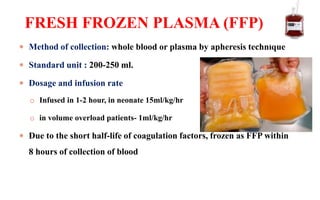
 Method of collection: whole blood or plasma by apheresis technique
 Standard unit : 200-250 ml.
 Dosage and infusion rate
o Infused in 1-2 hour, in neonate 15ml/kg/hr
o in volume overload patients- 1ml/kg/hr
 Due to the short half-life of coagulation factors, frozen as FFP within
8 hours of collection of blood
FRESH FROZEN PLASMA (FFP)
 INR 1.6 with bleeding
 INR 1.6 and patients about to go to undergo an invasive procedure,
Therapeutic exchange
 Major bleeding associated with warfarin anticoagulation or vitamin
K deficiency
 Deficiency of multiple coagulation factors , Ex: Liver disease, DIC
 Factor replacement for rare inherited coagulation factor disorders
Indications
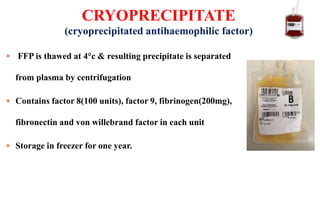
 FFP is thawed at 4°c & resulting precipitate is separated
from plasma by centrifugation
 Contains factor 8(100 units), factor 9, fibrinogen(200mg),
fibronectin and von willebrand factor in each unit
 Storage in freezer for one year.
CRYOPRECIPITATE
(cryoprecipitated antihaemophilic factor)
• Deficiencies of factor 8 and fibrinogen
• Fibrinogen 100 and the patient is bleeding or about to undergo
an invasive procedure
• Massive bleeding
• Can be used in uremic bleeding, which is not responding to
other measures.
Indications
Types
1. Random donor platelets (pooled platelets)
2. Single donor platelet (apheresis platelets)
PLATELET TRANSFUSION
 One unit of platelet is isolated from every unit of donated blood by
centrifuging
 4 to 6 units of pooled platelets are required in single setting to raise
the platelet level
 Advantages : Low cost, easy collection and processing
 Disadvantages : Exposure to multiple donors in single transfusion
and risk of infection
Random donor platelets
(Pooled platelets)
 Platelets are collected from a single donor in blood bank over two
hour Pheresis procedure
 Platelets and some white cells are removed while red cells and
plasma are returned back to donor
 One unit of SDP is equivalent to six units of RDP
 Advantage : Here recipient is exposed to only single donor
Single donor platelet
(Apheresis platelets)
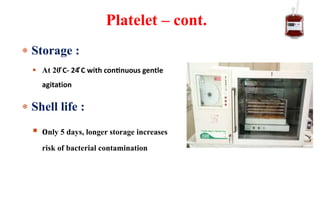
 Storage :
 At 20 ̊C- 24 ̊C with continuous gentle
agitation
 Shell life :
 only 5 days, longer storage increases
risk of bacterial contamination
Platelet – cont.
[To treat active bleeding]
 Count must be kept above 50,000/mm3 in most bleeding situations
 In DIC and central nervous system bleeding , cut off is 1,00,000/mm3
 Bleeding on anti platelet medication
Indications
(Therapeutic)
1. Preparation for an invasive procedure :
• Neurosurgery or Ocular surgery : 1,00,000/mm3
• Major surgery : 50,000/mm3
• Endoscopic procedures : 50,000/mm3 for therapeutic
: 20,000/mm3 for diagnostic
• Central line placement : 20,000/mm3
• Lumbar puncture : 40,000/mm3 to 50,000/mm3
• Epidural anaesthesia : 80,000/mm3
• Bone marrow aspiration : 20,000/mm3
(Can be done with lower counts with applying pressure at site of procedure)
Indications
(Prophylactic)
[To prevent spontaneous bleeding]
2. Prevention of spontaneous bleeding
- Afebrile patients (Bone marrow suppression) : 10,000/mm3
- Febrile or septic patients : 30,000/mm3
- ITP, TTP or HIT : Transfusion is indicated only if they bleed
- Haematological malignancies and chemotherapy : 10,000 – 20,000/mm3
Indications – cont..
 Dosage of platelets
- One unit of SDP or 4-6 units of RDP over a period of 20-30 minutes
- Increases platelet count by approximately 30,000/mm3
Platelet – cont.
Platelets express ABO and HLA type 1 class antigens , usually
compatible transfusions appear to cause a greater count increment
in patients
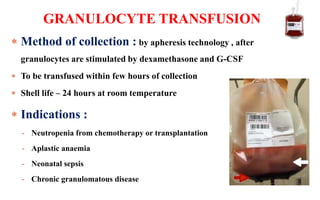
 Method of collection : by apheresis technology , after
granulocytes are stimulated by dexamethasone and G-CSF
 To be transfused within few hours of collection
 Shell life – 24 hours at room temperature
 Indications :
- Neutropenia from chemotherapy or transplantation
- Aplastic anaemia
- Neonatal sepsis
- Chronic granulomatous disease
GRANULOCYTE TRANSFUSION
Features of PBM
- Evidence based guidelines for transfusion indication and dose
- Physician education and monitoring
Patient Blood Management (PBM)
PBM is a multidisciplinary approach to
improve patient outcome using evidence based
strategies in patients who may need
transfusion
- Preoperative anemia evaluation and management
- Intraoperative and postoperative autologous salvage
- Intraoperative normovolemic hemodilution
- Point of care hemostasis testing
- Use of hemostatic agents
- Limiting phlebotomy blood loss for laboratory testing
Features of PBM – cont..
Types
1. Immune mediated
2. Non-immune mediate
3. Infectious complication
ADVERSE REACTION TO BLOOD
TRANSFUSION
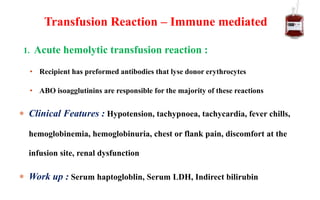
1. Acute hemolytic transfusion reaction :
• Recipient has preformed antibodies that lyse donor erythrocytes
• ABO isoagglutinins are responsible for the majority of these reactions
 Clinical Features : Hypotension, tachypnoea, tachycardia, fever chills,
hemoglobinemia, hemoglobinuria, chest or flank pain, discomfort at the
infusion site, renal dysfunction
 Work up : Serum haptogloblin, Serum LDH, Indirect bilirubin
Transfusion Reaction – Immune mediated
Management :
 STOP blood transfusion immediately
 Diuresis- Furosemide or Mannitol
 Subject post transfusion blood to coomb’s test
Transfusion Reaction – Immune mediated Cont..
2. Delayed hemolytic transfusion reactions:
- Occurs in patients previously sensitized to donor allo-antigens.
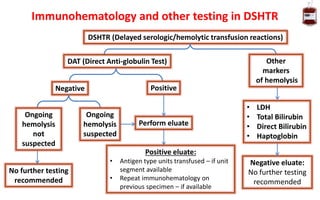
Immunohematology and other testing in DSHTR
DSHTR (Delayed serologic/hemolytic transfusion reactions)
DAT (Direct Anti-globulin Test)
Negative Positive
Ongoing
hemolysis
not
suspected
No further testing
recommended
Ongoing
hemolysis
suspected
Perform eluate
Positive eluate:
• Antigen type units transfused – if unit
segment available
• Repeat immunohematology on
previous specimen – if available
Other
markers
of hemolysis
• LDH
• Total Bilirubin
• Direct Bilirubin
• Haptoglobin
Negative eluate:
No further testing
recommended
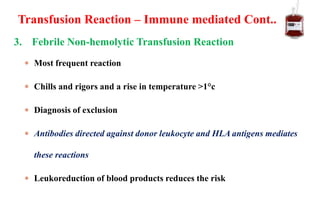
3. Febrile Non-hemolytic Transfusion Reaction
 Most frequent reaction
 Chills and rigors and a rise in temperature >1°c
 Diagnosis of exclusion
 Antibodies directed against donor leukocyte and HLA antigens mediates
these reactions
 Leukoreduction of blood products reduces the risk
Transfusion Reaction – Immune mediated Cont..
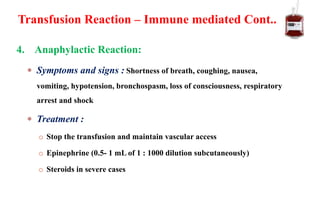
4. Anaphylactic Reaction:
 Symptoms and signs : Shortness of breath, coughing, nausea,
vomiting, hypotension, bronchospasm, loss of consciousness, respiratory
arrest and shock
 Treatment :
o Stop the transfusion and maintain vascular access
o Epinephrine (0.5- 1 mL of 1 : 1000 dilution subcutaneously)
o Steroids in severe cases
Transfusion Reaction – Immune mediated Cont..
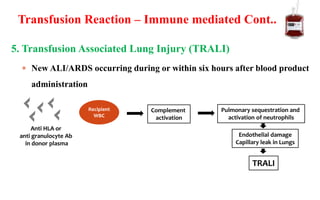
5. Transfusion Associated Lung Injury (TRALI)
 New ALI/ARDS occurring during or within six hours after blood product
administration
Anti HLA or
anti granulocyte Ab
in donor plasma
Recipient
WBC
Complement
activation
Pulmonary sequestration and
activation of neutrophils
Endothelial damage
Capillary leak in Lungs
TRALI
Transfusion Reaction – Immune mediated Cont..
 Symptoms and signs :
 Dyspnoea, hypotension, fever
 Bilateral non-cardiogenic pulmonary edema, Pao2/FIo2 <300mmHg
 Management :
 Supportive
 Avoid plasma transfusion from multiparous women and screening for anti-
HLA antibodies
A
L
I
Transfusion Reaction – Immune mediated Cont..
5. TRALI – cont..
6. Transfusion Associated GVHD (TA-GVHD) :
 Mediated by donor T lymphocytes that recognize host HLA antigens as
foreign and mount an immune response
 Clinical features : Fever with characteristic Cutaneous eruption,
Diarrhoea and liver function abnormalities
 Treatment :
o GVHD highly resistant to treatment with immunosuppressive therapies
o Irradiation of cellular components reduces the risk
Transfusion Reaction – Immune mediated Cont..
7. Post-transfusion Purpura:
 Thrombocytopenia 7-10 days after platelet transfusion
 Common in women
 Antibody react with both donor and recipient platelets
 Antigen HPA-1a found on platelet glycoprotein receptor шa receptor
 Avoid further transfusion
 IV immunoglobulin or plasmapheresis can be tried
Transfusion Reaction – Immune mediated Cont..
8. Allergic reaction:
 Urticarial reaction are related to plasma protein found in
transfused components
 Treatment :
o Stop transfusion and Administer antihistamines (diphenhydramine
50 mg orally or IM)
o Continue transfusion after symptom resolved
o Premedication with antihistamines can be tried when history of
transfusion reaction present
Transfusion Reaction – Immune mediated Cont..
1. Fluid over load (TACO) :
o Clinical Features : Severe hypoxemia, Raised BP, Jugular
venous distension, Raised central venous pressure
o Diagnosis : CXR- pulmonary edema, cardiomegaly, distended
pulmonary artery, BNP – elevated >1.5
o Treatment : Upright posture, Supplemental oxygen, Diuresis
o Prevention : Slow transfusion rate, Transfuse in small volumes
Transfusion Reaction – Non-Immune mediated
2. Hypothermia :
- Because of rapid transfusion of refrigerated (4 ̊c) or frozen (18 ̊c)
components can cause cardiac dysrhythmia by exposing SA node to cold
fluid
- can use in line warmer
3. Electrolyte toxicity :
Hyperkalemia - Neonate and renal failure patient at risk.
Use fresh or washed RBC
Hypocalcemia - In multiple transfusion
Inj. Calcium IV in separate line
Transfusion Reaction – Non-Immune mediated
4. Iron overload :
o Common after 100 units of RBC transfusion
o Deferoxamine or Deferasirox can be used
5. Hypotensive reactions :
o Noted in patient on ACE inhibitors because of increased Bradykinin.
o BP returns to normal without intervention
6. Immunomodulation :
o Transfusion of allogenic blood is immunosuppressive
o Mediated by transfused leukocytes
o Leukocyte depleted cellular products cause less immunosuppression
Transfusion Reaction – Non-Immune mediated
 The transmittable risks include:
o Hepatitis B, C, D
o Human T-cell lymphotropic viruses
(HTLV-1 & HTLV-2)
o HIV-1 & HIV-2
o Cytomegalovirus
o West Nile Virus
o Epstein-Barr virus
Transfusion Reaction
(Infectious complications)
o Malaria
o Syphilis
o Parvovirus B19
o Prions including
Creutzfeldt-Jakob and
variant
o Lyme Disease
 Pre-transfusion: Informed consent, Temp, Pulse, BP, O2 saturation
 During transfusion: Vitals after 15 min
 Only 0.9% NS is compatible
 Avoid RL and hypo/hypertonic solution
 Avoid medication in same line, if possible avoid al-together
 Post transfusion:
 Check sign for any reaction
 Vitals 4-6 hr after BT
Clinical aspect of BT
No transfusion is zero
risk event
THANK YOU
 Harrison’s internal medicine 20th edition
 Rossis principle of transfusion medicine 5th edition
REFERENCES

Blood components

  • 1.
    BLOOD COMPONENT THERAPY PRESENTER :Dr. Supriya Jamatia MODERATOR : Prof. Robinson Ningshen
  • 2.
     Allows optimaluse of limited community resource  First animal to human transfusion on 1667 by Denis  Landsteiner description of blood group on 1901  Direct transfusion by means of arterio-venous anastomosis on 1917 Introduction Transfusing only the portion of the blood needed by the patient is called blood component therapy
  • 3.
     Red bloodcell  Oxygenation of tissues  Platelets  Prevention or cessation of bleeding  Fresh frozen plasma  Cessation of bleeding  Cryoprecipitate  Cessation of bleeding  Cryoprecipitate-poor plasma  Plasma exchange  Granulocytes  Treatment of infection  Frozen blood cells  Storage of rare blood  Leukocyte-depleted red cells  Prevention of reaction and certain diseases Component and Medical use
  • 4.
  • 5.
     Maintain viabilityand function  Prevent physical changes  Minimize bacterial contamination Goals Of Blood Collection
  • 6.
     Phlebotomy  Hemapheresis( using differential centrifugation) Methods of collection from donors
  • 8.
     Anticoagulants preventblood clotting  Preservatives provide nutrients for cells Anticoagulants - Preservative Solutions
  • 9.
    Anticoagulants CPD CPD-A1 Storage time21 days 35 days Temperature 1-6 °c 1-6 °c Slows glycolytic activity Adenine None Substrate for ATP synthesis Volume 450 +/- 10% Dextrose Supports ATP generation by glycolytic pathway Citrate Prevents coagulation by binding calcium
  • 10.
     Add additivesolution to RBCs which consists of: • Saline • Adenine • Glucose • Mannitol  Extends storage to 42 days  Final hematocrit approximately 66% Additive Solution
  • 11.
     Affects oxygendissociation curve  pH drops  ↓ 2,3-DPG  Once transfused RBCs regenerate ATP , 2,3-DPG  Few functional platelets present  Viable (living) RBCs decrease Changes in stored blood
  • 12.
    Plasma hemoglobin Plasma K+ Viable cells pH ATP 2,3-DPG PlasmaNa+ Helps release oxygen from hemoglobin (once transfused, ATP & 2,3-DPG return to normal) K+Na+
  • 13.
     Modified by •Irradiation • Leukoreduction (filters) • Washing ( saline or saline-anticoagulant sol) Modifications of blood component
  • 14.
    Blood/ Start infusionComplete infusion blood product Whole blood/ within 30 min. of within 4 hour red cells removing pack (less in high ambient temperature) Platelet immediately within 20 min concentrates FFP within 30 min within 20 min
  • 15.
     Plasma derivativesare fractionated from large volumes of plasma in large industrial units  Ex: Albumin, intravenous gamma globulin, Factor 8 etc.. Difference between blood component and plasma derivatives?
  • 16.
    Types  Whole blood Packed red blood cells RED CELL TRANSFUSIONS Used to increase the haemoglobin level in patients with anemia or to replace losses after acute bleeding episodes
  • 17.
    Comparison between Wholeblood and PRBC Parameter Whole blood Packed red cells Volume 350 – 450 ml 250 – 300 ml Increment in Hb 1 -1.5 gm/dl 1 -1.5 gm/dl Red cell mass /ml Same as PRBC Same as WB Viable platelets No No Labile factors No No Plasma citrate ++++ + Allergic reactions ++++ + FNHTR ++++ + Waste of components Yes No
  • 18.
     Volume –225 to 350 ml  Anticoagulant used – citrate phosphate dextrose adenine  Shell life ( with additive solutions)- 35 to 42 days  Stored at 4°c  Must be ABO compatible,  ↑Hb One unit by 1 g/dl or ↑Hct 3%  Adverse reactions can be prevented by leukoreduction and irradiation PACKED RED BLOOD CELLS
  • 19.
    Whole blood : Acute and massive loss of blood where volume replacement is required Packed RBC :  Anemia with Hb ≤7.0 gm/dl  To increase the oxygen carrying capacity Indications Exceptions to this rule are • Symptomatic myocardial ischemia with Hb <10gm/dl. • Trauma or on-going blood loss where strict cut-off may not be possible
  • 20.
    Loss of Totalblood volume (TBV) :  TBV - 30-40% • Rapid volume replacement • RBC transfusion likely needed  TBV - >40% • Life-threatening bleeding • Requires rapid volume replacement • Requires RBC transfusion Indication in Acute Blood Loss
  • 21.
     Treat theunderlying cause (e.g. iron,folate,B12)  Try EPO trial if the patient can be observed rather than treated immediately Indication in Chronic Blood Loss  Hb >10g/dl, rarely needed  Hb <6g/dl, usually needed  Hb 6-10g/dl and Co-morbid Conditions
  • 22.
    • 20% bloodvolume loss can do well without transfusion • Change in vitals signs not due to anaesthesia • Decreased Urine Output • Estimated blood loss > 1000 ml Indication in Intraoperative Usage Whether patient requires transfusion or not should be decided based upon clinical condition, not solely by the haemoglobin level
  • 23.
     FFP –plasma is separated and stored at -18 to -30°c within 8 hours of collection  PF24- separated within 24 hours of collection. (Both of above products can be stored upto one year) PLASMA COMPONENTS • Thawed plasma – after plasma is thawed it can be kept in refrigerator(1-6 ̊C) for 4 days. • Liquid plasma - plasma that has never been frozen. Expire in 5 days. • Solvent/detergent plasma - treatment with viral inactivating agents prior to freezing.
  • 24.
     Method ofcollection: whole blood or plasma by apheresis technique  Standard unit : 200-250 ml.  Dosage and infusion rate o Infused in 1-2 hour, in neonate 15ml/kg/hr o in volume overload patients- 1ml/kg/hr  Due to the short half-life of coagulation factors, frozen as FFP within 8 hours of collection of blood FRESH FROZEN PLASMA (FFP)
  • 25.
     INR 1.6with bleeding  INR 1.6 and patients about to go to undergo an invasive procedure, Therapeutic exchange  Major bleeding associated with warfarin anticoagulation or vitamin K deficiency  Deficiency of multiple coagulation factors , Ex: Liver disease, DIC  Factor replacement for rare inherited coagulation factor disorders Indications
  • 26.
     FFP isthawed at 4°c & resulting precipitate is separated from plasma by centrifugation  Contains factor 8(100 units), factor 9, fibrinogen(200mg), fibronectin and von willebrand factor in each unit  Storage in freezer for one year. CRYOPRECIPITATE (cryoprecipitated antihaemophilic factor)
  • 27.
    • Deficiencies offactor 8 and fibrinogen • Fibrinogen 100 and the patient is bleeding or about to undergo an invasive procedure • Massive bleeding • Can be used in uremic bleeding, which is not responding to other measures. Indications
  • 28.
    Types 1. Random donorplatelets (pooled platelets) 2. Single donor platelet (apheresis platelets) PLATELET TRANSFUSION
  • 29.
     One unitof platelet is isolated from every unit of donated blood by centrifuging  4 to 6 units of pooled platelets are required in single setting to raise the platelet level  Advantages : Low cost, easy collection and processing  Disadvantages : Exposure to multiple donors in single transfusion and risk of infection Random donor platelets (Pooled platelets)
  • 30.
     Platelets arecollected from a single donor in blood bank over two hour Pheresis procedure  Platelets and some white cells are removed while red cells and plasma are returned back to donor  One unit of SDP is equivalent to six units of RDP  Advantage : Here recipient is exposed to only single donor Single donor platelet (Apheresis platelets)
  • 31.
     Storage : At 20 ̊C- 24 ̊C with continuous gentle agitation  Shell life :  only 5 days, longer storage increases risk of bacterial contamination Platelet – cont.
  • 32.
    [To treat activebleeding]  Count must be kept above 50,000/mm3 in most bleeding situations  In DIC and central nervous system bleeding , cut off is 1,00,000/mm3  Bleeding on anti platelet medication Indications (Therapeutic)
  • 33.
    1. Preparation foran invasive procedure : • Neurosurgery or Ocular surgery : 1,00,000/mm3 • Major surgery : 50,000/mm3 • Endoscopic procedures : 50,000/mm3 for therapeutic : 20,000/mm3 for diagnostic • Central line placement : 20,000/mm3 • Lumbar puncture : 40,000/mm3 to 50,000/mm3 • Epidural anaesthesia : 80,000/mm3 • Bone marrow aspiration : 20,000/mm3 (Can be done with lower counts with applying pressure at site of procedure) Indications (Prophylactic) [To prevent spontaneous bleeding]
  • 34.
    2. Prevention ofspontaneous bleeding - Afebrile patients (Bone marrow suppression) : 10,000/mm3 - Febrile or septic patients : 30,000/mm3 - ITP, TTP or HIT : Transfusion is indicated only if they bleed - Haematological malignancies and chemotherapy : 10,000 – 20,000/mm3 Indications – cont..
  • 35.
     Dosage ofplatelets - One unit of SDP or 4-6 units of RDP over a period of 20-30 minutes - Increases platelet count by approximately 30,000/mm3 Platelet – cont. Platelets express ABO and HLA type 1 class antigens , usually compatible transfusions appear to cause a greater count increment in patients
  • 36.
     Method ofcollection : by apheresis technology , after granulocytes are stimulated by dexamethasone and G-CSF  To be transfused within few hours of collection  Shell life – 24 hours at room temperature  Indications : - Neutropenia from chemotherapy or transplantation - Aplastic anaemia - Neonatal sepsis - Chronic granulomatous disease GRANULOCYTE TRANSFUSION
  • 37.
    Features of PBM -Evidence based guidelines for transfusion indication and dose - Physician education and monitoring Patient Blood Management (PBM) PBM is a multidisciplinary approach to improve patient outcome using evidence based strategies in patients who may need transfusion
  • 38.
    - Preoperative anemiaevaluation and management - Intraoperative and postoperative autologous salvage - Intraoperative normovolemic hemodilution - Point of care hemostasis testing - Use of hemostatic agents - Limiting phlebotomy blood loss for laboratory testing Features of PBM – cont..
  • 39.
    Types 1. Immune mediated 2.Non-immune mediate 3. Infectious complication ADVERSE REACTION TO BLOOD TRANSFUSION
  • 41.
    1. Acute hemolytictransfusion reaction : • Recipient has preformed antibodies that lyse donor erythrocytes • ABO isoagglutinins are responsible for the majority of these reactions  Clinical Features : Hypotension, tachypnoea, tachycardia, fever chills, hemoglobinemia, hemoglobinuria, chest or flank pain, discomfort at the infusion site, renal dysfunction  Work up : Serum haptogloblin, Serum LDH, Indirect bilirubin Transfusion Reaction – Immune mediated
  • 42.
    Management :  STOPblood transfusion immediately  Diuresis- Furosemide or Mannitol  Subject post transfusion blood to coomb’s test Transfusion Reaction – Immune mediated Cont.. 2. Delayed hemolytic transfusion reactions: - Occurs in patients previously sensitized to donor allo-antigens.
  • 43.
    Immunohematology and othertesting in DSHTR DSHTR (Delayed serologic/hemolytic transfusion reactions) DAT (Direct Anti-globulin Test) Negative Positive Ongoing hemolysis not suspected No further testing recommended Ongoing hemolysis suspected Perform eluate Positive eluate: • Antigen type units transfused – if unit segment available • Repeat immunohematology on previous specimen – if available Other markers of hemolysis • LDH • Total Bilirubin • Direct Bilirubin • Haptoglobin Negative eluate: No further testing recommended
  • 44.
    3. Febrile Non-hemolyticTransfusion Reaction  Most frequent reaction  Chills and rigors and a rise in temperature >1°c  Diagnosis of exclusion  Antibodies directed against donor leukocyte and HLA antigens mediates these reactions  Leukoreduction of blood products reduces the risk Transfusion Reaction – Immune mediated Cont..
  • 45.
    4. Anaphylactic Reaction: Symptoms and signs : Shortness of breath, coughing, nausea, vomiting, hypotension, bronchospasm, loss of consciousness, respiratory arrest and shock  Treatment : o Stop the transfusion and maintain vascular access o Epinephrine (0.5- 1 mL of 1 : 1000 dilution subcutaneously) o Steroids in severe cases Transfusion Reaction – Immune mediated Cont..
  • 46.
    5. Transfusion AssociatedLung Injury (TRALI)  New ALI/ARDS occurring during or within six hours after blood product administration Anti HLA or anti granulocyte Ab in donor plasma Recipient WBC Complement activation Pulmonary sequestration and activation of neutrophils Endothelial damage Capillary leak in Lungs TRALI Transfusion Reaction – Immune mediated Cont..
  • 47.
     Symptoms andsigns :  Dyspnoea, hypotension, fever  Bilateral non-cardiogenic pulmonary edema, Pao2/FIo2 <300mmHg  Management :  Supportive  Avoid plasma transfusion from multiparous women and screening for anti- HLA antibodies A L I Transfusion Reaction – Immune mediated Cont.. 5. TRALI – cont..
  • 48.
    6. Transfusion AssociatedGVHD (TA-GVHD) :  Mediated by donor T lymphocytes that recognize host HLA antigens as foreign and mount an immune response  Clinical features : Fever with characteristic Cutaneous eruption, Diarrhoea and liver function abnormalities  Treatment : o GVHD highly resistant to treatment with immunosuppressive therapies o Irradiation of cellular components reduces the risk Transfusion Reaction – Immune mediated Cont..
  • 49.
    7. Post-transfusion Purpura: Thrombocytopenia 7-10 days after platelet transfusion  Common in women  Antibody react with both donor and recipient platelets  Antigen HPA-1a found on platelet glycoprotein receptor шa receptor  Avoid further transfusion  IV immunoglobulin or plasmapheresis can be tried Transfusion Reaction – Immune mediated Cont..
  • 50.
    8. Allergic reaction: Urticarial reaction are related to plasma protein found in transfused components  Treatment : o Stop transfusion and Administer antihistamines (diphenhydramine 50 mg orally or IM) o Continue transfusion after symptom resolved o Premedication with antihistamines can be tried when history of transfusion reaction present Transfusion Reaction – Immune mediated Cont..
  • 51.
    1. Fluid overload (TACO) : o Clinical Features : Severe hypoxemia, Raised BP, Jugular venous distension, Raised central venous pressure o Diagnosis : CXR- pulmonary edema, cardiomegaly, distended pulmonary artery, BNP – elevated >1.5 o Treatment : Upright posture, Supplemental oxygen, Diuresis o Prevention : Slow transfusion rate, Transfuse in small volumes Transfusion Reaction – Non-Immune mediated
  • 52.
    2. Hypothermia : -Because of rapid transfusion of refrigerated (4 ̊c) or frozen (18 ̊c) components can cause cardiac dysrhythmia by exposing SA node to cold fluid - can use in line warmer 3. Electrolyte toxicity : Hyperkalemia - Neonate and renal failure patient at risk. Use fresh or washed RBC Hypocalcemia - In multiple transfusion Inj. Calcium IV in separate line Transfusion Reaction – Non-Immune mediated
  • 53.
    4. Iron overload: o Common after 100 units of RBC transfusion o Deferoxamine or Deferasirox can be used 5. Hypotensive reactions : o Noted in patient on ACE inhibitors because of increased Bradykinin. o BP returns to normal without intervention 6. Immunomodulation : o Transfusion of allogenic blood is immunosuppressive o Mediated by transfused leukocytes o Leukocyte depleted cellular products cause less immunosuppression Transfusion Reaction – Non-Immune mediated
  • 54.
     The transmittablerisks include: o Hepatitis B, C, D o Human T-cell lymphotropic viruses (HTLV-1 & HTLV-2) o HIV-1 & HIV-2 o Cytomegalovirus o West Nile Virus o Epstein-Barr virus Transfusion Reaction (Infectious complications) o Malaria o Syphilis o Parvovirus B19 o Prions including Creutzfeldt-Jakob and variant o Lyme Disease
  • 55.
     Pre-transfusion: Informedconsent, Temp, Pulse, BP, O2 saturation  During transfusion: Vitals after 15 min  Only 0.9% NS is compatible  Avoid RL and hypo/hypertonic solution  Avoid medication in same line, if possible avoid al-together  Post transfusion:  Check sign for any reaction  Vitals 4-6 hr after BT Clinical aspect of BT No transfusion is zero risk event
  • 56.
  • 57.
     Harrison’s internalmedicine 20th edition  Rossis principle of transfusion medicine 5th edition REFERENCES