MASSIVE TRANSFUSION
PROTOCOLA brief clinical review
OBJECTIVES
 HEMORRHGIC SHOCK
 MASSIVE TRANSFUSION
 TRANSFUSION COMPLICATIONS
 CONCLUSION
HEMORRHGIC SHOCK
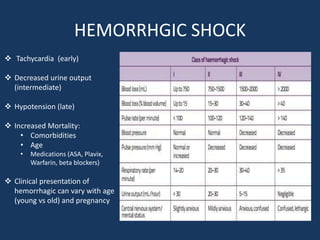
 Tachycardia (early)
 Decreased urine output
(intermediate)
 Hypotension (late)
 Increased Mortality:
• Comorbidities
• Age
• Medications (ASA, Plavix,
Warfarin, beta blockers)
 Clinical presentation of
hemorrhagic can vary with age
(young vs old) and pregnancy
HEMORRHGIC SHOCK
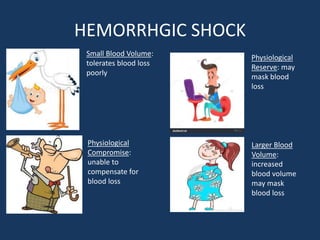
Small Blood Volume:
tolerates blood loss
poorly
Physiological
Compromise:
unable to
compensate for
blood loss
Physiological
Reserve: may
mask blood
loss
Larger Blood
Volume:
increased
blood volume
may mask
blood loss
HEMORRHGIC SHOCK
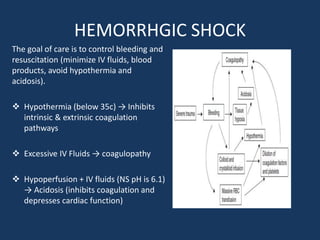
The goal of care is to control bleeding and
resuscitation (minimize IV fluids, blood
products, avoid hypothermia and
acidosis).
 Hypothermia (below 35c) → Inhibits
intrinsic & extrinsic coagulation
pathways
 Excessive IV Fluids → coagulopathy
 Hypoperfusion + IV fluids (NS pH is 6.1)
→ Acidosis (inhibits coagulation and
depresses cardiac function)
MASSIVE TRANSFUSION PROTOCOL
 “Implementation of a Massive
Transfusion Protocol (MTP) promotes early
and aggressive coagulation factor therapy
as well as the limitation of crystalloid
infusion, the prevention of coagulopathy,
hypothermia and acidosis” (the ‘Lethal
Triad’)
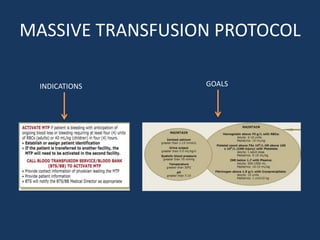
 Indications & Goals?
MASSIVE TRANSFUSION PROTOCOL
INDICATIONS GOALS
MASSIVE TRANSFUSION PROTOCOL
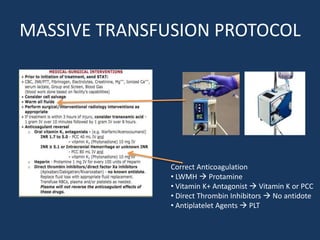
Correct Anticoagulation
• LWMH  Protamine
• Vitamin K+ Antagonist  Vitamin K or PCC
• Direct Thrombin Inhibitors  No antidote
• Antiplatelet Agents  PLT
MASSIVE TRANSFUSION PROTOCOL
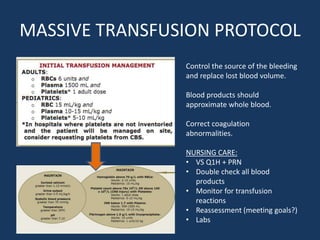
Control the source of the bleeding
and replace lost blood volume.
Blood products should
approximate whole blood.
Correct coagulation
abnormalities.
NURSING CARE:
• VS Q1H + PRN
• Double check all blood
products
• Monitor for transfusion
reactions
• Reassessment (meeting goals?)
• Labs
MASSIVE TRANSFUSION PROTOCOL
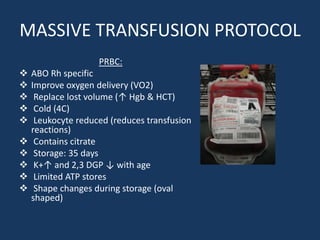
PRBC:
 ABO Rh specific
 Improve oxygen delivery (VO2)
 Replace lost volume (↑ Hgb & HCT)
 Cold (4C)
 Leukocyte reduced (reduces transfusion
reactions)
 Contains citrate
 Storage: 35 days
 K+↑ and 2,3 DGP ↓ with age
 Limited ATP stores
 Shape changes during storage (oval
shaped)
MASSIVE TRANSFUSION PROTOCOL
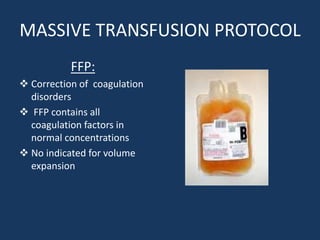
FFP:
 Correction of coagulation
disorders
 FFP contains all
coagulation factors in
normal concentrations
 No indicated for volume
expansion
MASSIVE TRANSFUSION PROTOCOL
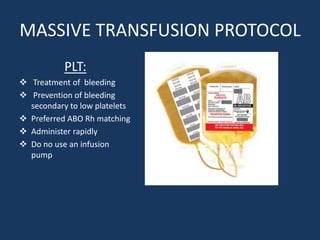
PLT:
 Treatment of bleeding
 Prevention of bleeding
secondary to low platelets
 Preferred ABO Rh matching
 Administer rapidly
 Do no use an infusion
pump
MASSIVE TRANSFUSION PROTOCOL
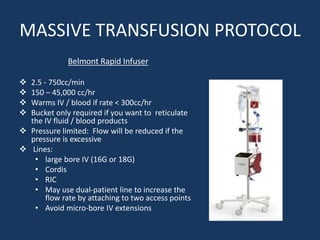
Belmont Rapid Infuser
 2.5 - 750cc/min
 150 – 45,000 cc/hr
 Warms IV / blood if rate < 300cc/hr
 Bucket only required if you want to reticulate
the IV fluid / blood products
 Pressure limited: Flow will be reduced if the
pressure is excessive
 Lines:
• large bore IV (16G or 18G)
• Cordis
• RIC
• May use dual-patient line to increase the
flow rate by attaching to two access points
• Avoid micro-bore IV extensions
MASSIVE TRANSFUSION PROTOCOL
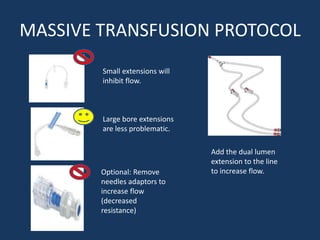
Small extensions will
inhibit flow.
Large bore extensions
are less problematic.
Optional: Remove
needles adaptors to
increase flow
(decreased
resistance)
Add the dual lumen
extension to the line
to increase flow.
MASSIVE TRANSFUSION PROTOCOL
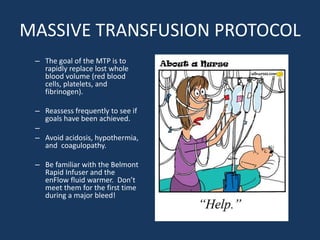
– The goal of the MTP is to
rapidly replace lost whole
blood volume (red blood
cells, platelets, and
fibrinogen).
– Reassess frequently to see if
goals have been achieved.
–
– Avoid acidosis, hypothermia,
and coagulopathy.
– Be familiar with the Belmont
Rapid Infuser and the
enFlow fluid warmer. Don’t
meet them for the first time
during a major bleed!
BLOOD
ABO
 Karl Landsteiner, who identified the O, A,
and B blood types in 1900.
 Alfred von Decastello and Adriano Sturli
discovered the fourth type, AB, in 1902.
 Antigen – marker expressed on the call wall
 Antibodies –used by the immune system to
neutralize pathogens
 RBC – 100 to 120 day life span / oxygen
transporters
ABO
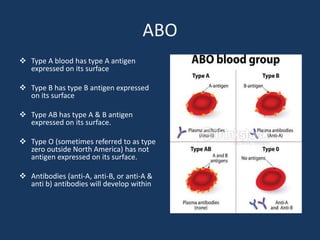
 Type A blood has type A antigen
expressed on its surface
 Type B has type B antigen expressed
on its surface
 Type AB has type A & B antigen
expressed on its surface.
 Type O (sometimes referred to as type
zero outside North America) has not
antigen expressed on its surface.
 Antibodies (anti-A, anti-B, or anti-A &
anti b) antibodies will develop within
RHESE FACTOR
 Discovered in 1937 by Karl Landsteiner and
Alexander S. Wiener.
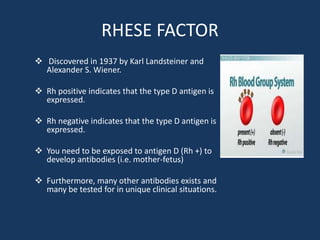
 Rh positive indicates that the type D antigen is
expressed.
 Rh negative indicates that the type D antigen is
expressed.
 You need to be exposed to antigen D (Rh +) to
develop antibodies (i.e. mother-fetus)
 Furthermore, many other antibodies exists and
many be tested for in unique clinical situations.
ABO +/-
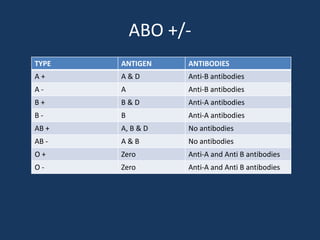
TYPE ANTIGEN ANTIBODIES
A + A & D Anti-B antibodies
A - A Anti-B antibodies
B + B & D Anti-A antibodies
B - B Anti-A antibodies
AB + A, B & D No antibodies
AB - A & B No antibodies
O + Zero Anti-A and Anti B antibodies
O - Zero Anti-A and Anti B antibodies
ABO +/-
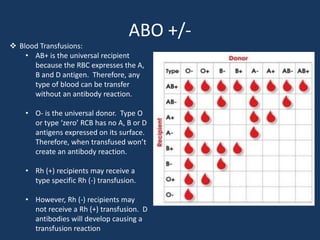
 Blood Transfusions:
• AB+ is the universal recipient
because the RBC expresses the A,
B and D antigen. Therefore, any
type of blood can be transfer
without an antibody reaction.
• O- is the universal donor. Type O
or type ‘zero’ RCB has no A, B or D
antigens expressed on its surface.
Therefore, when transfused won’t
create an antibody reaction.
• Rh (+) recipients may receive a
type specific Rh (-) transfusion.
• However, Rh (-) recipients may
not receive a Rh (+) transfusion. D
antibodies will develop causing a
transfusion reaction
TRANSUSION REACTIONS
 Acute Hemolytic Transfusion Reaction (AHTR)
Delayed Hemolytic Transfusion Reaction (DHTR)
 Febrile Non-hemolytic Reaction
 Allergic Reaction
 Anaphylaxis
 Transfusion Related Acute Lung Injury
!! DANGER !!
TRANSUSION REACTIONS
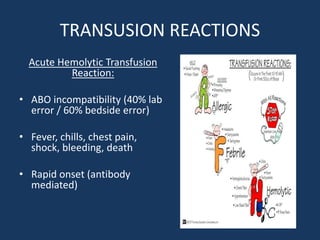
Acute Hemolytic Transfusion
Reaction:
• ABO incompatibility (40% lab
error / 60% bedside error)
• Fever, chills, chest pain,
shock, bleeding, death
• Rapid onset (antibody
mediated)
TRANSUSION REACTIONS
Delayed Hemolytic
Transfusion Reaction:
• Seen in patients with previous
transfusion or pregnancy
• Antibodies develop
• Develops days to weeks after the
transfusion
TRANSUSION REACTIONS
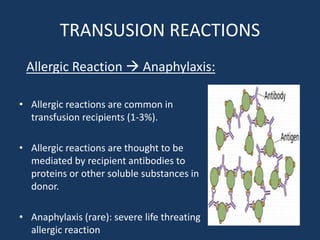
Allergic Reaction  Anaphylaxis:
• Allergic reactions are common in
transfusion recipients (1-3%).
• Allergic reactions are thought to be
mediated by recipient antibodies to
proteins or other soluble substances in
donor.
• Anaphylaxis (rare): severe life threating
allergic reaction
TRANSUSION REACTIONS
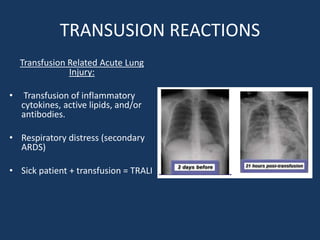
Transfusion Related Acute Lung
Injury:
• Transfusion of inflammatory
cytokines, active lipids, and/or
antibodies.
• Respiratory distress (secondary
ARDS)
• Sick patient + transfusion = TRALI
TRANSFUSION COMPLICATIONS
 Metabolic Effects:
• Hyperkalemia (especially in patient with acidosis
and renal failure)
• Citrate Toxicity: ↓Ca+ and metabolic alkalosis
 Hypothermia
• Associated with poor outcomes
• Warm blood when possible
Massive Transfusion Protocol + Blood transfusions

Massive Transfusion Protocol + Blood transfusions

  • 1.
  • 2.
    OBJECTIVES  HEMORRHGIC SHOCK MASSIVE TRANSFUSION  TRANSFUSION COMPLICATIONS  CONCLUSION
  • 3.
    HEMORRHGIC SHOCK  Tachycardia(early)  Decreased urine output (intermediate)  Hypotension (late)  Increased Mortality: • Comorbidities • Age • Medications (ASA, Plavix, Warfarin, beta blockers)  Clinical presentation of hemorrhagic can vary with age (young vs old) and pregnancy
  • 4.
    HEMORRHGIC SHOCK Small BloodVolume: tolerates blood loss poorly Physiological Compromise: unable to compensate for blood loss Physiological Reserve: may mask blood loss Larger Blood Volume: increased blood volume may mask blood loss
  • 5.
    HEMORRHGIC SHOCK The goalof care is to control bleeding and resuscitation (minimize IV fluids, blood products, avoid hypothermia and acidosis).  Hypothermia (below 35c) → Inhibits intrinsic & extrinsic coagulation pathways  Excessive IV Fluids → coagulopathy  Hypoperfusion + IV fluids (NS pH is 6.1) → Acidosis (inhibits coagulation and depresses cardiac function)
  • 6.
    MASSIVE TRANSFUSION PROTOCOL “Implementation of a Massive Transfusion Protocol (MTP) promotes early and aggressive coagulation factor therapy as well as the limitation of crystalloid infusion, the prevention of coagulopathy, hypothermia and acidosis” (the ‘Lethal Triad’)  Indications & Goals?
  • 7.
  • 8.
    MASSIVE TRANSFUSION PROTOCOL CorrectAnticoagulation • LWMH  Protamine • Vitamin K+ Antagonist  Vitamin K or PCC • Direct Thrombin Inhibitors  No antidote • Antiplatelet Agents  PLT
  • 9.
    MASSIVE TRANSFUSION PROTOCOL Controlthe source of the bleeding and replace lost blood volume. Blood products should approximate whole blood. Correct coagulation abnormalities. NURSING CARE: • VS Q1H + PRN • Double check all blood products • Monitor for transfusion reactions • Reassessment (meeting goals?) • Labs
  • 10.
    MASSIVE TRANSFUSION PROTOCOL PRBC: ABO Rh specific  Improve oxygen delivery (VO2)  Replace lost volume (↑ Hgb & HCT)  Cold (4C)  Leukocyte reduced (reduces transfusion reactions)  Contains citrate  Storage: 35 days  K+↑ and 2,3 DGP ↓ with age  Limited ATP stores  Shape changes during storage (oval shaped)
  • 11.
    MASSIVE TRANSFUSION PROTOCOL FFP: Correction of coagulation disorders  FFP contains all coagulation factors in normal concentrations  No indicated for volume expansion
  • 12.
    MASSIVE TRANSFUSION PROTOCOL PLT: Treatment of bleeding  Prevention of bleeding secondary to low platelets  Preferred ABO Rh matching  Administer rapidly  Do no use an infusion pump
  • 13.
    MASSIVE TRANSFUSION PROTOCOL BelmontRapid Infuser  2.5 - 750cc/min  150 – 45,000 cc/hr  Warms IV / blood if rate < 300cc/hr  Bucket only required if you want to reticulate the IV fluid / blood products  Pressure limited: Flow will be reduced if the pressure is excessive  Lines: • large bore IV (16G or 18G) • Cordis • RIC • May use dual-patient line to increase the flow rate by attaching to two access points • Avoid micro-bore IV extensions
  • 14.
    MASSIVE TRANSFUSION PROTOCOL Smallextensions will inhibit flow. Large bore extensions are less problematic. Optional: Remove needles adaptors to increase flow (decreased resistance) Add the dual lumen extension to the line to increase flow.
  • 15.
    MASSIVE TRANSFUSION PROTOCOL –The goal of the MTP is to rapidly replace lost whole blood volume (red blood cells, platelets, and fibrinogen). – Reassess frequently to see if goals have been achieved. – – Avoid acidosis, hypothermia, and coagulopathy. – Be familiar with the Belmont Rapid Infuser and the enFlow fluid warmer. Don’t meet them for the first time during a major bleed!
  • 16.
  • 17.
    ABO  Karl Landsteiner,who identified the O, A, and B blood types in 1900.  Alfred von Decastello and Adriano Sturli discovered the fourth type, AB, in 1902.  Antigen – marker expressed on the call wall  Antibodies –used by the immune system to neutralize pathogens  RBC – 100 to 120 day life span / oxygen transporters
  • 18.
    ABO  Type Ablood has type A antigen expressed on its surface  Type B has type B antigen expressed on its surface  Type AB has type A & B antigen expressed on its surface.  Type O (sometimes referred to as type zero outside North America) has not antigen expressed on its surface.  Antibodies (anti-A, anti-B, or anti-A & anti b) antibodies will develop within
  • 19.
    RHESE FACTOR  Discoveredin 1937 by Karl Landsteiner and Alexander S. Wiener.  Rh positive indicates that the type D antigen is expressed.  Rh negative indicates that the type D antigen is expressed.  You need to be exposed to antigen D (Rh +) to develop antibodies (i.e. mother-fetus)  Furthermore, many other antibodies exists and many be tested for in unique clinical situations.
  • 20.
    ABO +/- TYPE ANTIGENANTIBODIES A + A & D Anti-B antibodies A - A Anti-B antibodies B + B & D Anti-A antibodies B - B Anti-A antibodies AB + A, B & D No antibodies AB - A & B No antibodies O + Zero Anti-A and Anti B antibodies O - Zero Anti-A and Anti B antibodies
  • 21.
    ABO +/-  BloodTransfusions: • AB+ is the universal recipient because the RBC expresses the A, B and D antigen. Therefore, any type of blood can be transfer without an antibody reaction. • O- is the universal donor. Type O or type ‘zero’ RCB has no A, B or D antigens expressed on its surface. Therefore, when transfused won’t create an antibody reaction. • Rh (+) recipients may receive a type specific Rh (-) transfusion. • However, Rh (-) recipients may not receive a Rh (+) transfusion. D antibodies will develop causing a transfusion reaction
  • 22.
    TRANSUSION REACTIONS  AcuteHemolytic Transfusion Reaction (AHTR) Delayed Hemolytic Transfusion Reaction (DHTR)  Febrile Non-hemolytic Reaction  Allergic Reaction  Anaphylaxis  Transfusion Related Acute Lung Injury !! DANGER !!
  • 23.
    TRANSUSION REACTIONS Acute HemolyticTransfusion Reaction: • ABO incompatibility (40% lab error / 60% bedside error) • Fever, chills, chest pain, shock, bleeding, death • Rapid onset (antibody mediated)
  • 24.
    TRANSUSION REACTIONS Delayed Hemolytic TransfusionReaction: • Seen in patients with previous transfusion or pregnancy • Antibodies develop • Develops days to weeks after the transfusion
  • 25.
    TRANSUSION REACTIONS Allergic Reaction Anaphylaxis: • Allergic reactions are common in transfusion recipients (1-3%). • Allergic reactions are thought to be mediated by recipient antibodies to proteins or other soluble substances in donor. • Anaphylaxis (rare): severe life threating allergic reaction
  • 26.
    TRANSUSION REACTIONS Transfusion RelatedAcute Lung Injury: • Transfusion of inflammatory cytokines, active lipids, and/or antibodies. • Respiratory distress (secondary ARDS) • Sick patient + transfusion = TRALI
  • 27.
    TRANSFUSION COMPLICATIONS  MetabolicEffects: • Hyperkalemia (especially in patient with acidosis and renal failure) • Citrate Toxicity: ↓Ca+ and metabolic alkalosis  Hypothermia • Associated with poor outcomes • Warm blood when possible