

Platelet Transfusion

  Magdy El Ekiaby,MD
   Shabrawishi BTC


        Shabrawishi BTC
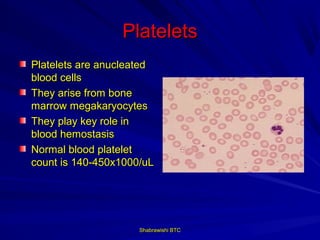
Platelets
Platelets are anucleated
blood cells
They arise from bone
marrow megakaryocytes
They play key role in
blood hemostasis
Normal blood platelet
count is 140-450x1000/uL


                     Shabrawishi BTC
Thrombocyopenia
Hereditary thrombocytopenia as TAR,
May-Hegglin,……..etc
Acquired as in ITP, TTP, hypersplinism,…
etc


                Shabrawishi BTC
Thrombasthenia
Hereditary as Glanzmann thrombasthenia,
Bernard-Soulier Syndrome,…… etc
Acquired thrombasthenia as in drug
induced cases due to salicylates and non-
steroidal anti-inflammatory drugs


                Shabrawishi BTC
Indications of Platelet Transfusion
Severe thrombocytopenia <5000/ul in
patients without clinical bleeding
Thrombocytopenia with clinical bleeding or
as supportive therapy during
chemo/radiotherapy and in
transplantations


                Shabrawishi BTC
Contraindications of Platelet
          Transfusion
Autoimmune thrombocytopenia
Thrombotic Thrombocytopenic Purpura &
related syndromes


               Shabrawishi BTC
Platelet Donor Criteria
Age, 18 – 55 years
Sex
Donor Screening
Blood Screening (HBV, HCV, HIV 1&2
serology & ID-NAT + Syphilis Ab)
Blood group & Rh
No Salicylates or non steroidal anti-
inflammatory drugs for 7 days
                Shabrawishi BTC
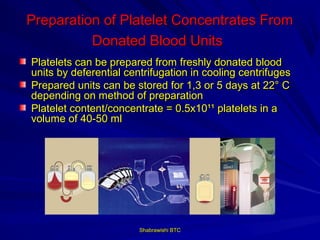
Preparation of Platelet Concentrates From
          Donated Blood Units
Platelets can be prepared from freshly donated blood
units by deferential centrifugation in cooling centrifuges
Prepared units can be stored for 1,3 or 5 days at 22° C
depending on method of preparation
Platelet content/concentrate = 0.5x10¹¹ platelets in a
volume of 40-50 ml


                        Shabrawishi BTC
Preparation of Platelet Concentrate
      Using Cell Separators
 Blood donors can donate platelets only by cell
 separators

 Depending on donor platelet count one can obtain single
 or double platelet therapeutic dose

 Platelet therapeutic dose= 3x10¹¹ in 200 ml plasma
 volume and can be stored for 1,3 or 5 days at 22° C on
 platelet shaker

 Ideally it should contain <5x10*6 leucocytes


                        Shabrawishi BTC
Dose of Platelet Transfusion
In clinical bleeding, platelet transfusion
should be given untill bleeding is controled
In prophylaxis as in surgery and
chemo/radiotherapy, the required level of
platelets is determined by the clinician
according to many factors, eg. Type of
surgery, clinical condition of the patient,
……. etc

                 Shabrawishi BTC
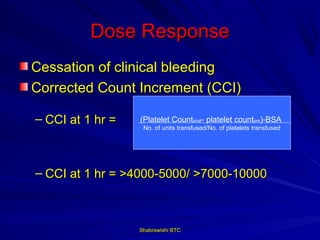
Dose Response
Cessation of clinical bleeding
Corrected Count Increment (CCI)

– CCI at 1 hr =   (Platelet Countpost- platelet countpre)-BSA
                   No. of units transfused/No. of platelets transfused


– CCI at 1 hr = >4000-5000/ >7000-10000


                  Shabrawishi BTC
Complications of Platelet Transfusion

Immunolgical
Bacterial
Viral


               Shabrawishi BTC
Immunologicl Complications
Allergy & Anaphylaxis
PTP
GVHD
Platelet Refractoriness


                 Shabrawishi BTC
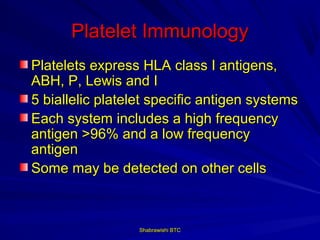
Platelet Immunology
Platelets express HLA class I antigens,
ABH, P, Lewis and I
5 biallelic platelet specific antigen systems
Each system includes a high frequency
antigen >96% and a low frequency
antigen
Some may be detected on other cells


                  Shabrawishi BTC
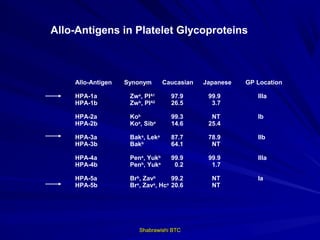
Allo-Antigens in Platelet Glycoproteins


    Allo-Antigen   Synonym       Caucasian   Japanese   GP Location

    HPA-1a          Zw a, PIA1     97.9       99.9         IIIa
    HPA-1b          Zw b, PIA2     26.5        3.7

    HPA-2a          Kob            99.3        NT          Ib
    HPA-2b          Koa, Siba      14.6       25.4

    HPA-3a          Baka, Leka     87.7       78.9         IIb
    HPA-3b          Bakb           64.1        NT

    HPA-4a          Pena, Yukb     99.9       99.9         IIIa
    HPA-4b          Penb, Yuka      0.2        1.7

    HPA-5a          Brb, Zavb      99.2        NT          Ia
    HPA-5b          Br , Zav , Hc 20.6
                      a     a    a
                                               NT


                       Shabrawishi BTC
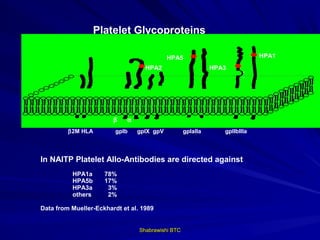
Platelet Glycoproteins

                                                HPA5                            HPA1
                                       HPA2                      HPA3
                                                                           s
                                                                           s


                                ss


                        β    α
         β2M HLA         gpIb        gpIX gpV          gpIaIIa      gpIIbIIIa


In NAITP Platelet Allo-Antibodies are directed against
          HPA1a      78%
          HPA5b      17%
          HPA3a       3%
          others      2%

Data from Mueller-Eckhardt et al. 1989


                                     Shabrawishi BTC
Platelet Antibodies
A platelet reactive antibody may react against
any antigen on the platelet
Platelet antibodies may be HLA (class I) ,
platelet specific antigen, ABH, ... Etc specific
antibodies
Like red cell antibodies, they are IgG or Ig M and
cause mostly extravascular destruction
The antibodies may be auto or allo-antibodies


                    Shabrawishi BTC
Post Transfusion Purpura, PTP


• PTP is a rare (1 / 50000) but severe side effect of blood transfusion
 that resembles DTR due to red cell transfusion

• In more than 90% of patients PTP is encountered in women who are
 HPA1b and have developed anti HPA1a antibodies due to
 immunization by previous pregnancy

• Fall in platelet count 5 to 10 days after transfusion of any of the blood
 components

• Mortality is high, some 5% of PTP cases die

• The most effective therapy is plasmapheresis &/or IVIg

• Corticosteroids is an essential therapy in combination with other
 therapies
                                 Shabrawishi BTC
Graft Versus Host Disease (GVHD)
 It is reactivity of donor lymphocytes
 against host tissues in immuno-
 suppressed patients
 This causes dermatitis, hepatitis,
 gastroentritis & if it happens due to
 transfusion of cellular blood components it
 is usually fatal
 It can be prevented by irradiation of RBCs
 & platelets

                  Shabrawishi BTC
Platelet Refractoriness, PR


• Platelets are given to thrombocytopenic cancer patients to prevent
 major hemorrhage

• PR is the less than expected increase in platelet count

• PR occurs in 10 to 20% of patients who receive prophylactic platelets

• 1.4 million platelet concentrates from 5.6 million donations are used
 each year in the EU

• Anti-HLA or anti-HPA antibodies destroy transfused random
 ABO/RhD-compatible platelets

• The refractory state increases the chance of major bleeding,
 including cerebral bleeding

• Treatment of choice is HLA and HPA selected donor platelets or
 platelet cross matching
                                 Shabrawishi BTC
Causes of Platelet Refractoriness
Non-immunological
– Splenomegaly
– Drugs (eg amphotricin B)
– Accelerated platelet consumption


                  Shabrawishi BTC
Management of PR
Prevention by leucodepleted cellular blood
components, <5×10⁶ WBCs/blood
product
HLA & HPA matched donors
Cross matched platelet concentrates


                Shabrawishi BTC
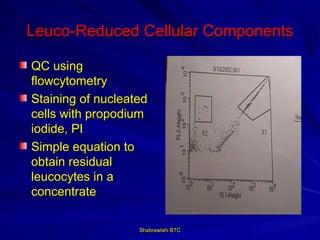
Leuco-Reduced Cellular Components

QC using
flowcytometry
Staining of nucleated
cells with propodium
iodide, PI
Simple equation to
obtain residual
leucocytes in a
concentrate

                   Shabrawishi BTC
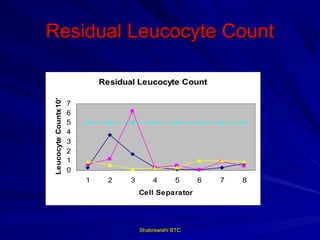
Residual Leucocyte Count

                               Residual Leucocyte Count
Leucocyte Countx10*6


                       7
                       6
                       5
                       4
                       3
                       2
                       1
                       0
                           1     2    3       4       5     6   7   8
                                          Cell Separator


                                          Shabrawishi BTC
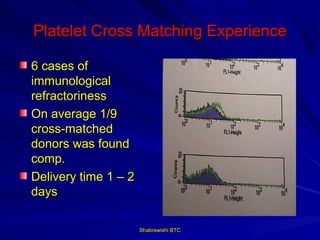
Platelet Cross Matching Experience

6 cases of
immunological
refractoriness
On average 1/9
cross-matched
donors was found
comp.
Delivery time 1 – 2
days

                      Shabrawishi BTC
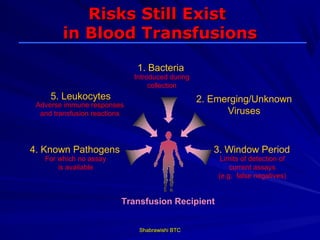
Risks Still Exist
        in Blood Transfusions

                              1. Bacteria
                              Introduced during
                                   collection
     5. Leukocytes                                2. Emerging/Unknown
 Adverse immune responses
  and transfusion reactions                             Viruses


4. Known Pathogens                                   3. Window Period
   For which no assay                                  Limits of detection of
       is available                                       current assays
                                                      (e.g. false negatives)


                          Transfusion Recipient


                               Shabrawishi BTC
Bacterial Contamination
         Risk of bacterial contamination in platelet doses can be
          as high as 1:2,0001
         The mortality rate for platelet-related sepsis is one in four 2
         A prospective study3 of 3,584 platelet transfusions in 161
          bone marrow transplant patients demonstrated risk of
          symptomatic bacteremia as:
                   • 1 per 16 patients
                   •     1 per 350 transfusions
                   •     1 per 2,100 platelet units
     UK SHOT data reported three deaths in UK between
      1996 and 1999 as a result of bacterial contamination4
1
    Blajchman MA, The Safety of the Blood Supply, Hillyer CD ed. 1999: 18-27.    3
                                                                                   Chiu EKW et al, Transfusion. 1994:34:950-953.
2
    Goodnough LT et al, New England Journal of Medicine. 1999; 340/6: 438-447. 4 Love EM et al. The Serious Hazards of Transfusion Annual
                                                                       Report 1999-2000. Published March 2001.
Emerging/Unknown Pathogens

   It is impossible to know if and when emerging
    pathogens will threaten the safety of the blood
    supply

   Impact of previously unknown pathogens is
    demonstrated through HCV and HIV

   New viruses continue to emerge at a rate of every
    2–3 years with a potentially damaging virus
    transmitted through blood every 5 years1


    1
     LEK Consulting. Market research commissioned by Baxter Healthcare Corporation.
    Boston, MA, USA: January 2001.
                                                     Shabrawishi BTC
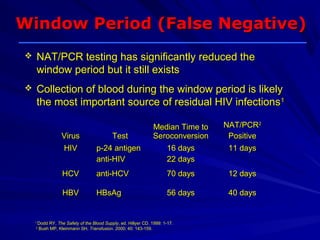
Window Period (False Negative)
   NAT/PCR testing has significantly reduced the
    window period but it still exists
   Collection of blood during the window period is likely
    the most important source of residual HIV infections1

                                                                  Median Time to   NAT/PCR2
                    Virus                 Test                    Seroconversion    Positive
                    HIV              p-24 antigen                    16 days        11 days
                                     anti-HIV                        22 days
                    HCV              anti-HCV                           70 days     12 days

                    HBV              HBsAg                              56 days     40 days


    1
        Dodd RY, The Safety of the Blood Supply, ed. Hillyer CD. 1999: 1-17.
    2
        Bush MP, Kleinmann SH, Transfusion. 2000; 40: 143-159.
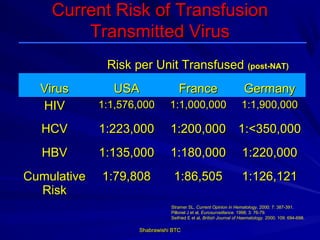
Current Risk of Transfusion
        Transmitted Virus
              Risk per Unit Transfused (post-NAT)
  Virus        USA                France                            Germany
  HIV        1:1,576,000       1:1,000,000                         1:1,900,000

  HCV        1:223,000         1:200,000 1:<350,000
  HBV        1:135,000         1:180,000                           1:220,000
Cumulative   1:79,808           1:86,505                           1:126,121
  Risk
                               Stramer SL, Current Opinion in Hematology. 2000; 7: 387-391.
                               Pillonel J et al, Eurosurveillance. 1998; 3: 76-79.
                               Seifried E et al, British Journal of Haematology. 2000; 109: 694-698.

                    Shabrawishi BTC
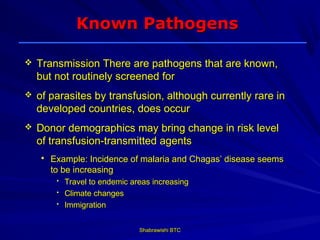
Known Pathogens

   Transmission There are pathogens that are known,
    but not routinely screened for
   of parasites by transfusion, although currently rare in
    developed countries, does occur
   Donor demographics may bring change in risk level
    of transfusion-transmitted agents
       Example: Incidence of malaria and Chagas’ disease seems
        to be increasing
         • Travel to endemic areas increasing
         • Climate changes
         • Immigration


                               Shabrawishi BTC
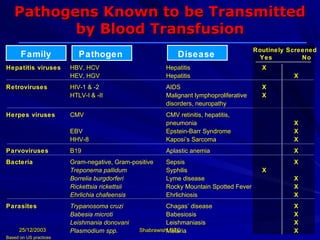
Pathogens Known to be Transmitted
          by Blood Transfusion
                                                                                        Routinely Screened
      Family               Pathogen                         Disease                      Yes          No
Hepatitis viruses       HBV, HCV                        Hepatitis                         X
                        HEV, HGV                        Hepatitis                                  X
Retroviruses            HIV-1 & -2                      AIDS                              X
                        HTLV-I & -II                    Malignant lymphoproliferative     X
                                                        disorders, neuropathy
Herpes viruses          CMV                             CMV retinitis, hepatitis,
                                                        pneumonia                                  X
                        EBV                             Epstein-Barr Syndrome                      X
                        HHV-8                           Kaposi’s Sarcoma                           X
Parvoviruses            B19                             Aplastic anemia                            X
Bacteria                Gram-negative, Gram-positive    Sepsis                                     X
                        Treponema pallidum              Syphilis                          X
                        Borrelia burgdorferi            Lyme disease                               X
                        Rickettsia rickettsii           Rocky Mountain Spotted Fever               X
                        Ehrlichia chafeensis            Ehrlichiosis                               X
Parasites               Trypanosoma cruzi                Chagas’ disease                           X
                        Babesia microti                  Babesiosis                                X
                        Leishmania donovani              Leishmaniasis                             X
      25/12/2003        Plasmodium spp.        Shabrawishi BTC
                                                         Malaria                                   X
Based on US practices
Pathogen Inactivation
    Technology


        Shabrawishi BTC
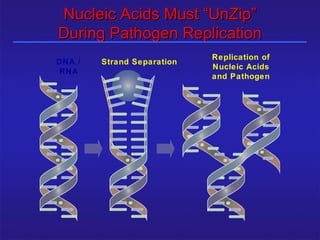
Nucleic Acids Must “UnZip”
             During Pathogen Replication
                                               Replication of
             DNA /   Strand Separation
                                               Nucleic Acids
             RNA
                                               and Pathogen


25/12/2003                   Shabrawishi BTC
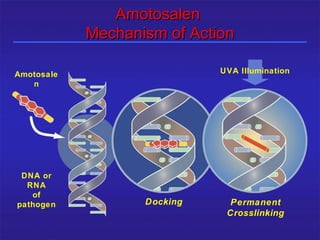
Amotosalen
             Mechanism of Action

Amotosale                            UVA Illumination
   n


 DNA or
  RNA
   of
pathogen             Docking           Permanent
                                      Crosslinking
25/12/2003         Shabrawishi BTC
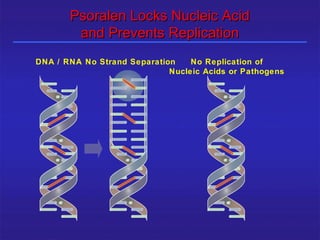
Psoralen Locks Nucleic Acid
              and Prevents Replication
      DNA / RNA No Strand Separation    No Replication of
                                   Nucleic Acids or Pathogens


25/12/2003                  Shabrawishi BTC
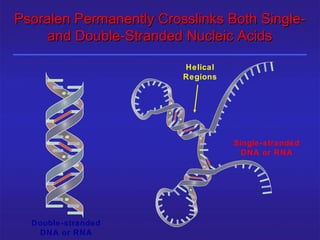
Psoralen Permanently Crosslinks Both Single-
    and Double-Stranded Nucleic Acids

                                         Helical
                                         Regions


                                                   Single-stranded
                                                    DNA or RNA


     Double-stranded
25/12/2003             Shabrawishi BTC
        DNA or RNA
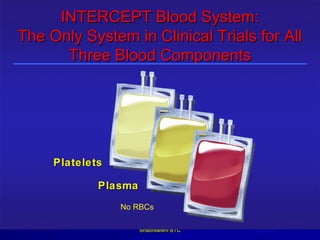
INTERCEPT Blood System:
The Only System in Clinical Trials for All
      Three Blood Components


     Platelets

             Plasma
                 No RBCs

                      Shabrawishi BTC
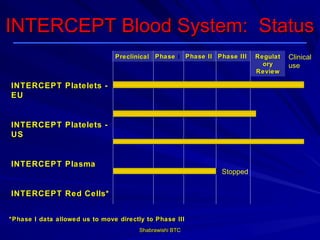
INTERCEPT Blood System: Status
                                Preclinical Phase I Phase II Phase III   Regulat   Clinical
                                                                           ory     use
                                                                         Review

INTERCEPT Platelets -
EU


INTERCEPT Platelets -
US


INTERCEPT Plasma
                                                              Stopped


INTERCEPT Red Cells*


*Phase I data allowed us to move directly to Phase III
                                        Shabrawishi BTC
Psoralen Blood System for Platelets and
    Plasma Use a Similar Process

The Psoralen Blood System for platelets
and plasma use the same compound
This compound, amotosalen, is activated
by UVA light
Both systems use the same UVA device
(the Illuminator)


                Shabrawishi BTC
Conclusion
Platelet transfusion is an important
therapeutic modality in transfusion
medicine
GMP, proper prescription and accurate
monitoring are all essential factors for safe
and effective outcome


                  Shabrawishi BTC
Shabrawishi BTC

Platelet transfusion

  • 1.
    Platelet Transfusion Magdy El Ekiaby,MD Shabrawishi BTC Shabrawishi BTC
  • 2.
    Platelets Platelets are anucleated bloodcells They arise from bone marrow megakaryocytes They play key role in blood hemostasis Normal blood platelet count is 140-450x1000/uL Shabrawishi BTC
  • 3.
    Thrombocyopenia Hereditary thrombocytopenia asTAR, May-Hegglin,……..etc Acquired as in ITP, TTP, hypersplinism,… etc Shabrawishi BTC
  • 4.
    Thrombasthenia Hereditary as Glanzmannthrombasthenia, Bernard-Soulier Syndrome,…… etc Acquired thrombasthenia as in drug induced cases due to salicylates and non- steroidal anti-inflammatory drugs Shabrawishi BTC
  • 5.
    Indications of PlateletTransfusion Severe thrombocytopenia <5000/ul in patients without clinical bleeding Thrombocytopenia with clinical bleeding or as supportive therapy during chemo/radiotherapy and in transplantations Shabrawishi BTC
  • 6.
    Contraindications of Platelet Transfusion Autoimmune thrombocytopenia Thrombotic Thrombocytopenic Purpura & related syndromes Shabrawishi BTC
  • 7.
    Platelet Donor Criteria Age,18 – 55 years Sex Donor Screening Blood Screening (HBV, HCV, HIV 1&2 serology & ID-NAT + Syphilis Ab) Blood group & Rh No Salicylates or non steroidal anti- inflammatory drugs for 7 days Shabrawishi BTC
  • 8.
    Preparation of PlateletConcentrates From Donated Blood Units Platelets can be prepared from freshly donated blood units by deferential centrifugation in cooling centrifuges Prepared units can be stored for 1,3 or 5 days at 22° C depending on method of preparation Platelet content/concentrate = 0.5x10¹¹ platelets in a volume of 40-50 ml Shabrawishi BTC
  • 9.
    Preparation of PlateletConcentrate Using Cell Separators Blood donors can donate platelets only by cell separators Depending on donor platelet count one can obtain single or double platelet therapeutic dose Platelet therapeutic dose= 3x10¹¹ in 200 ml plasma volume and can be stored for 1,3 or 5 days at 22° C on platelet shaker Ideally it should contain <5x10*6 leucocytes Shabrawishi BTC
  • 10.
    Dose of PlateletTransfusion In clinical bleeding, platelet transfusion should be given untill bleeding is controled In prophylaxis as in surgery and chemo/radiotherapy, the required level of platelets is determined by the clinician according to many factors, eg. Type of surgery, clinical condition of the patient, ……. etc Shabrawishi BTC
  • 11.
    Dose Response Cessation ofclinical bleeding Corrected Count Increment (CCI) – CCI at 1 hr = (Platelet Countpost- platelet countpre)-BSA No. of units transfused/No. of platelets transfused – CCI at 1 hr = >4000-5000/ >7000-10000 Shabrawishi BTC
  • 12.
    Complications of PlateletTransfusion Immunolgical Bacterial Viral Shabrawishi BTC
  • 13.
    Immunologicl Complications Allergy &Anaphylaxis PTP GVHD Platelet Refractoriness Shabrawishi BTC
  • 14.
    Platelet Immunology Platelets expressHLA class I antigens, ABH, P, Lewis and I 5 biallelic platelet specific antigen systems Each system includes a high frequency antigen >96% and a low frequency antigen Some may be detected on other cells Shabrawishi BTC
  • 15.
    Allo-Antigens in PlateletGlycoproteins Allo-Antigen Synonym Caucasian Japanese GP Location HPA-1a Zw a, PIA1 97.9 99.9 IIIa HPA-1b Zw b, PIA2 26.5 3.7 HPA-2a Kob 99.3 NT Ib HPA-2b Koa, Siba 14.6 25.4 HPA-3a Baka, Leka 87.7 78.9 IIb HPA-3b Bakb 64.1 NT HPA-4a Pena, Yukb 99.9 99.9 IIIa HPA-4b Penb, Yuka 0.2 1.7 HPA-5a Brb, Zavb 99.2 NT Ia HPA-5b Br , Zav , Hc 20.6 a a a NT Shabrawishi BTC
  • 16.
    Platelet Glycoproteins HPA5 HPA1 HPA2 HPA3 s s ss β α β2M HLA gpIb gpIX gpV gpIaIIa gpIIbIIIa In NAITP Platelet Allo-Antibodies are directed against HPA1a 78% HPA5b 17% HPA3a 3% others 2% Data from Mueller-Eckhardt et al. 1989 Shabrawishi BTC
  • 17.
    Platelet Antibodies A plateletreactive antibody may react against any antigen on the platelet Platelet antibodies may be HLA (class I) , platelet specific antigen, ABH, ... Etc specific antibodies Like red cell antibodies, they are IgG or Ig M and cause mostly extravascular destruction The antibodies may be auto or allo-antibodies Shabrawishi BTC
  • 18.
    Post Transfusion Purpura,PTP • PTP is a rare (1 / 50000) but severe side effect of blood transfusion that resembles DTR due to red cell transfusion • In more than 90% of patients PTP is encountered in women who are HPA1b and have developed anti HPA1a antibodies due to immunization by previous pregnancy • Fall in platelet count 5 to 10 days after transfusion of any of the blood components • Mortality is high, some 5% of PTP cases die • The most effective therapy is plasmapheresis &/or IVIg • Corticosteroids is an essential therapy in combination with other therapies Shabrawishi BTC
  • 19.
    Graft Versus HostDisease (GVHD) It is reactivity of donor lymphocytes against host tissues in immuno- suppressed patients This causes dermatitis, hepatitis, gastroentritis & if it happens due to transfusion of cellular blood components it is usually fatal It can be prevented by irradiation of RBCs & platelets Shabrawishi BTC
  • 20.
    Platelet Refractoriness, PR •Platelets are given to thrombocytopenic cancer patients to prevent major hemorrhage • PR is the less than expected increase in platelet count • PR occurs in 10 to 20% of patients who receive prophylactic platelets • 1.4 million platelet concentrates from 5.6 million donations are used each year in the EU • Anti-HLA or anti-HPA antibodies destroy transfused random ABO/RhD-compatible platelets • The refractory state increases the chance of major bleeding, including cerebral bleeding • Treatment of choice is HLA and HPA selected donor platelets or platelet cross matching Shabrawishi BTC
  • 21.
    Causes of PlateletRefractoriness Non-immunological – Splenomegaly – Drugs (eg amphotricin B) – Accelerated platelet consumption Shabrawishi BTC
  • 22.
    Management of PR Preventionby leucodepleted cellular blood components, <5×10⁶ WBCs/blood product HLA & HPA matched donors Cross matched platelet concentrates Shabrawishi BTC
  • 23.
    Leuco-Reduced Cellular Components QCusing flowcytometry Staining of nucleated cells with propodium iodide, PI Simple equation to obtain residual leucocytes in a concentrate Shabrawishi BTC
  • 24.
    Residual Leucocyte Count Residual Leucocyte Count Leucocyte Countx10*6 7 6 5 4 3 2 1 0 1 2 3 4 5 6 7 8 Cell Separator Shabrawishi BTC
  • 25.
    Platelet Cross MatchingExperience 6 cases of immunological refractoriness On average 1/9 cross-matched donors was found comp. Delivery time 1 – 2 days Shabrawishi BTC
  • 26.
    Risks Still Exist in Blood Transfusions 1. Bacteria Introduced during collection 5. Leukocytes 2. Emerging/Unknown Adverse immune responses and transfusion reactions Viruses 4. Known Pathogens 3. Window Period For which no assay Limits of detection of is available current assays (e.g. false negatives) Transfusion Recipient Shabrawishi BTC
  • 27.
    Bacterial Contamination  Risk of bacterial contamination in platelet doses can be as high as 1:2,0001  The mortality rate for platelet-related sepsis is one in four 2  A prospective study3 of 3,584 platelet transfusions in 161 bone marrow transplant patients demonstrated risk of symptomatic bacteremia as: • 1 per 16 patients • 1 per 350 transfusions • 1 per 2,100 platelet units  UK SHOT data reported three deaths in UK between 1996 and 1999 as a result of bacterial contamination4 1 Blajchman MA, The Safety of the Blood Supply, Hillyer CD ed. 1999: 18-27. 3 Chiu EKW et al, Transfusion. 1994:34:950-953. 2 Goodnough LT et al, New England Journal of Medicine. 1999; 340/6: 438-447. 4 Love EM et al. The Serious Hazards of Transfusion Annual Report 1999-2000. Published March 2001.
  • 28.
    Emerging/Unknown Pathogens  It is impossible to know if and when emerging pathogens will threaten the safety of the blood supply  Impact of previously unknown pathogens is demonstrated through HCV and HIV  New viruses continue to emerge at a rate of every 2–3 years with a potentially damaging virus transmitted through blood every 5 years1 1 LEK Consulting. Market research commissioned by Baxter Healthcare Corporation. Boston, MA, USA: January 2001. Shabrawishi BTC
  • 29.
    Window Period (FalseNegative)  NAT/PCR testing has significantly reduced the window period but it still exists  Collection of blood during the window period is likely the most important source of residual HIV infections1 Median Time to NAT/PCR2 Virus Test Seroconversion Positive HIV p-24 antigen 16 days 11 days anti-HIV 22 days HCV anti-HCV 70 days 12 days HBV HBsAg 56 days 40 days 1 Dodd RY, The Safety of the Blood Supply, ed. Hillyer CD. 1999: 1-17. 2 Bush MP, Kleinmann SH, Transfusion. 2000; 40: 143-159.
  • 30.
    Current Risk ofTransfusion Transmitted Virus Risk per Unit Transfused (post-NAT) Virus USA France Germany HIV 1:1,576,000 1:1,000,000 1:1,900,000 HCV 1:223,000 1:200,000 1:<350,000 HBV 1:135,000 1:180,000 1:220,000 Cumulative 1:79,808 1:86,505 1:126,121 Risk Stramer SL, Current Opinion in Hematology. 2000; 7: 387-391. Pillonel J et al, Eurosurveillance. 1998; 3: 76-79. Seifried E et al, British Journal of Haematology. 2000; 109: 694-698. Shabrawishi BTC
  • 31.
    Known Pathogens  Transmission There are pathogens that are known, but not routinely screened for  of parasites by transfusion, although currently rare in developed countries, does occur  Donor demographics may bring change in risk level of transfusion-transmitted agents  Example: Incidence of malaria and Chagas’ disease seems to be increasing • Travel to endemic areas increasing • Climate changes • Immigration Shabrawishi BTC
  • 32.
    Pathogens Known tobe Transmitted by Blood Transfusion Routinely Screened Family Pathogen Disease Yes No Hepatitis viruses HBV, HCV Hepatitis X HEV, HGV Hepatitis X Retroviruses HIV-1 & -2 AIDS X HTLV-I & -II Malignant lymphoproliferative X disorders, neuropathy Herpes viruses CMV CMV retinitis, hepatitis, pneumonia X EBV Epstein-Barr Syndrome X HHV-8 Kaposi’s Sarcoma X Parvoviruses B19 Aplastic anemia X Bacteria Gram-negative, Gram-positive Sepsis X Treponema pallidum Syphilis X Borrelia burgdorferi Lyme disease X Rickettsia rickettsii Rocky Mountain Spotted Fever X Ehrlichia chafeensis Ehrlichiosis X Parasites Trypanosoma cruzi Chagas’ disease X Babesia microti Babesiosis X Leishmania donovani Leishmaniasis X 25/12/2003 Plasmodium spp. Shabrawishi BTC Malaria X Based on US practices
  • 33.
    Pathogen Inactivation Technology Shabrawishi BTC
  • 34.
    Nucleic Acids Must“UnZip” During Pathogen Replication Replication of DNA / Strand Separation Nucleic Acids RNA and Pathogen 25/12/2003 Shabrawishi BTC
  • 35.
    Amotosalen Mechanism of Action Amotosale UVA Illumination n DNA or RNA of pathogen Docking Permanent Crosslinking 25/12/2003 Shabrawishi BTC
  • 36.
    Psoralen Locks NucleicAcid and Prevents Replication DNA / RNA No Strand Separation No Replication of Nucleic Acids or Pathogens 25/12/2003 Shabrawishi BTC
  • 37.
    Psoralen Permanently CrosslinksBoth Single- and Double-Stranded Nucleic Acids Helical Regions Single-stranded DNA or RNA Double-stranded 25/12/2003 Shabrawishi BTC DNA or RNA
  • 38.
    INTERCEPT Blood System: TheOnly System in Clinical Trials for All Three Blood Components Platelets Plasma No RBCs Shabrawishi BTC
  • 39.
    INTERCEPT Blood System:Status Preclinical Phase I Phase II Phase III Regulat Clinical ory use Review INTERCEPT Platelets - EU INTERCEPT Platelets - US INTERCEPT Plasma Stopped INTERCEPT Red Cells* *Phase I data allowed us to move directly to Phase III Shabrawishi BTC
  • 40.
    Psoralen Blood Systemfor Platelets and Plasma Use a Similar Process The Psoralen Blood System for platelets and plasma use the same compound This compound, amotosalen, is activated by UVA light Both systems use the same UVA device (the Illuminator) Shabrawishi BTC
  • 41.
    Conclusion Platelet transfusion isan important therapeutic modality in transfusion medicine GMP, proper prescription and accurate monitoring are all essential factors for safe and effective outcome Shabrawishi BTC
  • 42.

Editor's Notes