ACUTE BRAIN ATTACK - 911 RUBEN T. DELA CRUZ  MD, FPNA ACUTE STROKE UNIT- MANILA ADVENTIST MEDICAL CENTER
OBJECTIVES STROKE IMPACT  KNOW THE CLASSIFICATION OF STROKES HOW TO DIAGNOSE STROKES GUIDELINES FOR ACUTE STROKE TREATMENT
STROKE IMPACT STROKE IS BRAIN ATTACK ! Sudden onset of focal neurological deficit lasting  more than 24 hours  due to an underlying vascular pathology. No. 2 Killer  worldwide No. 1 Killer  in Asia- Western Pacific, China, and Japan 20 million  people every year with  5 million  deaths Locally:  500  strokes per  100,000  population
CLINICAL STROKE CLASSIFICATION TIA AND MILD STROKE MODERATE STROKE SEVERE STROKE
TIA and MILD STROKE Transient Ischemic Attack-  deficits resolved within 24 hours including transient blindness in one eye OR ALERT Patient  with any of the ff: a. mild pure motor weakness of one side of the body. b. pure sensory deficit c. slurred speech but intelligible d. vertigo with incoordination e. visual field defects alone f. combination of a and b
MODERATE STROKE Awake  patient with  significant  motor and/or sensory and/or language and/or visual deficit OR Disoriented , drowsy, or  stuporous  patient but with  purposeful response  to painful stimuli
SEVERE STROKE Comatose  patient with nonpurposeful response,  decorticate, OR Decerebrate posturing  to painful stimuli or comatose patient with no response to painful stimuli
DIAGNOSING STROKE Clinical – (80%)  2.  Neuroimaging – (20%)  * Establish the time of onset of symptoms * Cranial CT scan is the initial imaging  study of choice Sudden, focal, Loss of function History, Physical & Neurological Exam
ROLE of DIAGNOSTIC EXAM   Confirm & establish the clinical diagnosis Rule out stroke “mimickers” Determine pathologic type  Infarct, ICH, SAH Determine etiology & stroke mechanism Screen for medical & neurologic complications of stroke
COMMON STROKE “MIMICKERS” Seizures Systemic infection Brain tumor Toxic-metabolic enceph Positional vertigo Syncope Trauma Subdural hematoma Herpes enceph Transient global amnesia Dementia Demyelinating dse Cervical spine fracture Myasthenia gravis Parkinson’s dse Hypertensive enceph Conversion disorder Bell’s palsy
DIFFERENTIAL DIAGNOSIS OF STROKE Pure hemifacial weakness (e.g. Bell’s palsy) Fever prior to onset of symptoms  Trauma  Recurrent seizures Weakness with atrophy Recurrent headaches If any of the ff conditions is present,  STROKE is probably UNLIKELY …. SSP Guidelines for the Prevention & Management  of Brain Attack, 2003
With the advent of numerous diagnostic modalities, appropriate  sequential diagnostic examinations  are most important to confirm the clinical diagnosis of stroke. First-line (emergent) diagnostic exam   Second-line diagnostic investigations
CBC, PT/ PTT,  Blood sugar Plain Cranial CT EMERGENT DIAGNOSTIC EXAM   SSP Guidelines for the Prevention & Management  of Brain Attack, 2003 Electrocardiogram
SECOND-LINE DIAGNOSTIC STUDIES  (To Identify Etiology and Stroke Mechanism) Neurovascular Studies Carotid Duplex Transcranial Doppler studies(TCD) Catheter Angiography CT Angiography  Magnetic Resonance Angiography (MRA) Cardiac investigation Echocardiography 24 hour Holter
 
Hematologic Studies Hypercoagulable states – Protein C, S, Fibrinogen  Antithrombin III   APAS - ANA, Anticardiolipin Ab, Lupus anticoagulant Homocysteine  Drug Levels  – e.g. Metamphetamine Genetic  – Familial homocystinuria, MELAS, CADASIL SECOND-LINE DIAGNOSTIC STUDIES  (To Identify Etiology and Stroke Mechanism) Biopsy  – e.g Vasculitis, Temporal arteritis
Plain Cranial CT is recommended Neuroimaging in Acute Stroke Hyperacute 3 hours 12 hours 48 hours First-line modality imaging in suspected stroke cases Widely available, relatively inexpensive,  non - invasive & quick Accurately  differentiates   hemorrhagic and ischemic strokes Should be performed & interpreted  ASAP
RATIONALE FOR NEUROIMAGING Identify the  lesion   (is it a stroke?) Determine the  type  of stroke  (ischemic or hemorrhage?) Localize  the stroke  (where is it?) Quantify  the lesion  (how large is it?) Determine the  age  of the lesion
BASIC CONCEPTS Cranial computed (x-ray) tomography scan Air, Fluid (e.g. CSF, infarction) =  hypodense  Bone, calcification, blood  =  hyperdense
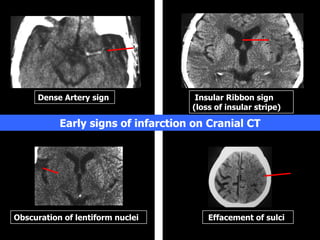
CT FINDINGS in HYPERACUTE INFARCTION (0 - 6 hrs) Almost 60% of CT scans done in the first few hours of ischemic stroke:  NORMAL However, the following signs may be seen: Hyperdense  artery (“dense MCA sign”) Obscuration  of lentiform nuclei Loss of grey-white interphase  along lateral insula (“insular ribbon sign”) Effacement  of sulci
Early signs of infarction on Cranial CT Dense Artery sign Insular Ribbon sign (loss of insular stripe) Obscuration of lentiform nuclei Effacement of sulci
CRANIAL CT in  ACUTE ISCHEMIC STROKE Infarction:   focal  hypodense area  in cortical, subcortical, or deep gray or white matter, following a vascular territory, or watershed distribution
CT FINDINGS in SUBACUTE /  CHRONIC INFARCTION Wedge-shaped large cortical infarct Round / ovoid small subcortical infarcts
Subacute  R-ICA infarct Subacute L-MCA infarct CT FINDINGS in SUBACUTE /  CHRONIC INFARCTION
Hyperdense lesion in left lentiform nucleus with hypodense rim (vasogenic edema) CT FINDINGS in INTRACEREBRAL HEMORRHAGE
Common Sites of Hypertensive ICH
Cranial CT of Hemorrhagic Stroke Stroke Society of the Philippines recommendations for computation of  hematoma volume Planimetric Method or Pixel Method Modified Kothari method (ABC/2)
A - greatest hemorrhage diameter B  -   diameter 90 degrees to A C -  no of CT slices  with hemorrhage x  by the slice thickness *  Measurement of Hematoma Volume Modified Kothari Method A x B x C  /  2 Select the CT slice with the largest  area of hemorrhage A B Hemorrhage > 75% of the largest area = 1 slice Hemorrhage  >  25 – 75% of the largest area = 0.5 slice Hemorrhage < 25% of the largest area - 0
Interpretation of Hematoma Volume for Supratentorial Hemorrhages < 30cc  small   medical 30 – 50cc moderate > 50cc large   surgical * Factor in age, neurologic status, concomitant medical conditions
CT SCAN FINDINGS in SUBARACHNOID HEMORRHAGE
Advantages of Cranial MRI DIAGNOSING STROKE: Other Neuroimaging Techniques More sensitive in detecting  small lesions / lacunar infarcts early infarction brainstem / post fossa lesions Can detect lesions as early as 6 hours from  onset of stroke (as early as 90 mins. for  Diffusion MRI)
Early signs of infarction on MRI Slow flow (absence of normal flow void) in involved artery Parenchymal signal changes (hypointense on T1) T1 DWI: acute infarct appears bright Parenchymal signal changes (hyperintense on T2) T2
R medullary Infarction T1 T2 MAGNETIC RESONANCE IMAGING in BRAINSTEM INFARCTION R Pontine Infarction
Limitations of Cranial MRI DIAGNOSING STROKE: Other Neuroimaging Techniques More expensive & less widely available Longer acquisition time compared to CT (difficult in uncooperative patients) Contraindicated in patients with metallic    implants (e.g. pacemaker) Not sensitive in detecting acute hemorrhage
MRI is  not sensitive  in detecting  ACUTE HEMORRHAGE Cranial MRI Cranial CT scan Pontine Hemorrhage
NEUROVASCULAR EVALUATION Ultrasound Techniques Catheter Angiography CT Angiography MR Angiography
RATIONALE for NEUROVASCULAR EVALUATION Identifying occlusive arterial disease  (Is there blockage ?) Localizing the occlusion  (Where ?, carotid ?, intracranial ?) Quantifying the degree of stenosis  (How severe ?) Determining the pathology  (Athero ?, dissection ?, others ?)  Identifying other vascular lesions
Recommendations for Neurovascular Imaging in Patients with Stroke   A non-invasive screening technique is indicated as an  initial diagnostic test Conventional radiographic angiography may be  indicated based on findings of non-invasive  screening procedures (i.e. severe stenosis,  occlusion) Cerebral arteriography may also be required when a  diagnosis of vasculitis, dissection, vascular  malformation needs confirmation or exclusion
Transcranial Doppler (TCD) Carotid/vertebral Duplex VASCULAR  ULTRASOUND  “ NEUROSONOLOGY ”
CAROTID DUPLEX Established technique to identify  extracranial carotid / vertebral artery disease Advantages: non-invasive, bedside availability, low cost Disadvantages: operator  dependent, unable to differentiate  occlusion from near occlusion
TRANSCRANIAL DOPPLER Established technique to evaluate basal intracranial arteries Established utility in stroke (e.g. stenosis,    vasospasm,    ICP, vasomotor reactivity)  Advantages: non-invasive, bedside availability, low  cost, allows serial monitoring, detects  micro emboli Disadvantages: operator dependent, poor temporal  window, circle of Willis variation
Stenosis / occlusion Emboli detection  Collateralization Vasospasm Increased ICP / Brain death Cerebral Autoregulation TCD APPLICATION in STROKE
MAGNETIC RESONANCE    ANGIOGRAPHY CT ANGIOGRAPHY Other Non-Invasive  Neurovascular Imaging Procedures
Severe  Carotid Stenosis CATHETER ANGIOGRAPHY Vertebral  Artery Stenosis MCA  Stenosis “  Gold standard”
AV Malformation CATHETER ANGIOGRAPHY Venous angioma Aneurysm Cost, availability, invasive procedure Risks (vascular damage, stroke, ionizing radiation, reaction to contrast) Exclusion: poor renal function, absent femoral pulses, coagulopathy
CARDIAC EVALUATION Holter Monitoring 2 D Echocardiography
Recommendations for Echocardiography in Patients with Stroke … Clinical evidence of heart disease Less than or equal 45 years of age  Older patients, without evidence of extra or intracranial  occlusive disease or other obvious cause Abrupt occlusion of major peripheral or visceral artery Suspect embolic disease (non-lacunar syndrome,  multiple arterial territory involvement) Clinical therapeutic decision will depend on results of  echocardiography
LV thrombus LV dyskinesia Mitral stenosis Mitral annular calcification Mitral valve prolapse Atrial thrombus   Atrial appendage thrombus Atrial septal aneurysm Patent foramen ovale Aortic arch athero /  dissection Transthoracic vs Transesophageal  Echocardiography TTE Preferred TEE Preferred
Proper use of diagnostic examinations in stroke requires an understanding of:   Underlying disease process Principles of test involved Advantages & limitations of each procedure How each investigation influences patient management
SUMMARY Rule out stroke mimickers History, PE & NE should be done immediately  on patients with stroke Do emergent diagnostic tests to determine  patient’s eligibility for  rTPA
SUMMARY CT scan remains to be the most important brain  imaging test. Cranial MRI is not recommended  for routine evaluation of acute stroke patients Differentiation of ischemic & hemorrhagic stroke is  important because of marked difference in the  management  Second line diagnostic tests need not be done in the  ER setting and should not delay treatment
GUIDELINES FOR TIA AND MILD STROKE MANAGEMENT PRIORITIES Ascertain clinical diagnosis of  stroke or TIA Exclude common  stroke mimickers Monitor and manage blood pressure SBP = 220 or DBP= 120 MAP= 130 Avoid precipitous drop in BP>  20% of        baseline  MAP No  rapid-acting  sublingual  agents Use oral or easily  titratable IV antihypertensive Ensure appropriate hydration.  No hypotonic  IV fluids
GUIDELINES FOR TIA AND MILD STROKE EMERGENT diagnostics Complete Blood count (CBC) Blood sugar (CBG, HGT, or RBS) Electrocardiogram (ECG) PT/PTT (Atrial Fibrillation or possible  cardioembolic source) Plain CT Scan Of brain as soon as possible
GUIDELINES FOR TIA AND MILD STROKE EARLY SPECIFIC TREATMENT FOR THROMBOTIC OR LACUNAR STROKE (CTSCAN CONFIRMED ) Aspirin 160-325 mg start as early as possible for 14 days Neuroprotection Early rehabilitation within 72 hours
GUIDELINES FOR TIA AND MILD STROKE EARLY SPECIFIC TREATMENT FOR CARDIOEMBOLIC (CTSCAN CONFIRMED) Anticoagulation with IV heparin or subcutaneous LMWH Or Aspirin 160-325 mg/day (If anticoagulation not  available) Neuroprotection Early rehabilitation within 72 hours If infective endocarditis is suspected, give antibiotics and  do not anticoagulate.
GUIDELINES FOR TIA AND MILD STROKE EARLY SPECIFIC TREATMENT FOR HEMORRHAGIC If there is suspicion of nonhypertensive cause for ICH (e.g. AVM, aneurysm), REFER to neurosurgeon. Neuroprotection Early rehabilitation with in 72 hrs
GUIDELINES FOR TIA AND MILD STROKE EARLY SPECIFIC TREATMENT FOR T.I.A. Aspirin 160-325 mg/ day If crescendo T I A (multiple events within hours,  Increasing severity and duration of deficits), consider ANTICOAGULATION with intravenous  heparin
GUIDELINES FOR TIA AND MILD STROKE CT SCAN NOT AVAILABLE No specific emergent drug treatment recommended Neuroprotection Consult a neurologist or neurosurgeon Early supportive rehabilitation
GUIDELINES FOR TIA AND MILD STROKE PLACE OF TREATMENT Admit to Hospital (Stroke Unit) 1. Stroke onset within 48 hours 2. Patients requiring specific active intervention  for any of the following: a. BP control, monitoring, and stabilization b. Cardiac stabilization, incl. Atrial    fibrillation, CHF, acute MI c. Hydration d. Anticoagulation, if ICH ruled out by CT
GUIDELINES FOR TIA AND MILD STROKE PLACE OF TREATMENT Admit to Hospital (Stroke   Unit) 3.  Rapidly worsening deficits 4.  >4 TIA’s in 2 weeks prior to consult 5.  1-4 TIA’s in 2 weeks but high risk (multiple  events within hours, increasing severity and  duration of deficits
GUIDELINES FOR TIA AND MILD STROKE PLACE OF TREATMENT URGENT  OUTPATIENT  WORK-UP 1.  S ingle  TIA more than 2 weeks ago 2. 1-4 TIA’s in 2 weeks, but not high risk (no change  in severity and duration of deficit, cardiac  arrhythmia, carotid bruit) 3. Transient monocular blindness alone 4. Stable mild strokes occurring > 48 hrs not  requiring specific active intervention *Advise immediate re-consult if there is worsening of deficit .
GUIDELINES FOR MODERATE STROKE MANAGEMENT PRIORITIES 1. Basic emergent supportive care (ABC of resuscitation) 2.  Monitor and manage blood pressure. Treat if SBP>220; DBP>120; MAP= >130 Precautions: Avoid precipitous drop in BP >20% MAP No Sublingual agents 3. Exclude stroke mimickers 4. Identify co-morbidities (cardiac dis. Gastric ulcer, etc) 5.  Recognize and treat early signs of increased ICP
GUIDELINES FOR MODERATE STROKE EMERGENT DIAGNOSTICS Complete Blood Count Blood sugar (CBG, HGT, RBS) PT/PTT Serum Na and K+ Electrocardiogram (ECG) Plain CT Scan of brain ASAP
GUIDELINES FOR MODERATE STROKE EARLY SPECIFIC TREATMENT (CTSCAN CONFIRMED) Ischemic- Noncardioembolic (Thrombotic/ Lacunar ) - If within 3 hours of stroke onset, consider rtPA    treatment and refer to specialist - Aspirin 160-325 mg/day start as early as  possible - Neuroprotection - Early supportive rehabilitation
GUIDELINES FOR MODERATE STROKE EARLY SPECIFIC TREATMENT (CTSCAN CONFIRMED ) CARDIOEMBOLIC - If within 3 hours of stroke onset consider rtPA `   treatment and refer to specialist - Aspirin 150- 325 mg/day start as early as pos. - Early anticoagulation if source of embolism  can be demonstrated - Neuroprotection - Early supportive rehabilitation * If infective endocarditis is suspected, give antibiotics and DO NOT  anticoagulate
GUIDELINES FOR MODERATE STROKE EARLY SPECIFIC TREATMENT (CTSCAN CONFIRMED ) HEMORRHAGIC - Supportive treatment: 1. Mannitol 20% 0.5 mg/kg BW q 6 h for 2- 5 days 2. Neuroprotection - Neurosurgery consult for hematomas distorting or displacing  4 th  ventricle - Within 12-24 h, recommended surgery for hematoma: 1. size 10-30 cc (non-dominant subcortical frontal/temporal) 2. size >30 cc (subcortical, putaminal, cerebellar) - Early supportive rehabilitation
GUIDELINES FOR MODERATE STROKE CT SCAN NOT AVAILABLE = USE SCORING SYSTEM Likely Ischemic Likely Hemorrhagic No specific emergent drug Tx. Neuroprotection Refer to Specialist Early Supportive Rehabilitation Refer to Neurologist/ Neurosurgeon further Dx workups and/or subsequent surgery Neuroprotection Early supportive rehabilitation
GUIDELINES FOR SEVERE STROKE Management Priorities Basic Emergent supportive care (ABC of Resus.) Neurovital signs: BP; PR, CR, RR, Temp, Pupils. Glasgow Coma scale, Recognize and Treat early signs of increased ICP Monitor and manage blood pressure. Treat if SBP is 220 or DBP of 120 or MAP of 130. Precautions: *Avoid precipitous drop in BP >20% of MAP *Do not use sublingual agents Ascertain clinical Dx; exclude stroke mimickers Identify co-morbidities (cardiac dis. Gastric ulcer, etc)
GUIDELINES FOR SEVERE STROKE EMERGENT DIAGNOSTICS: Complete blood count,  Blood Sugar,  PT/PTT,  Serum  Na, K Electrocardiogram,  Plain CTscan of the brain
GUIDELINES FOR SEVERE STROKE EARLY SPECIFIC TREATMENT (CTSCAN CONFIRMED) Non-cardioembolic (Thrombotic/Lacunar) -  May give aspirin 160-325mg/day - Neuroprotection - If cerebellar infarct, consult neurosurgeon ASAP - Early supportive rehabilitation Place of Treatment:  Hospital, Intensive Care Unit or  Acute Stroke Unit
GUIDELINES FOR SEVERE STROKE EARLY SPECIFIC TREATMENT (CTSCAN CONFIRMED) HEMORRHAGIC - Supportive Treatment: 1. Mannitol 20% 0.5 mg/kg q 6h for 2-5 days 2. Neuroprotection - Neurosurgery consult if: 1. Patient not herniated, hematoma in putamen,  subcortical, cerebellum and goal is to  reduce mortality’ 2. Herniated patient but family is willing 3. ICP monitoring contemplated and salvage surgery is  considered Place of Tx.:   Intensive Care Unit
BRING HOME MESSAGE STROKE IS BRAIN ATTACK! STROKE IS AN EMERGENCY! STROKE IS TREATABLE! STROKE IS PREVENTABLE!
CIFIC TREATMENT

Acute brain attack 911

  • 1.
    ACUTE BRAIN ATTACK- 911 RUBEN T. DELA CRUZ MD, FPNA ACUTE STROKE UNIT- MANILA ADVENTIST MEDICAL CENTER
  • 2.
    OBJECTIVES STROKE IMPACT KNOW THE CLASSIFICATION OF STROKES HOW TO DIAGNOSE STROKES GUIDELINES FOR ACUTE STROKE TREATMENT
  • 3.
    STROKE IMPACT STROKEIS BRAIN ATTACK ! Sudden onset of focal neurological deficit lasting more than 24 hours due to an underlying vascular pathology. No. 2 Killer worldwide No. 1 Killer in Asia- Western Pacific, China, and Japan 20 million people every year with 5 million deaths Locally: 500 strokes per 100,000 population
  • 4.
    CLINICAL STROKE CLASSIFICATIONTIA AND MILD STROKE MODERATE STROKE SEVERE STROKE
  • 5.
    TIA and MILDSTROKE Transient Ischemic Attack- deficits resolved within 24 hours including transient blindness in one eye OR ALERT Patient with any of the ff: a. mild pure motor weakness of one side of the body. b. pure sensory deficit c. slurred speech but intelligible d. vertigo with incoordination e. visual field defects alone f. combination of a and b
  • 6.
    MODERATE STROKE Awake patient with significant motor and/or sensory and/or language and/or visual deficit OR Disoriented , drowsy, or stuporous patient but with purposeful response to painful stimuli
  • 7.
    SEVERE STROKE Comatose patient with nonpurposeful response, decorticate, OR Decerebrate posturing to painful stimuli or comatose patient with no response to painful stimuli
  • 8.
    DIAGNOSING STROKE Clinical– (80%) 2. Neuroimaging – (20%) * Establish the time of onset of symptoms * Cranial CT scan is the initial imaging study of choice Sudden, focal, Loss of function History, Physical & Neurological Exam
  • 9.
    ROLE of DIAGNOSTICEXAM Confirm & establish the clinical diagnosis Rule out stroke “mimickers” Determine pathologic type Infarct, ICH, SAH Determine etiology & stroke mechanism Screen for medical & neurologic complications of stroke
  • 10.
    COMMON STROKE “MIMICKERS”Seizures Systemic infection Brain tumor Toxic-metabolic enceph Positional vertigo Syncope Trauma Subdural hematoma Herpes enceph Transient global amnesia Dementia Demyelinating dse Cervical spine fracture Myasthenia gravis Parkinson’s dse Hypertensive enceph Conversion disorder Bell’s palsy
  • 11.
    DIFFERENTIAL DIAGNOSIS OFSTROKE Pure hemifacial weakness (e.g. Bell’s palsy) Fever prior to onset of symptoms Trauma Recurrent seizures Weakness with atrophy Recurrent headaches If any of the ff conditions is present, STROKE is probably UNLIKELY …. SSP Guidelines for the Prevention & Management of Brain Attack, 2003
  • 12.
    With the adventof numerous diagnostic modalities, appropriate sequential diagnostic examinations are most important to confirm the clinical diagnosis of stroke. First-line (emergent) diagnostic exam Second-line diagnostic investigations
  • 13.
    CBC, PT/ PTT, Blood sugar Plain Cranial CT EMERGENT DIAGNOSTIC EXAM SSP Guidelines for the Prevention & Management of Brain Attack, 2003 Electrocardiogram
  • 14.
    SECOND-LINE DIAGNOSTIC STUDIES (To Identify Etiology and Stroke Mechanism) Neurovascular Studies Carotid Duplex Transcranial Doppler studies(TCD) Catheter Angiography CT Angiography Magnetic Resonance Angiography (MRA) Cardiac investigation Echocardiography 24 hour Holter
  • 15.
  • 16.
    Hematologic Studies Hypercoagulablestates – Protein C, S, Fibrinogen Antithrombin III APAS - ANA, Anticardiolipin Ab, Lupus anticoagulant Homocysteine Drug Levels – e.g. Metamphetamine Genetic – Familial homocystinuria, MELAS, CADASIL SECOND-LINE DIAGNOSTIC STUDIES (To Identify Etiology and Stroke Mechanism) Biopsy – e.g Vasculitis, Temporal arteritis
  • 17.
    Plain Cranial CTis recommended Neuroimaging in Acute Stroke Hyperacute 3 hours 12 hours 48 hours First-line modality imaging in suspected stroke cases Widely available, relatively inexpensive, non - invasive & quick Accurately differentiates hemorrhagic and ischemic strokes Should be performed & interpreted ASAP
  • 18.
    RATIONALE FOR NEUROIMAGINGIdentify the lesion (is it a stroke?) Determine the type of stroke (ischemic or hemorrhage?) Localize the stroke (where is it?) Quantify the lesion (how large is it?) Determine the age of the lesion
  • 19.
    BASIC CONCEPTS Cranialcomputed (x-ray) tomography scan Air, Fluid (e.g. CSF, infarction) = hypodense Bone, calcification, blood = hyperdense
  • 20.
    CT FINDINGS inHYPERACUTE INFARCTION (0 - 6 hrs) Almost 60% of CT scans done in the first few hours of ischemic stroke: NORMAL However, the following signs may be seen: Hyperdense artery (“dense MCA sign”) Obscuration of lentiform nuclei Loss of grey-white interphase along lateral insula (“insular ribbon sign”) Effacement of sulci
  • 21.
    Early signs ofinfarction on Cranial CT Dense Artery sign Insular Ribbon sign (loss of insular stripe) Obscuration of lentiform nuclei Effacement of sulci
  • 22.
    CRANIAL CT in ACUTE ISCHEMIC STROKE Infarction: focal hypodense area in cortical, subcortical, or deep gray or white matter, following a vascular territory, or watershed distribution
  • 23.
    CT FINDINGS inSUBACUTE / CHRONIC INFARCTION Wedge-shaped large cortical infarct Round / ovoid small subcortical infarcts
  • 24.
    Subacute R-ICAinfarct Subacute L-MCA infarct CT FINDINGS in SUBACUTE / CHRONIC INFARCTION
  • 25.
    Hyperdense lesion inleft lentiform nucleus with hypodense rim (vasogenic edema) CT FINDINGS in INTRACEREBRAL HEMORRHAGE
  • 26.
    Common Sites ofHypertensive ICH
  • 27.
    Common Sites ofHypertensive ICH
  • 28.
    Cranial CT ofHemorrhagic Stroke Stroke Society of the Philippines recommendations for computation of hematoma volume Planimetric Method or Pixel Method Modified Kothari method (ABC/2)
  • 29.
    A - greatesthemorrhage diameter B - diameter 90 degrees to A C - no of CT slices with hemorrhage x by the slice thickness * Measurement of Hematoma Volume Modified Kothari Method A x B x C / 2 Select the CT slice with the largest area of hemorrhage A B Hemorrhage > 75% of the largest area = 1 slice Hemorrhage > 25 – 75% of the largest area = 0.5 slice Hemorrhage < 25% of the largest area - 0
  • 30.
    Interpretation of HematomaVolume for Supratentorial Hemorrhages < 30cc small medical 30 – 50cc moderate > 50cc large surgical * Factor in age, neurologic status, concomitant medical conditions
  • 31.
    CT SCAN FINDINGSin SUBARACHNOID HEMORRHAGE
  • 32.
    Advantages of CranialMRI DIAGNOSING STROKE: Other Neuroimaging Techniques More sensitive in detecting small lesions / lacunar infarcts early infarction brainstem / post fossa lesions Can detect lesions as early as 6 hours from onset of stroke (as early as 90 mins. for Diffusion MRI)
  • 33.
    Early signs ofinfarction on MRI Slow flow (absence of normal flow void) in involved artery Parenchymal signal changes (hypointense on T1) T1 DWI: acute infarct appears bright Parenchymal signal changes (hyperintense on T2) T2
  • 34.
    R medullary InfarctionT1 T2 MAGNETIC RESONANCE IMAGING in BRAINSTEM INFARCTION R Pontine Infarction
  • 35.
    Limitations of CranialMRI DIAGNOSING STROKE: Other Neuroimaging Techniques More expensive & less widely available Longer acquisition time compared to CT (difficult in uncooperative patients) Contraindicated in patients with metallic implants (e.g. pacemaker) Not sensitive in detecting acute hemorrhage
  • 36.
    MRI is not sensitive in detecting ACUTE HEMORRHAGE Cranial MRI Cranial CT scan Pontine Hemorrhage
  • 37.
    NEUROVASCULAR EVALUATION UltrasoundTechniques Catheter Angiography CT Angiography MR Angiography
  • 38.
    RATIONALE for NEUROVASCULAREVALUATION Identifying occlusive arterial disease (Is there blockage ?) Localizing the occlusion (Where ?, carotid ?, intracranial ?) Quantifying the degree of stenosis (How severe ?) Determining the pathology (Athero ?, dissection ?, others ?) Identifying other vascular lesions
  • 39.
    Recommendations for NeurovascularImaging in Patients with Stroke A non-invasive screening technique is indicated as an initial diagnostic test Conventional radiographic angiography may be indicated based on findings of non-invasive screening procedures (i.e. severe stenosis, occlusion) Cerebral arteriography may also be required when a diagnosis of vasculitis, dissection, vascular malformation needs confirmation or exclusion
  • 40.
    Transcranial Doppler (TCD)Carotid/vertebral Duplex VASCULAR ULTRASOUND “ NEUROSONOLOGY ”
  • 41.
    CAROTID DUPLEX Establishedtechnique to identify extracranial carotid / vertebral artery disease Advantages: non-invasive, bedside availability, low cost Disadvantages: operator dependent, unable to differentiate occlusion from near occlusion
  • 42.
    TRANSCRANIAL DOPPLER Establishedtechnique to evaluate basal intracranial arteries Established utility in stroke (e.g. stenosis, vasospasm,  ICP, vasomotor reactivity) Advantages: non-invasive, bedside availability, low cost, allows serial monitoring, detects micro emboli Disadvantages: operator dependent, poor temporal window, circle of Willis variation
  • 43.
    Stenosis / occlusionEmboli detection Collateralization Vasospasm Increased ICP / Brain death Cerebral Autoregulation TCD APPLICATION in STROKE
  • 44.
    MAGNETIC RESONANCE ANGIOGRAPHY CT ANGIOGRAPHY Other Non-Invasive Neurovascular Imaging Procedures
  • 45.
    Severe CarotidStenosis CATHETER ANGIOGRAPHY Vertebral Artery Stenosis MCA Stenosis “ Gold standard”
  • 46.
    AV Malformation CATHETERANGIOGRAPHY Venous angioma Aneurysm Cost, availability, invasive procedure Risks (vascular damage, stroke, ionizing radiation, reaction to contrast) Exclusion: poor renal function, absent femoral pulses, coagulopathy
  • 47.
    CARDIAC EVALUATION HolterMonitoring 2 D Echocardiography
  • 48.
    Recommendations for Echocardiographyin Patients with Stroke … Clinical evidence of heart disease Less than or equal 45 years of age Older patients, without evidence of extra or intracranial occlusive disease or other obvious cause Abrupt occlusion of major peripheral or visceral artery Suspect embolic disease (non-lacunar syndrome, multiple arterial territory involvement) Clinical therapeutic decision will depend on results of echocardiography
  • 49.
    LV thrombus LVdyskinesia Mitral stenosis Mitral annular calcification Mitral valve prolapse Atrial thrombus Atrial appendage thrombus Atrial septal aneurysm Patent foramen ovale Aortic arch athero / dissection Transthoracic vs Transesophageal Echocardiography TTE Preferred TEE Preferred
  • 50.
    Proper use ofdiagnostic examinations in stroke requires an understanding of: Underlying disease process Principles of test involved Advantages & limitations of each procedure How each investigation influences patient management
  • 51.
    SUMMARY Rule outstroke mimickers History, PE & NE should be done immediately on patients with stroke Do emergent diagnostic tests to determine patient’s eligibility for rTPA
  • 52.
    SUMMARY CT scanremains to be the most important brain imaging test. Cranial MRI is not recommended for routine evaluation of acute stroke patients Differentiation of ischemic & hemorrhagic stroke is important because of marked difference in the management Second line diagnostic tests need not be done in the ER setting and should not delay treatment
  • 53.
    GUIDELINES FOR TIAAND MILD STROKE MANAGEMENT PRIORITIES Ascertain clinical diagnosis of stroke or TIA Exclude common stroke mimickers Monitor and manage blood pressure SBP = 220 or DBP= 120 MAP= 130 Avoid precipitous drop in BP> 20% of baseline MAP No rapid-acting sublingual agents Use oral or easily titratable IV antihypertensive Ensure appropriate hydration. No hypotonic IV fluids
  • 54.
    GUIDELINES FOR TIAAND MILD STROKE EMERGENT diagnostics Complete Blood count (CBC) Blood sugar (CBG, HGT, or RBS) Electrocardiogram (ECG) PT/PTT (Atrial Fibrillation or possible cardioembolic source) Plain CT Scan Of brain as soon as possible
  • 55.
    GUIDELINES FOR TIAAND MILD STROKE EARLY SPECIFIC TREATMENT FOR THROMBOTIC OR LACUNAR STROKE (CTSCAN CONFIRMED ) Aspirin 160-325 mg start as early as possible for 14 days Neuroprotection Early rehabilitation within 72 hours
  • 56.
    GUIDELINES FOR TIAAND MILD STROKE EARLY SPECIFIC TREATMENT FOR CARDIOEMBOLIC (CTSCAN CONFIRMED) Anticoagulation with IV heparin or subcutaneous LMWH Or Aspirin 160-325 mg/day (If anticoagulation not available) Neuroprotection Early rehabilitation within 72 hours If infective endocarditis is suspected, give antibiotics and do not anticoagulate.
  • 57.
    GUIDELINES FOR TIAAND MILD STROKE EARLY SPECIFIC TREATMENT FOR HEMORRHAGIC If there is suspicion of nonhypertensive cause for ICH (e.g. AVM, aneurysm), REFER to neurosurgeon. Neuroprotection Early rehabilitation with in 72 hrs
  • 58.
    GUIDELINES FOR TIAAND MILD STROKE EARLY SPECIFIC TREATMENT FOR T.I.A. Aspirin 160-325 mg/ day If crescendo T I A (multiple events within hours, Increasing severity and duration of deficits), consider ANTICOAGULATION with intravenous heparin
  • 59.
    GUIDELINES FOR TIAAND MILD STROKE CT SCAN NOT AVAILABLE No specific emergent drug treatment recommended Neuroprotection Consult a neurologist or neurosurgeon Early supportive rehabilitation
  • 60.
    GUIDELINES FOR TIAAND MILD STROKE PLACE OF TREATMENT Admit to Hospital (Stroke Unit) 1. Stroke onset within 48 hours 2. Patients requiring specific active intervention for any of the following: a. BP control, monitoring, and stabilization b. Cardiac stabilization, incl. Atrial fibrillation, CHF, acute MI c. Hydration d. Anticoagulation, if ICH ruled out by CT
  • 61.
    GUIDELINES FOR TIAAND MILD STROKE PLACE OF TREATMENT Admit to Hospital (Stroke Unit) 3. Rapidly worsening deficits 4. >4 TIA’s in 2 weeks prior to consult 5. 1-4 TIA’s in 2 weeks but high risk (multiple events within hours, increasing severity and duration of deficits
  • 62.
    GUIDELINES FOR TIAAND MILD STROKE PLACE OF TREATMENT URGENT OUTPATIENT WORK-UP 1. S ingle TIA more than 2 weeks ago 2. 1-4 TIA’s in 2 weeks, but not high risk (no change in severity and duration of deficit, cardiac arrhythmia, carotid bruit) 3. Transient monocular blindness alone 4. Stable mild strokes occurring > 48 hrs not requiring specific active intervention *Advise immediate re-consult if there is worsening of deficit .
  • 63.
    GUIDELINES FOR MODERATESTROKE MANAGEMENT PRIORITIES 1. Basic emergent supportive care (ABC of resuscitation) 2. Monitor and manage blood pressure. Treat if SBP>220; DBP>120; MAP= >130 Precautions: Avoid precipitous drop in BP >20% MAP No Sublingual agents 3. Exclude stroke mimickers 4. Identify co-morbidities (cardiac dis. Gastric ulcer, etc) 5. Recognize and treat early signs of increased ICP
  • 64.
    GUIDELINES FOR MODERATESTROKE EMERGENT DIAGNOSTICS Complete Blood Count Blood sugar (CBG, HGT, RBS) PT/PTT Serum Na and K+ Electrocardiogram (ECG) Plain CT Scan of brain ASAP
  • 65.
    GUIDELINES FOR MODERATESTROKE EARLY SPECIFIC TREATMENT (CTSCAN CONFIRMED) Ischemic- Noncardioembolic (Thrombotic/ Lacunar ) - If within 3 hours of stroke onset, consider rtPA treatment and refer to specialist - Aspirin 160-325 mg/day start as early as possible - Neuroprotection - Early supportive rehabilitation
  • 66.
    GUIDELINES FOR MODERATESTROKE EARLY SPECIFIC TREATMENT (CTSCAN CONFIRMED ) CARDIOEMBOLIC - If within 3 hours of stroke onset consider rtPA ` treatment and refer to specialist - Aspirin 150- 325 mg/day start as early as pos. - Early anticoagulation if source of embolism can be demonstrated - Neuroprotection - Early supportive rehabilitation * If infective endocarditis is suspected, give antibiotics and DO NOT anticoagulate
  • 67.
    GUIDELINES FOR MODERATESTROKE EARLY SPECIFIC TREATMENT (CTSCAN CONFIRMED ) HEMORRHAGIC - Supportive treatment: 1. Mannitol 20% 0.5 mg/kg BW q 6 h for 2- 5 days 2. Neuroprotection - Neurosurgery consult for hematomas distorting or displacing 4 th ventricle - Within 12-24 h, recommended surgery for hematoma: 1. size 10-30 cc (non-dominant subcortical frontal/temporal) 2. size >30 cc (subcortical, putaminal, cerebellar) - Early supportive rehabilitation
  • 68.
    GUIDELINES FOR MODERATESTROKE CT SCAN NOT AVAILABLE = USE SCORING SYSTEM Likely Ischemic Likely Hemorrhagic No specific emergent drug Tx. Neuroprotection Refer to Specialist Early Supportive Rehabilitation Refer to Neurologist/ Neurosurgeon further Dx workups and/or subsequent surgery Neuroprotection Early supportive rehabilitation
  • 69.
    GUIDELINES FOR SEVERESTROKE Management Priorities Basic Emergent supportive care (ABC of Resus.) Neurovital signs: BP; PR, CR, RR, Temp, Pupils. Glasgow Coma scale, Recognize and Treat early signs of increased ICP Monitor and manage blood pressure. Treat if SBP is 220 or DBP of 120 or MAP of 130. Precautions: *Avoid precipitous drop in BP >20% of MAP *Do not use sublingual agents Ascertain clinical Dx; exclude stroke mimickers Identify co-morbidities (cardiac dis. Gastric ulcer, etc)
  • 70.
    GUIDELINES FOR SEVERESTROKE EMERGENT DIAGNOSTICS: Complete blood count, Blood Sugar, PT/PTT, Serum Na, K Electrocardiogram, Plain CTscan of the brain
  • 71.
    GUIDELINES FOR SEVERESTROKE EARLY SPECIFIC TREATMENT (CTSCAN CONFIRMED) Non-cardioembolic (Thrombotic/Lacunar) - May give aspirin 160-325mg/day - Neuroprotection - If cerebellar infarct, consult neurosurgeon ASAP - Early supportive rehabilitation Place of Treatment: Hospital, Intensive Care Unit or Acute Stroke Unit
  • 72.
    GUIDELINES FOR SEVERESTROKE EARLY SPECIFIC TREATMENT (CTSCAN CONFIRMED) HEMORRHAGIC - Supportive Treatment: 1. Mannitol 20% 0.5 mg/kg q 6h for 2-5 days 2. Neuroprotection - Neurosurgery consult if: 1. Patient not herniated, hematoma in putamen, subcortical, cerebellum and goal is to reduce mortality’ 2. Herniated patient but family is willing 3. ICP monitoring contemplated and salvage surgery is considered Place of Tx.: Intensive Care Unit
  • 73.
    BRING HOME MESSAGESTROKE IS BRAIN ATTACK! STROKE IS AN EMERGENCY! STROKE IS TREATABLE! STROKE IS PREVENTABLE!
  • 74.

Editor's Notes

  • #4 Worldwide at any given time 15 million stroke survivors are awaiting a second stroke. Locally 400,000 stroke victims are waiting for the next one.
  • #6 Defined as can raise arm above shoulder, clumsy hand, or can ambulate without assistance d. Like gait disturbance, unsteadiness, or clumsy hand.
  • #7 Motor strength- 0-2/5; sensory complete hypo/anesthetic; global aphasia
  • #9 The diagnosis of stroke is relatively straightforward. 80% of the diagnosis rely on clinical evaluation of the patient through the history, PE and Neurological Examination. One of the importance of a good Clinical Diagnosis of stroke is to Establish the Time of Onset of Symptoms with the anticipation of giving Thrombolysis. However, diagnostic errors based solely on clinical features still occur and the level of accuracy is insufficient to guide treatment decisions. Because clinical findings overlap, a brain imaging study is mandatory to distinguish ischemic stroke from hemorrhage or other structural brain lesions that may imitate stroke.
  • #10 Therefore the Role of the Diagnostic Exam in Stroke is to . .
  • #11 The more common stroke mimickers include . .
  • #12 The Stroke Society of the Philippines came out with a consensus regarding the likelihood of an event NOT being a stroke and includes . .
  • #14 The SSP Guidelines recommend the Emergent Diagnostic Exams to include:
  • #15 Second line diagnostic studies are done to identify etiology and stroke mechanism. This includes...
  • #18 Neuroimaging is an important part of the evaluation and treatment of acute stroke. The plain CT scan is recommended as a first line modality in suspected stroke cases. It is...
  • #21 In a CT scan performed in patients with hyperacute stroke, 60% will turn out to be normal. However, the following signs may be seen:
  • #22 The Hyperdense MCA sign is not yet indicative of infarction. The territory supplied is at risk for hypoperfusion. Whether infarction will take place depends on the collateral blood supply and recanalization. The loss of the insular stripe, obscurationof the lentiform nuclei and effacement of the sulci are indirect signs of a beginning edema from an infarction.
  • #23 In acute ischemic stroke, the CT will show infarction of brain tissue as a...
  • #24 In subacute and chronic infarctions, the area affected will have evidence of hypodensity that is hard to miss. Large cortical infarcts tend to be wedge-shaped while small subcortical infarcts are usually round and ovoid.
  • #26 CT findings in intracerebral hemorrhages are quite distinct. They are hyperdense lesions that may or may not have a hypodense rim that suggests edema.
  • #27 The most common cause of ICH is secondary to hypertension. It is important to note these common sites of ICH.
  • #32 In SAH, the CT will show hyperdensities along the subarachnoid spaces, in between the sulci. This slide shows the diffuse distribution of the subarachnoid blood specially in the Sylvian fissures.
  • #45 The MRA is another neurovascular imaging modality that is often used. It is an important non-invasive imaging of the vessels. One of its limitations however is the tendency to overestimate stenosis and is not reliable in detecting distal or branch intracranial occlusion.
  • #46 Still, the gold standard for imaging the anterior and posterior circulation is the conventional 4 vessel angiography. It is used to determine the severity of stenosis and detection of …
  • #47 AV malformations, aneurysms, venous angiomas and similar vascular abnormalities…
  • #48 The cardiac evaluation is an important part of the evaluation of a patient with a stroke.