BLOOD TRANSFUSION
AND
ITS COMPONENTS
PRESENTED BY:
DR.ANKITA MADAN
MODERATER : DR. ANUMEHA JAIN
Characteristics of ideal blood substitute
could be defined by the following terms:
• Easily available
• Oxygen carrying capacity : Good capacity or even better than biological
blood
• Volume expansion
• No major toxic or physiological effects
• No chemical reaction with oxygen, activation of complement system
• Metabolized and eliminated by the body
• Universal compatibility: Elimination of cross matching
• Pathogen free: Elimination of blood borne disease
• Minimal side effects
• Survivability over a wider range of storage temperatures
• Long shelf life
• Maintains arterial blood pressure and pH
• Cost efficient
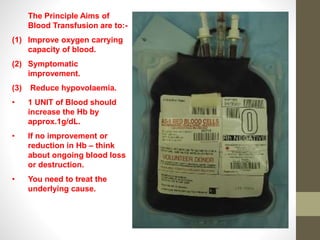
The Principle Aims of
Blood Transfusion are to:-
(1) Improve oxygen carrying
capacity of blood.
(2) Symptomatic
improvement.
(3) Reduce hypovolaemia.
• 1 UNIT of Blood should
increase the Hb by
approx.1g/dL.
• If no improvement or
reduction in Hb – think
about ongoing blood loss
or destruction.
• You need to treat the
underlying cause.
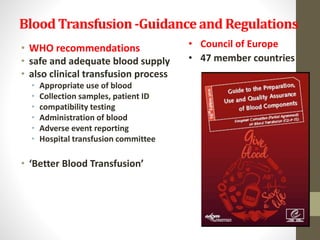
Blood Transfusion-Guidance and Regulations
• WHO recommendations
• safe and adequate blood supply
• also clinical transfusion process
• Appropriate use of blood
• Collection samples, patient ID
• compatibility testing
• Administration of blood
• Adverse event reporting
• Hospital transfusion committee
• ‘Better Blood Transfusion’
• Council of Europe
• 47 member countries
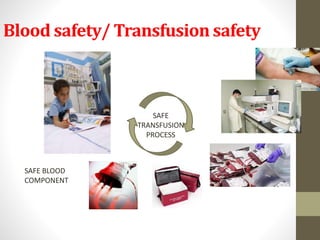
Blood safety/ Transfusion safety
SAFE
TRANSFUSION
PROCESS
SAFE BLOOD
COMPONENT
BLOOD GROUPING
• Landsteiner described ABO system in 1900.
• In ABO grouping both red cells and serum are tested as the
serum contains isohaemagglutinins to those group specific
substances which are not present on the red cells.
• Rhesus grouping is usually done to determine the presence or
absence of the D antigen.
CROSS - MATCHING
• Cross – matching of patients serum against donor red cells by
various method.
• Cells and serum are incubated in saline at room temperatures and
37˚c for 2 hours with the addition of albumin. Incompatibility is
indicated by lysis or agglutination of the red cells.
Indications for Blood Transfusion
Acute Anaemia
(1) Symptomatic hypovolaemia and blood loss.
(2) Peri-operative – ‘replacing losses’
(3) Haemolysis (treat the underlying cause)
(4) Severe, critical illness.
Blood Transfusion Indications
Acute Anaemia
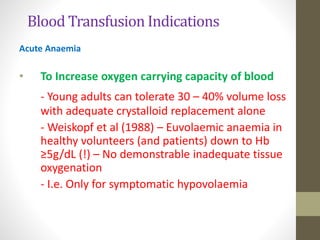
• To Increase oxygen carrying capacity of blood
- Young adults can tolerate 30 – 40% volume loss
with adequate crystalloid replacement alone
- Weiskopf et al (1988) – Euvolaemic anaemia in
healthy volunteers (and patients) down to Hb
≥5g/dL (!) – No demonstrable inadequate tissue
oxygenation
- I.e. Only for symptomatic hypovolaemia
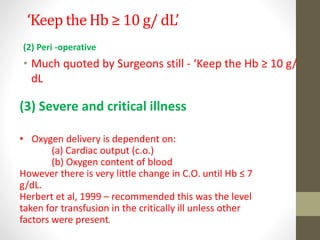
‘Keep the Hb ≥ 10 g/ dL’
(2) Peri -operative
• Much quoted by Surgeons still - ‘Keep the Hb ≥ 10 g/
dL
(3) Severe and critical illness
• Oxygen delivery is dependent on:
(a) Cardiac output (c.o.)
(b) Oxygen content of blood
However there is very little change in C.O. until Hb ≤ 7
g/dL.
Herbert et al, 1999 – recommended this was the level
taken for transfusion in the critically ill unless other
factors were present.
Recommendations for Transfusion
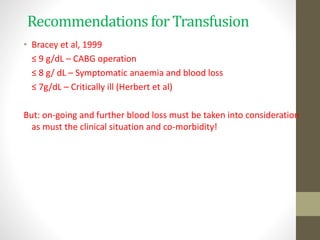
• Bracey et al, 1999
≤ 9 g/dL – CABG operation
≤ 8 g/ dL – Symptomatic anaemia and blood loss
≤ 7g/dL – Critically ill (Herbert et al)
But: on-going and further blood loss must be taken into consideration
as must the clinical situation and co-morbidity!
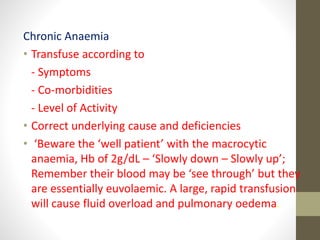
Chronic Anaemia
• Transfuse according to
- Symptoms
- Co-morbidities
- Level of Activity
• Correct underlying cause and deficiencies
• ‘Beware the ‘well patient’ with the macrocytic
anaemia, Hb of 2g/dL – ‘Slowly down – Slowly up’;
Remember their blood may be ‘see through’ but they
are essentially euvolaemic. A large, rapid transfusion
will cause fluid overload and pulmonary oedema.
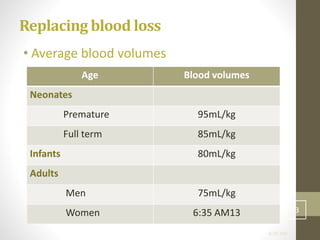
Replacing blood loss
• Average blood volumes
6:35 AM
13
Age Blood volumes
Neonates
Premature 95mL/kg
Full term 85mL/kg
Infants 80mL/kg
Adults
Men 75mL/kg
Women 6:35 AM13
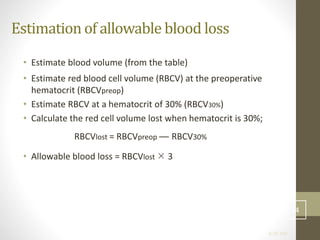
Estimation of allowable blood loss
• Estimate blood volume (from the table)
• Estimate red blood cell volume (RBCV) at the preoperative
hematocrit (RBCVpreop)
• Estimate RBCV at a hematocrit of 30% (RBCV30%)
• Calculate the red cell volume lost when hematocrit is 30%;
RBCVlost = RBCVpreop — RBCV30%
• Allowable blood loss = RBCVlost  3
6:35 AM
14
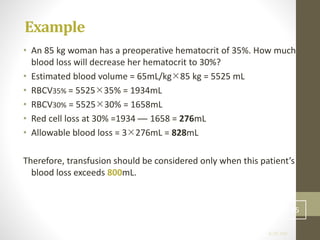
Example
• An 85 kg woman has a preoperative hematocrit of 35%. How much
blood loss will decrease her hematocrit to 30%?
• Estimated blood volume = 65mL/kg85 kg = 5525 mL
• RBCV35% = 552535% = 1934mL
• RBCV30% = 552530% = 1658mL
• Red cell loss at 30% =1934 — 1658 = 276mL
• Allowable blood loss = 3276mL = 828mL
Therefore, transfusion should be considered only when this patient’s
blood loss exceeds 800mL.
6:35 AM
15
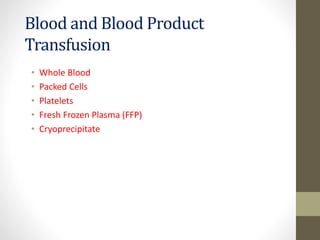
Blood and Blood Product
Transfusion
• Whole Blood
• Packed Cells
• Platelets
• Fresh Frozen Plasma (FFP)
• Cryoprecipitate
6:35 AM
17
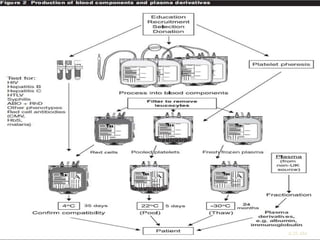
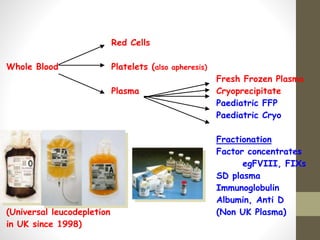
Red Cells
Whole Blood Platelets (also apheresis)
Fresh Frozen Plasma
Plasma Cryoprecipitate
Paediatric FFP
Paediatric Cryo
Fractionation
Factor concentrates
egFVIII, FIXs
SD plasma
Immunoglobulin
Albumin, Anti D
(Universal leucodepletion (Non UK Plasma)
in UK since 1998)
Fractionation of whole blood
• Separation of cellular constituents
within blood can be achieved by a
process known as differential
centrifugation.
• Acceleration force is adjusted to
sediment certain cellular constituents
and leave others in suspension.
• Blood sample is separated into two
phases; cellular sediment and a
supernatant that may be either cellular
or cell-free.
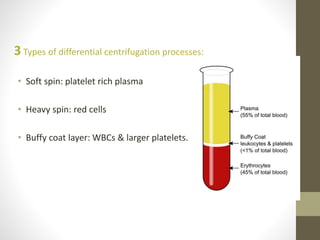
3 Types of differential centrifugation processes:
• Soft spin: platelet rich plasma
• Heavy spin: red cells
• Buffy coat layer: WBCs & larger platelets.
Whole blood components
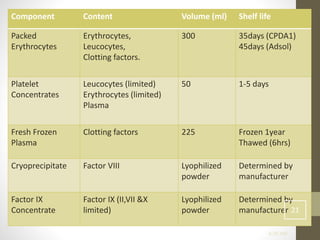
Component Content Volume (ml) Shelf life
Packed
Erythrocytes
Erythrocytes,
Leucocytes,
Clotting factors.
300 35days (CPDA1)
45days (Adsol)
Platelet
Concentrates
Leucocytes (limited)
Erythrocytes (limited)
Plasma
50 1-5 days
Fresh Frozen
Plasma
Clotting factors 225 Frozen 1year
Thawed (6hrs)
Cryoprecipitate Factor VIII Lyophilized
powder
Determined by
manufacturer
Factor IX
Concentrate
Factor IX (II,VII &X
limited)
Lyophilized
powder
Determined by
manufacturer
6:35 AM
21
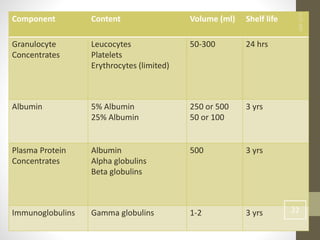
Component Content Volume (ml) Shelf life
Granulocyte
Concentrates
Leucocytes
Platelets
Erythrocytes (limited)
50-300 24 hrs
Albumin 5% Albumin
25% Albumin
250 or 500
50 or 100
3 yrs
Plasma Protein
Concentrates
Albumin
Alpha globulins
Beta globulins
500 3 yrs
Immunoglobulins Gamma globulins 1-2 3 yrs
6:35AM
22
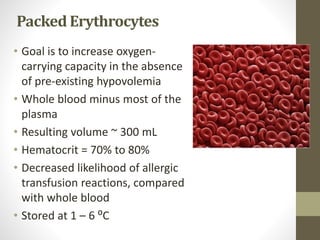
Packed Erythrocytes
• Goal is to increase oxygen-
carrying capacity in the absence
of pre-existing hypovolemia
• Whole blood minus most of the
plasma
• Resulting volume ~ 300 mL
• Hematocrit = 70% to 80%
• Decreased likelihood of allergic
transfusion reactions, compared
with whole blood
• Stored at 1 – 6 ⁰C
• Citrate-phosphate dextrose preservative + Adenine (CPDA-1;
CPD-A)
 Storage time 28 days 35 days
 Increased erythrocyte survival by allowing cells to
resynthesize ATP needed to fuel metabolic reactions
• Citrate-phosphate-dextrose + extra nutrients (adenine,
glucose, mannitol, sodium chloride)  Adsol
 Increased storage time (42 days).
 Contains about 100 mL of additional saline 
hematocrit 55% rather than 70%
• May be used to replace blood loss that is <1,500 mL in an adult
• One unit of packed erythrocytes typically increases the hematocrit 3%
or hemoglobin concentration 1 g/dL in a 70kg non-bleeding adult
Hb conc: >10 g/dL - transfusion rarely indicated
< 6 g/dL - almost always indicated,
especially when anemia is acute
Intermediate concentrations (6 to 10 g/dL) – transfusion depends on the
patient's risk for complications of inadequate oxygenation
• Administration is facilitated by reconstituting them with crystalloid
solutions to decrease viscosity.
 5% glucose in 0.9% saline
 0.9% saline
 Normosol
• Lactated Ringer's solution should probably not be used - calcium
ions present could induce clotting
• Hypotonic diluent (glucose solutions)  osmotic lysis of infused
erythrocytes
Platelet Concentrates
Platelets for transfusion are collected in two ways:
• Pooled platelets: This is a two-step procedure. Firstly, one
unit of platelets is produced from a unit of whole blood.
Then, 4-6 of these units (from different donors) are ‘pooled’
together in a single pack to be given to a thrombocytopenic
patient.
• Apheresis platelets: These have the advantage of being
collected from a single donor (to reduce the risk of disease
transmission). As blood cycles through the apheresis
machine, platelets are removed and all other blood
constituents are returned to the donor. The amount of
platelets collected with this procedure represents the
equivalent of 4-6 units of random donor platelets.
• One unit of platelet concentrate will increase the
platelet count 5,000 to 10,000 cells/mL3
• Usual therapeutic dose is one platelet concentrate
per 10 kg of body weight
• Storage is limited to 5 days – to minimize risk of
sepsis
• Contain only a few erythrocytes, but large amounts of
plasma (leukocytes)  administration on the basis of
ABO compatibility is desirable.
• Small quantity of erythrocytes present can cause Rh
immunization if platelets from an Rh-positive donor
are administered to an Rh-negative recipient  Rh -
compatible platelets should be used in women of
child-bearing age.
Indications:
• Surgical and obstetric patients with platelet count <50,000 cells/mL3
• >100,000 cells/mL3 - rarely require therapy
• Intermediate platelet counts (50,000 to 100,000 cells/mL3) - based
on the patient's risk for more significant bleeding.
• In nonsurgical patients, spontaneous bleeding is uncommon with
platelet counts of >10,000 cells/mL3.
Fresh Frozen Plasma
• FFP is collected as the supernatant after centrifuging a donation of whole
blood.
• It is frozen within 8 hours and may be stored for up to 1 year at —30 ˚C.
• Under these conditions, the loss of Factors V and VIII is kept to a minimum.
• Frozen packs are brittle and should be handled with care.
• The frozen plasma can be thawed using a dry oven (10minutes), microwave
(2—3 minutes) or a water bath (20 minutes).
• Thawed FFP is best used immediately but may be stored at 4˚C and infused
within 24 hours, provided it is kept at this temperature or returned to the
blood bank for storage within 30 minutes of being removed from a 4˚C
fridge.
• Contains all procoagulants except platelets in a
concentration of 1 unit/mL, as well as naturally occurring
inhibitors.
• Compatibility for ABO antigens is desirable, but cross-
matching is not necessary.
• Life-threatening allergic reactions, and the transmission of
diseases (HBV / HIV) possible
6:35 AM
33
• Usual starting dose is two units (400 to 500 mL) or one
plasmapheresis unit to treat active bleeding due to a
congenital or acquired deficiency of coagulation factors as
confirmed by
 PT >1.5 times normal (usually >18 s),
 Partial Thromboplastin Time >1.5 times normal
(usually >55 to 60 s), or
 Coagulation factor assay of <25% activity
Indications of FFP
• Correction of excessive microvascular bleeding in the
presence of a PT greater than 1.5 times normal, an INR
greater than 2.0, or an aPTT greater than twice normal.
• Correction of excessive microvascular bleeding that is
secondary to coagulation factor deficiency in patients
receiving massive transfusion (approximately 70ml/Kg) and
when PT or INR and aPTT are not available on time.
• Urgent reversal of warfarin therapy when human
prothrombin complex is unavailable (5-8ml/kg iv)
Indications of FFP
• Correction of known coagulation factor deficiencies for which
specific coagulation factor concentrates are unavailable.
• Heparin resistance (antithrombin III deficiency) in a patient requiring
heparin.
• Not recommended for hypovolemia or hypoalbuminemia
Cryoprecipitated Antihemophilic factor
(factor VIII)
• Fraction of plasma that precipitates when
fresh frozen plasma is thawed.
• Stored at room temperature; to be used within 3 hours.
• Mainly intravascular
• Elimination half time 12 hrs.
• Only approved component that has fibrinogen in concentrated form.
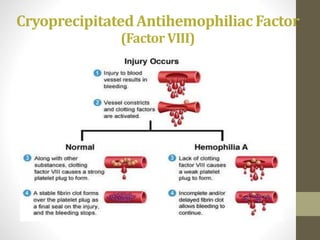
CryoprecipitatedAntihemophiliac Factor
(FactorVIII)
USES
• Hemophilia A
[high concentrations of factor VIII (80 to 120 units) in a
volume of only about 10 ml]
• In non bleeding patients with congenital fibrinogen deficiency or
Von Willebrands disease not responding to desmopressin.
• Bleeding patients with VWD.
• In massively transfused patients with fibrinogen concentrates <80-
100 mg/dl.
Adverse reactions
• Hyperfibrinogenemia
• Greater risk of viral transmission eg. Hepatitis (commercial
preparations derived from multiple donors)
• Hemolytic anemia (if given to individuals with A, B or AB
erythrocyte antigens)
Factor IX Concentrate
• Can be infused without typing or cross – matching
• Concentrated nature; small amount of fluid needed for
administration  Hypervolemic reactions do not occur
• Pooled origin  Significant potential to cause hepatitis
• High concentrations of prothrombin and factor X that result from
factor IX  High risk of thrombotic complications
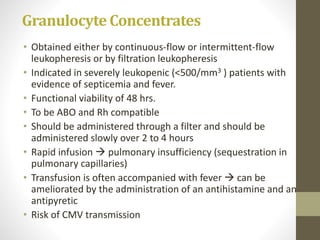
Granulocyte Concentrates
• Obtained either by continuous-flow or intermittent-flow
leukopheresis or by filtration leukopheresis
• Indicated in severely leukopenic (<500/mm3 ) patients with
evidence of septicemia and fever.
• Functional viability of 48 hrs.
• To be ABO and Rh compatible
• Should be administered through a filter and should be
administered slowly over 2 to 4 hours
• Rapid infusion  pulmonary insufficiency (sequestration in
pulmonary capillaries)
• Transfusion is often accompanied with fever  can be
ameliorated by the administration of an antihistamine and an
antipyretic
• Risk of CMV transmission
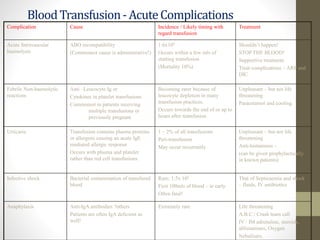
BloodTransfusion-AcuteComplications
Complication Cause Incidence / Likely timing with
regard transfusion
Treatment
Acute Intravascular
haemolysis
ABO incompatibility
(Commonest cause is administrative!)
1:6x10⁵
Occurs within a few mls of
starting transfusion
(Mortality 10%)
Shouldn’t happen!
STOP THE BLOOD!
Supportive treatment
Treat complications – ARF and
DIC
Febrile Non-haemolytic
reactions
Anti –Leucocyte Ig or
Cytokines in platelet transfusions
Commonest in patients receiving
multiple transfusions or
previously pregnant
Becoming rarer because of
leucocyte depletion in many
transfusion practices.
Occurs towards the end of or up to
hours after transfusion
Unpleasant – but not life
threatening
Paracetamol and cooling.
Urticaria Transfusion contains plasma proteins
or allergens causing an acute IgE
mediated allergic response
Occurs with plasma and platelet
rather than red cell transfusions.
1 – 2% of all transfusions
Peri-transfusion
May occur recurrently
Unpleasant – but not life
threatening
Anti-histamines –
(can be given prophylactically
in known patients)
Infective shock Bacterial contamination of transfused
blood
Rare; 1:5x 10⁵
First 100mls of blood – ie early
Often fatal!
That of Septicaemia and shock
– fluids, IV antibiotics
Anaphylaxis Anti-IgA antibodies ?others
Patients are often IgA deficient as
well!
Extremely rare Life threatening
A.B.C / Crash team call
IV / IM adrenaline, steroids,
aHistamines, Oxygen
Nebulisers.
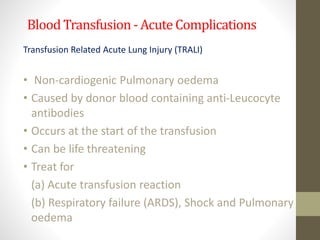
Blood Transfusion- Acute Complications
Transfusion Related Acute Lung Injury (TRALI)
• Non-cardiogenic Pulmonary oedema
• Caused by donor blood containing anti-Leucocyte
antibodies
• Occurs at the start of the transfusion
• Can be life threatening
• Treat for
(a) Acute transfusion reaction
(b) Respiratory failure (ARDS), Shock and Pulmonary
oedema
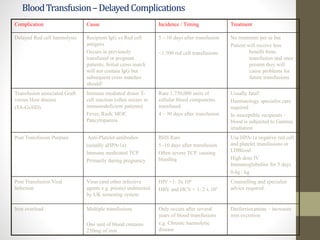
BloodTransfusion–DelayedComplications
Complication Cause Incidence / Timing Treatment
Delayed Red cell haemolysis Recipient IgG vs Red cell
antigens
Occurs in previously
transfused or pregnant
patients; Initial cross match
will not contain IgG but
subsequent cross matches
should!
5 – 10 days after transfusion
<1:500 red cell transfusions
No treatment per se but
Patient will receive less
benefit from
transfusion and once
present they will
cause problems for
future transfusions
Transfusion associated Graft
versus Host disease
(TA-GvHD)
Immune mediated donor T-
cell reaction (often occurs in
immunodeficient patients)
Fever, Rash, MOF,
Pancytopaenia
Rare 1:750,000 units of
cellular blood components
transfused
4 – 30 days after transfusion
Usually fatal!
Haematology specialist care
required
In susceptible recipients –
blood is subjected to Gamma
irradiation
Post Transfusion Purpura Anti-Platelet antibodies
(usually aHPA-1a)
Immune medicated TCP
Primarily during pregnancy
RHS Rare
5 -10 days after transfusion
Often severe TCP causing
bleeding
Use HPA-1a negative red cell
and platelet transfusions or
LDBlood
High dose IV
Immunoglobulins for 5 days
0.4g / kg
Post Transfusion Viral
Infection
Virus (and other infective
agents e.g. prions) undetected
by UK screening system
HIV <1: 3x 10⁶
HBV and HCV < 1: 2 x 10⁵
Counselling and specialist
advice required
Iron overload Multiple transfusions
One unit of blood contains
250mg of iron
Only occurs after several
years of blood transfusions
e.g. Chronic haemolytic
disease
Desferrioxamine – increases
iron excretion
BOMBAY BLOOD GROUP
• hh blood group or oh is a rare blood group.
• First discovered in bombay by DR.Y.M. BHENDE in 1952.
• The serum contained antibodies that reacted with all red blood cells
with normal ABO phenotypes.
• Red blood cells lack all of ABO blood group antigens and have
additional antigen that was previously unknown.
MASSIVE BLOOD TRANSFUSION
• >50% of blood volume in 4 hrs
• >1 blood volume in 24hrs
• In children transfusion of >40ml/kg
• It can lead to rapidly drop in recipient’s temperature to low as
27.5˚c which causes fatal dysrhthmias.
• It leads to high plasma citrate level which decreases ionised
calcium in blood. It can cause cardiac arrest and impair the
blood clotting system.
• The citrate metabolised to bicarbonate producing metabolic alkalosis
within 24hrs.
• During storage aggregates of leucocytes and platelets with diameters
upto 200 µm are formed. Filter is of 170 µm so there is passage of
quite sizeable aggregates. Large volume infused without ultrafiltration
can lead to increase in arteriovenous shunting and alveolar arterial
oxygen differences.
THANK YOU

Blood transfusion

  • 1.
    BLOOD TRANSFUSION AND ITS COMPONENTS PRESENTEDBY: DR.ANKITA MADAN MODERATER : DR. ANUMEHA JAIN
  • 2.
    Characteristics of idealblood substitute could be defined by the following terms: • Easily available • Oxygen carrying capacity : Good capacity or even better than biological blood • Volume expansion • No major toxic or physiological effects • No chemical reaction with oxygen, activation of complement system • Metabolized and eliminated by the body • Universal compatibility: Elimination of cross matching • Pathogen free: Elimination of blood borne disease • Minimal side effects • Survivability over a wider range of storage temperatures • Long shelf life • Maintains arterial blood pressure and pH • Cost efficient
  • 3.
    The Principle Aimsof Blood Transfusion are to:- (1) Improve oxygen carrying capacity of blood. (2) Symptomatic improvement. (3) Reduce hypovolaemia. • 1 UNIT of Blood should increase the Hb by approx.1g/dL. • If no improvement or reduction in Hb – think about ongoing blood loss or destruction. • You need to treat the underlying cause.
  • 4.
    Blood Transfusion-Guidance andRegulations • WHO recommendations • safe and adequate blood supply • also clinical transfusion process • Appropriate use of blood • Collection samples, patient ID • compatibility testing • Administration of blood • Adverse event reporting • Hospital transfusion committee • ‘Better Blood Transfusion’ • Council of Europe • 47 member countries
  • 5.
    Blood safety/ Transfusionsafety SAFE TRANSFUSION PROCESS SAFE BLOOD COMPONENT
  • 6.
    BLOOD GROUPING • Landsteinerdescribed ABO system in 1900. • In ABO grouping both red cells and serum are tested as the serum contains isohaemagglutinins to those group specific substances which are not present on the red cells. • Rhesus grouping is usually done to determine the presence or absence of the D antigen.
  • 7.
    CROSS - MATCHING •Cross – matching of patients serum against donor red cells by various method. • Cells and serum are incubated in saline at room temperatures and 37˚c for 2 hours with the addition of albumin. Incompatibility is indicated by lysis or agglutination of the red cells.
  • 8.
    Indications for BloodTransfusion Acute Anaemia (1) Symptomatic hypovolaemia and blood loss. (2) Peri-operative – ‘replacing losses’ (3) Haemolysis (treat the underlying cause) (4) Severe, critical illness.
  • 9.
    Blood Transfusion Indications AcuteAnaemia • To Increase oxygen carrying capacity of blood - Young adults can tolerate 30 – 40% volume loss with adequate crystalloid replacement alone - Weiskopf et al (1988) – Euvolaemic anaemia in healthy volunteers (and patients) down to Hb ≥5g/dL (!) – No demonstrable inadequate tissue oxygenation - I.e. Only for symptomatic hypovolaemia
  • 10.
    ‘Keep the Hb≥ 10 g/ dL’ (2) Peri -operative • Much quoted by Surgeons still - ‘Keep the Hb ≥ 10 g/ dL (3) Severe and critical illness • Oxygen delivery is dependent on: (a) Cardiac output (c.o.) (b) Oxygen content of blood However there is very little change in C.O. until Hb ≤ 7 g/dL. Herbert et al, 1999 – recommended this was the level taken for transfusion in the critically ill unless other factors were present.
  • 11.
    Recommendations for Transfusion •Bracey et al, 1999 ≤ 9 g/dL – CABG operation ≤ 8 g/ dL – Symptomatic anaemia and blood loss ≤ 7g/dL – Critically ill (Herbert et al) But: on-going and further blood loss must be taken into consideration as must the clinical situation and co-morbidity!
  • 12.
    Chronic Anaemia • Transfuseaccording to - Symptoms - Co-morbidities - Level of Activity • Correct underlying cause and deficiencies • ‘Beware the ‘well patient’ with the macrocytic anaemia, Hb of 2g/dL – ‘Slowly down – Slowly up’; Remember their blood may be ‘see through’ but they are essentially euvolaemic. A large, rapid transfusion will cause fluid overload and pulmonary oedema.
  • 13.
    Replacing blood loss •Average blood volumes 6:35 AM 13 Age Blood volumes Neonates Premature 95mL/kg Full term 85mL/kg Infants 80mL/kg Adults Men 75mL/kg Women 6:35 AM13
  • 14.
    Estimation of allowableblood loss • Estimate blood volume (from the table) • Estimate red blood cell volume (RBCV) at the preoperative hematocrit (RBCVpreop) • Estimate RBCV at a hematocrit of 30% (RBCV30%) • Calculate the red cell volume lost when hematocrit is 30%; RBCVlost = RBCVpreop — RBCV30% • Allowable blood loss = RBCVlost  3 6:35 AM 14
  • 15.
    Example • An 85kg woman has a preoperative hematocrit of 35%. How much blood loss will decrease her hematocrit to 30%? • Estimated blood volume = 65mL/kg85 kg = 5525 mL • RBCV35% = 552535% = 1934mL • RBCV30% = 552530% = 1658mL • Red cell loss at 30% =1934 — 1658 = 276mL • Allowable blood loss = 3276mL = 828mL Therefore, transfusion should be considered only when this patient’s blood loss exceeds 800mL. 6:35 AM 15
  • 16.
    Blood and BloodProduct Transfusion • Whole Blood • Packed Cells • Platelets • Fresh Frozen Plasma (FFP) • Cryoprecipitate
  • 17.
  • 18.
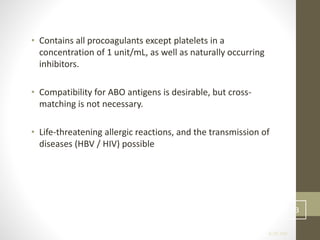
    Red Cells Whole BloodPlatelets (also apheresis) Fresh Frozen Plasma Plasma Cryoprecipitate Paediatric FFP Paediatric Cryo Fractionation Factor concentrates egFVIII, FIXs SD plasma Immunoglobulin Albumin, Anti D (Universal leucodepletion (Non UK Plasma) in UK since 1998)
  • 19.
    Fractionation of wholeblood • Separation of cellular constituents within blood can be achieved by a process known as differential centrifugation. • Acceleration force is adjusted to sediment certain cellular constituents and leave others in suspension. • Blood sample is separated into two phases; cellular sediment and a supernatant that may be either cellular or cell-free.
  • 20.
    3 Types ofdifferential centrifugation processes: • Soft spin: platelet rich plasma • Heavy spin: red cells • Buffy coat layer: WBCs & larger platelets.
  • 21.
    Whole blood components ComponentContent Volume (ml) Shelf life Packed Erythrocytes Erythrocytes, Leucocytes, Clotting factors. 300 35days (CPDA1) 45days (Adsol) Platelet Concentrates Leucocytes (limited) Erythrocytes (limited) Plasma 50 1-5 days Fresh Frozen Plasma Clotting factors 225 Frozen 1year Thawed (6hrs) Cryoprecipitate Factor VIII Lyophilized powder Determined by manufacturer Factor IX Concentrate Factor IX (II,VII &X limited) Lyophilized powder Determined by manufacturer 6:35 AM 21
  • 22.
    Component Content Volume(ml) Shelf life Granulocyte Concentrates Leucocytes Platelets Erythrocytes (limited) 50-300 24 hrs Albumin 5% Albumin 25% Albumin 250 or 500 50 or 100 3 yrs Plasma Protein Concentrates Albumin Alpha globulins Beta globulins 500 3 yrs Immunoglobulins Gamma globulins 1-2 3 yrs 6:35AM 22
  • 23.
    Packed Erythrocytes • Goalis to increase oxygen- carrying capacity in the absence of pre-existing hypovolemia • Whole blood minus most of the plasma • Resulting volume ~ 300 mL • Hematocrit = 70% to 80% • Decreased likelihood of allergic transfusion reactions, compared with whole blood • Stored at 1 – 6 ⁰C
  • 24.
    • Citrate-phosphate dextrosepreservative + Adenine (CPDA-1; CPD-A)  Storage time 28 days 35 days  Increased erythrocyte survival by allowing cells to resynthesize ATP needed to fuel metabolic reactions • Citrate-phosphate-dextrose + extra nutrients (adenine, glucose, mannitol, sodium chloride)  Adsol  Increased storage time (42 days).  Contains about 100 mL of additional saline  hematocrit 55% rather than 70%
  • 25.
    • May beused to replace blood loss that is <1,500 mL in an adult • One unit of packed erythrocytes typically increases the hematocrit 3% or hemoglobin concentration 1 g/dL in a 70kg non-bleeding adult Hb conc: >10 g/dL - transfusion rarely indicated < 6 g/dL - almost always indicated, especially when anemia is acute Intermediate concentrations (6 to 10 g/dL) – transfusion depends on the patient's risk for complications of inadequate oxygenation
  • 26.
    • Administration isfacilitated by reconstituting them with crystalloid solutions to decrease viscosity.  5% glucose in 0.9% saline  0.9% saline  Normosol • Lactated Ringer's solution should probably not be used - calcium ions present could induce clotting • Hypotonic diluent (glucose solutions)  osmotic lysis of infused erythrocytes
  • 27.
    Platelet Concentrates Platelets fortransfusion are collected in two ways: • Pooled platelets: This is a two-step procedure. Firstly, one unit of platelets is produced from a unit of whole blood. Then, 4-6 of these units (from different donors) are ‘pooled’ together in a single pack to be given to a thrombocytopenic patient. • Apheresis platelets: These have the advantage of being collected from a single donor (to reduce the risk of disease transmission). As blood cycles through the apheresis machine, platelets are removed and all other blood constituents are returned to the donor. The amount of platelets collected with this procedure represents the equivalent of 4-6 units of random donor platelets.
  • 28.
    • One unitof platelet concentrate will increase the platelet count 5,000 to 10,000 cells/mL3 • Usual therapeutic dose is one platelet concentrate per 10 kg of body weight • Storage is limited to 5 days – to minimize risk of sepsis • Contain only a few erythrocytes, but large amounts of plasma (leukocytes)  administration on the basis of ABO compatibility is desirable. • Small quantity of erythrocytes present can cause Rh immunization if platelets from an Rh-positive donor are administered to an Rh-negative recipient  Rh - compatible platelets should be used in women of child-bearing age.
  • 29.
    Indications: • Surgical andobstetric patients with platelet count <50,000 cells/mL3 • >100,000 cells/mL3 - rarely require therapy • Intermediate platelet counts (50,000 to 100,000 cells/mL3) - based on the patient's risk for more significant bleeding. • In nonsurgical patients, spontaneous bleeding is uncommon with platelet counts of >10,000 cells/mL3.
  • 30.
    Fresh Frozen Plasma •FFP is collected as the supernatant after centrifuging a donation of whole blood. • It is frozen within 8 hours and may be stored for up to 1 year at —30 ˚C. • Under these conditions, the loss of Factors V and VIII is kept to a minimum. • Frozen packs are brittle and should be handled with care. • The frozen plasma can be thawed using a dry oven (10minutes), microwave (2—3 minutes) or a water bath (20 minutes). • Thawed FFP is best used immediately but may be stored at 4˚C and infused within 24 hours, provided it is kept at this temperature or returned to the blood bank for storage within 30 minutes of being removed from a 4˚C fridge.
  • 32.
    • Contains allprocoagulants except platelets in a concentration of 1 unit/mL, as well as naturally occurring inhibitors. • Compatibility for ABO antigens is desirable, but cross- matching is not necessary. • Life-threatening allergic reactions, and the transmission of diseases (HBV / HIV) possible 6:35 AM 33
  • 33.
    • Usual startingdose is two units (400 to 500 mL) or one plasmapheresis unit to treat active bleeding due to a congenital or acquired deficiency of coagulation factors as confirmed by  PT >1.5 times normal (usually >18 s),  Partial Thromboplastin Time >1.5 times normal (usually >55 to 60 s), or  Coagulation factor assay of <25% activity
  • 34.
    Indications of FFP •Correction of excessive microvascular bleeding in the presence of a PT greater than 1.5 times normal, an INR greater than 2.0, or an aPTT greater than twice normal. • Correction of excessive microvascular bleeding that is secondary to coagulation factor deficiency in patients receiving massive transfusion (approximately 70ml/Kg) and when PT or INR and aPTT are not available on time. • Urgent reversal of warfarin therapy when human prothrombin complex is unavailable (5-8ml/kg iv)
  • 35.
    Indications of FFP •Correction of known coagulation factor deficiencies for which specific coagulation factor concentrates are unavailable. • Heparin resistance (antithrombin III deficiency) in a patient requiring heparin. • Not recommended for hypovolemia or hypoalbuminemia
  • 36.
    Cryoprecipitated Antihemophilic factor (factorVIII) • Fraction of plasma that precipitates when fresh frozen plasma is thawed. • Stored at room temperature; to be used within 3 hours. • Mainly intravascular • Elimination half time 12 hrs. • Only approved component that has fibrinogen in concentrated form.
  • 37.
  • 38.
    USES • Hemophilia A [highconcentrations of factor VIII (80 to 120 units) in a volume of only about 10 ml] • In non bleeding patients with congenital fibrinogen deficiency or Von Willebrands disease not responding to desmopressin. • Bleeding patients with VWD. • In massively transfused patients with fibrinogen concentrates <80- 100 mg/dl.
  • 39.
    Adverse reactions • Hyperfibrinogenemia •Greater risk of viral transmission eg. Hepatitis (commercial preparations derived from multiple donors) • Hemolytic anemia (if given to individuals with A, B or AB erythrocyte antigens)
  • 40.
    Factor IX Concentrate •Can be infused without typing or cross – matching • Concentrated nature; small amount of fluid needed for administration  Hypervolemic reactions do not occur • Pooled origin  Significant potential to cause hepatitis • High concentrations of prothrombin and factor X that result from factor IX  High risk of thrombotic complications
  • 41.
    Granulocyte Concentrates • Obtainedeither by continuous-flow or intermittent-flow leukopheresis or by filtration leukopheresis • Indicated in severely leukopenic (<500/mm3 ) patients with evidence of septicemia and fever. • Functional viability of 48 hrs. • To be ABO and Rh compatible • Should be administered through a filter and should be administered slowly over 2 to 4 hours • Rapid infusion  pulmonary insufficiency (sequestration in pulmonary capillaries) • Transfusion is often accompanied with fever  can be ameliorated by the administration of an antihistamine and an antipyretic • Risk of CMV transmission
  • 42.
    BloodTransfusion-AcuteComplications Complication Cause Incidence/ Likely timing with regard transfusion Treatment Acute Intravascular haemolysis ABO incompatibility (Commonest cause is administrative!) 1:6x10⁵ Occurs within a few mls of starting transfusion (Mortality 10%) Shouldn’t happen! STOP THE BLOOD! Supportive treatment Treat complications – ARF and DIC Febrile Non-haemolytic reactions Anti –Leucocyte Ig or Cytokines in platelet transfusions Commonest in patients receiving multiple transfusions or previously pregnant Becoming rarer because of leucocyte depletion in many transfusion practices. Occurs towards the end of or up to hours after transfusion Unpleasant – but not life threatening Paracetamol and cooling. Urticaria Transfusion contains plasma proteins or allergens causing an acute IgE mediated allergic response Occurs with plasma and platelet rather than red cell transfusions. 1 – 2% of all transfusions Peri-transfusion May occur recurrently Unpleasant – but not life threatening Anti-histamines – (can be given prophylactically in known patients) Infective shock Bacterial contamination of transfused blood Rare; 1:5x 10⁵ First 100mls of blood – ie early Often fatal! That of Septicaemia and shock – fluids, IV antibiotics Anaphylaxis Anti-IgA antibodies ?others Patients are often IgA deficient as well! Extremely rare Life threatening A.B.C / Crash team call IV / IM adrenaline, steroids, aHistamines, Oxygen Nebulisers.
  • 43.
    Blood Transfusion- AcuteComplications Transfusion Related Acute Lung Injury (TRALI) • Non-cardiogenic Pulmonary oedema • Caused by donor blood containing anti-Leucocyte antibodies • Occurs at the start of the transfusion • Can be life threatening • Treat for (a) Acute transfusion reaction (b) Respiratory failure (ARDS), Shock and Pulmonary oedema
  • 44.
    BloodTransfusion–DelayedComplications Complication Cause Incidence/ Timing Treatment Delayed Red cell haemolysis Recipient IgG vs Red cell antigens Occurs in previously transfused or pregnant patients; Initial cross match will not contain IgG but subsequent cross matches should! 5 – 10 days after transfusion <1:500 red cell transfusions No treatment per se but Patient will receive less benefit from transfusion and once present they will cause problems for future transfusions Transfusion associated Graft versus Host disease (TA-GvHD) Immune mediated donor T- cell reaction (often occurs in immunodeficient patients) Fever, Rash, MOF, Pancytopaenia Rare 1:750,000 units of cellular blood components transfused 4 – 30 days after transfusion Usually fatal! Haematology specialist care required In susceptible recipients – blood is subjected to Gamma irradiation Post Transfusion Purpura Anti-Platelet antibodies (usually aHPA-1a) Immune medicated TCP Primarily during pregnancy RHS Rare 5 -10 days after transfusion Often severe TCP causing bleeding Use HPA-1a negative red cell and platelet transfusions or LDBlood High dose IV Immunoglobulins for 5 days 0.4g / kg Post Transfusion Viral Infection Virus (and other infective agents e.g. prions) undetected by UK screening system HIV <1: 3x 10⁶ HBV and HCV < 1: 2 x 10⁵ Counselling and specialist advice required Iron overload Multiple transfusions One unit of blood contains 250mg of iron Only occurs after several years of blood transfusions e.g. Chronic haemolytic disease Desferrioxamine – increases iron excretion
  • 45.
    BOMBAY BLOOD GROUP •hh blood group or oh is a rare blood group. • First discovered in bombay by DR.Y.M. BHENDE in 1952. • The serum contained antibodies that reacted with all red blood cells with normal ABO phenotypes. • Red blood cells lack all of ABO blood group antigens and have additional antigen that was previously unknown.
  • 46.
    MASSIVE BLOOD TRANSFUSION •>50% of blood volume in 4 hrs • >1 blood volume in 24hrs • In children transfusion of >40ml/kg • It can lead to rapidly drop in recipient’s temperature to low as 27.5˚c which causes fatal dysrhthmias. • It leads to high plasma citrate level which decreases ionised calcium in blood. It can cause cardiac arrest and impair the blood clotting system.
  • 47.
    • The citratemetabolised to bicarbonate producing metabolic alkalosis within 24hrs. • During storage aggregates of leucocytes and platelets with diameters upto 200 µm are formed. Filter is of 170 µm so there is passage of quite sizeable aggregates. Large volume infused without ultrafiltration can lead to increase in arteriovenous shunting and alveolar arterial oxygen differences.
  • 48.