Alcohol abuse Biliary tract diseases Drugs Trauma Viral infections Metabolic disorders Connective tissue diseases
Idiopathic in 30% of acute pancreatitis 25 – 40% of chronic pancreatitis
Severe constant epigastric pain    back Elevated serum Amylase, Lipase levels Ascites, pleural effusion Hypercalcemia, hypocalcemia Hypertriglyceridemia (Serum amylase maybe normal) Chronic pancreatitis: Normal enzyme levels
Serum Amylase: rises within 24 hrs; remains elevated 1-3 days; 3x ULN; 85% of patients will have elevated amylase levels Amylase also found in salivary glands, liver, small intestines, kidneys and fallopian tubes Amylase elevated in CA of lungs, esophagus, breast, and ovary Lipase: single best enzyme
 
Plain radiography: 1. sentinel loop (localized ileus of jejunum) 2. air fluid levels 3. colon cut off sign (distension of      transverse colon) 4. duodenal distension   5. mass (pseudocyst)
UGIS: widened C loop Ultrasonography: edema, inflammation,  calcifications, cysts, mass lesions CT Scan EUS (Endoscopic Ultrasound) MRCP ERCP
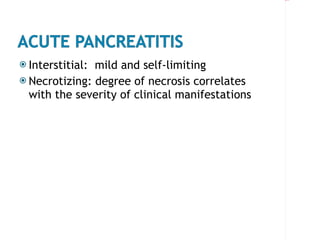
Interstitial:  mild and self-limiting Necrotizing: degree of necrosis correlates with the severity of clinical manifestations
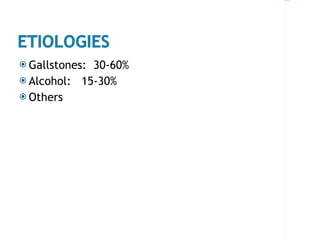
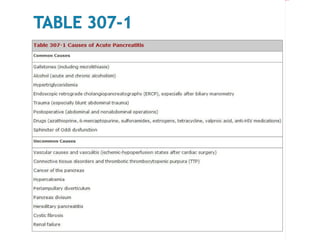
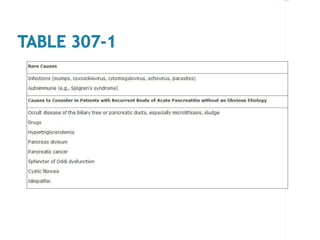
Gallstones:  30-60% Alcohol:  15-30% Others
 
 
Initial Phase: Intrapancreatic digestive enzyme activation andacina cell injury Second phase: activation, chemoattraction, sequestration of neutrophils    intrapancreatic inflammation Third phase: due to the effects on the distant organs of activated proteolytic enzymes and cytokines    proteolysis, edema, insterstitial hemorrhage, vasgular damage, coag necrosis
Cellular necrosis    liberation of bradykinin, histamine and vasoactive substances    vasodilation, increased vascular permeability and edema    lungs (ARDS , SIRS), multiorgan failure
Pain: constant, severe, boring; epigastrium    back, chest, flanks: supine and relieved by trunk flexing and knees drawn up. Nausea, vomiting, abdominal distention Fever, tachycardia, hypotension Hypovolemia; shock Cullen’s sign Turner’s sign
Amylase: 3x ULN; return to N in 72 hrs; higher in gall stones Lipase: elevated for 7-14 days; higher in alcohol-related Leukocytosis Hyperglycemia Hypocalcemia Hyperbilirubinemia
Hypertriglyceridemia LDH, AST Alkaline phosphatase Hypoxemia


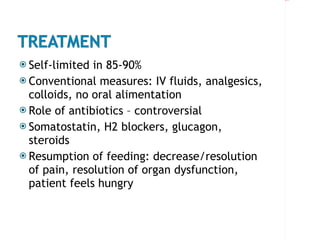
Self-limited in 85-90% Conventional measures: IV fluids, analgesics, colloids, no oral alimentation Role of antibiotics – controversial Somatostatin, H2 blockers, glucagon, steroids Resumption of feeding: decrease/resolution of pain, resolution of organ dysfunction, patient feels hungry
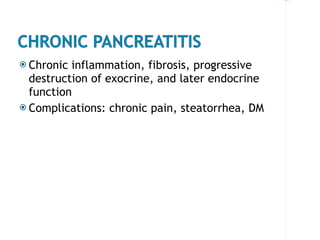
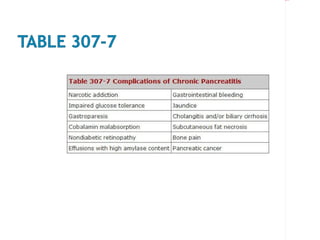
Chronic inflammation, fibrosis, progressive destruction of exocrine, and later endocrine function Complications: chronic pain, steatorrhea, DM
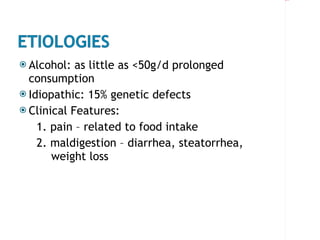
Alcohol: as little as <50g/d prolonged consumption Idiopathic: 15% genetic defects Clinical Features:  1. pain – related to food intake 2. maldigestion – diarrhea, steatorrhea,  weight loss
 
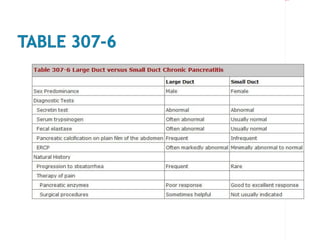
Amylase and Lipase not usually elevated Secretin test: best sensitivity/specificity; abN when 60% of exocrine function is lost Radiography: calcifications Ultrasonography CT scans MRCP ERCP
 
Enzyme therapy to control diarrhea Octreotide – somatostatin analogue that inhibits pancreatic secretion; decrease pain in large-duct disease Endoscopic treatment: sphincterotomy, stenting, stone extraction, drainage of pseudocyst

Pancreatic disease

  • 1.
  • 2.
    Alcohol abuse Biliarytract diseases Drugs Trauma Viral infections Metabolic disorders Connective tissue diseases
  • 3.
    Idiopathic in 30%of acute pancreatitis 25 – 40% of chronic pancreatitis
  • 4.
    Severe constant epigastricpain  back Elevated serum Amylase, Lipase levels Ascites, pleural effusion Hypercalcemia, hypocalcemia Hypertriglyceridemia (Serum amylase maybe normal) Chronic pancreatitis: Normal enzyme levels
  • 5.
    Serum Amylase: riseswithin 24 hrs; remains elevated 1-3 days; 3x ULN; 85% of patients will have elevated amylase levels Amylase also found in salivary glands, liver, small intestines, kidneys and fallopian tubes Amylase elevated in CA of lungs, esophagus, breast, and ovary Lipase: single best enzyme
  • 6.
  • 7.
    Plain radiography: 1.sentinel loop (localized ileus of jejunum) 2. air fluid levels 3. colon cut off sign (distension of transverse colon) 4. duodenal distension 5. mass (pseudocyst)
  • 8.
    UGIS: widened Cloop Ultrasonography: edema, inflammation, calcifications, cysts, mass lesions CT Scan EUS (Endoscopic Ultrasound) MRCP ERCP
  • 9.
    Interstitial: mildand self-limiting Necrotizing: degree of necrosis correlates with the severity of clinical manifestations
  • 10.
    Gallstones: 30-60%Alcohol: 15-30% Others
  • 11.
  • 12.
  • 13.
    Initial Phase: Intrapancreaticdigestive enzyme activation andacina cell injury Second phase: activation, chemoattraction, sequestration of neutrophils  intrapancreatic inflammation Third phase: due to the effects on the distant organs of activated proteolytic enzymes and cytokines  proteolysis, edema, insterstitial hemorrhage, vasgular damage, coag necrosis
  • 14.
    Cellular necrosis  liberation of bradykinin, histamine and vasoactive substances  vasodilation, increased vascular permeability and edema  lungs (ARDS , SIRS), multiorgan failure
  • 15.
    Pain: constant, severe,boring; epigastrium  back, chest, flanks: supine and relieved by trunk flexing and knees drawn up. Nausea, vomiting, abdominal distention Fever, tachycardia, hypotension Hypovolemia; shock Cullen’s sign Turner’s sign
  • 16.
    Amylase: 3x ULN;return to N in 72 hrs; higher in gall stones Lipase: elevated for 7-14 days; higher in alcohol-related Leukocytosis Hyperglycemia Hypocalcemia Hyperbilirubinemia
  • 17.
    Hypertriglyceridemia LDH, ASTAlkaline phosphatase Hypoxemia
  • 18.
  • 19.
  • 20.
  • 21.
    Self-limited in 85-90%Conventional measures: IV fluids, analgesics, colloids, no oral alimentation Role of antibiotics – controversial Somatostatin, H2 blockers, glucagon, steroids Resumption of feeding: decrease/resolution of pain, resolution of organ dysfunction, patient feels hungry
  • 22.
    Chronic inflammation, fibrosis,progressive destruction of exocrine, and later endocrine function Complications: chronic pain, steatorrhea, DM
  • 23.
    Alcohol: as littleas <50g/d prolonged consumption Idiopathic: 15% genetic defects Clinical Features: 1. pain – related to food intake 2. maldigestion – diarrhea, steatorrhea, weight loss
  • 24.
  • 25.
    Amylase and Lipasenot usually elevated Secretin test: best sensitivity/specificity; abN when 60% of exocrine function is lost Radiography: calcifications Ultrasonography CT scans MRCP ERCP
  • 26.
  • 27.
    Enzyme therapy tocontrol diarrhea Octreotide – somatostatin analogue that inhibits pancreatic secretion; decrease pain in large-duct disease Endoscopic treatment: sphincterotomy, stenting, stone extraction, drainage of pseudocyst