OBSTRUCTIVE JAUNDICE
Dr.B.Selvaraj MS;Mch;FICS;
Professor Of Surgery
Melaka Manipal Medical college
Melaka 75150 Malaysia
BILIARY ATRESIA
BILIARY ATRESIA- Objectives
To be aware of possible causes of surgical jaundice in infancy
To be aware of clinical features of biliary atresia
To be familiar with the methods of investigation
To understand the management options
To be aware of the surgical outcome and results
BILIARY ATRESIA
Biliary atresia is also known as progressive obliterative
cholangiopathy
Biliary atresia causes a progressive damage of the extrahepatic and
intrahepatic bile ducts with cholestasis because of obstructive
cholangiopathy secondary to inflammation, leading to fibrosis, and if
not recognized and treated, it leads to biliary cirrhosis and liver
failure.
The incidence of biliary atresia is 1:10,000 to 1:15,000 live births
Biliary atresia affects girls more often than boys.
BILIARY ATRESIA
Asians and African-Americans are affected more frequently than
Caucasians - more common in Chinese and Japanese.
Biliary atresia should be recognized and distinguished from neonatal
jaundice. Infants with prolonged jaundice should be thoroughly
investigated for biliary atresia.
Biliary atresia should be considered in all neonates with direct
hyperbilirubinemia
A high index of suspicion is important to make the diagnosis of
biliary atresia because surgical treatment by age 2 months has
clearly been shown to improve the outcome and establishment of bile
flow and to prevent the development of biliary cirrhosis.
BILIARY ATRESIA-Etiology
The exact cause of biliary atresia is not known and many factors
have been incriminated
1. Reovirus 3 infection.
2. Congenital malformation. Early studies postulated a congenital
malformation of the biliary ducts leading to their obstruction.
3. Congenital cytomegalovirus (CMV) infection.
4. Autoimmunity
5. A possible association with the gene GPC1, which is located on the
longarm of chromosome 2 (2q37).
6. Identification of active and progressive inflammation and
destruction of the biliary system
BILIARY ATRESIA-Types
Clinically, biliary atresia occurs in two distinct forms:
 The fetal-embryonic form:
− Appears in the first 2 weeks of life.
− About 10–20 % of affected neonates have associated congenital
defects.
 The postnatal form:
− Appears in neonates and infants aged 2–8 weeks.
− Progressive inflammation and obliteration of the extrahepatic bile
ducts occur after birth.
− Not associated with congenital anomalies.
− Infants may have a short jaundice-free interval.
BILIARY ATRESIA-Types
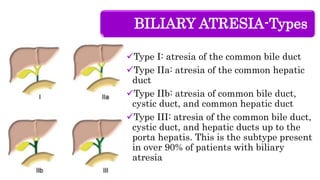
Type I: atresia of the common bile duct
Type IIa: atresia of the common hepatic
duct
Type IIb: atresia of common bile duct,
cystic duct, and common hepatic duct
Type III: atresia of the common bile duct,
cystic duct, and hepatic ducts up to the
porta hepatis. This is the subtype present
in over 90% of patients with biliary
atresia
ASSOCIATED ANOMALIES
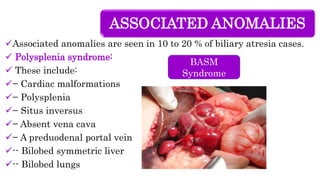
Associated anomalies are seen in 10 to 20 % of biliary atresia cases.
 Polysplenia syndrome:
 These include:
− Cardiac malformations
− Polysplenia
− Situs inversus
− Absent vena cava
− A preduodenal portal vein
-- Bilobed symmetric liver
-- Bilobed lungs
BASM
Syndrome
Clinical Features
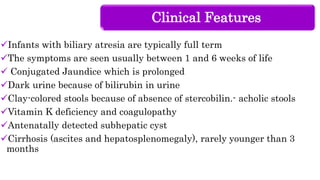
Infants with biliary atresia are typically full term
The symptoms are seen usually between 1 and 6 weeks of life
 Conjugated Jaundice which is prolonged
Dark urine because of bilirubin in urine
Clay-colored stools because of absence of stercobilin.- acholic stools
Vitamin K deficiency and coagulopathy
Antenatally detected subhepatic cyst
Cirrhosis (ascites and hepatosplenomegaly), rarely younger than 3
months
Biliary Atresia- Investigations
 LFT: Total bilirubin and direct bilirubin are elevated
ALP & GGT are elevated; AST & ALT mildly elevated
Medical causes, such as a1-antitrypsin deficiency, Alagille’s
syndrome, cystic fibrosis and neonatal hepatitis, should be
excluded.
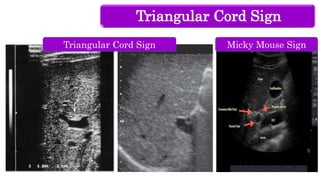
 Biliary USG: whether the gallbladder is atrophic, dilated or
abnormal.
 to exclude other etiologies like choledochal cyst
 Triangular cord sign: Presence of fibrous cone of bile duct
remnant at porta hepatis
Triangular Cord Sign
Triangular Cord Sign Micky Mouse Sign
Biliary Atresia- Investigations
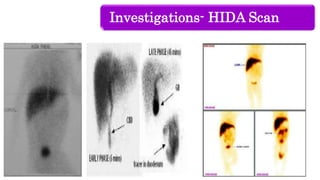
 Hepatobiliary isotope scan- HIDA scan: In biliary atresia, there is
normal uptake by the liver and failure of secretion of the isotope,
while in neonatal hepatitis there is poor liver uptake of isotope.
Intestinal excretion of the isotope confirms patency of the
extrahepatic bile ducts
Percutaneous liver biopsy: bile ductular proliferation; bile duct plugs;
inflammatory cell infiltrate, hepatocyte giant cell transformation
Intraoperative cholangiography: this procedure definitively
demonstrates anatomy and patency of the extrahepatic bile ducts
Investigations- HIDA Scan
Investigations- IOC
Intra Operative Cholangiogram
Biliary Atresia- Treatment
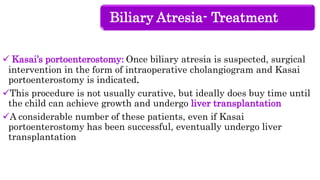
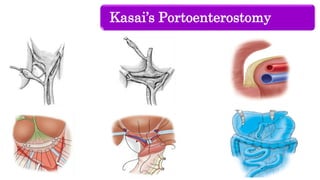
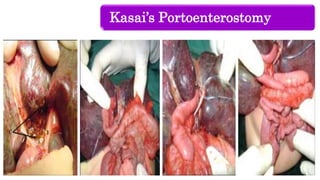
 Kasai’s portoenterostomy: Once biliary atresia is suspected, surgical
intervention in the form of intraoperative cholangiogram and Kasai
portoenterostomy is indicated.
This procedure is not usually curative, but ideally does buy time until
the child can achieve growth and undergo liver transplantation
A considerable number of these patients, even if Kasai
portoenterostomy has been successful, eventually undergo liver
transplantation
Kasai’s Portoenterostomy
Biliary Atresia- Postop care
 In the immediate postoperative period, Methylprednisolone should
be given for it’s anti-inflammatory and choleretic effects
Ursodeoxycholic acid has also been shown to enhance bile flow.
In order to prevent cholangitis postoperatively, immediate postop
give IV antibiotics, then prophylaxis with trimethoprim–
sulfamethoxazole has been used on a long-term basis.
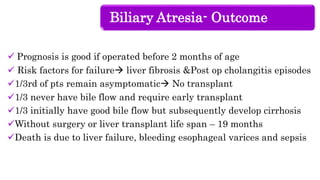
Biliary Atresia- Outcome
 Prognosis is good if operated before 2 months of age
 Risk factors for failure liver fibrosis &Post op cholangitis episodes
1/3rd of pts remain asymptomatic No transplant
1/3 never have bile flow and require early transplant
1/3 initially have good bile flow but subsequently develop cirrhosis
Without surgery or liver transplant life span – 19 months
Death is due to liver failure, bleeding esophageal varices and sepsis
Biliary Atresia - Mindmap
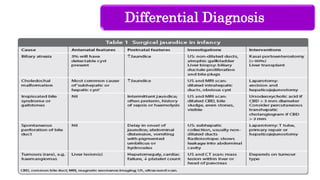
Differential Diagnosis
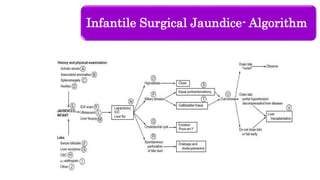
Infantile Surgical Jaundice- Algorithm
THANK YOU
Subscribe to get notified
regarding my latest
uploads

Biliary atresia- Obstructive jaundice/ Pediatric surgery

  • 1.
    OBSTRUCTIVE JAUNDICE Dr.B.Selvaraj MS;Mch;FICS; ProfessorOf Surgery Melaka Manipal Medical college Melaka 75150 Malaysia BILIARY ATRESIA
  • 2.
    BILIARY ATRESIA- Objectives Tobe aware of possible causes of surgical jaundice in infancy To be aware of clinical features of biliary atresia To be familiar with the methods of investigation To understand the management options To be aware of the surgical outcome and results
  • 3.
    BILIARY ATRESIA Biliary atresiais also known as progressive obliterative cholangiopathy Biliary atresia causes a progressive damage of the extrahepatic and intrahepatic bile ducts with cholestasis because of obstructive cholangiopathy secondary to inflammation, leading to fibrosis, and if not recognized and treated, it leads to biliary cirrhosis and liver failure. The incidence of biliary atresia is 1:10,000 to 1:15,000 live births Biliary atresia affects girls more often than boys.
  • 4.
    BILIARY ATRESIA Asians andAfrican-Americans are affected more frequently than Caucasians - more common in Chinese and Japanese. Biliary atresia should be recognized and distinguished from neonatal jaundice. Infants with prolonged jaundice should be thoroughly investigated for biliary atresia. Biliary atresia should be considered in all neonates with direct hyperbilirubinemia A high index of suspicion is important to make the diagnosis of biliary atresia because surgical treatment by age 2 months has clearly been shown to improve the outcome and establishment of bile flow and to prevent the development of biliary cirrhosis.
  • 5.
    BILIARY ATRESIA-Etiology The exactcause of biliary atresia is not known and many factors have been incriminated 1. Reovirus 3 infection. 2. Congenital malformation. Early studies postulated a congenital malformation of the biliary ducts leading to their obstruction. 3. Congenital cytomegalovirus (CMV) infection. 4. Autoimmunity 5. A possible association with the gene GPC1, which is located on the longarm of chromosome 2 (2q37). 6. Identification of active and progressive inflammation and destruction of the biliary system
  • 6.
    BILIARY ATRESIA-Types Clinically, biliaryatresia occurs in two distinct forms:  The fetal-embryonic form: − Appears in the first 2 weeks of life. − About 10–20 % of affected neonates have associated congenital defects.  The postnatal form: − Appears in neonates and infants aged 2–8 weeks. − Progressive inflammation and obliteration of the extrahepatic bile ducts occur after birth. − Not associated with congenital anomalies. − Infants may have a short jaundice-free interval.
  • 7.
    BILIARY ATRESIA-Types Type I:atresia of the common bile duct Type IIa: atresia of the common hepatic duct Type IIb: atresia of common bile duct, cystic duct, and common hepatic duct Type III: atresia of the common bile duct, cystic duct, and hepatic ducts up to the porta hepatis. This is the subtype present in over 90% of patients with biliary atresia
  • 8.
    ASSOCIATED ANOMALIES Associated anomaliesare seen in 10 to 20 % of biliary atresia cases.  Polysplenia syndrome:  These include: − Cardiac malformations − Polysplenia − Situs inversus − Absent vena cava − A preduodenal portal vein -- Bilobed symmetric liver -- Bilobed lungs BASM Syndrome
  • 9.
    Clinical Features Infants withbiliary atresia are typically full term The symptoms are seen usually between 1 and 6 weeks of life  Conjugated Jaundice which is prolonged Dark urine because of bilirubin in urine Clay-colored stools because of absence of stercobilin.- acholic stools Vitamin K deficiency and coagulopathy Antenatally detected subhepatic cyst Cirrhosis (ascites and hepatosplenomegaly), rarely younger than 3 months
  • 10.
    Biliary Atresia- Investigations LFT: Total bilirubin and direct bilirubin are elevated ALP & GGT are elevated; AST & ALT mildly elevated Medical causes, such as a1-antitrypsin deficiency, Alagille’s syndrome, cystic fibrosis and neonatal hepatitis, should be excluded.  Biliary USG: whether the gallbladder is atrophic, dilated or abnormal.  to exclude other etiologies like choledochal cyst  Triangular cord sign: Presence of fibrous cone of bile duct remnant at porta hepatis
  • 11.
    Triangular Cord Sign TriangularCord Sign Micky Mouse Sign
  • 12.
    Biliary Atresia- Investigations Hepatobiliary isotope scan- HIDA scan: In biliary atresia, there is normal uptake by the liver and failure of secretion of the isotope, while in neonatal hepatitis there is poor liver uptake of isotope. Intestinal excretion of the isotope confirms patency of the extrahepatic bile ducts Percutaneous liver biopsy: bile ductular proliferation; bile duct plugs; inflammatory cell infiltrate, hepatocyte giant cell transformation Intraoperative cholangiography: this procedure definitively demonstrates anatomy and patency of the extrahepatic bile ducts
  • 13.
  • 14.
  • 15.
    Biliary Atresia- Treatment Kasai’s portoenterostomy: Once biliary atresia is suspected, surgical intervention in the form of intraoperative cholangiogram and Kasai portoenterostomy is indicated. This procedure is not usually curative, but ideally does buy time until the child can achieve growth and undergo liver transplantation A considerable number of these patients, even if Kasai portoenterostomy has been successful, eventually undergo liver transplantation
  • 16.
  • 17.
  • 18.
    Biliary Atresia- Postopcare  In the immediate postoperative period, Methylprednisolone should be given for it’s anti-inflammatory and choleretic effects Ursodeoxycholic acid has also been shown to enhance bile flow. In order to prevent cholangitis postoperatively, immediate postop give IV antibiotics, then prophylaxis with trimethoprim– sulfamethoxazole has been used on a long-term basis.
  • 19.
    Biliary Atresia- Outcome Prognosis is good if operated before 2 months of age  Risk factors for failure liver fibrosis &Post op cholangitis episodes 1/3rd of pts remain asymptomatic No transplant 1/3 never have bile flow and require early transplant 1/3 initially have good bile flow but subsequently develop cirrhosis Without surgery or liver transplant life span – 19 months Death is due to liver failure, bleeding esophageal varices and sepsis
  • 20.
  • 21.
  • 22.
  • 23.
    THANK YOU Subscribe toget notified regarding my latest uploads