PANCREATIC CARCINOMA
Dr.B.Selvaraj MS;Mch;FICS
Professor of surgery
Melaka Manipal Medical College
Melaka 75150 Malaysia
OBSTRUCTIVE JAUNDICE
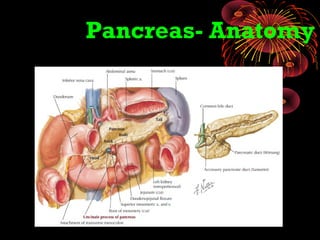
Pancreas- Anatomy
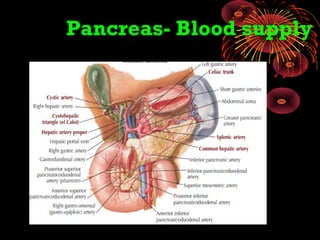
Pancreas- Blood supply
Classical Clinical
Vignette
• 72 yrs old man presents with jaundice for 7days
with dull abdominal discomfort for 2 months. He
gives H/O loss of appetite and loss of weight.
• His stools have become lighter in color and his
urine is much darker than before
• He has a 50+ pack-year smoking history before
quitting last year
• He was recently diagnosed with type 2 diabetes,
but has no other medical problems
Classical Clinical
Vignette
• O/E: he has a yellow hue to his eyes and tongue,
along with scratch marks on his skin.
• A non-tender globular mass is palpated in the
right upper quadrant (RUQ) of the abdomen
• Labs: Laboratory testing reveals total and direct
bilirubin of 18 mg/dL (normal 0.2–1.3 mg/dL) and
17.2 mg/dL (<0.3 mg/dL), respectively.
• Alkaline phosphatase (ALP) elevated at 215 μ/L
(33–131 μ/L). AST & ALT mildly elevated
• 3rd
most common GIT cancer.
• 4th
most common cause of cancer death
• Death to incidence ratio is one.
( lowest among all types of cancer). why???
• Male:Female ratio 2:1
• Peak age 65 to 75 yrs
• Common in black americans
Introduction
Risk factors
• Cigarette smoking.
• Increased age.
• Chronic pancreatitis.
• Family H/O Pancreatic Cancer in more
than 2 first degree relatives
• Increased saturated fat intake.
• Exposure to non chlorinated solvents
Genetic Risk factors
• Chronic familial relapsing pancreatitis.
• Familial breast cancer ( BRCA2).
• Peutz –Jeghers syndrome.
• HNPCC (Hereditary non polyposis colorectal
cancer)
• Gardener syndrome.
• Familial atypical mole and melanoma
syndrome.
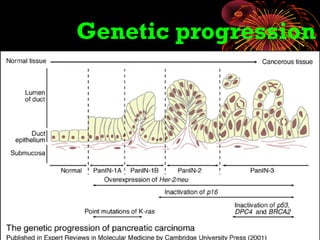
Genetic progression
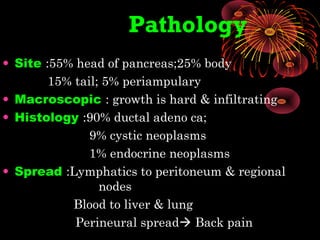
Pathology
• Site :55% head of pancreas;25% body
15% tail; 5% periampulary
• Macroscopic : growth is hard & infiltrating
• Histology :90% ductal adeno ca;
9% cystic neoplasms
1% endocrine neoplasms
• Spread :Lymphatics to peritoneum & regional
nodes
Blood to liver & lung
Perineural spread Back pain
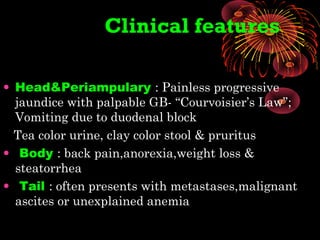
Clinical features
• Head&Periampulary : Painless progressive
jaundice with palpable GB- “Courvoisier’s Law”;
Vomiting due to duodenal block
Tea color urine, clay color stool & pruritus
• Body : back pain,anorexia,weight loss &
steatorrhea
• Tail : often presents with metastases,malignant
ascites or unexplained anemia
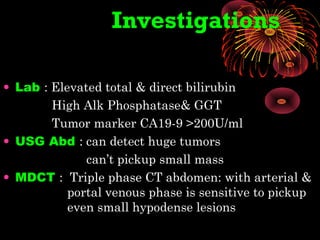
Investigations
• Lab : Elevated total & direct bilirubin
High Alk Phosphatase& GGT
Tumor marker CA19-9 >200U/ml
• USG Abd : can detect huge tumors
can’t pickup small mass
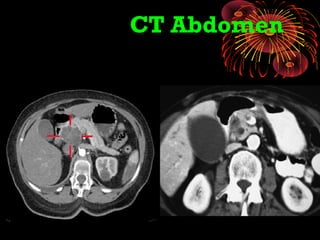
• MDCT : Triple phase CT abdomen: with arterial &
portal venous phase is sensitive to pickup
even small hypodense lesions
Investigations
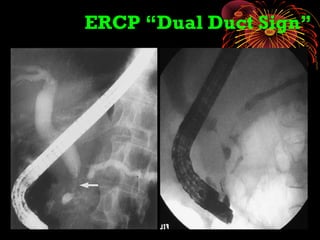
• ERCP & MRCP : “Dual duct sign”
Therapeutic ERCP for palliative stent in CBD
& Duodenum
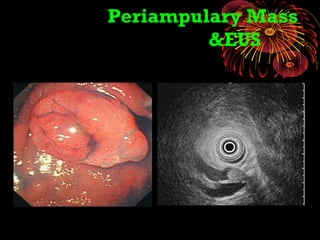
• Endoscopic Ultrasound:(EUS)
Excellent for staging the tumor
EUS guided pancreatic biopsy
CT Abdomen
ERCP “Dual Duct Sign”
Periampulary Mass
&EUS
Staging
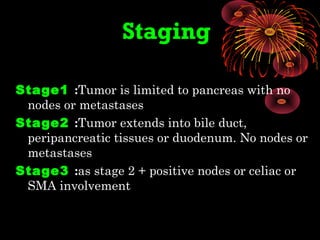
Stage1 :Tumor is limited to pancreas with no
nodes or metastases
Stage2 :Tumor extends into bile duct,
peripancreatic tissues or duodenum. No nodes or
metastases
Stage3 :as stage 2 + positive nodes or celiac or
SMA involvement
Staging
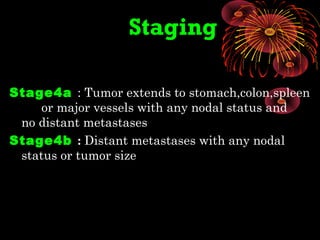
Stage4a : Tumor extends to stomach,colon,spleen
or major vessels with any nodal status and
no distant metastases
Stage4b : Distant metastases with any nodal
status or tumor size
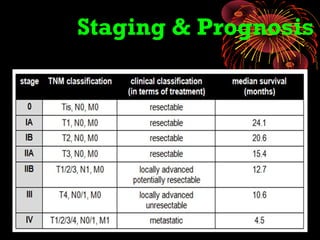
Staging & Prognosis
Treatment
• Rescectable tumors
• Borderline resectability
• Unresectable tumors
Resectable tumors
• Normal fat planes between tumor and
SMA, SMV
• Absence of extrapancreatic disease
• Patent SMPV confluence
• No direct extension to celiac axis or SMA
Borderline tumors
• Short segment occlusion of SMPV
confluence with an adequate vessel for
grafting
• Short segment (< 1 cm ) abutment of the
common or proper hepatic artery or SMA on
high quality CT
Unresectable tumors
• Extrapancreatic disease- distant metastases
• Encasement of coelic axis or SMA
( anything more than short
abutment)
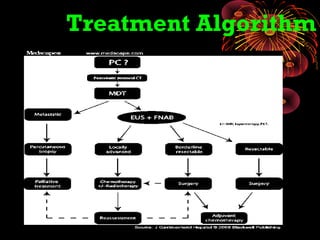
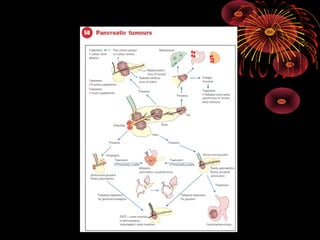
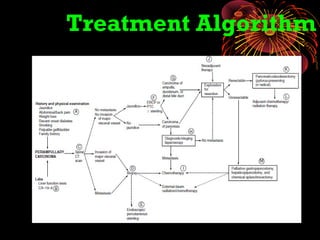
Treatment Algorithm
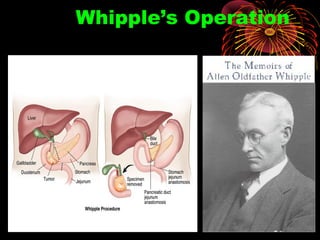
Whipple’s Operation
Complications
• Delayed gastric emptying
• Pancreatic fistula
• Intra-abdominal abscess
• Operative site hge
• GI Hemorrhage
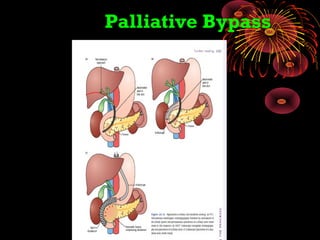
Palliative Surgery
• Biliary obstruction:
 Biliary enteric bypass
 Endoscopic biliary stent
placement
 Radiographic transhepatic
stent placement
Palliative Surgery
• Gastric outlet obstruction:
 Gastroenteric bypass
 Endoscopically placed
duodenal stent
Palliative Bypass
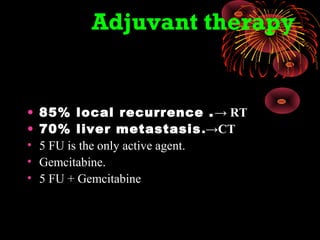
Adjuvant therapy
• 85% local recurrence .→ RT
• 70% liver metastasis.→CT
• 5 FU is the only active agent.
• Gemcitabine.
• 5 FU + Gemcitabine
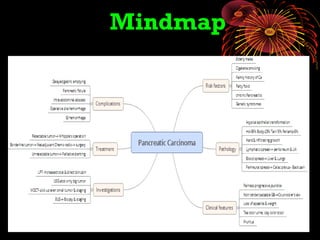
Mindmap
Treatment Algorithm
PANCREATIC CARCINOMA/ Obstructive Jaundice

PANCREATIC CARCINOMA/ Obstructive Jaundice

  • 1.
    PANCREATIC CARCINOMA Dr.B.Selvaraj MS;Mch;FICS Professorof surgery Melaka Manipal Medical College Melaka 75150 Malaysia OBSTRUCTIVE JAUNDICE
  • 2.
  • 3.
  • 4.
    Classical Clinical Vignette • 72yrs old man presents with jaundice for 7days with dull abdominal discomfort for 2 months. He gives H/O loss of appetite and loss of weight. • His stools have become lighter in color and his urine is much darker than before • He has a 50+ pack-year smoking history before quitting last year • He was recently diagnosed with type 2 diabetes, but has no other medical problems
  • 5.
    Classical Clinical Vignette • O/E:he has a yellow hue to his eyes and tongue, along with scratch marks on his skin. • A non-tender globular mass is palpated in the right upper quadrant (RUQ) of the abdomen • Labs: Laboratory testing reveals total and direct bilirubin of 18 mg/dL (normal 0.2–1.3 mg/dL) and 17.2 mg/dL (<0.3 mg/dL), respectively. • Alkaline phosphatase (ALP) elevated at 215 μ/L (33–131 μ/L). AST & ALT mildly elevated
  • 6.
    • 3rd most commonGIT cancer. • 4th most common cause of cancer death • Death to incidence ratio is one. ( lowest among all types of cancer). why??? • Male:Female ratio 2:1 • Peak age 65 to 75 yrs • Common in black americans Introduction
  • 7.
    Risk factors • Cigarettesmoking. • Increased age. • Chronic pancreatitis. • Family H/O Pancreatic Cancer in more than 2 first degree relatives • Increased saturated fat intake. • Exposure to non chlorinated solvents
  • 8.
    Genetic Risk factors •Chronic familial relapsing pancreatitis. • Familial breast cancer ( BRCA2). • Peutz –Jeghers syndrome. • HNPCC (Hereditary non polyposis colorectal cancer) • Gardener syndrome. • Familial atypical mole and melanoma syndrome.
  • 9.
  • 10.
    Pathology • Site :55%head of pancreas;25% body 15% tail; 5% periampulary • Macroscopic : growth is hard & infiltrating • Histology :90% ductal adeno ca; 9% cystic neoplasms 1% endocrine neoplasms • Spread :Lymphatics to peritoneum & regional nodes Blood to liver & lung Perineural spread Back pain
  • 11.
    Clinical features • Head&Periampulary: Painless progressive jaundice with palpable GB- “Courvoisier’s Law”; Vomiting due to duodenal block Tea color urine, clay color stool & pruritus • Body : back pain,anorexia,weight loss & steatorrhea • Tail : often presents with metastases,malignant ascites or unexplained anemia
  • 12.
    Investigations • Lab :Elevated total & direct bilirubin High Alk Phosphatase& GGT Tumor marker CA19-9 >200U/ml • USG Abd : can detect huge tumors can’t pickup small mass • MDCT : Triple phase CT abdomen: with arterial & portal venous phase is sensitive to pickup even small hypodense lesions
  • 13.
    Investigations • ERCP &MRCP : “Dual duct sign” Therapeutic ERCP for palliative stent in CBD & Duodenum • Endoscopic Ultrasound:(EUS) Excellent for staging the tumor EUS guided pancreatic biopsy
  • 14.
  • 15.
  • 16.
  • 17.
    Staging Stage1 :Tumor islimited to pancreas with no nodes or metastases Stage2 :Tumor extends into bile duct, peripancreatic tissues or duodenum. No nodes or metastases Stage3 :as stage 2 + positive nodes or celiac or SMA involvement
  • 18.
    Staging Stage4a : Tumorextends to stomach,colon,spleen or major vessels with any nodal status and no distant metastases Stage4b : Distant metastases with any nodal status or tumor size
  • 19.
  • 20.
    Treatment • Rescectable tumors •Borderline resectability • Unresectable tumors
  • 21.
    Resectable tumors • Normalfat planes between tumor and SMA, SMV • Absence of extrapancreatic disease • Patent SMPV confluence • No direct extension to celiac axis or SMA
  • 22.
    Borderline tumors • Shortsegment occlusion of SMPV confluence with an adequate vessel for grafting • Short segment (< 1 cm ) abutment of the common or proper hepatic artery or SMA on high quality CT
  • 23.
    Unresectable tumors • Extrapancreaticdisease- distant metastases • Encasement of coelic axis or SMA ( anything more than short abutment)
  • 24.
  • 25.
  • 26.
    Complications • Delayed gastricemptying • Pancreatic fistula • Intra-abdominal abscess • Operative site hge • GI Hemorrhage
  • 27.
    Palliative Surgery • Biliaryobstruction:  Biliary enteric bypass  Endoscopic biliary stent placement  Radiographic transhepatic stent placement
  • 28.
    Palliative Surgery • Gastricoutlet obstruction:  Gastroenteric bypass  Endoscopically placed duodenal stent
  • 29.
  • 30.
    Adjuvant therapy • 85%local recurrence .→ RT • 70% liver metastasis.→CT • 5 FU is the only active agent. • Gemcitabine. • 5 FU + Gemcitabine
  • 32.
  • 33.

Editor's Notes

  • #2 Dear Students Good afternoon, Today I am going to talk on one the most lethal cancers the Pancreatic Carcinoma My objective is all of you after hearing this presentation should able to understand the etiology, pathology, clinical presentation,investigations and management of a case of Ca Pancreas.