Presenter: Dr. Pashi V. M
Registrar peadiatrics surgery
 Yellowish discoloration of the skin, mucous
membranes, and sclerae of the eyes
 Hyperbilirubinemia
 Deposition of bile salts in these tissues
 Jaundice in the first few weeks of life categorised
into
Hematologic,
Enzymatic/metabolic,
Infectious and
Obstructive
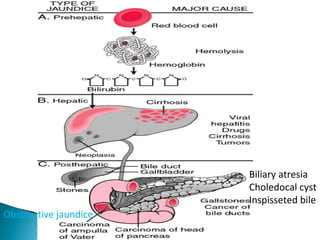
Biliary atresia
Choledocal cyst
Inspisseted bile
Obstructive jaundice
Post hepatic(Obstructive jaundice )
an interruption in the drainage of bile in
the biliary system.
 Neonatal cholestasis is defined as prolonged
elevation of serum levels of conjugated bilirubin
beyond the first 14 days of life.
• Biliary atresia
• Choledochal cyst
• Gallstones or biliary sludge
• Alagille syndrome
• Inspissated bile
• Cystic fibrosis
• Neonatal sclerosing cholangitis
• Congenital hepatic fibrosis/Caroli’s disease
• Intrahepatic hypoplasia
• spontaneous perforation of the bile duct
 Obstructive jaundice in infancy
surgical challenge
 Short time between the appearance of the
jaundice and the optimal time for surgical
intervention
between 4 and 6 weeks
Bile
Fluid made by the liver
Two main functions:
1. Carrying toxins and waste products out of the
body
2. Helping the body digest fats and absorb the fat-
soluble vitamins A, D, E, and K
• Bile becomes trapped, builds up, and damages
the liver. The damage leads to scarring, loss of
liver tissue, and cirrhosis
• Cirrhosis, portal hypertension, liver failure, and
death
• Deficiency of vitamin A,D,E,K – clotting factor
deficiency – bleeding disorder
 Biliary atresia: most common cause of obstructive
jaundice
requiring operation in children
 Choledochal cyst: 2nd
most common cause
 Life-threatening condition
 Bile ducts inside or outside the liver do not have
normal openings
 Rare
 1:18,000 infants
 More common in
Females
Premature babies,
Children of Asian or African American
heritage
• Multiple causes: none proven yet
• Not an inherited disease
• Some are:
1. Viral or bacterial infection after birth
cytomegalovirus, retrovirus, or rotavirus
2. Immune system problem
when the immune system attacks the liver
or bile ducts for unknown reasons
3. Genetic mutation
4. Problem during liver and bile duct
development in the womb
1. Fetal(syndromic) : appears while the baby is in the
womb
• known as the embryonic type
• associated congenital anomalies such as an
interrupted inferior vena cava, preduodenal portal
vein, intestinal malrotation, situs inversus, cardiac
defects, and polysplenia.
• In this variety, which accounts for 10% to 20% of all
2.Perinatal(Nonsyndromic):
more common
become evident at 2 to 4 weeks after birth
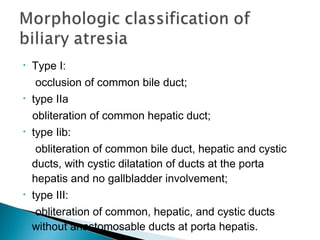
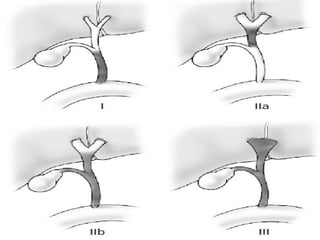
• Type I:
occlusion of common bile duct;
• type IIa
obliteration of common hepatic duct;
• type Iib:
obliteration of common bile duct, hepatic and cystic
ducts, with cystic dilatation of ducts at the porta
hepatis and no gallbladder involvement;
• type III:
obliteration of common, hepatic, and cystic ducts
without anastomosable ducts at porta hepatis.
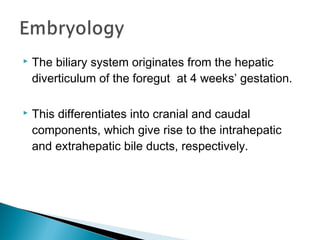
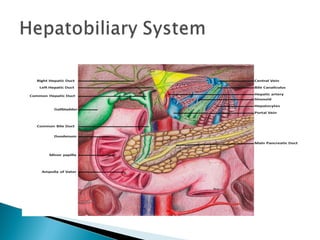
 The biliary system originates from the hepatic
diverticulum of the foregut at 4 weeks’ gestation.
 This differentiates into cranial and caudal
components, which give rise to the intrahepatic
and extrahepatic bile ducts, respectively.
• Jaundice
• Dark urine
• Gray stools
From a lack of bilirubin reaching the intestines
• Slow weight gain and growth
• Hepatomegaly
 Routine Examinations
 Color of stool
 Consistency of the liver
 Conventional liver function tests, including test for
γ-glutamyl transpeptidase
 Coagulation times (PT, aPTT)
Special biochemical studies
 Hepatitis A, B, C serologic studies
 TORCH titers
 α1-Antitrypsin level
 Serum lipoprotein-X
 Serum bile acid
Confirmation of patency of extrahepatic bile
ducts
 Duodenal fluid aspiration
 Ultrasonography
 Hepatobiliary scintigraphy
 Endoscopic retrograde cholangiopancreatography
 Near-infrared reflectance spectroscopy
Other:
 Needle biopsy of the liver for histopathologic
studies
 Laparoscopy
 Surgical cholangiography
 Biliary atresia is treated by
surgery- Kasai procedure or
a liver transplant
 Kasai opretaion- Named after the surgeon Morio
Kasai
 This procedure is most effective in infants younger
than 3 months old
 As they usually haven’t yet developed permanent
liver damage
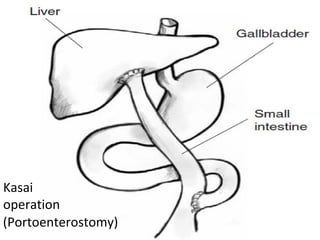
 Surgeon removes the infant’s damaged bile ducts
and brings up a loop of intestine to replace them.
 As a result, bile flows straight to the small
intestine
Kasai
operation
(Portoenterostomy)
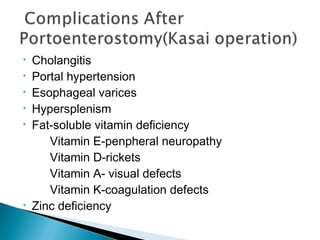
• Cholangitis
• Portal hypertension
• Esophageal varices
• Hypersplenism
• Fat-soluble vitamin deficiency
Vitamin E-penpheral neuropathy
Vitamin D-rickets
Vitamin A- visual defects
Vitamin K-coagulation defects
• Zinc deficiency
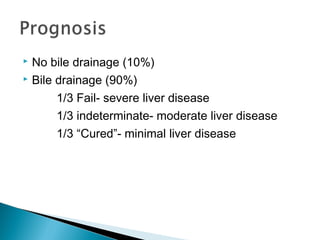
 No bile drainage (10%)
 Bile drainage (90%)
1/3 Fail- severe liver disease
1/3 indeterminate- moderate liver disease
1/3 “Cured”- minimal liver disease
Liver Transplant
 Liver transplantation is the definitive treatment for
biliary atresia
 Survival rate after surgery has increased
dramatically in recent years
• Technical failure
• Hepatic artery thrombosis
• Biliary obstruction
• Rejection
• Infection
Bacterial
Viral
Fungal
CHOLEDOCHAL CYST
 A choledochal cyst is a rare congenital swelling of
the hepatic or bile duct .
 These cysts can be intrahepatic, meaning that
they occur in the part of the duct located inside of
the liver.
 They can also be extrahepatic, meaning part of
the bile duct that is located outside the liver.
 Frequently include an anomalous junction of the
pancreatic duct and CBD (pancreaticobiliary
malunion [PBMU])
 Intrahepatic bile duct dilatation with or without
downstream stenosis
 Varying degrees of hepatic fibrosis
• Congenital weakness of the bile duct wall, a
primary abnormality of proliferation during
embryologic ductal development, and congenital
obstruction have been postulated
• In 1969, the “long common channel theory”
was Proposed:
PBMU allows reflux of pancreatic enzymes into
the CBD, which leads to disruption of the duct
walls
 Pancreaticobiliary ductal junction has been
demonstrated to be outside the duodenal wall
before the eighth week of gestation and then
migrates normally toward the duodenal lumen.
 Thus, PBMU may persist as a result of arrest in
this migration.
 PBMU(pancreaticobiliary malunion)and congenital
stenosis are the basic causative factors of
choledochal cyst
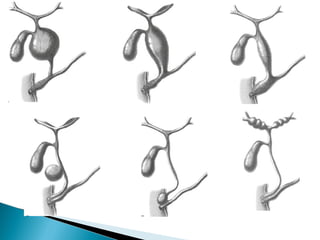
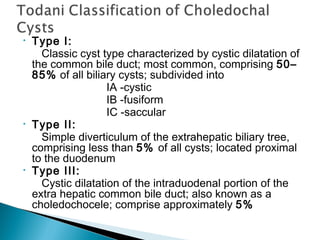
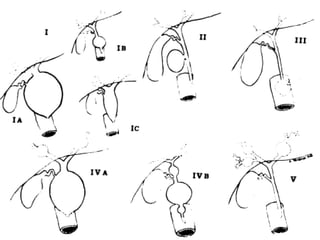
• Type I:
Classic cyst type characterized by cystic dilatation of
the common bile duct; most common, comprising 50–
85% of all biliary cysts; subdivided into
IA -cystic
IB -fusiform
IC -saccular
• Type II:
Simple diverticulum of the extrahepatic biliary tree,
comprising less than 5% of all cysts; located proximal
to the duodenum
• Type III:
Cystic dilatation of the intraduodenal portion of the
extra hepatic common bile duct; also known as a
choledochocele; comprise approximately 5%
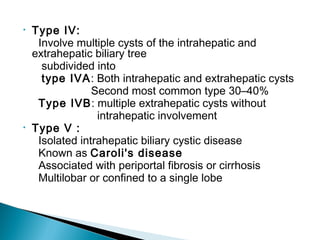
• Type IV:
Involve multiple cysts of the intrahepatic and
extrahepatic biliary tree
subdivided into
type IVA: Both intrahepatic and extrahepatic cysts
Second most common type 30–40%
Type IVB: multiple extrahepatic cysts without
intrahepatic involvement
• Type V :
Isolated intrahepatic biliary cystic disease
Known as Caroli's disease
Associated with periportal fibrosis or cirrhosis
Multilobar or confined to a single lobe
 The classic triad
Pain, jaundice, and abdominal mass.
Conjugated bilirubin (80%),
Failure to thrive
 Intermittent jaundice and recurrent cholangitis
 pancreatitis
• Raised white blood cell count, (increased immature
neutrophils in patients with cholangitis).
• Abnormal LFTs - cholestasis.
• Serum amylase and lipase concentrations may be
increased in the presence of pancreatitis.
• Serum amylase concentrations also may be elevated in
biliary obstruction and cholangitis.
• Abdominal ultrasonography
• Technetium 99m
Tc hepatobiliary iminodiacetic acid (HIDA)
scan is often used and is particularly useful for showing
continuity with bile ducts and diagnosis of cyst rupture
• Abdominal CT scan and MRI help to delineate the anatomy
of the lesion and of the surrounding structures
• Percutaneous transhepatic cholangiography (PTC) or
endoscopic retrograde cholangiopancreatography (ERCP)
• If a patient presents with pancreatitis or cholangitis,
treated supportively prior to definitive operative
management
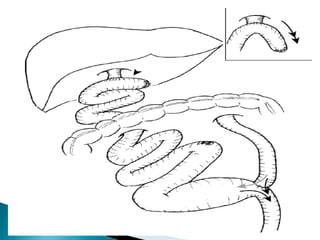
• Radical excision of the cyst with reconstruction of the
biliary tract using a Roux-en-Y loop of jejunum.
• Complete resection of the cyst is important because of
• Ascending cholangitis
• Intrahepatic bile duct stones
• Intrapancreatic terminal choledochus calculi
• Pancreatic duct calculus
• Stones in the blind pouch of the end-to-side
Roux-en-Y hepaticojejunostomy
• Bowel obstruction
• Cholangiocarcinoma
• Liver dysfunction
• Pancreatitis
• Inspissated bile within the distal common bile duct may
cause obstructive jaundice in newborns
• Due to haemolysis, diuretic therapy, parenteral nutrition,
prematurity, or cystic fibrosis.
• Inspissated bile plug syndrome difficult to distinguish from
biliary atresia.
• In both conditions-
jaundice and acholic stools, conjugated
hyperbilirubinaemia, and no biliary excretion on a
radionuclide scan.
• USG reveals dilated proximal bile ducts and inspissated
bile.
• Exceptionally small but grossly visible and
radiographically patent extrahepatic biliary duct
system
• Neonatal hepatitis,α1-antitrypsin deficiency,
intrahepatic biliary atresia, Alagille syndrome, and
• Non cannot be improved by surgical maneuvers.
The prognosis is highly variable and depends on
the primary disease.
• Genetic disorder
• Inherited in an autosomal dominant pattern, and its
estimated prevalence is 1 in every 100,000 live births
• Typical features: peculiar facies with a high, prominent
forehead and deep-set eyes, chronic cholestasis,
butterfly-like vertebral arch defects, and heart disease
(usually peripheral pulmonary stenosis)
• respond to supportive measures such as treatment
with ursodeoxycholic acid and phenobarbital.
• May need liver transplantation as well
 Jaundice beyod the age of 14 days need
meticulous investigation and obstructive causes to
be ruled out.
 Obstructive jaundice, timely intervention can save
a great hazard of liver failure and need of liver
transplantation.
The end
Thank you!!!!!

Surgical jaundice in neonates

  • 1.
    Presenter: Dr. PashiV. M Registrar peadiatrics surgery
  • 2.
     Yellowish discolorationof the skin, mucous membranes, and sclerae of the eyes  Hyperbilirubinemia  Deposition of bile salts in these tissues
  • 3.
     Jaundice inthe first few weeks of life categorised into Hematologic, Enzymatic/metabolic, Infectious and Obstructive
  • 4.
  • 5.
    Post hepatic(Obstructive jaundice) an interruption in the drainage of bile in the biliary system.
  • 6.
     Neonatal cholestasisis defined as prolonged elevation of serum levels of conjugated bilirubin beyond the first 14 days of life.
  • 7.
    • Biliary atresia •Choledochal cyst • Gallstones or biliary sludge • Alagille syndrome • Inspissated bile • Cystic fibrosis • Neonatal sclerosing cholangitis • Congenital hepatic fibrosis/Caroli’s disease • Intrahepatic hypoplasia • spontaneous perforation of the bile duct
  • 8.
     Obstructive jaundicein infancy surgical challenge  Short time between the appearance of the jaundice and the optimal time for surgical intervention between 4 and 6 weeks
  • 9.
    Bile Fluid made bythe liver Two main functions: 1. Carrying toxins and waste products out of the body 2. Helping the body digest fats and absorb the fat- soluble vitamins A, D, E, and K
  • 10.
    • Bile becomestrapped, builds up, and damages the liver. The damage leads to scarring, loss of liver tissue, and cirrhosis • Cirrhosis, portal hypertension, liver failure, and death • Deficiency of vitamin A,D,E,K – clotting factor deficiency – bleeding disorder
  • 11.
     Biliary atresia:most common cause of obstructive jaundice requiring operation in children  Choledochal cyst: 2nd most common cause
  • 12.
     Life-threatening condition Bile ducts inside or outside the liver do not have normal openings
  • 13.
     Rare  1:18,000infants  More common in Females Premature babies, Children of Asian or African American heritage
  • 14.
    • Multiple causes:none proven yet • Not an inherited disease • Some are: 1. Viral or bacterial infection after birth cytomegalovirus, retrovirus, or rotavirus 2. Immune system problem when the immune system attacks the liver or bile ducts for unknown reasons 3. Genetic mutation 4. Problem during liver and bile duct development in the womb
  • 15.
    1. Fetal(syndromic) :appears while the baby is in the womb • known as the embryonic type • associated congenital anomalies such as an interrupted inferior vena cava, preduodenal portal vein, intestinal malrotation, situs inversus, cardiac defects, and polysplenia. • In this variety, which accounts for 10% to 20% of all 2.Perinatal(Nonsyndromic): more common become evident at 2 to 4 weeks after birth
  • 16.
    • Type I: occlusionof common bile duct; • type IIa obliteration of common hepatic duct; • type Iib: obliteration of common bile duct, hepatic and cystic ducts, with cystic dilatation of ducts at the porta hepatis and no gallbladder involvement; • type III: obliteration of common, hepatic, and cystic ducts without anastomosable ducts at porta hepatis.
  • 18.
     The biliarysystem originates from the hepatic diverticulum of the foregut at 4 weeks’ gestation.  This differentiates into cranial and caudal components, which give rise to the intrahepatic and extrahepatic bile ducts, respectively.
  • 21.
    • Jaundice • Darkurine • Gray stools From a lack of bilirubin reaching the intestines • Slow weight gain and growth • Hepatomegaly
  • 22.
     Routine Examinations Color of stool  Consistency of the liver  Conventional liver function tests, including test for γ-glutamyl transpeptidase  Coagulation times (PT, aPTT)
  • 23.
    Special biochemical studies Hepatitis A, B, C serologic studies  TORCH titers  α1-Antitrypsin level  Serum lipoprotein-X  Serum bile acid
  • 24.
    Confirmation of patencyof extrahepatic bile ducts  Duodenal fluid aspiration  Ultrasonography  Hepatobiliary scintigraphy  Endoscopic retrograde cholangiopancreatography  Near-infrared reflectance spectroscopy
  • 25.
    Other:  Needle biopsyof the liver for histopathologic studies  Laparoscopy  Surgical cholangiography
  • 26.
     Biliary atresiais treated by surgery- Kasai procedure or a liver transplant  Kasai opretaion- Named after the surgeon Morio Kasai  This procedure is most effective in infants younger than 3 months old  As they usually haven’t yet developed permanent liver damage
  • 27.
     Surgeon removesthe infant’s damaged bile ducts and brings up a loop of intestine to replace them.  As a result, bile flows straight to the small intestine
  • 28.
  • 29.
    • Cholangitis • Portalhypertension • Esophageal varices • Hypersplenism • Fat-soluble vitamin deficiency Vitamin E-penpheral neuropathy Vitamin D-rickets Vitamin A- visual defects Vitamin K-coagulation defects • Zinc deficiency
  • 30.
     No biledrainage (10%)  Bile drainage (90%) 1/3 Fail- severe liver disease 1/3 indeterminate- moderate liver disease 1/3 “Cured”- minimal liver disease
  • 31.
    Liver Transplant  Livertransplantation is the definitive treatment for biliary atresia  Survival rate after surgery has increased dramatically in recent years
  • 32.
    • Technical failure •Hepatic artery thrombosis • Biliary obstruction • Rejection • Infection Bacterial Viral Fungal
  • 33.
  • 34.
     A choledochalcyst is a rare congenital swelling of the hepatic or bile duct .  These cysts can be intrahepatic, meaning that they occur in the part of the duct located inside of the liver.  They can also be extrahepatic, meaning part of the bile duct that is located outside the liver.
  • 35.
     Frequently includean anomalous junction of the pancreatic duct and CBD (pancreaticobiliary malunion [PBMU])  Intrahepatic bile duct dilatation with or without downstream stenosis  Varying degrees of hepatic fibrosis
  • 37.
    • Congenital weaknessof the bile duct wall, a primary abnormality of proliferation during embryologic ductal development, and congenital obstruction have been postulated • In 1969, the “long common channel theory” was Proposed: PBMU allows reflux of pancreatic enzymes into the CBD, which leads to disruption of the duct walls
  • 38.
     Pancreaticobiliary ductaljunction has been demonstrated to be outside the duodenal wall before the eighth week of gestation and then migrates normally toward the duodenal lumen.  Thus, PBMU may persist as a result of arrest in this migration.
  • 39.
     PBMU(pancreaticobiliary malunion)andcongenital stenosis are the basic causative factors of choledochal cyst
  • 40.
    • Type I: Classiccyst type characterized by cystic dilatation of the common bile duct; most common, comprising 50– 85% of all biliary cysts; subdivided into IA -cystic IB -fusiform IC -saccular • Type II: Simple diverticulum of the extrahepatic biliary tree, comprising less than 5% of all cysts; located proximal to the duodenum • Type III: Cystic dilatation of the intraduodenal portion of the extra hepatic common bile duct; also known as a choledochocele; comprise approximately 5%
  • 41.
    • Type IV: Involvemultiple cysts of the intrahepatic and extrahepatic biliary tree subdivided into type IVA: Both intrahepatic and extrahepatic cysts Second most common type 30–40% Type IVB: multiple extrahepatic cysts without intrahepatic involvement • Type V : Isolated intrahepatic biliary cystic disease Known as Caroli's disease Associated with periportal fibrosis or cirrhosis Multilobar or confined to a single lobe
  • 43.
     The classictriad Pain, jaundice, and abdominal mass. Conjugated bilirubin (80%), Failure to thrive  Intermittent jaundice and recurrent cholangitis  pancreatitis
  • 44.
    • Raised whiteblood cell count, (increased immature neutrophils in patients with cholangitis). • Abnormal LFTs - cholestasis. • Serum amylase and lipase concentrations may be increased in the presence of pancreatitis. • Serum amylase concentrations also may be elevated in biliary obstruction and cholangitis. • Abdominal ultrasonography • Technetium 99m Tc hepatobiliary iminodiacetic acid (HIDA) scan is often used and is particularly useful for showing continuity with bile ducts and diagnosis of cyst rupture • Abdominal CT scan and MRI help to delineate the anatomy of the lesion and of the surrounding structures • Percutaneous transhepatic cholangiography (PTC) or endoscopic retrograde cholangiopancreatography (ERCP)
  • 45.
    • If apatient presents with pancreatitis or cholangitis, treated supportively prior to definitive operative management • Radical excision of the cyst with reconstruction of the biliary tract using a Roux-en-Y loop of jejunum. • Complete resection of the cyst is important because of
  • 47.
    • Ascending cholangitis •Intrahepatic bile duct stones • Intrapancreatic terminal choledochus calculi • Pancreatic duct calculus • Stones in the blind pouch of the end-to-side Roux-en-Y hepaticojejunostomy • Bowel obstruction • Cholangiocarcinoma • Liver dysfunction • Pancreatitis
  • 48.
    • Inspissated bilewithin the distal common bile duct may cause obstructive jaundice in newborns • Due to haemolysis, diuretic therapy, parenteral nutrition, prematurity, or cystic fibrosis. • Inspissated bile plug syndrome difficult to distinguish from biliary atresia. • In both conditions- jaundice and acholic stools, conjugated hyperbilirubinaemia, and no biliary excretion on a radionuclide scan. • USG reveals dilated proximal bile ducts and inspissated bile.
  • 49.
    • Exceptionally smallbut grossly visible and radiographically patent extrahepatic biliary duct system • Neonatal hepatitis,α1-antitrypsin deficiency, intrahepatic biliary atresia, Alagille syndrome, and • Non cannot be improved by surgical maneuvers. The prognosis is highly variable and depends on the primary disease.
  • 50.
    • Genetic disorder •Inherited in an autosomal dominant pattern, and its estimated prevalence is 1 in every 100,000 live births • Typical features: peculiar facies with a high, prominent forehead and deep-set eyes, chronic cholestasis, butterfly-like vertebral arch defects, and heart disease (usually peripheral pulmonary stenosis) • respond to supportive measures such as treatment with ursodeoxycholic acid and phenobarbital. • May need liver transplantation as well
  • 51.
     Jaundice beyodthe age of 14 days need meticulous investigation and obstructive causes to be ruled out.  Obstructive jaundice, timely intervention can save a great hazard of liver failure and need of liver transplantation.
  • 52.