Best Practices in Learning Center ManagementNCLCA InstituteJuly 2010Dr. Lisa D’Adamo–WeinsteinDirector, Academic SupportSUNY Empire State College, Northeast Center
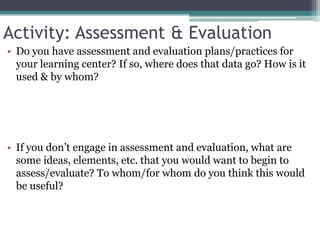
Best practices in learning center management are difficult to define.  Learning centers are multifaceted and complex, varying according to student demographics, institutional structures, facilities, funding, programs/services, staff expertise/size, and a myriad of other factors. This presentation will introduce participants to some models of best practices in order to spark conversation, promote reflection, provide insight, and point participants to resources to be explored within their own institutional contexts.http://nclcainstitute2010.pbworks.com Dr. Lisa D'Adamo-WeinsteinDirector, Academic SupportSUNY Empire State College, Northeast Center21 British American Blvd. Latham, NY 12110518-783-6203 ext 5939 			lisa@docdw.com			Lisa.D’Adamo-Weinstein@esc.edu
Definitions of “Best Practices”" Best practices refer to organizational, administrative, instructional, counseling, advising, and tutoring activities engaged in by highly successful developmental programs. These practices are typically validated by the research and the literature in developmental education." Boylan, H. R. (2002). What Works: Research-based Practices in Developmental Education. Boone, NC: Continuous Quality Improvement Network with the National Center  for Developmental Education, p. 3."Best Practices are defined as elements and activities that the institution perceives as congruent with its mission and the concomitant mission of its academic support center aka learning support center." Christ, F. L. "Best Practices of Learning Support Centers," a presentation at the 2005 Winter Institute, Austin, Texas, January 4, 2005.Bibliography on Best Practices can be found at: http://www.lsche.net/resources/res_bibs_bestprac.htm
NCLCA defines a learning center as…a place wherestudentscan be taught to becomemore efficientandeffective learners. Learning Center services may include:tutoring, mentoring, supplemental instruction, academic and skill-building labs,computer aided instruction, success seminars/programs,advising and more.Source:  http://www.nclca.org
Successful Academic Support & Learning Assistance Programs include…* Proactive interventions,* Supportive environments,* Personalized support systems,* Small group tutorials,* Development of students’ basic learning skills,* Teaching of study skills and learning strategies in the context of academic content courses,* Opportunities to interact in informal settings and develop personal relationships with faculty, and * Opportunities to experience success.Adapted from:  Maxwell, M. (1997). Improving Student Learning Skills. Clearwater, FL: H&H Publishing.Casazza, M. E. & Silverman, S. (1996). Learning Assistance and Developmental Education.              San Francisco: Jossey-Bass.
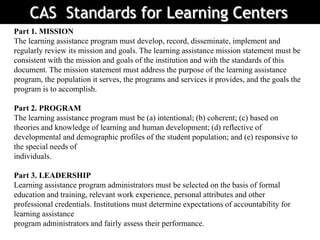
Learning Center Management …Learning assistance program administrators must: exercise authority over resources for which they are responsible to achieve their respective missions; articulate a vision for their organization; establish the program mission, policies, and procedures; set goals and objectives; prescribe and practice ethical behavior; recruit, select, supervise and develop others in the learning assistance program; manage, plan, budget and evaluate; communicate effectively; and marshal cooperative action from colleagues, employees, other institutional constituencies, and persons outside the organization. Program administrators must address individual, organizational, or environmental conditions that inhibit goal achievement.  Program administrators must improve programs and services continuously in response to changing needs of students and institutional priorities.SOURCE: http://www.nade.net/documents/Articles/CAS.Standards.pdf
Mission & GoalsStaffFacilitiesSOURCE: Some Promising Practices for Learning Support Centers [F. L. Christ/NCLCA, 2005 ] - http://www.lsche.net/resources/res_stand_bestpract.htm
SOURCE: Some Promising Practices for Learning Support Centers [F. L. Christ/NCLCA, 2005 ] - http://www.lsche.net/resources/res_stand_bestpract.htm
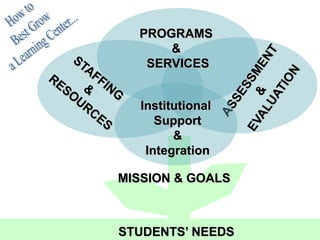
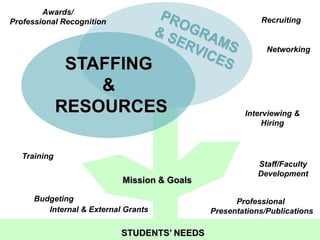
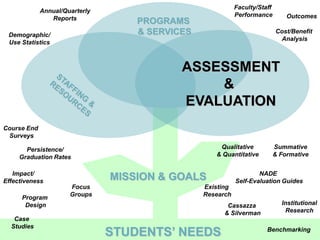
How to Best Grow a Learning Center...PROGRAMS & SERVICESASSESSMENT& EVALUATIONSTAFFING & RESOURCESInstitutional Support&IntegrationMISSION & GOALS STUDENTS’ NEEDS
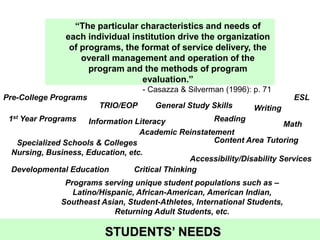
“The particular characteristics and needs of each individual institution drive the organization of programs, the format of service delivery, the overall management and operation of the program and the methods of program evaluation.”- Casazza & Silverman (1996): p. 71ESLPre-College ProgramsTRIO/EOPGeneral Study SkillsWritingReading1st Year ProgramsInformation LiteracyMathAcademic ReinstatementContent Area TutoringSpecialized Schools & CollegesNursing, Business, Education, etc.Accessibility/Disability Services		Developmental EducationCritical ThinkingPrograms serving unique student populations such as – Latino/Hispanic, African-American, American Indian, Southeast Asian, Student-Athletes, International Students, Returning Adult Students, etc.STUDENTS’ NEEDS
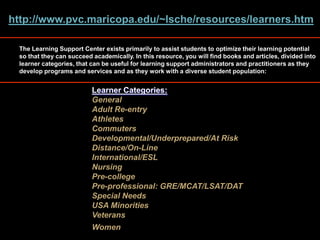
http://www.pvc.maricopa.edu/~lsche/resources/learners.htmThe Learning Support Center exists primarily to assist students to optimize their learning potential so that they can succeed academically. In this resource, you will find books and articles, divided into learner categories, that can be useful for learning support administrators and practitioners as they develop programs and services and as they work with a diverse student population:Learner Categories:GeneralAdult Re-entryAthletesCommutersDevelopmental/Underprepared/At RiskDistance/On-LineInternational/ESLNursingPre-collegePre-professional: GRE/MCAT/LSAT/DATSpecial NeedsUSA MinoritiesVeteransWomen
Your Students: Defining Who, What, & HowWho are the students you serve in your LC? What kinds of resources, programs, & services do they use?How do you interact with them (F-2-F, Online, Paper, E-mail, etc.)?
Your “Clients”: Refining Who, What, & HowAre there other students (staff, faculty, etc) you could serve in your LC? What other kinds of resources, programs, & services do you wish you could offer?How might you expand how you interact with students(F-2-F, Online, Paper, E-mail, etc.)?
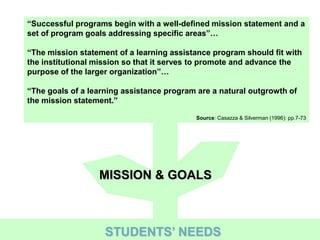
“Successful programs begin with a well-defined mission statement and a set of program goals addressing specific areas”…“The mission statement of a learning assistance program should fit with the institutional mission so that it serves to promote and advance the purpose of the larger organization”…“The goals of a learning assistance program are a natural outgrowth of the mission statement.”Source: Casazza & Silverman (1996): pp.7-73MISSION & GOALS STUDENTS’ NEEDS
Activity: Mission & GoalsDo you have a mission statement for your learning center? If so, is it tied closely to your institutional mission? When is the last time you reviewed/renewed it?If you don’t have one, what are some ideas, elements, etc. that you would want to include?
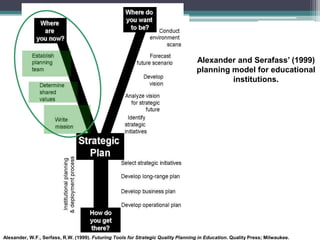
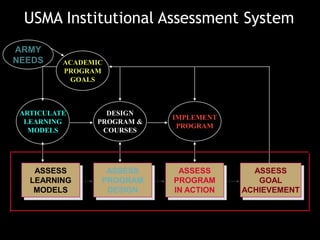
Alexander and Serafass’ (1999) planning model for educational institutions.Alexander, W.F., Serfass, R.W. (1999). FuturingTools for Strategic Quality Planning in Education. Quality Press; Milwaukee.
USMA MISSIONTo educate, train, and inspire the Corps of Cadets so that each graduate is a commissioned leader of character committed to the values of  Duty, Honor, Country; professional growth throughout a career as an officer in the United States Army; and a lifetime of selfless service to the Nation.
We contribute to the purpose and mission of the United States Military Academy by committing ourselves to developing the full potential of the United States Corps of Cadets through comprehensive performance psychologyandacademic skills training.We pursue this vision by teaching a unique combination of reading, studyandapplied performance psychology skills that assist cadets in becoming self-directed learners.  We empower cadets to actively pursue their full academic, physical/athletic, andmilitary potential..
Academic Excellence Program (AEP)AEP MissionWe are a team passionate about cadet success.As learning excellence professionals, we teach and model comprehensive academic success strategies focusing on all cadets.We live what we teach for our cadets and each other.AEP Pedagogical EmphasisAEP programs and services focus on cadets’Academic success
Learning experiences
First-year transitional needs
Leadership development AEP programs and services emphasize learning that is Self-directed
Intentional
Life-longEmpire State CollegeMission& CommitmentsThe Mission of Empire State CollegeEmpire State College enables motivated adults, regardless of geography or life circumstance, to design a rigorous, individualized academic program and earn a college degree.The Commitments of Empire State CollegeTo support self-directed, intellectually curious learners who collaborate with faculty mentors.To document, evaluate and award credit for an adult’s prior college-level life learning.To offer each student an array of learning experiences through independent study, seminars, short-term residencies, and online courses.To develop, implement and assess new approaches to learning that recognize the strengths and needs of adult learners.To provide access to degree programs at multiple locations in New York state and abroad, and through the World Wide Web.To expand degree opportunities for adult learners through partnerships with employers and unions, government agencies and the armed forces, and community organizations and educational institutions.
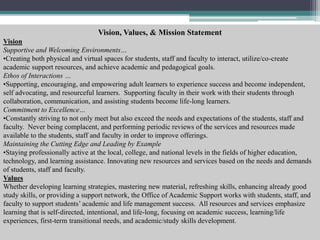
Vision, Values, & Mission StatementVision Supportive and Welcoming Environments… Creating both physical and virtual spaces for students, staff and faculty to interact, utilize/co-create academic support resources, and achieve academic and pedagogical goals. Ethos of Interactions …Supporting, encouraging, and empowering adult learners to experience success and become independent, self advocating, and resourceful learners.  Supporting faculty in their work with their students through collaboration, communication, and assisting students become life-long learners.Commitment to Excellence…Constantly striving to not only meet but also exceed the needs and expectations of the students, staff and faculty.  Never being complacent, and performing periodic reviews of the services and resources made available to the students, staff and faculty in order to improve offerings.Maintaining the Cutting Edge and Leading by ExampleStaying professionally active at the local, college, and national levels in the fields of higher education, technology, and learning assistance. Innovating new resources and services based on the needs and demands of students, staff and faculty. Values Whether developing learning strategies, mastering new material, refreshing skills, enhancing already good study skills, or providing a support network, the Office of Academic Support works with students, staff, and faculty to support students’ academic and life management success.  All resources and services emphasize learning that is self-directed, intentional, and life-long, focusing on academic success, learning/life experiences, first-term transitional needs, and academic/study skills development.
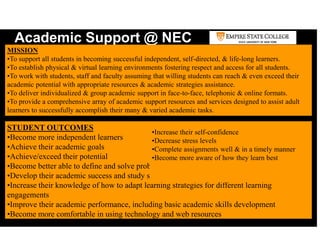
Academic Support @ NECMISSIONTo support all students in becoming successful independent, self-directed, & life-long learners.
To establish physical & virtual learning environments fostering respect and access for all students.
To work with students, staff and faculty assuming that willing students can reach & even exceed their academic potential with appropriate resources & academic strategies assistance.
To deliver individualized & group academic support in face-to-face, telephonic & online formats.
To provide a comprehensive array of academic support resources and services designed to assist adult learners to successfully accomplish their many & varied academic tasks. STUDENT OUTCOMESBecome more independent learners
Achieve their academic goals
Achieve/exceed their potential
Become better able to define and solve problems
Develop their academic success and study skills
Increase their knowledge of how to adapt learning strategies for different learning engagements
Improve their academic performance, including basic academic skills development
Become more comfortable in using technology and web resources
Increase their self-confidence
Decrease stress levels
Complete assignments well & in a timely manner
Become more aware of how they learn bestMissionSUNY Empire State College’s dedicated faculty and staff use innovative, alternative and flexible approaches to higher education that transform people and communities by providing rigorous programs that connect individuals’ unique and diverse lives to their personal learning goals.
Northeast Center Office of Academic SupportMissionThe staff of the Northeast Center Office of Academic Support operate as a collaborative team, striving to establish a friendly welcoming learning environment for all students. We support students in becoming successful independent learners through a comprehensive array of services and resources tailored to students’ individual academic needs and goals. We deliver these services and resources via individualized and group programming in face-to-face, telephonic and virtual formats. Wework with students, staff and faculty with the expectation that willing students can reach and exceed their academic potential with appropriate assistance.
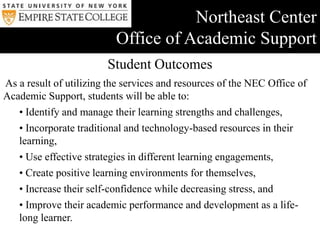
Northeast Center Office of Academic SupportStudent Outcomes As a result of utilizing the services and resources of the NEC Office of Academic Support, students will be able to: Identify and manage their learning strengths and challenges,
 Incorporate traditional and technology-based resources in their learning,
 Use effective strategies in different learning engagements,
 Create positive learning environments for themselves,
 Increase their self-confidence while decreasing stress, and
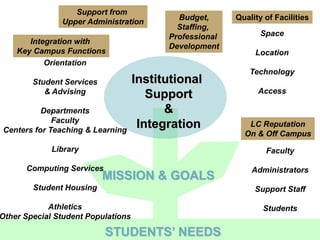
 Improve their academic performance and development as a life-long learner.Support from Upper AdministrationBudget,Staffing, Professional DevelopmentQuality of FacilitiesSpaceLocationTechnologyAccessIntegration with Key Campus FunctionsOrientationStudent Services& AdvisingDepartmentsFacultyCenters for Teaching & LearningLibraryComputing ServicesStudent HousingAthleticsOther Special Student PopulationsInstitutional Support&IntegrationLC ReputationOn & Off CampusFacultyAdministratorsSupport StaffStudentsMISSION & GOALS STUDENTS’ NEEDS
SWOT: Institutional Support & IntegrationSTRENGTHSWEAKNESSESOPPORTUNITIESTHREATS
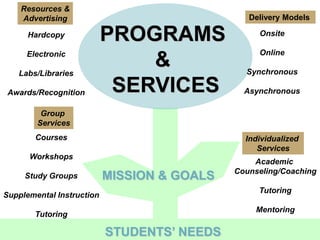
Resources &AdvertisingDelivery Models PROGRAMS & SERVICESOnsiteOnlineSynchronousAsynchronous HardcopyElectronicLabs/LibrariesAwards/RecognitionGroup ServicesCoursesWorkshopsStudy GroupsSupplemental InstructionTutoringIndividualized ServicesAcademic Counseling/CoachingTutoringMentoringMISSION & GOALS STUDENTS’ NEEDS
Activity: TYPES of SERVICES What types do you offer?What would you like to offer?
SWOT: Programs & Services - ExistingSTRENGTHSWEAKNESSESOPPORTUNITIESTHREATS
SWOT: Programs & Services - DesiredSTRENGTHSWEAKNESSESOPPORTUNITIESTHREATS
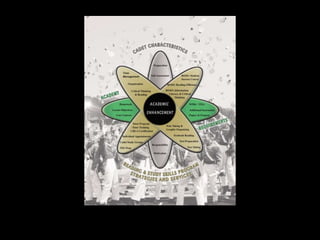
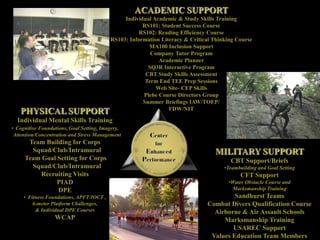
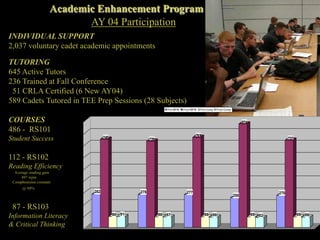
ACADEMIC SUPPORTIndividual Academic & Study Skills TrainingRS101: Student Success CourseRS102: Reading Efficiency CourseRS103: Information Literacy & Critical Thinking CourseMA100 Inclusion SupportCompany Tutor ProgramAcademic PlannerSQ3R Interactive ProgramCBT Study Skills AssessmentTerm End TEE Prep SessionsWeb Site- CEP SkillsPlebe Course Directors GroupSummer Briefings IAW/TOEP/FDW/NITPHYSICAL SUPPORTIndividual Mental Skills TrainingCognitive Foundations, Goal Setting, Imagery,Attention/Concentration and Stress ManagementTeam Building for Corps Squad/Club/Intramural Team Goal Setting for Corps Squad/Club/IntramuralRecruiting VisitsPIADDPEFitness Foundations, APFT/IOCT , 6-meter Platform Challenges,& Individual DPE CoursesWCAPMILITARY SUPPORTCBT Support/BriefsTeambuilding and Goal SettingCFT SupportWater Obstacle Course and Marksmanship TrainingSandhurst TeamsCombat Divers Qualification CourseAirborne & Air Assault SchoolsMarksmanship TrainingUSAREC SupportValues Education Team Members
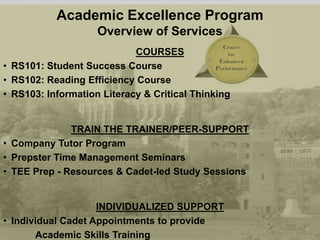
Academic Excellence ProgramOverview of ServicesCOURSESRS101: Student Success Course
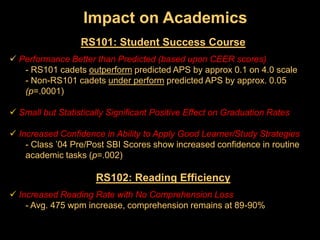
RS102: Reading Efficiency Course
RS103: Information Literacy & Critical ThinkingTRAIN THE TRAINER/PEER-SUPPORTCompany Tutor Program
Prepster Time Management Seminars

Best Practices in Managing your Learning Center effectively

  • 1.
    Best Practices inLearning Center ManagementNCLCA InstituteJuly 2010Dr. Lisa D’Adamo–WeinsteinDirector, Academic SupportSUNY Empire State College, Northeast Center
  • 2.
    Best practices inlearning center management are difficult to define. Learning centers are multifaceted and complex, varying according to student demographics, institutional structures, facilities, funding, programs/services, staff expertise/size, and a myriad of other factors. This presentation will introduce participants to some models of best practices in order to spark conversation, promote reflection, provide insight, and point participants to resources to be explored within their own institutional contexts.http://nclcainstitute2010.pbworks.com Dr. Lisa D'Adamo-WeinsteinDirector, Academic SupportSUNY Empire State College, Northeast Center21 British American Blvd. Latham, NY 12110518-783-6203 ext 5939 lisa@docdw.com Lisa.D’Adamo-Weinstein@esc.edu
  • 3.
    Definitions of “BestPractices”" Best practices refer to organizational, administrative, instructional, counseling, advising, and tutoring activities engaged in by highly successful developmental programs. These practices are typically validated by the research and the literature in developmental education." Boylan, H. R. (2002). What Works: Research-based Practices in Developmental Education. Boone, NC: Continuous Quality Improvement Network with the National Center  for Developmental Education, p. 3."Best Practices are defined as elements and activities that the institution perceives as congruent with its mission and the concomitant mission of its academic support center aka learning support center." Christ, F. L. "Best Practices of Learning Support Centers," a presentation at the 2005 Winter Institute, Austin, Texas, January 4, 2005.Bibliography on Best Practices can be found at: http://www.lsche.net/resources/res_bibs_bestprac.htm
  • 4.
    NCLCA defines alearning center as…a place wherestudentscan be taught to becomemore efficientandeffective learners. Learning Center services may include:tutoring, mentoring, supplemental instruction, academic and skill-building labs,computer aided instruction, success seminars/programs,advising and more.Source: http://www.nclca.org
  • 5.
    Successful Academic Support& Learning Assistance Programs include…* Proactive interventions,* Supportive environments,* Personalized support systems,* Small group tutorials,* Development of students’ basic learning skills,* Teaching of study skills and learning strategies in the context of academic content courses,* Opportunities to interact in informal settings and develop personal relationships with faculty, and * Opportunities to experience success.Adapted from: Maxwell, M. (1997). Improving Student Learning Skills. Clearwater, FL: H&H Publishing.Casazza, M. E. & Silverman, S. (1996). Learning Assistance and Developmental Education. San Francisco: Jossey-Bass.
  • 6.
    Learning Center Management…Learning assistance program administrators must: exercise authority over resources for which they are responsible to achieve their respective missions; articulate a vision for their organization; establish the program mission, policies, and procedures; set goals and objectives; prescribe and practice ethical behavior; recruit, select, supervise and develop others in the learning assistance program; manage, plan, budget and evaluate; communicate effectively; and marshal cooperative action from colleagues, employees, other institutional constituencies, and persons outside the organization. Program administrators must address individual, organizational, or environmental conditions that inhibit goal achievement. Program administrators must improve programs and services continuously in response to changing needs of students and institutional priorities.SOURCE: http://www.nade.net/documents/Articles/CAS.Standards.pdf
  • 7.
    Mission & GoalsStaffFacilitiesSOURCE:Some Promising Practices for Learning Support Centers [F. L. Christ/NCLCA, 2005 ] - http://www.lsche.net/resources/res_stand_bestpract.htm
  • 8.
    SOURCE: Some PromisingPractices for Learning Support Centers [F. L. Christ/NCLCA, 2005 ] - http://www.lsche.net/resources/res_stand_bestpract.htm
  • 9.
    How to BestGrow a Learning Center...PROGRAMS & SERVICESASSESSMENT& EVALUATIONSTAFFING & RESOURCESInstitutional Support&IntegrationMISSION & GOALS STUDENTS’ NEEDS
  • 10.
    “The particular characteristicsand needs of each individual institution drive the organization of programs, the format of service delivery, the overall management and operation of the program and the methods of program evaluation.”- Casazza & Silverman (1996): p. 71ESLPre-College ProgramsTRIO/EOPGeneral Study SkillsWritingReading1st Year ProgramsInformation LiteracyMathAcademic ReinstatementContent Area TutoringSpecialized Schools & CollegesNursing, Business, Education, etc.Accessibility/Disability Services Developmental EducationCritical ThinkingPrograms serving unique student populations such as – Latino/Hispanic, African-American, American Indian, Southeast Asian, Student-Athletes, International Students, Returning Adult Students, etc.STUDENTS’ NEEDS
  • 11.
    http://www.pvc.maricopa.edu/~lsche/resources/learners.htmThe Learning SupportCenter exists primarily to assist students to optimize their learning potential so that they can succeed academically. In this resource, you will find books and articles, divided into learner categories, that can be useful for learning support administrators and practitioners as they develop programs and services and as they work with a diverse student population:Learner Categories:GeneralAdult Re-entryAthletesCommutersDevelopmental/Underprepared/At RiskDistance/On-LineInternational/ESLNursingPre-collegePre-professional: GRE/MCAT/LSAT/DATSpecial NeedsUSA MinoritiesVeteransWomen
  • 12.
    Your Students: DefiningWho, What, & HowWho are the students you serve in your LC? What kinds of resources, programs, & services do they use?How do you interact with them (F-2-F, Online, Paper, E-mail, etc.)?
  • 13.
    Your “Clients”: RefiningWho, What, & HowAre there other students (staff, faculty, etc) you could serve in your LC? What other kinds of resources, programs, & services do you wish you could offer?How might you expand how you interact with students(F-2-F, Online, Paper, E-mail, etc.)?
  • 14.
    “Successful programs beginwith a well-defined mission statement and a set of program goals addressing specific areas”…“The mission statement of a learning assistance program should fit with the institutional mission so that it serves to promote and advance the purpose of the larger organization”…“The goals of a learning assistance program are a natural outgrowth of the mission statement.”Source: Casazza & Silverman (1996): pp.7-73MISSION & GOALS STUDENTS’ NEEDS
  • 15.
    Activity: Mission &GoalsDo you have a mission statement for your learning center? If so, is it tied closely to your institutional mission? When is the last time you reviewed/renewed it?If you don’t have one, what are some ideas, elements, etc. that you would want to include?
  • 16.
    Alexander and Serafass’(1999) planning model for educational institutions.Alexander, W.F., Serfass, R.W. (1999). FuturingTools for Strategic Quality Planning in Education. Quality Press; Milwaukee.
  • 17.
    USMA MISSIONTo educate,train, and inspire the Corps of Cadets so that each graduate is a commissioned leader of character committed to the values of Duty, Honor, Country; professional growth throughout a career as an officer in the United States Army; and a lifetime of selfless service to the Nation.
  • 18.
    We contribute tothe purpose and mission of the United States Military Academy by committing ourselves to developing the full potential of the United States Corps of Cadets through comprehensive performance psychologyandacademic skills training.We pursue this vision by teaching a unique combination of reading, studyandapplied performance psychology skills that assist cadets in becoming self-directed learners. We empower cadets to actively pursue their full academic, physical/athletic, andmilitary potential..
  • 19.
    Academic Excellence Program(AEP)AEP MissionWe are a team passionate about cadet success.As learning excellence professionals, we teach and model comprehensive academic success strategies focusing on all cadets.We live what we teach for our cadets and each other.AEP Pedagogical EmphasisAEP programs and services focus on cadets’Academic success
  • 20.
  • 21.
  • 22.
    Leadership development AEPprograms and services emphasize learning that is Self-directed
  • 23.
  • 24.
    Life-longEmpire State CollegeMission&CommitmentsThe Mission of Empire State CollegeEmpire State College enables motivated adults, regardless of geography or life circumstance, to design a rigorous, individualized academic program and earn a college degree.The Commitments of Empire State CollegeTo support self-directed, intellectually curious learners who collaborate with faculty mentors.To document, evaluate and award credit for an adult’s prior college-level life learning.To offer each student an array of learning experiences through independent study, seminars, short-term residencies, and online courses.To develop, implement and assess new approaches to learning that recognize the strengths and needs of adult learners.To provide access to degree programs at multiple locations in New York state and abroad, and through the World Wide Web.To expand degree opportunities for adult learners through partnerships with employers and unions, government agencies and the armed forces, and community organizations and educational institutions.
  • 25.
    Vision, Values, &Mission StatementVision Supportive and Welcoming Environments… Creating both physical and virtual spaces for students, staff and faculty to interact, utilize/co-create academic support resources, and achieve academic and pedagogical goals. Ethos of Interactions …Supporting, encouraging, and empowering adult learners to experience success and become independent, self advocating, and resourceful learners. Supporting faculty in their work with their students through collaboration, communication, and assisting students become life-long learners.Commitment to Excellence…Constantly striving to not only meet but also exceed the needs and expectations of the students, staff and faculty. Never being complacent, and performing periodic reviews of the services and resources made available to the students, staff and faculty in order to improve offerings.Maintaining the Cutting Edge and Leading by ExampleStaying professionally active at the local, college, and national levels in the fields of higher education, technology, and learning assistance. Innovating new resources and services based on the needs and demands of students, staff and faculty. Values Whether developing learning strategies, mastering new material, refreshing skills, enhancing already good study skills, or providing a support network, the Office of Academic Support works with students, staff, and faculty to support students’ academic and life management success. All resources and services emphasize learning that is self-directed, intentional, and life-long, focusing on academic success, learning/life experiences, first-term transitional needs, and academic/study skills development.
  • 26.
    Academic Support @NECMISSIONTo support all students in becoming successful independent, self-directed, & life-long learners.
  • 27.
    To establish physical& virtual learning environments fostering respect and access for all students.
  • 28.
    To work withstudents, staff and faculty assuming that willing students can reach & even exceed their academic potential with appropriate resources & academic strategies assistance.
  • 29.
    To deliver individualized& group academic support in face-to-face, telephonic & online formats.
  • 30.
    To provide acomprehensive array of academic support resources and services designed to assist adult learners to successfully accomplish their many & varied academic tasks. STUDENT OUTCOMESBecome more independent learners
  • 31.
  • 32.
  • 33.
    Become better ableto define and solve problems
  • 34.
    Develop their academicsuccess and study skills
  • 35.
    Increase their knowledgeof how to adapt learning strategies for different learning engagements
  • 36.
    Improve their academicperformance, including basic academic skills development
  • 37.
    Become more comfortablein using technology and web resources
  • 38.
  • 39.
  • 40.
    Complete assignments well& in a timely manner
  • 41.
    Become more awareof how they learn bestMissionSUNY Empire State College’s dedicated faculty and staff use innovative, alternative and flexible approaches to higher education that transform people and communities by providing rigorous programs that connect individuals’ unique and diverse lives to their personal learning goals.
  • 42.
    Northeast Center Officeof Academic SupportMissionThe staff of the Northeast Center Office of Academic Support operate as a collaborative team, striving to establish a friendly welcoming learning environment for all students. We support students in becoming successful independent learners through a comprehensive array of services and resources tailored to students’ individual academic needs and goals. We deliver these services and resources via individualized and group programming in face-to-face, telephonic and virtual formats. Wework with students, staff and faculty with the expectation that willing students can reach and exceed their academic potential with appropriate assistance.
  • 43.
    Northeast Center Officeof Academic SupportStudent Outcomes As a result of utilizing the services and resources of the NEC Office of Academic Support, students will be able to: Identify and manage their learning strengths and challenges,
  • 44.
    Incorporate traditionaland technology-based resources in their learning,
  • 45.
    Use effectivestrategies in different learning engagements,
  • 46.
    Create positivelearning environments for themselves,
  • 47.
    Increase theirself-confidence while decreasing stress, and
  • 48.
    Improve theiracademic performance and development as a life-long learner.Support from Upper AdministrationBudget,Staffing, Professional DevelopmentQuality of FacilitiesSpaceLocationTechnologyAccessIntegration with Key Campus FunctionsOrientationStudent Services& AdvisingDepartmentsFacultyCenters for Teaching & LearningLibraryComputing ServicesStudent HousingAthleticsOther Special Student PopulationsInstitutional Support&IntegrationLC ReputationOn & Off CampusFacultyAdministratorsSupport StaffStudentsMISSION & GOALS STUDENTS’ NEEDS
  • 49.
    SWOT: Institutional Support& IntegrationSTRENGTHSWEAKNESSESOPPORTUNITIESTHREATS
  • 50.
    Resources &AdvertisingDelivery ModelsPROGRAMS & SERVICESOnsiteOnlineSynchronousAsynchronous HardcopyElectronicLabs/LibrariesAwards/RecognitionGroup ServicesCoursesWorkshopsStudy GroupsSupplemental InstructionTutoringIndividualized ServicesAcademic Counseling/CoachingTutoringMentoringMISSION & GOALS STUDENTS’ NEEDS
  • 51.
    Activity: TYPES ofSERVICES What types do you offer?What would you like to offer?
  • 52.
    SWOT: Programs &Services - ExistingSTRENGTHSWEAKNESSESOPPORTUNITIESTHREATS
  • 53.
    SWOT: Programs &Services - DesiredSTRENGTHSWEAKNESSESOPPORTUNITIESTHREATS
  • 55.
    ACADEMIC SUPPORTIndividual Academic& Study Skills TrainingRS101: Student Success CourseRS102: Reading Efficiency CourseRS103: Information Literacy & Critical Thinking CourseMA100 Inclusion SupportCompany Tutor ProgramAcademic PlannerSQ3R Interactive ProgramCBT Study Skills AssessmentTerm End TEE Prep SessionsWeb Site- CEP SkillsPlebe Course Directors GroupSummer Briefings IAW/TOEP/FDW/NITPHYSICAL SUPPORTIndividual Mental Skills TrainingCognitive Foundations, Goal Setting, Imagery,Attention/Concentration and Stress ManagementTeam Building for Corps Squad/Club/Intramural Team Goal Setting for Corps Squad/Club/IntramuralRecruiting VisitsPIADDPEFitness Foundations, APFT/IOCT , 6-meter Platform Challenges,& Individual DPE CoursesWCAPMILITARY SUPPORTCBT Support/BriefsTeambuilding and Goal SettingCFT SupportWater Obstacle Course and Marksmanship TrainingSandhurst TeamsCombat Divers Qualification CourseAirborne & Air Assault SchoolsMarksmanship TrainingUSAREC SupportValues Education Team Members
  • 56.
    Academic Excellence ProgramOverviewof ServicesCOURSESRS101: Student Success Course
  • 57.
  • 58.
    RS103: Information Literacy& Critical ThinkingTRAIN THE TRAINER/PEER-SUPPORTCompany Tutor Program
  • 59.

Editor's Notes

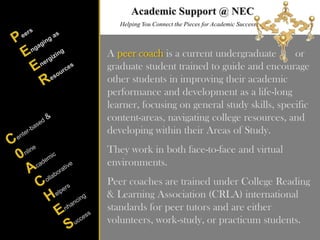
  • #24 One of the first pieces we need to address are the vision, mission and strategic plan of SUNY Empire State College. The Northeast Center of Academic Support contributes to these by offering a comprehensive array of academic support services and resources tailored to students’ individual academic needs and goals. We are collaborative, innovative and flexible in our use of methodologies utilizing both face-to-face and virtual environments as modes of delivery, primarily serving the students, faculty, and staff of the Northeast Center but also making our services and resources available to the ESC community at large through websites and online collaborative tools.
  • #36 Welcome to the Office of Academic Support at the Northeast Center of SUNY Empire State College. We are expanding and enhancing the services and resources we provide to students and are excited to share this brief video outlining our philosophy and mission and previewing what will be available to students, instructors, and mentors starting in the Fall 2010 semester. Our goal is to help students, staff and faculty connect the pieces for academic success at all stages of a student’s educational journey at Empire State College.