EDUCATION 265 School Plant
Management
Reporter: ELMA C. GAPUSAN
Professor: Engr. Paulino Reomero, Ph.D
Guide for Planning School
Construction Projects
SECTION II. PLANNING SCHOOL CONSTRUCTION PROJECTS
Participants in the Planning Process
 • superintendent
 • business manager
 • specialized district staff
 • principals
 • teachers
 • support staff
 • students
 • parents
 • citizens
 • architect, engineer
 • construction manager, contractor
 • commissioning agent
 • educational consultant
 • community survey consultant
 • fiscal consultant
 • legal counsel
 • local or regional governmental officials
 • Minnesota Department of Children,
 Families & Learning staff
 • state or local regulatory agency staff
Planning a School Construction Project (a) Assessment of Needs
1. Identify possible construction project issues such as the
following:
 • school site
 • school facility
 • program
 • student enrollment
 • technology
 • building code
• accessibility
 • health and safety
 • community use/partnership
 • school restructuring
 • school district reorganization
 • land acquisition
(b) Preliminary Planning 3-9 MONTHS
1.Presenting and reviewing data with committee, school district
community, staff, and school board, develop educational, community
user, and partnership program facility design options which meet
educational community learning/program needs and the goals of the
school, school district, community users, and partnership programs.
2. Review preliminary plan(s) and cost estimates, financing plan
(including debt service equalization, if any), tax impact, construction
delivery method), move management, and ballot question(s)
3. If school construction project proposal exceeds $500,000,
prepare and submit package of information to CFL for
commissioner review and comment at lease 60-90 days before
scheduled bond issue referendum.
FINAL PLANNING twelve to twenty-six months+
 Plan and develop bond issue referendum information
materials, schedule building tours, public meetings, etc.
 Publish commissioner review and comment 20 to 60 days
before referendum.
 If referendum passes, coordinate architect, committee,
staff, and administrative development and review of
detailed plans, specifications, and project budget.
 Develop, review, and secure school board approval of final
plans, specifications, and construction documents.
 Plan for the timely sale of bonds, reinvestment of proceeds,
and securing of proceeds for project payments.
 Project construction
 Move Management.
 Complete construction.
Selecting a School Architect and Other
Consultants
Major steps in the selection of an architect include the
following:
1. Form a selection committee.
2. Invite applications from interested architects.
3. Review and screen applications.
4. Interview final architect candidates.
5. Select the architect and negotiate the terms of a
contract.
Assessing Existing School Sites and
Facilities
 A school district may determine the capacity of a facility as follows
(classroom = teaching
station): (# of classrooms) x (capacity of classrooms) x (% utilization of
classrooms)
 To determine how many classroom spaces or teaching stations are
needed for a program or class
(e.g. science or English), use the following formula:
Program or class enrollment = # sections = # of classrooms needed
class size class periods per day
Figure classroom utilization as the number of class periods minus one (for
teacher preparation),
or at 80% or whatever percentage scheduling experience proves to be the
utilization of a classroom or instructional area.
For example:
225 student enrollment = 8.3 sections = 1.4 classrooms needed
27 students per class 6 periods per day utilization
Projecting Educational Program and
Service Space Needs
 Projecting what new or expanded programs and services
need to be accommodated in school facilities can be a
very difficult task. Few school facilities are constructed
with space set aside for growth, and many lack adequate
storage, office, and conference room spaces. Many new or
renovated schools report that they are in need of
additional spaces within two years of occupying
new/renovated facilities.
Renovate an Existing School or Build a
New School?
 The more “yes” answers there are to the following questions, the
greater the likelihood that a school facility in its entirety is not
adequate for current student, staff, program, and community
needs, and needs to be replaced:
♦ Does the school district have too many school facilities for the numbers of
students?
♦ Are there student safety issues (e.g. student and bus drop-off ) on the school site?
♦ Is the school site too small to meet current needs for parking and outdoor
activities?
♦ Is it very difficult or impossible to solve school site issues by closing streets and/or
purchasing adjacent properties?
♦ Are their major exterior issues such as leaking roofs, groundwater penetration,
sagging walls,
mold, and brick in need of repair or replacement?
♦ Are major portions of the school greater than 50 years old and/or in poor condition?
♦ Are there many additions to the school over the years, and are learning and support
spaces
separated that should be clustered together?
♦ Are major portions of the school inaccessible to students with disabilities and
adults?
♦ Does the school have indoor health and safety issues such as poor indoor air quality,
fire
safety, and mold?
♦ Does the school have mold, asbestos, water penetration, or other issues
behind exterior or interior surfaces the cost of which to repair or replace is
difficult to estimate without special engineering studies?
♦ Are general classrooms, specialized areas (labs, shops, music, art, physical
education, and
special education), multipurpose areas, and support spaces (e.g. storage,
conference spaces) insufficient for current needs?
♦ Are there many load-bearing walls, wood floors, and other design features
that make renovation of the school difficult and expensive?
♦ Are the mechanical, electrical, plumbing, and heating, ventilation, and air-
conditioning systems in poor condition?
♦ Is lighting insufficient and/or do the windows, ceilings, and walls need
replacement?
♦ Is further wiring for technology costly because of the age and/or design of
the school?
♦ Is the student enrollment either too small or too large for the capacity of the
facility?
♦ Are school operational and maintenance costs high?
♦ Are community use spaces in the school few or insufficient for current needs?
♦ Are the high costs of renovating the school, the unpredictability of
renovation costs, and the
disadvantages of continuing to use it as a school clear and understandable?
♦ Are the concerns of supporters of the school centered on issues other than
how the facility
can best improve student learning and teaching, and help prepare students for
their future?
♦ Does the school have good potential for reuse? Is there a viable reuse option
for the school?
Selecting a School Site
(a) Site Selection Process
A new school site selection process needs to involve the following steps:
1. Specify the spaces needed for current school and community programs and
for anticipated
program expansion.
2. Form a school site selection team composed of school and district staff,
parents, students,
citizens, school-community partners, and local officials (e.g. city and county
planners, park
board).
3. Employ or work with consulting architects, engineers, local or state
traffic/road officials, real
estate specialists, and appraisers to evaluate possible school sites and the
costs of site
development.
4. Research and review local and regional planning and zoning requirements
and land costs.
5. Convene public meetings to discuss impact of school construction.
6. Review and apply the school site selection considerations specified in (b)
below, rank sites,
and recommend possible site(s) to the school board.
(b) Site Selection Considerations
1.Size
2.Location
3. Health and Life Safety.
4. Topography, Soil.
5. Present/Previous Use.
6. Zoning, Utilities.
7. Cost and Availability.
SCHOOL SITE SIZE GUIDELINES
SCHOOL LEVEL SITE SIZE
ELEMENTARY SCHOOL - 10-15 ACRES +
K-8 OR MIDDLE LEVEL SCHOOOL - 25-35 ACRES +
K-12 SCHOOL OR SMALL HIGH SCHOOL - 35-40 ACRES +
LARGE HIGH SCHOOL (>2,000 STUDENTS) - 60 ACRES +
CAMPUS (TWO OR MORE SCHOOLS) COMBINE SITE SIZES +
ALL SCHOOLS PLUS
ONE ADDITIONAL ACRE FOR EACH 100 STUDENTS OF
ESTIMATED STUDENT ENROLLMENT AND COMMUNITY
USE/PARTNERSHIP PROGRAM CAPACITY, INCLUDING
POSSIBLE ADDITIONS
(c) Improving an Existing School Site
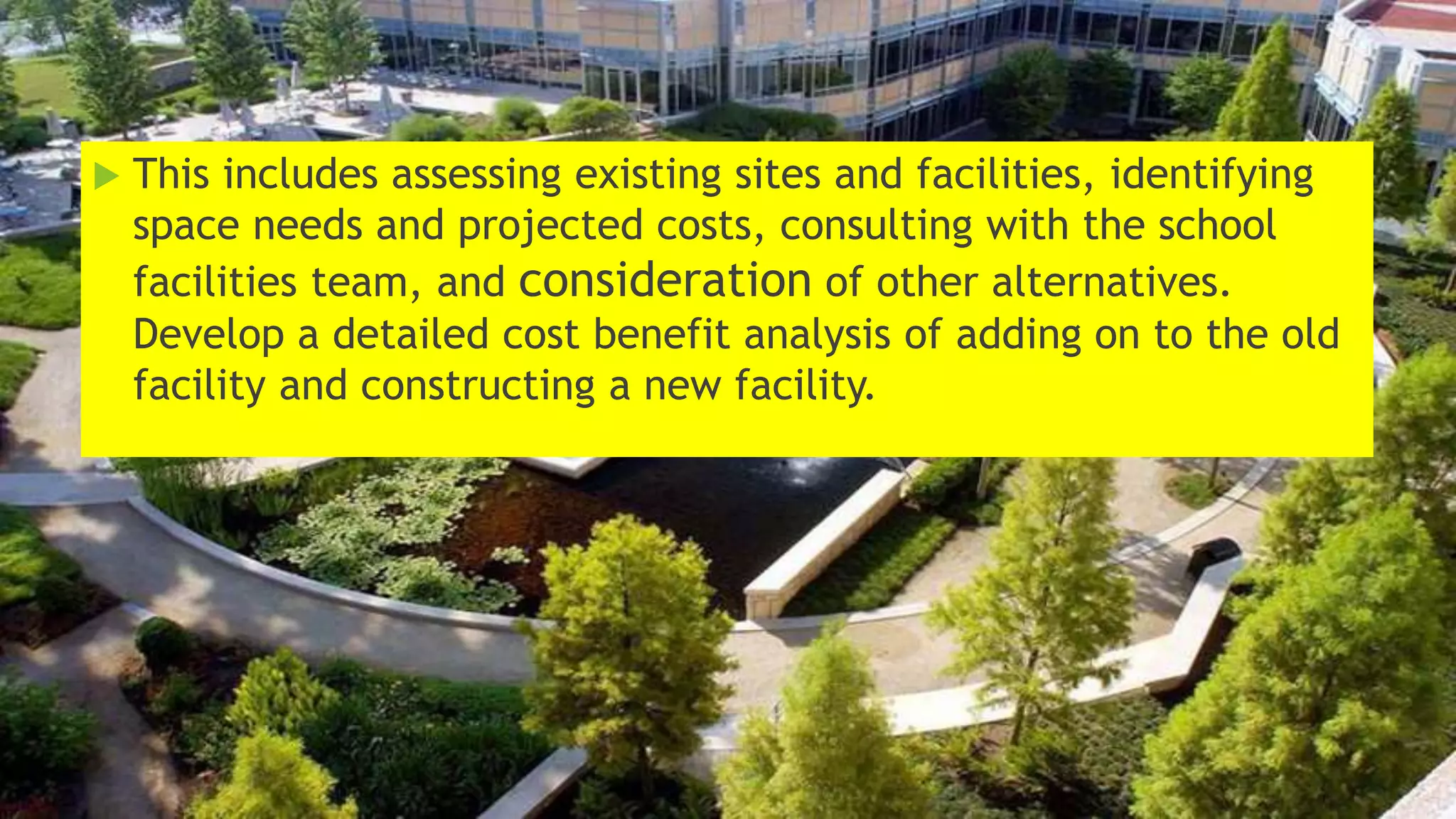
 This includes assessing existing sites and facilities, identifying
space needs and projected costs, consulting with the school
facilities team, and consideration of other alternatives.
Develop a detailed cost benefit analysis of adding on to the old
facility and constructing a new facility.
(d) Planning for School Site Access and Safety
-School site access and safety
concerns necessitate consultation early on (before a review and
comment submittal) with
street and highway planning officials at the local and/or state level
for the purpose of
providing for adequate and safe school site access. Safe and
convenient access to the school for students, parents, visitors, and
community users
must be a priority in designing a school site.
SINGLE OR MULTIPLE PRIME GENERAL CONTRACTING
The general contractor(s) assumes and manages risk,
directly employs subcontractors, and is
responsible for the conformance of construction to the
contract documents. The legal construction
contract is between the general contractor and the
school district owner. The architect has a
contract with the school district owner and has no
contractual ties to the general contractor.
AGENCY CONSTRUCTION MANAGEMENT
The ACM advises the owner and architect during construction.
The ACM provides scheduling
and coordination (i.e. construction meetings, actual
construction, safety programs),
observes/inspects construction to ensure compliance with the
contract documents by contractors,
acts as a conduit for owner-architect-contractor
communications, assists the architect in
evaluating claims made by contractor(s), and signs off on
certificates of payment.
Move Management
Carefully managing a move as your new/renovated facilities are
being completed will help make
the transition as smooth as possible. The complexities and
complications of the move will
positively or negatively affect the attitudes of staff and students
towards the facilities. Move
management issues to consider include the following:
♦ Moving into the Facility- Moving
into a facility while contractors are still working,
cleaning up, or moving out can be a
frustrating experience for all parties.
♦Moving Timelines: the move will take longer if
moving into new facilities with all-new
furnishings and equipment. Plan for moving existing
equipment, and recognize that moving
science, technology, and other specialized
equipment will require special handling.
♦ Complete Landscaping-this might seem
trivial in view of the entire building project,
but
nothing creates a bigger mess than tracking
mud and dirt into a school because walks and
landscaping are not completed. Allow two to
three months for landscaping to “take hold”
before introducing students and the public to
the facility.
♦ Coordinating Move: make sure that final
inspections are complete and final certificates of
occupancy in place to avoid embarrassing situations
for the school and the school district.
Check with all local utility providers to make sure all
services are connected to and
operational in the new facility. Check the emergency
back-up power system, if available.
♦ Commissioning Facility: all new school facilities and
many renovated school facilities must
undergo commissioning . As much as possible, complete this
process of verifying the functionality of HVAC, airflow
monitoring, and other building systems when the systems are
installed and before the building is occupied. Ask your
architect or engineer for assistance with this process. This
process should also include training your facilities and
maintenance staff to help them understand thoroughly how to
operate and adjust building
systems, thus reducing the chances of costly breakdowns and
repairs.
THANK YOU FOR LISTENING!

School Plant Management Educ. 265

  • 1.
    EDUCATION 265 SchoolPlant Management Reporter: ELMA C. GAPUSAN Professor: Engr. Paulino Reomero, Ph.D
  • 2.
    Guide for PlanningSchool Construction Projects SECTION II. PLANNING SCHOOL CONSTRUCTION PROJECTS
  • 3.
    Participants in thePlanning Process  • superintendent  • business manager  • specialized district staff  • principals  • teachers  • support staff  • students  • parents  • citizens  • architect, engineer
  • 4.
     • constructionmanager, contractor  • commissioning agent  • educational consultant  • community survey consultant  • fiscal consultant  • legal counsel  • local or regional governmental officials  • Minnesota Department of Children,  Families & Learning staff  • state or local regulatory agency staff
  • 5.
    Planning a SchoolConstruction Project (a) Assessment of Needs 1. Identify possible construction project issues such as the following:  • school site  • school facility  • program  • student enrollment  • technology  • building code
  • 6.
    • accessibility  •health and safety  • community use/partnership  • school restructuring  • school district reorganization  • land acquisition
  • 7.
    (b) Preliminary Planning3-9 MONTHS 1.Presenting and reviewing data with committee, school district community, staff, and school board, develop educational, community user, and partnership program facility design options which meet educational community learning/program needs and the goals of the school, school district, community users, and partnership programs. 2. Review preliminary plan(s) and cost estimates, financing plan (including debt service equalization, if any), tax impact, construction delivery method), move management, and ballot question(s)
  • 8.
    3. If schoolconstruction project proposal exceeds $500,000, prepare and submit package of information to CFL for commissioner review and comment at lease 60-90 days before scheduled bond issue referendum.
  • 9.
    FINAL PLANNING twelveto twenty-six months+  Plan and develop bond issue referendum information materials, schedule building tours, public meetings, etc.  Publish commissioner review and comment 20 to 60 days before referendum.  If referendum passes, coordinate architect, committee, staff, and administrative development and review of detailed plans, specifications, and project budget.
  • 10.
     Develop, review,and secure school board approval of final plans, specifications, and construction documents.  Plan for the timely sale of bonds, reinvestment of proceeds, and securing of proceeds for project payments.  Project construction  Move Management.  Complete construction.
  • 11.
    Selecting a SchoolArchitect and Other Consultants Major steps in the selection of an architect include the following: 1. Form a selection committee. 2. Invite applications from interested architects. 3. Review and screen applications. 4. Interview final architect candidates. 5. Select the architect and negotiate the terms of a contract.
  • 12.
    Assessing Existing SchoolSites and Facilities  A school district may determine the capacity of a facility as follows (classroom = teaching station): (# of classrooms) x (capacity of classrooms) x (% utilization of classrooms)
  • 13.
     To determinehow many classroom spaces or teaching stations are needed for a program or class (e.g. science or English), use the following formula: Program or class enrollment = # sections = # of classrooms needed class size class periods per day
  • 14.
    Figure classroom utilizationas the number of class periods minus one (for teacher preparation), or at 80% or whatever percentage scheduling experience proves to be the utilization of a classroom or instructional area. For example: 225 student enrollment = 8.3 sections = 1.4 classrooms needed 27 students per class 6 periods per day utilization
  • 15.
    Projecting Educational Programand Service Space Needs  Projecting what new or expanded programs and services need to be accommodated in school facilities can be a very difficult task. Few school facilities are constructed with space set aside for growth, and many lack adequate storage, office, and conference room spaces. Many new or renovated schools report that they are in need of additional spaces within two years of occupying new/renovated facilities.
  • 16.
    Renovate an ExistingSchool or Build a New School?  The more “yes” answers there are to the following questions, the greater the likelihood that a school facility in its entirety is not adequate for current student, staff, program, and community needs, and needs to be replaced:
  • 17.
    ♦ Does theschool district have too many school facilities for the numbers of students? ♦ Are there student safety issues (e.g. student and bus drop-off ) on the school site? ♦ Is the school site too small to meet current needs for parking and outdoor activities? ♦ Is it very difficult or impossible to solve school site issues by closing streets and/or purchasing adjacent properties? ♦ Are their major exterior issues such as leaking roofs, groundwater penetration, sagging walls, mold, and brick in need of repair or replacement? ♦ Are major portions of the school greater than 50 years old and/or in poor condition? ♦ Are there many additions to the school over the years, and are learning and support spaces separated that should be clustered together? ♦ Are major portions of the school inaccessible to students with disabilities and adults? ♦ Does the school have indoor health and safety issues such as poor indoor air quality, fire
  • 18.
    safety, and mold? ♦Does the school have mold, asbestos, water penetration, or other issues behind exterior or interior surfaces the cost of which to repair or replace is difficult to estimate without special engineering studies? ♦ Are general classrooms, specialized areas (labs, shops, music, art, physical education, and special education), multipurpose areas, and support spaces (e.g. storage, conference spaces) insufficient for current needs? ♦ Are there many load-bearing walls, wood floors, and other design features that make renovation of the school difficult and expensive? ♦ Are the mechanical, electrical, plumbing, and heating, ventilation, and air- conditioning systems in poor condition?
  • 19.
    ♦ Is lightinginsufficient and/or do the windows, ceilings, and walls need replacement? ♦ Is further wiring for technology costly because of the age and/or design of the school? ♦ Is the student enrollment either too small or too large for the capacity of the facility? ♦ Are school operational and maintenance costs high? ♦ Are community use spaces in the school few or insufficient for current needs? ♦ Are the high costs of renovating the school, the unpredictability of renovation costs, and the disadvantages of continuing to use it as a school clear and understandable? ♦ Are the concerns of supporters of the school centered on issues other than how the facility can best improve student learning and teaching, and help prepare students for their future? ♦ Does the school have good potential for reuse? Is there a viable reuse option for the school?
  • 20.
    Selecting a SchoolSite (a) Site Selection Process A new school site selection process needs to involve the following steps: 1. Specify the spaces needed for current school and community programs and for anticipated program expansion. 2. Form a school site selection team composed of school and district staff, parents, students, citizens, school-community partners, and local officials (e.g. city and county planners, park board).
  • 21.
    3. Employ orwork with consulting architects, engineers, local or state traffic/road officials, real estate specialists, and appraisers to evaluate possible school sites and the costs of site development. 4. Research and review local and regional planning and zoning requirements and land costs. 5. Convene public meetings to discuss impact of school construction. 6. Review and apply the school site selection considerations specified in (b) below, rank sites, and recommend possible site(s) to the school board.
  • 22.
    (b) Site SelectionConsiderations 1.Size 2.Location 3. Health and Life Safety. 4. Topography, Soil. 5. Present/Previous Use. 6. Zoning, Utilities. 7. Cost and Availability.
  • 23.
    SCHOOL SITE SIZEGUIDELINES SCHOOL LEVEL SITE SIZE ELEMENTARY SCHOOL - 10-15 ACRES + K-8 OR MIDDLE LEVEL SCHOOOL - 25-35 ACRES + K-12 SCHOOL OR SMALL HIGH SCHOOL - 35-40 ACRES + LARGE HIGH SCHOOL (>2,000 STUDENTS) - 60 ACRES + CAMPUS (TWO OR MORE SCHOOLS) COMBINE SITE SIZES + ALL SCHOOLS PLUS ONE ADDITIONAL ACRE FOR EACH 100 STUDENTS OF ESTIMATED STUDENT ENROLLMENT AND COMMUNITY USE/PARTNERSHIP PROGRAM CAPACITY, INCLUDING POSSIBLE ADDITIONS
  • 24.
    (c) Improving anExisting School Site  This includes assessing existing sites and facilities, identifying space needs and projected costs, consulting with the school facilities team, and consideration of other alternatives. Develop a detailed cost benefit analysis of adding on to the old facility and constructing a new facility.
  • 25.
    (d) Planning forSchool Site Access and Safety -School site access and safety concerns necessitate consultation early on (before a review and comment submittal) with street and highway planning officials at the local and/or state level for the purpose of providing for adequate and safe school site access. Safe and convenient access to the school for students, parents, visitors, and community users must be a priority in designing a school site.
  • 26.
    SINGLE OR MULTIPLEPRIME GENERAL CONTRACTING The general contractor(s) assumes and manages risk, directly employs subcontractors, and is responsible for the conformance of construction to the contract documents. The legal construction contract is between the general contractor and the school district owner. The architect has a contract with the school district owner and has no contractual ties to the general contractor.
  • 27.
    AGENCY CONSTRUCTION MANAGEMENT TheACM advises the owner and architect during construction. The ACM provides scheduling and coordination (i.e. construction meetings, actual construction, safety programs), observes/inspects construction to ensure compliance with the contract documents by contractors, acts as a conduit for owner-architect-contractor communications, assists the architect in evaluating claims made by contractor(s), and signs off on certificates of payment.
  • 28.
    Move Management Carefully managinga move as your new/renovated facilities are being completed will help make the transition as smooth as possible. The complexities and complications of the move will positively or negatively affect the attitudes of staff and students towards the facilities. Move management issues to consider include the following:
  • 29.
    ♦ Moving intothe Facility- Moving into a facility while contractors are still working, cleaning up, or moving out can be a frustrating experience for all parties. ♦Moving Timelines: the move will take longer if moving into new facilities with all-new furnishings and equipment. Plan for moving existing equipment, and recognize that moving science, technology, and other specialized equipment will require special handling.
  • 30.
    ♦ Complete Landscaping-thismight seem trivial in view of the entire building project, but nothing creates a bigger mess than tracking mud and dirt into a school because walks and landscaping are not completed. Allow two to three months for landscaping to “take hold” before introducing students and the public to the facility.
  • 31.
    ♦ Coordinating Move:make sure that final inspections are complete and final certificates of occupancy in place to avoid embarrassing situations for the school and the school district. Check with all local utility providers to make sure all services are connected to and operational in the new facility. Check the emergency back-up power system, if available.
  • 32.
    ♦ Commissioning Facility:all new school facilities and many renovated school facilities must undergo commissioning . As much as possible, complete this process of verifying the functionality of HVAC, airflow monitoring, and other building systems when the systems are installed and before the building is occupied. Ask your architect or engineer for assistance with this process. This process should also include training your facilities and maintenance staff to help them understand thoroughly how to operate and adjust building systems, thus reducing the chances of costly breakdowns and repairs.
  • 33.
    THANK YOU FORLISTENING!