SCHOOL-BASED MANAGEMENT
.
SCHOOL-BASED MANAGEMENT
PRINCIPLES, DIMENSIONS, INDICATORS
School-Based Management (SBM)
 is the decentralization of instructive dynamic authority from the
Government or the Central Office to the principals, teachers, students,
parents or guardians and networks or communities to guarantee a more
successful school organization and a superior responsibility of staffs.
Principles of School-Based Management
 Leadership and Governance
 Curriculum and Instruction
 Accountability and Continuous Improvement
 Management of Resources
Leadership and Governance
 an organization of leadership that gives the vision and direction to
the school system making it significant and receptive to the settings
of different networks or communities.
Leadership and Governance
 an organization of leadership that gives the vision and direction to
the school system making it significant and receptive to the settings
of different networks or communities.
 gives a Development Plan created cooperatively by the partners of
the school and local area.
Leadership and Governance
 an organization of leadership that gives the vision and direction to
the school system making it significant and receptive to the settings
of different networks or communities.
 gives a Development Plan created cooperatively by the partners of
the school and local area.
 The school is coordinated by a clear structure and work plans that
advance common initiative and administration and characterize the
jobs and obligations of the stakeholders.
Leadership and Governance
 A leadership network facilitates correspondence between and among
school and local area leaders for informed direction and tackling of
school local area wide-learning issues. A long term program is in
activity that tends to the preparation and improvement needs of
school and community leaders.
Principles of School-Based Management
 Leadership and Governance
 Curriculum and Instruction/Learning
 Accountability and Continuous Improvement
 Management of Resources
Curriculum and Instruction
 is a field within education which seeks to research, develop, and
implement curriculum changes that increase learner achievement in
instructive settings. The field focuses on how people learn and the
best ways to educate.
Accountability and Continuous
Improvement
 A clear, transparent, inclusive and responsive accountability system
is in place, collaboratively developed by community stakeholders,
which monitors expected and actual performance, continually
addresses the gaps, and ensures a venue for feedback and redress.
Management of Resources
 Resources are collectively and prudently prepared and made with
straightforwardness, adequacy and proficiency.
Management of Resources
 When it comes to education, resource management involves making
a strategic plan for organizing and using school resources.
 Resource management involves evaluation and maximization of such
resources.
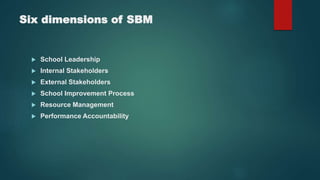
Six dimensions of SBM
 School Leadership
 Internal Stakeholders
 External Stakeholders
 School Improvement Process
 Resource Management
 Performance Accountability
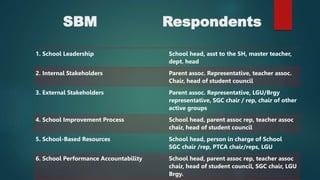
SBM Respondents
1. School Leadership School head, asst to the SH, master teacher,
dept. head
2. Internal Stakeholders Parent assoc. Representative, teacher assoc.
Chair, head of student council
3. External Stakeholders Parent assoc. Representative, LGU/Brgy
representative, SGC chair / rep, chair of other
active groups
4. School Improvement Process School head, parent assoc rep, teacher assoc
chair, head of student council
5. School-Based Resources School head, person in charge of School
SGC chair /rep, PTCA chair/reps, LGU
6. School Performance Accountability School head, parent assoc rep, teacher assoc
chair, head of student council, SGC chair, LGU
Brgy.
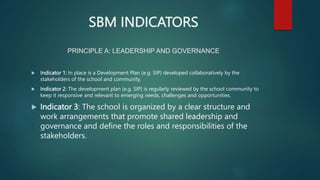
SBM INDICATORS
PRINCIPLE A: LEADERSHIP AND GOVERNANCE
 Indicator 1: In place is a Development Plan (e.g. SIP)
developed collaboratively by the stakeholders of the school
and community.
SBM INDICATORS
PRINCIPLE A: LEADERSHIP AND GOVERNANCE
 Indicator 1: In place is a Development Plan (e.g. SIP) developed collaboratively by the
stakeholders of the school and community.
 Indicator 2: The development plan (e.g. SIP) is regularly reviewed by the
school community to keep it responsive and relevant to emerging needs,
challenges and opportunities.
SBM INDICATORS
PRINCIPLE A: LEADERSHIP AND GOVERNANCE
 Indicator 1: In place is a Development Plan (e.g. SIP) developed collaboratively by the
stakeholders of the school and community.
 Indicator 2: The development plan (e.g. SIP) is regularly reviewed by the school community to
keep it responsive and relevant to emerging needs, challenges and opportunities.
 Indicator 3: The school is organized by a clear structure and
work arrangements that promote shared leadership and
governance and define the roles and responsibilities of the
stakeholders.
SBM INDICATORS
PRINCIPLE A: LEADERSHIP AND GOVERNANCE
 Indicator 1: In place is a Development Plan (e.g. SIP) developed collaboratively by the
stakeholders of the school and community.
 Indicator 2: The development plan (e.g. SIP) is regularly reviewed by the school community to
keep it responsive and relevant to emerging needs, challenges and opportunities.
 Indicator 3: The school is organized by a clear structure and work arrangements that promote
shared leadership and governance and define the roles and responsibilities of the
stakeholders.
 Indicator 4: A leadership network facilitates communication between and
among school and community leaders for informed decision-making and
solving of schoolcommunity wide- learning problems.
SBM INDICATORS
PRINCIPLE A: LEADERSHIP AND GOVERNANCE
 Indicator 1: In place is a Development Plan (e.g. SIP) developed collaboratively by the
stakeholders of the school and community.
 Indicator 2: The development plan (e.g. SIP) is regularly reviewed by the school
community to keep it responsive and relevant to emerging needs, challenges and
opportunities.
 Indicator 3: The school is organized by a clear structure and work arrangements that
promote shared leadership and governance and define the roles and responsibilities
of the stakeholders.
 Indicator 4: A leadership network facilitates communication between and among
school and community leaders for informed decision-making and solving of
schoolcommunity wide- learning problems.
 Indicator 5: A long term program is in operation that addresses the
training and development needs of school and community leaders.
SBM INDICATORS
PRINCIPLE B: CURRICULUM AND INSTRUCTION
 Indicator 1: The curriculum provides for the development needs of all types
of learners in the school community.
SBM INDICATORS
PRINCIPLE B: CURRICULUM AND INSTRUCTION
 Indicator 1: The curriculum provides for the development needs of all types
of learners in the school community.
 Indicator 2: The implemented curriculum is localized.
SBM INDICATORS
PRINCIPLE B: CURRICULUM AND INSTRUCTION
 Indicator 1: The curriculum provides for the development needs of all types
of learners in the school community.
 Indicator 2: The implemented curriculum is localized.
 Indicator 3: The school and community developed methods
and materials for developing creative thinking and problem
solving.
SBM INDICATORS
PRINCIPLE B: CURRICULUM AND INSTRUCTION
 Indicator 1: The curriculum provides for the development needs of all types
of learners in the school community.
 Indicator 2: The implemented curriculum is localized.
 Indicator 3: The school and community developed methods and materials
for developing creative thinking and problem solving.
 Indicator 4: The learning systems are regularly and
collaboratively monitored.
SBM INDICATORS
PRINCIPLE B: CURRICULUM AND INSTRUCTION
 Indicator 1: The curriculum provides for the development needs of all types
of learners in the school community.
 Indicator 2: The implemented curriculum is localized.
 Indicator 3: The school and community developed methods and materials
for developing creative thinking and problem solving.
 Indicator 4: The learning systems are regularly and collaboratively
monitored.
 Indicator 5: Appropriate assessment tools for teaching and
learning are continuously reviewed and improved.
SBM INDICATORS
PRINCIPLE B: CURRICULUM AND INSTRUCTION
 Indicator 1: The curriculum provides for the development needs of all types of learners in
the school community.
 Indicator 2: The implemented curriculum is localized.
 Indicator 3: The school and community developed methods and materials for developing
creative thinking and problem solving.
 Indicator 4: The learning systems are regularly and collaboratively monitored.
 Indicator 5: Appropriate assessment tools for teaching and learning are continuously
reviewed and improved.
 Indicator 6: Learning managers and facilitators nurture values
and environments that are protective of all children and
demonstrate behaviors consistent to the organization's vision,
mission and goals.
SBM INDICATORS
PRINCIPLE B: CURRICULUM AND INSTRUCTION
 Indicator 1: The curriculum provides for the development needs of all types of learners in
the school community.
 Indicator 2: The implemented curriculum is localized.
 Indicator 3: The school and community developed methods and materials for developing
creative thinking and problem solving.
 Indicator 4: The learning systems are regularly and collaboratively monitored.
 Indicator 5: Appropriate assessment tools for teaching and learning are continuously
reviewed and improved.
 Indicator 6: Learning managers and facilitators nurture values and environments that are
protective of all children and demonstrate behaviors consistent to the organization's
vision, mission and goals.
 Indicator 7: Methods and resources are learner and
community-friendly.
SBM INDICATORS
PRINCIPLE C: ACCOUNTABILITY AND CONTINUOUS IMPROVEMENT
 .
SBM INDICATORS
PRINCIPLE C: ACCOUNTABILITY AND CONTINUOUS IMPROVEMENT
 Indicator 1: Roles and responsibilities of accountable persons and
collective body/ies are clearly defined and agreed upon by community
stakeholders.
SBM INDICATORS
PRINCIPLE C: ACCOUNTABILITY AND CONTINUOUS IMPROVEMENT
 Indicator 1: Roles and responsibilities of accountable persons and
collective body/ies are clearly defined and agreed upon by community
stakeholders.
 Indicator 2: Achievement of goals is recognized based on a
collaboratively developed performance accountability system; gaps are
addressed through appropriate action.
SBM INDICATORS
PRINCIPLE C: ACCOUNTABILITY AND CONTINUOUS IMPROVEMENT
 Indicator 1: Roles and responsibilities of accountable persons and collective
body/ies are clearly defined and agreed upon by community stakeholders.
 Indicator 2: Achievement of goals is recognized based on a collaboratively
developed performance accountability system; gaps are addressed through
appropriate action.
 Indicator 3: Participatory assessment of School initiated periodic Collaborative
conduct of School-community-performance is done regularly performance
assessments developed performance with the community.
SBM INDICATORS
PRINCIPLE C: ACCOUNTABILITY AND CONTINUOUS IMPROVEMENT
 Indicator 1: Roles and responsibilities of accountable persons and
collective body/ies are clearly defined and agreed upon by community
stakeholders.
 Indicator 2: Achievement of goals is recognized based on a
collaboratively developed performance accountability system; gaps are
addressed through appropriate action.
 Indicator 3: Participatory assessment of School initiated periodic
Collaborative conduct of School-community-performance is done
regularly performance assessments developed performance with the
community.
 Indicator 4: Accountability assessment criteria and tools, feedback
mechanism and information collection and validation techniques and
processes are inclusive and collaboratively developed and agreed.
SBM INDICATORS
PRINCIPLE C: ACCOUNTABILITY AND CONTINUOUS IMPROVEMENT
 Indicator 1: Roles and responsibilities of accountable persons and collective
body/ies are clearly defined and agreed upon by community stakeholders.
 Indicator 2: Achievement of goals is recognized based on a collaboratively
developed performance accountability system; gaps are addressed through
appropriate action.
 Indicator 3: Participatory assessment of School initiated periodic Collaborative
conduct of School-community-performance is done regularly performance
assessments developed performance with the community.
 Indicator 4: Accountability assessment criteria and tools, feedback mechanism
and information collection and validation techniques and processes are
inclusive and collaboratively developed and agreed.
 Indicator 5: Participatory assessment of performance is done regularly with
the community. Assessment results and lessons learned serve as basis for
feedback, technical assistance, recognition and plan adjustment.
SBM INDICATORS
PRINCIPLE D: MANAGEMENT OF RESOURCES
 .
SBM INDICATORS
PRINCIPLE D: MANAGEMENT OF RESOURCES
 Indicator 1: Regular resource inventory is collaboratively undertaken by
learning managers, learning facilitators, and community stakeholders as
basis for resource allocation and mobilization.
SBM INDICATORS
PRINCIPLE D: MANAGEMENT OF RESOURCES
 Indicator 1: Regular resource inventory is collaboratively undertaken by
learning managers, learning facilitators, and community stakeholders as
basis for resource allocation and mobilization.
 Indicator 2: A regular dialogue for planning and resource programming, that
is accessible and inclusive, continuously engage stakeholders and support
implementation of community education.
SBM INDICATORS
PRINCIPLE D: MANAGEMENT OF RESOURCES
 Indicator 1: Regular resource inventory is collaboratively undertaken by
learning managers, learning facilitators, and community stakeholders as
basis for resource allocation and mobilization.
 Indicator 2: A regular dialogue for planning and resource programming, that
is accessible and inclusive, continuously engage stakeholders and support
implementation of community education.
 Indicator 3: In place is a community-developed resource management
system that drives appropriate behaviors of the stakeholders to ensure
judicious, appropriate, and effective use of resources.
SBM INDICATORS
PRINCIPLE D: MANAGEMENT OF RESOURCES
 Indicator 1: Regular resource inventory is collaboratively undertaken by
learning managers, learning facilitators, and community stakeholders as
basis for resource allocation and mobilization.
 Indicator 2: A regular dialogue for planning and resource programming, that
is accessible and inclusive, continuously engage stakeholders and support
implementation of community education.
 Indicator 3: In place is a community-developed resource management
system that drives appropriate behaviors of the stakeholders to ensure
judicious, appropriate, and effective use of resources.
 Indicator 4: Regular monitoring, evaluation, and reporting processes of
resource management are collaboratively developed and implemented by
the learning managers, facilitators, and community stakeholders.
SBM INDICATORS
PRINCIPLE D: MANAGEMENT OF RESOURCES
 Indicator 1: Regular resource inventory is collaboratively undertaken by
learning managers, learning facilitators, and community stakeholders as
basis for resource allocation and mobilization.
 Indicator 2: A regular dialogue for planning and resource programming, that
is accessible and inclusive, continuously engage stakeholders and support
implementation of community education.
 Indicator 3: In place is a community-developed resource management
system that drives appropriate behaviors of the stakeholders to ensure
judicious, appropriate, and effective use of resources.
 Indicator 4: Regular monitoring, evaluation, and reporting processes of
resource management are collaboratively developed and implemented by
the learning managers, facilitators, and community stakeholders.
 Indicator 5: There is a system that manages the network and linkages which
strength and sustain partnerships for improving resource management.
Thank you
.
.
.

SCHOOL-BASED MANAGEMENT.pptx

  • 1.
  • 2.
  • 3.
    School-Based Management (SBM) is the decentralization of instructive dynamic authority from the Government or the Central Office to the principals, teachers, students, parents or guardians and networks or communities to guarantee a more successful school organization and a superior responsibility of staffs.
  • 4.
    Principles of School-BasedManagement  Leadership and Governance  Curriculum and Instruction  Accountability and Continuous Improvement  Management of Resources
  • 5.
    Leadership and Governance an organization of leadership that gives the vision and direction to the school system making it significant and receptive to the settings of different networks or communities.
  • 6.
    Leadership and Governance an organization of leadership that gives the vision and direction to the school system making it significant and receptive to the settings of different networks or communities.  gives a Development Plan created cooperatively by the partners of the school and local area.
  • 7.
    Leadership and Governance an organization of leadership that gives the vision and direction to the school system making it significant and receptive to the settings of different networks or communities.  gives a Development Plan created cooperatively by the partners of the school and local area.  The school is coordinated by a clear structure and work plans that advance common initiative and administration and characterize the jobs and obligations of the stakeholders.
  • 8.
    Leadership and Governance A leadership network facilitates correspondence between and among school and local area leaders for informed direction and tackling of school local area wide-learning issues. A long term program is in activity that tends to the preparation and improvement needs of school and community leaders.
  • 9.
    Principles of School-BasedManagement  Leadership and Governance  Curriculum and Instruction/Learning  Accountability and Continuous Improvement  Management of Resources
  • 10.
    Curriculum and Instruction is a field within education which seeks to research, develop, and implement curriculum changes that increase learner achievement in instructive settings. The field focuses on how people learn and the best ways to educate.
  • 11.
    Accountability and Continuous Improvement A clear, transparent, inclusive and responsive accountability system is in place, collaboratively developed by community stakeholders, which monitors expected and actual performance, continually addresses the gaps, and ensures a venue for feedback and redress.
  • 12.
    Management of Resources Resources are collectively and prudently prepared and made with straightforwardness, adequacy and proficiency.
  • 13.
    Management of Resources When it comes to education, resource management involves making a strategic plan for organizing and using school resources.  Resource management involves evaluation and maximization of such resources.
  • 14.
    Six dimensions ofSBM  School Leadership  Internal Stakeholders  External Stakeholders  School Improvement Process  Resource Management  Performance Accountability
  • 15.
    SBM Respondents 1. SchoolLeadership School head, asst to the SH, master teacher, dept. head 2. Internal Stakeholders Parent assoc. Representative, teacher assoc. Chair, head of student council 3. External Stakeholders Parent assoc. Representative, LGU/Brgy representative, SGC chair / rep, chair of other active groups 4. School Improvement Process School head, parent assoc rep, teacher assoc chair, head of student council 5. School-Based Resources School head, person in charge of School SGC chair /rep, PTCA chair/reps, LGU 6. School Performance Accountability School head, parent assoc rep, teacher assoc chair, head of student council, SGC chair, LGU Brgy.
  • 16.
    SBM INDICATORS PRINCIPLE A:LEADERSHIP AND GOVERNANCE  Indicator 1: In place is a Development Plan (e.g. SIP) developed collaboratively by the stakeholders of the school and community.
  • 17.
    SBM INDICATORS PRINCIPLE A:LEADERSHIP AND GOVERNANCE  Indicator 1: In place is a Development Plan (e.g. SIP) developed collaboratively by the stakeholders of the school and community.  Indicator 2: The development plan (e.g. SIP) is regularly reviewed by the school community to keep it responsive and relevant to emerging needs, challenges and opportunities.
  • 18.
    SBM INDICATORS PRINCIPLE A:LEADERSHIP AND GOVERNANCE  Indicator 1: In place is a Development Plan (e.g. SIP) developed collaboratively by the stakeholders of the school and community.  Indicator 2: The development plan (e.g. SIP) is regularly reviewed by the school community to keep it responsive and relevant to emerging needs, challenges and opportunities.  Indicator 3: The school is organized by a clear structure and work arrangements that promote shared leadership and governance and define the roles and responsibilities of the stakeholders.
  • 19.
    SBM INDICATORS PRINCIPLE A:LEADERSHIP AND GOVERNANCE  Indicator 1: In place is a Development Plan (e.g. SIP) developed collaboratively by the stakeholders of the school and community.  Indicator 2: The development plan (e.g. SIP) is regularly reviewed by the school community to keep it responsive and relevant to emerging needs, challenges and opportunities.  Indicator 3: The school is organized by a clear structure and work arrangements that promote shared leadership and governance and define the roles and responsibilities of the stakeholders.  Indicator 4: A leadership network facilitates communication between and among school and community leaders for informed decision-making and solving of schoolcommunity wide- learning problems.
  • 20.
    SBM INDICATORS PRINCIPLE A:LEADERSHIP AND GOVERNANCE  Indicator 1: In place is a Development Plan (e.g. SIP) developed collaboratively by the stakeholders of the school and community.  Indicator 2: The development plan (e.g. SIP) is regularly reviewed by the school community to keep it responsive and relevant to emerging needs, challenges and opportunities.  Indicator 3: The school is organized by a clear structure and work arrangements that promote shared leadership and governance and define the roles and responsibilities of the stakeholders.  Indicator 4: A leadership network facilitates communication between and among school and community leaders for informed decision-making and solving of schoolcommunity wide- learning problems.  Indicator 5: A long term program is in operation that addresses the training and development needs of school and community leaders.
  • 21.
    SBM INDICATORS PRINCIPLE B:CURRICULUM AND INSTRUCTION  Indicator 1: The curriculum provides for the development needs of all types of learners in the school community.
  • 22.
    SBM INDICATORS PRINCIPLE B:CURRICULUM AND INSTRUCTION  Indicator 1: The curriculum provides for the development needs of all types of learners in the school community.  Indicator 2: The implemented curriculum is localized.
  • 23.
    SBM INDICATORS PRINCIPLE B:CURRICULUM AND INSTRUCTION  Indicator 1: The curriculum provides for the development needs of all types of learners in the school community.  Indicator 2: The implemented curriculum is localized.  Indicator 3: The school and community developed methods and materials for developing creative thinking and problem solving.
  • 24.
    SBM INDICATORS PRINCIPLE B:CURRICULUM AND INSTRUCTION  Indicator 1: The curriculum provides for the development needs of all types of learners in the school community.  Indicator 2: The implemented curriculum is localized.  Indicator 3: The school and community developed methods and materials for developing creative thinking and problem solving.  Indicator 4: The learning systems are regularly and collaboratively monitored.
  • 25.
    SBM INDICATORS PRINCIPLE B:CURRICULUM AND INSTRUCTION  Indicator 1: The curriculum provides for the development needs of all types of learners in the school community.  Indicator 2: The implemented curriculum is localized.  Indicator 3: The school and community developed methods and materials for developing creative thinking and problem solving.  Indicator 4: The learning systems are regularly and collaboratively monitored.  Indicator 5: Appropriate assessment tools for teaching and learning are continuously reviewed and improved.
  • 26.
    SBM INDICATORS PRINCIPLE B:CURRICULUM AND INSTRUCTION  Indicator 1: The curriculum provides for the development needs of all types of learners in the school community.  Indicator 2: The implemented curriculum is localized.  Indicator 3: The school and community developed methods and materials for developing creative thinking and problem solving.  Indicator 4: The learning systems are regularly and collaboratively monitored.  Indicator 5: Appropriate assessment tools for teaching and learning are continuously reviewed and improved.  Indicator 6: Learning managers and facilitators nurture values and environments that are protective of all children and demonstrate behaviors consistent to the organization's vision, mission and goals.
  • 27.
    SBM INDICATORS PRINCIPLE B:CURRICULUM AND INSTRUCTION  Indicator 1: The curriculum provides for the development needs of all types of learners in the school community.  Indicator 2: The implemented curriculum is localized.  Indicator 3: The school and community developed methods and materials for developing creative thinking and problem solving.  Indicator 4: The learning systems are regularly and collaboratively monitored.  Indicator 5: Appropriate assessment tools for teaching and learning are continuously reviewed and improved.  Indicator 6: Learning managers and facilitators nurture values and environments that are protective of all children and demonstrate behaviors consistent to the organization's vision, mission and goals.  Indicator 7: Methods and resources are learner and community-friendly.
  • 28.
    SBM INDICATORS PRINCIPLE C:ACCOUNTABILITY AND CONTINUOUS IMPROVEMENT  .
  • 29.
    SBM INDICATORS PRINCIPLE C:ACCOUNTABILITY AND CONTINUOUS IMPROVEMENT  Indicator 1: Roles and responsibilities of accountable persons and collective body/ies are clearly defined and agreed upon by community stakeholders.
  • 30.
    SBM INDICATORS PRINCIPLE C:ACCOUNTABILITY AND CONTINUOUS IMPROVEMENT  Indicator 1: Roles and responsibilities of accountable persons and collective body/ies are clearly defined and agreed upon by community stakeholders.  Indicator 2: Achievement of goals is recognized based on a collaboratively developed performance accountability system; gaps are addressed through appropriate action.
  • 31.
    SBM INDICATORS PRINCIPLE C:ACCOUNTABILITY AND CONTINUOUS IMPROVEMENT  Indicator 1: Roles and responsibilities of accountable persons and collective body/ies are clearly defined and agreed upon by community stakeholders.  Indicator 2: Achievement of goals is recognized based on a collaboratively developed performance accountability system; gaps are addressed through appropriate action.  Indicator 3: Participatory assessment of School initiated periodic Collaborative conduct of School-community-performance is done regularly performance assessments developed performance with the community.
  • 32.
    SBM INDICATORS PRINCIPLE C:ACCOUNTABILITY AND CONTINUOUS IMPROVEMENT  Indicator 1: Roles and responsibilities of accountable persons and collective body/ies are clearly defined and agreed upon by community stakeholders.  Indicator 2: Achievement of goals is recognized based on a collaboratively developed performance accountability system; gaps are addressed through appropriate action.  Indicator 3: Participatory assessment of School initiated periodic Collaborative conduct of School-community-performance is done regularly performance assessments developed performance with the community.  Indicator 4: Accountability assessment criteria and tools, feedback mechanism and information collection and validation techniques and processes are inclusive and collaboratively developed and agreed.
  • 33.
    SBM INDICATORS PRINCIPLE C:ACCOUNTABILITY AND CONTINUOUS IMPROVEMENT  Indicator 1: Roles and responsibilities of accountable persons and collective body/ies are clearly defined and agreed upon by community stakeholders.  Indicator 2: Achievement of goals is recognized based on a collaboratively developed performance accountability system; gaps are addressed through appropriate action.  Indicator 3: Participatory assessment of School initiated periodic Collaborative conduct of School-community-performance is done regularly performance assessments developed performance with the community.  Indicator 4: Accountability assessment criteria and tools, feedback mechanism and information collection and validation techniques and processes are inclusive and collaboratively developed and agreed.  Indicator 5: Participatory assessment of performance is done regularly with the community. Assessment results and lessons learned serve as basis for feedback, technical assistance, recognition and plan adjustment.
  • 34.
    SBM INDICATORS PRINCIPLE D:MANAGEMENT OF RESOURCES  .
  • 35.
    SBM INDICATORS PRINCIPLE D:MANAGEMENT OF RESOURCES  Indicator 1: Regular resource inventory is collaboratively undertaken by learning managers, learning facilitators, and community stakeholders as basis for resource allocation and mobilization.
  • 36.
    SBM INDICATORS PRINCIPLE D:MANAGEMENT OF RESOURCES  Indicator 1: Regular resource inventory is collaboratively undertaken by learning managers, learning facilitators, and community stakeholders as basis for resource allocation and mobilization.  Indicator 2: A regular dialogue for planning and resource programming, that is accessible and inclusive, continuously engage stakeholders and support implementation of community education.
  • 37.
    SBM INDICATORS PRINCIPLE D:MANAGEMENT OF RESOURCES  Indicator 1: Regular resource inventory is collaboratively undertaken by learning managers, learning facilitators, and community stakeholders as basis for resource allocation and mobilization.  Indicator 2: A regular dialogue for planning and resource programming, that is accessible and inclusive, continuously engage stakeholders and support implementation of community education.  Indicator 3: In place is a community-developed resource management system that drives appropriate behaviors of the stakeholders to ensure judicious, appropriate, and effective use of resources.
  • 38.
    SBM INDICATORS PRINCIPLE D:MANAGEMENT OF RESOURCES  Indicator 1: Regular resource inventory is collaboratively undertaken by learning managers, learning facilitators, and community stakeholders as basis for resource allocation and mobilization.  Indicator 2: A regular dialogue for planning and resource programming, that is accessible and inclusive, continuously engage stakeholders and support implementation of community education.  Indicator 3: In place is a community-developed resource management system that drives appropriate behaviors of the stakeholders to ensure judicious, appropriate, and effective use of resources.  Indicator 4: Regular monitoring, evaluation, and reporting processes of resource management are collaboratively developed and implemented by the learning managers, facilitators, and community stakeholders.
  • 39.
    SBM INDICATORS PRINCIPLE D:MANAGEMENT OF RESOURCES  Indicator 1: Regular resource inventory is collaboratively undertaken by learning managers, learning facilitators, and community stakeholders as basis for resource allocation and mobilization.  Indicator 2: A regular dialogue for planning and resource programming, that is accessible and inclusive, continuously engage stakeholders and support implementation of community education.  Indicator 3: In place is a community-developed resource management system that drives appropriate behaviors of the stakeholders to ensure judicious, appropriate, and effective use of resources.  Indicator 4: Regular monitoring, evaluation, and reporting processes of resource management are collaboratively developed and implemented by the learning managers, facilitators, and community stakeholders.  Indicator 5: There is a system that manages the network and linkages which strength and sustain partnerships for improving resource management.
  • 40.
  • 41.