Curriculum Adaptations
Continuing Rehabilitation
Education (CRE) Program for
Special Educators - Manovikas
Kendra, Kolkata, 9th July 2012
Dr. Krishnadas Nandagopal
UNIQUE
• Each STUDENT
• Each CLASSROOM
• Each TEACHER
• And therefore, student – teacher
RELATIONSHIPS
• Adaptation of curricula may not be always
necessary
• Provide Multi-level instruction
e.g., teachers, tutors, peers, para-
professionals
• Permit flexibility in achievement of goals
and standards
e.g., auditing a class, partial participation,
extra time, scribe
▪ Implement multiple modes of
assessment e.g., continuous, term /
semester, annual, oral, written,
discussion
▪ Make curriculum more accessible
through accommodation
▪ Ensure that supports are not based
on “Disability” label
Supports
VARIABLE
types or levels are based on:
• INSTRUCTIONAL activity
e.g., spelling, reading, arithmetic
• SOCIAL activity
e.g., singing, dancing, story-telling, games
Decision making process
• Identify student’s objectives & articulate goals
for student’s performance
• Determine what to teach (content) & how to
teach (with or without modification)
• How will it impact outcome?
• Consider influence of lesson format,
instructional arrangement, student-specific
learning strategy, lesson-specific goals,
learning environment, learning materials,
supports and supervision arrangements
Structure of Instruction
• Is changing the delivery or teaching style
effective?
• Is changing the instructional arrangement
effective? (e.g., small groups, co-operative
groups, peers, cross-age tutors)
• Is changing the lesson format conducive to
increased student participation? (e.g., activity-
based lessons, games, exploring thematic
concepts, community-based learning,
discovery-based learning, experiential
learning
• Is the same outcome achieved without
modification of the lesson?
Consider Demands of Task &
Evaluation Criteria
Will the student need adapted
curricular goals?
• Adjust performance
standards & pacing
• Same content, however, less
complex
• Similar content but functional
/ direct applications
• Adjust evaluation criteria,
grading system or
management techniques
Examine learning environments
• Classroom (airy, well-lit, clean, spacious, age-
appropriate furniture, seating arrangements,
wheel-chair accessibility)
• Physical environs (lunchroom, playground,
toilets)
• Social rules (seating of girls / boys, able /
disabled, rich / poor, meritorious / scholastic
impairment)
• Location of lesson (indoors, outdoors,
laboratory, virtual)
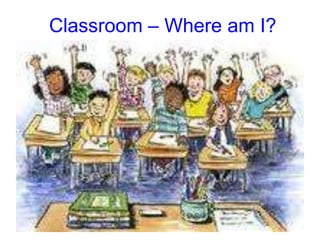
Classroom – Where am I?
Examine Learning Materials
Will different materials be needed to ensure
participation?
• Same content but variation in size, number,
format
• Additional or different materials/devices
• Materials that allow a different mode of input
• Materials that allow a different mode of output
• Materials that reduce the level of abstraction of
information
Examine Support Structures
Will personal assistance be needed to ensure
participation?
• From peers or the general education instructor?
• From the support facilitator’?
• From therapists’?
• From paraprofessionals?
• From others?
Alternative activities that foster
participation & interaction
Will a different activity need to be designed
and offered for the student and a
small group of peers?
• In the classroom
• ln other general education environments
• In community-based environments
When then should you consider
curriculum adaptation?
Does the curriculum meet student
needs?
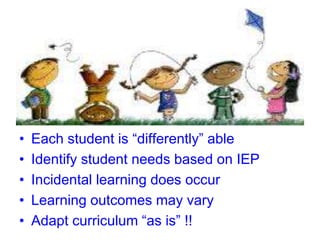
• Each student is “differently” able
• Identify student needs based on IEP
• Incidental learning does occur
• Learning outcomes may vary
• Adapt curriculum “as is” !!
Partial participation by student
Student with IEP works with all other
students in the class; examples include:
• A student with a short attention span
staying on task for 5 minutes
• Using a switch to activate a
communication device for use during a
class discussion
• Expressing one’s thoughts by drawing in
a journal instead of writing
• Holding a book during reading time
• Understanding the effect World War II
has on the present rather than knowing
the names and dates of key battles
Material / Environmental Adaptation
• Completing an assignment by
following visual cues rather
than written directions
• Changing instruction from
lecture to the cooperative
learning format
• Using a computer to write an
assignment instead of paper
and pencil
• Having the student listen to a
taped textbook
• Using enlarged print
• Using an assistive technology
device (hearing aid, Braille)
Providing physical assistance
• Starting a computer so that a
student with IEP can use it
• Guiding a hand during play
• Assisting in activating a switch.
• Completing most of the steps of
an activity and having a student
with an IEP do the remainder
(partial participation)
• Pushing a student in a
wheelchair to the next activity
Functional / Substitute / Alternate
Curriculum
• Community-based instruction
• Learning job skills in the school
cafeteria
• Learning how to use a
communication device
• Doing laundry for the athletic
department
• Learning cooking / grooming
skills at the home
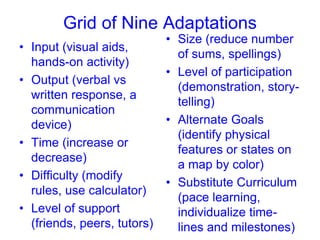
Grid of Nine Adaptations
• Input (visual aids,
hands-on activity)
• Output (verbal vs
written response, a
communication
device)
• Time (increase or
decrease)
• Difficulty (modify
rules, use calculator)
• Level of support
(friends, peers, tutors)
• Size (reduce number
of sums, spellings)
• Level of participation
(demonstration, story-
telling)
• Alternate Goals
(identify physical
features or states on
a map by color)
• Substitute Curriculum
(pace learning,
individualize time-
lines and milestones)
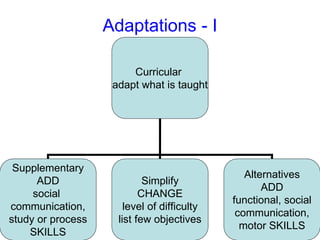
Adaptations - I
Curricular
adapt what is taught
Supplementary
ADD
social
communication,
study or process
SKILLS
Simplify
CHANGE
level of difficulty
list few objectives
Alternatives
ADD
functional, social
communication,
motor SKILLS
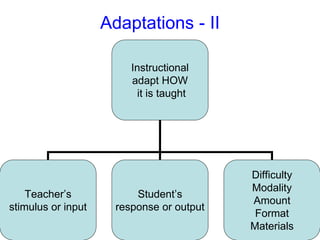
Adaptations - II
Instructional
adapt HOW
it is taught
Teacher’s
stimulus or input
Student’s
response or output
Difficulty
Modality
Amount
Format
Materials
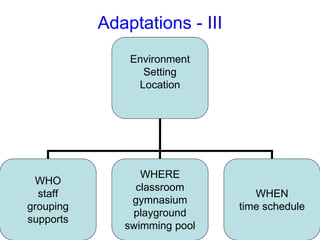
Adaptations - III
Environment
Setting
Location
WHO
staff
grouping
supports
WHERE
classroom
gymnasium
playground
swimming pool
WHEN
time schedule
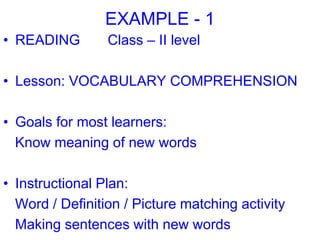
EXAMPLE - 1
• READING Class – II level
• Lesson: VOCABULARY COMPREHENSION
• Goals for most learners:
Know meaning of new words
• Instructional Plan:
Word / Definition / Picture matching activity
Making sentences with new words
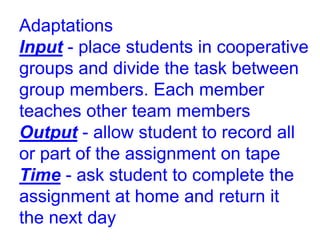
Adaptations
Input - place students in cooperative
groups and divide the task between
group members. Each member
teaches other team members
Output - allow student to record all
or part of the assignment on tape
Time - ask student to complete the
assignment at home and return it
the next day
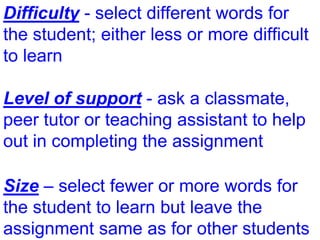
Difficulty - select different words for
the student; either less or more difficult
to learn
Level of support - ask a classmate,
peer tutor or teaching assistant to help
out in completing the assignment
Size – select fewer or more words for
the student to learn but leave the
assignment same as for other students
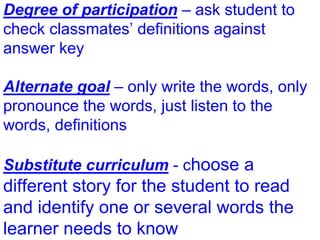
Degree of participation – ask student to
check classmates’ definitions against
answer key
Alternate goal – only write the words, only
pronounce the words, just listen to the
words, definitions
Substitute curriculum - choose a
different story for the student to read
and identify one or several words the
learner needs to know
THANK YOU ALL

Curriculum Adaptation.ppt

  • 1.
    Curriculum Adaptations Continuing Rehabilitation Education(CRE) Program for Special Educators - Manovikas Kendra, Kolkata, 9th July 2012 Dr. Krishnadas Nandagopal
  • 3.
    UNIQUE • Each STUDENT •Each CLASSROOM • Each TEACHER • And therefore, student – teacher RELATIONSHIPS
  • 5.
    • Adaptation ofcurricula may not be always necessary • Provide Multi-level instruction e.g., teachers, tutors, peers, para- professionals • Permit flexibility in achievement of goals and standards e.g., auditing a class, partial participation, extra time, scribe
  • 6.
    ▪ Implement multiplemodes of assessment e.g., continuous, term / semester, annual, oral, written, discussion ▪ Make curriculum more accessible through accommodation ▪ Ensure that supports are not based on “Disability” label
  • 7.
    Supports VARIABLE types or levelsare based on: • INSTRUCTIONAL activity e.g., spelling, reading, arithmetic • SOCIAL activity e.g., singing, dancing, story-telling, games
  • 8.
    Decision making process •Identify student’s objectives & articulate goals for student’s performance • Determine what to teach (content) & how to teach (with or without modification) • How will it impact outcome? • Consider influence of lesson format, instructional arrangement, student-specific learning strategy, lesson-specific goals, learning environment, learning materials, supports and supervision arrangements
  • 9.
    Structure of Instruction •Is changing the delivery or teaching style effective? • Is changing the instructional arrangement effective? (e.g., small groups, co-operative groups, peers, cross-age tutors) • Is changing the lesson format conducive to increased student participation? (e.g., activity- based lessons, games, exploring thematic concepts, community-based learning, discovery-based learning, experiential learning • Is the same outcome achieved without modification of the lesson?
  • 10.
    Consider Demands ofTask & Evaluation Criteria Will the student need adapted curricular goals? • Adjust performance standards & pacing • Same content, however, less complex • Similar content but functional / direct applications • Adjust evaluation criteria, grading system or management techniques
  • 11.
    Examine learning environments •Classroom (airy, well-lit, clean, spacious, age- appropriate furniture, seating arrangements, wheel-chair accessibility) • Physical environs (lunchroom, playground, toilets) • Social rules (seating of girls / boys, able / disabled, rich / poor, meritorious / scholastic impairment) • Location of lesson (indoors, outdoors, laboratory, virtual)
  • 12.
  • 15.
    Examine Learning Materials Willdifferent materials be needed to ensure participation? • Same content but variation in size, number, format • Additional or different materials/devices • Materials that allow a different mode of input • Materials that allow a different mode of output • Materials that reduce the level of abstraction of information
  • 17.
    Examine Support Structures Willpersonal assistance be needed to ensure participation? • From peers or the general education instructor? • From the support facilitator’? • From therapists’? • From paraprofessionals? • From others?
  • 18.
    Alternative activities thatfoster participation & interaction Will a different activity need to be designed and offered for the student and a small group of peers? • In the classroom • ln other general education environments • In community-based environments
  • 19.
    When then shouldyou consider curriculum adaptation? Does the curriculum meet student needs?
  • 20.
    • Each studentis “differently” able • Identify student needs based on IEP • Incidental learning does occur • Learning outcomes may vary • Adapt curriculum “as is” !!
  • 21.
    Partial participation bystudent Student with IEP works with all other students in the class; examples include: • A student with a short attention span staying on task for 5 minutes • Using a switch to activate a communication device for use during a class discussion • Expressing one’s thoughts by drawing in a journal instead of writing • Holding a book during reading time • Understanding the effect World War II has on the present rather than knowing the names and dates of key battles
  • 22.
    Material / EnvironmentalAdaptation • Completing an assignment by following visual cues rather than written directions • Changing instruction from lecture to the cooperative learning format • Using a computer to write an assignment instead of paper and pencil • Having the student listen to a taped textbook • Using enlarged print • Using an assistive technology device (hearing aid, Braille)
  • 23.
    Providing physical assistance •Starting a computer so that a student with IEP can use it • Guiding a hand during play • Assisting in activating a switch. • Completing most of the steps of an activity and having a student with an IEP do the remainder (partial participation) • Pushing a student in a wheelchair to the next activity
  • 24.
    Functional / Substitute/ Alternate Curriculum • Community-based instruction • Learning job skills in the school cafeteria • Learning how to use a communication device • Doing laundry for the athletic department • Learning cooking / grooming skills at the home
  • 25.
    Grid of NineAdaptations • Input (visual aids, hands-on activity) • Output (verbal vs written response, a communication device) • Time (increase or decrease) • Difficulty (modify rules, use calculator) • Level of support (friends, peers, tutors) • Size (reduce number of sums, spellings) • Level of participation (demonstration, story- telling) • Alternate Goals (identify physical features or states on a map by color) • Substitute Curriculum (pace learning, individualize time- lines and milestones)
  • 26.
    Adaptations - I Curricular adaptwhat is taught Supplementary ADD social communication, study or process SKILLS Simplify CHANGE level of difficulty list few objectives Alternatives ADD functional, social communication, motor SKILLS
  • 27.
    Adaptations - II Instructional adaptHOW it is taught Teacher’s stimulus or input Student’s response or output Difficulty Modality Amount Format Materials
  • 28.
  • 29.
    EXAMPLE - 1 •READING Class – II level • Lesson: VOCABULARY COMPREHENSION • Goals for most learners: Know meaning of new words • Instructional Plan: Word / Definition / Picture matching activity Making sentences with new words
  • 30.
    Adaptations Input - placestudents in cooperative groups and divide the task between group members. Each member teaches other team members Output - allow student to record all or part of the assignment on tape Time - ask student to complete the assignment at home and return it the next day
  • 31.
    Difficulty - selectdifferent words for the student; either less or more difficult to learn Level of support - ask a classmate, peer tutor or teaching assistant to help out in completing the assignment Size – select fewer or more words for the student to learn but leave the assignment same as for other students
  • 32.
    Degree of participation– ask student to check classmates’ definitions against answer key Alternate goal – only write the words, only pronounce the words, just listen to the words, definitions Substitute curriculum - choose a different story for the student to read and identify one or several words the learner needs to know
  • 33.