The Road to Becoming a 
Center of Excellence 
Lisa D’Adamo Weinstein 
Laura Sanders 
M. Elaine Richardson 
NCLCA Subcommittee for Learning Centers of Excellence Project
LCE Rationale 
The LCE program was developed by NCLCA to: 
• Promote professional standards of excellence for learning 
centers 
• Recognize the need for flexibility and inclusiveness in 
meeting the standards 
• Encourage centers to develop, maintain and assess quality 
programs and services to enhance student learning 
• Honor the history of established and unique centers 
• Celebrate the outstanding achievements of centers that meet 
and exceed these standards
Developing the 
Learning Centers Of Excellence Program 
Inspired by the works of Frank Christ, Council on 
Advancement of Standards in Higher Education, and 
John Gardner, NCLCA has developed seven major 
categories and subsets of those categories by which 
centers will be evaluated. 
● Christ, F. L. (2009). Best and Promising Practices for Learning Support 
Centers: A Handout for Workshop at NCLCA Conference in Golden, CO on 
October 3, 2009. 
● Council on Advancement of Standards in Higher Education (CAS) website 
to review and purchase the standards - 
http://www.cas.edu/index.php/standards 
● Model for the Centers of Excellence was Institutions of Excellence in the 
First College Year - http://www.jngi.org/institute/past-initiatives/ 
institutions-of-excellence-in-the-first-college-year/
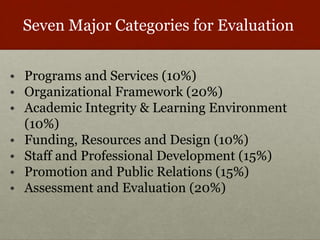
Seven Major Categories for Evaluation 
• Programs and Services (10%) 
• Organizational Framework (20%) 
• Academic Integrity & Learning Environment 
(10%) 
• Funding, Resources and Design (10%) 
• Staff and Professional Development (15%) 
• Promotion and Public Relations (15%) 
• Assessment and Evaluation (20%)
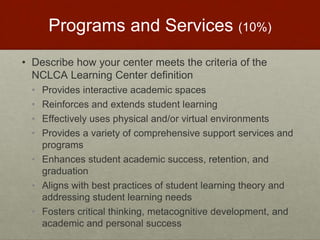
Programs and Services (10%) 
• Describe how your center meets the criteria of the 
NCLCA Learning Center definition 
• Provides interactive academic spaces 
• Reinforces and extends student learning 
• Effectively uses physical and/or virtual environments 
• Provides a variety of comprehensive support services and 
programs 
• Enhances student academic success, retention, and 
graduation 
• Aligns with best practices of student learning theory and 
addressing student learning needs 
• Fosters critical thinking, metacognitive development, and 
academic and personal success
Small Group Activity 
• Make a list of the programs and services 
in your center and share with your group. 
• How do these fit with the NCLCA 
definition of a Learning Center?
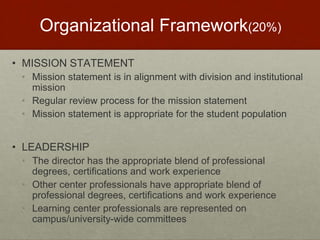
Organizational Framework(20%) 
• MISSION STATEMENT 
• Mission statement is in alignment with division and institutional 
mission 
• Regular review process for the mission statement 
• Mission statement is appropriate for the student population 
• LEADERSHIP 
• The director has the appropriate blend of professional 
degrees, certifications and work experience 
• Other center professionals have appropriate blend of 
professional degrees, certifications and work experience 
• Learning center professionals are represented on 
campus/university-wide committees
Small Group Activity 
• Discuss the mission statement for your 
center in your group. 
• Discuss the requirements for your center 
director and other personnel.
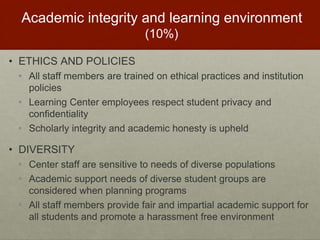
Academic integrity and learning environment 
(10%) 
• ETHICS AND POLICIES 
• All staff members are trained on ethical practices and institution 
policies 
• Learning Center employees respect student privacy and 
confidentiality 
• Scholarly integrity and academic honesty is upheld 
• DIVERSITY 
• Center staff are sensitive to needs of diverse populations 
• Academic support needs of diverse student groups are 
considered when planning programs 
• All staff members provide fair and impartial academic support for 
all students and promote a harassment free environment
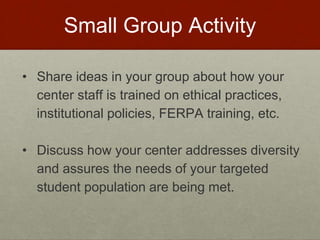
Small Group Activity 
• Share ideas in your group about how your 
center staff is trained on ethical practices, 
institutional policies, FERPA training, etc. 
• Discuss how your center addresses diversity 
and assures the needs of your targeted 
student population are being met.

The Road to Becoming a Center of Excellence

  • 1.
    The Road toBecoming a Center of Excellence Lisa D’Adamo Weinstein Laura Sanders M. Elaine Richardson NCLCA Subcommittee for Learning Centers of Excellence Project
  • 2.
    LCE Rationale TheLCE program was developed by NCLCA to: • Promote professional standards of excellence for learning centers • Recognize the need for flexibility and inclusiveness in meeting the standards • Encourage centers to develop, maintain and assess quality programs and services to enhance student learning • Honor the history of established and unique centers • Celebrate the outstanding achievements of centers that meet and exceed these standards
  • 3.
    Developing the LearningCenters Of Excellence Program Inspired by the works of Frank Christ, Council on Advancement of Standards in Higher Education, and John Gardner, NCLCA has developed seven major categories and subsets of those categories by which centers will be evaluated. ● Christ, F. L. (2009). Best and Promising Practices for Learning Support Centers: A Handout for Workshop at NCLCA Conference in Golden, CO on October 3, 2009. ● Council on Advancement of Standards in Higher Education (CAS) website to review and purchase the standards - http://www.cas.edu/index.php/standards ● Model for the Centers of Excellence was Institutions of Excellence in the First College Year - http://www.jngi.org/institute/past-initiatives/ institutions-of-excellence-in-the-first-college-year/
  • 4.
    Seven Major Categoriesfor Evaluation • Programs and Services (10%) • Organizational Framework (20%) • Academic Integrity & Learning Environment (10%) • Funding, Resources and Design (10%) • Staff and Professional Development (15%) • Promotion and Public Relations (15%) • Assessment and Evaluation (20%)
  • 5.
    Programs and Services(10%) • Describe how your center meets the criteria of the NCLCA Learning Center definition • Provides interactive academic spaces • Reinforces and extends student learning • Effectively uses physical and/or virtual environments • Provides a variety of comprehensive support services and programs • Enhances student academic success, retention, and graduation • Aligns with best practices of student learning theory and addressing student learning needs • Fosters critical thinking, metacognitive development, and academic and personal success
  • 6.
    Small Group Activity • Make a list of the programs and services in your center and share with your group. • How do these fit with the NCLCA definition of a Learning Center?
  • 7.
    Organizational Framework(20%) •MISSION STATEMENT • Mission statement is in alignment with division and institutional mission • Regular review process for the mission statement • Mission statement is appropriate for the student population • LEADERSHIP • The director has the appropriate blend of professional degrees, certifications and work experience • Other center professionals have appropriate blend of professional degrees, certifications and work experience • Learning center professionals are represented on campus/university-wide committees
  • 8.
    Small Group Activity • Discuss the mission statement for your center in your group. • Discuss the requirements for your center director and other personnel.
  • 9.
    Academic integrity andlearning environment (10%) • ETHICS AND POLICIES • All staff members are trained on ethical practices and institution policies • Learning Center employees respect student privacy and confidentiality • Scholarly integrity and academic honesty is upheld • DIVERSITY • Center staff are sensitive to needs of diverse populations • Academic support needs of diverse student groups are considered when planning programs • All staff members provide fair and impartial academic support for all students and promote a harassment free environment
  • 10.
    Small Group Activity • Share ideas in your group about how your center staff is trained on ethical practices, institutional policies, FERPA training, etc. • Discuss how your center addresses diversity and assures the needs of your targeted student population are being met.