School Culture
and Climate
Asha Prabhakar
Principal
Bal Bharati Public School
Sector-21, Noida


Culture
Tells people what is truly important

Tells people how they are to act
 Norms
 Beliefs
 Values
that make up the
 Rituals
persona of the school
 Ceremonies
 Symbols
 Stories

Culture
Continual sharing of ideas
 Collaboration
 Egalitarianism
 Practicality
 Acceptability
 Readiness
 Realistic approach
 Innovation

Culture
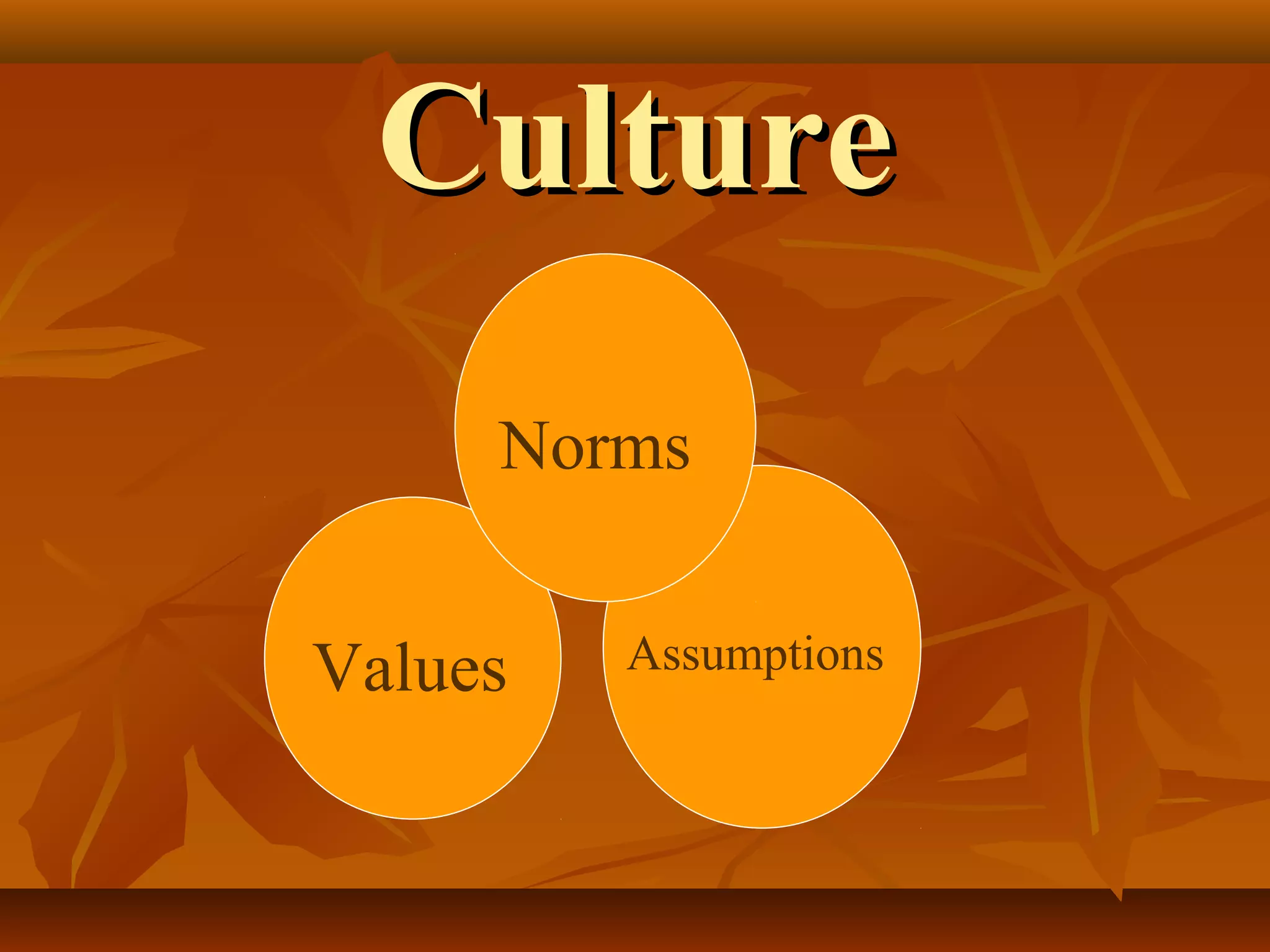
Norms
Values

Assumptions
The Principal Is the C.C.S.

Chief
Culture
Shaper
The Principal Is The Key
*What does the principal plan for?
* What does the principal monitor?
* What does the principal model?
*What does the principal reinforce through
recognition and celebration?
*What behavior is the principal willing to
confront?
Principals in Healthy Cultures








Are visible to all stakeholders
Communicate regularly and purposefully
Never forget that they are role models
Are passionate about their work
Accept responsibility for the school’s culture
Are organized
Exhibit a positive outlook
Principals In Healthy Cultures
Take pride in the physical
environment of the school
 Empower others appropriately
 Demonstrate stewardship –
they protect their school and its
people

Every school has:


A Formal Culture (job descriptions, traditions,
mission statement values, defined by
symbols[school mascot, song] )



An Informal Culture – how people interact
with each other, share information, how work
gets done and by whom



Subcultures – grade levels, departments,
young teachers, old teachers, fine arts.
So…..
Identifying school culture is a
complex undertaking.
It cannot be reduced to merely
having members of the community
list their beliefs, values, and
assumptions.
The Markers of School
Culture


The mission statement



Student programs



Programs for teachers



The physical building (the learning
environment)
Culture is the most powerful
source of leverage for
bringing about change in a
school – or any
organization, for that
matter.
Characteristics of a Healthy Culture
A Healthy Culture can:
*Unify people within the school and its
many communities
*Assist with establishment of a plan for
school improvement
*Focus people on the future and point to
what the school wants to become
*Promote growth in the folks who work
there
Healthy Cultures









Marked by professional collaboration
Teachers and administrators share their
knowledge and develop plans together to
achieve organizational goals
Principals work with teachers – they have a
shared mission and vision
Principals and teachers focus on student
learning
The school is aligned….goals and objectives
are consistent with the mission
School Culture is over a
period of time…the history

Climate is now, it’s the
perceptions/emotions being
evoked
School Climate is the communication of
its norms, beliefs, and values through
various behaviors and interactions and
their effect on others, with the primary
focus being on students. School Climate
is driven by and reflected in the daily
interactions of staff, administration,
students, support staff, and the outside
community.
Difference Between
Culture and Climate








Both are related to organizational behavior and
productivity
“Personality is to the individual what climate
is to the organization.”
School climate is the social atmosphere in
which people interact with others and the
school environment
Climate includes perceptions that people have
of the environment (safety, high expectations,
relationships with teachers, students, parents,
and administrators)
Climate continued….
The quality of interactions in the
teacher’s lounge
 The noise levels in the hallways and
cafeteria
 Physical comfort levels (heating, cooling,
lighting)
 How safe people feel
 How easy it is for students, teachers to
interact with one another informally (size
of school affects this)

Two Dimensions of
Climate
Academic Climate
Social Climate
Academic Climate
Results from how the school uses
rewards and praise
 Results from the effectiveness of
the teachers and principal
 Results from the collaborative
processes that exist within the
school

Social Climate
Results from the appearance, comfort,
and orderliness of the school facility
 Results from the opportunities students
have to participate in the school programs
 Results from the peer norms that are
present
 Results from the nature of the
administrative staff-student cohesion and
support systems

Leadership Builds the
Culture and Climate





Healthy cultures and positive climates do not
magically occur!
Strong cultures emerge due to the efforts of the
components
- support and nurture people
- connect and align people and programs
- launch a vision rooted in the belief that all
children can learn
- empower each other
The Twelve Norms of
School Culture
1.
2.
3.

4.
5.
6.

Collegiality
Experimentation
Reaching Out To The Knowledge
Base
Appreciation and Recognition
Caring, Celebration & Humor
Traditions
7.
8.
9.
10.
11.
12.

High Expectations
Protecting What’s Important
Tangible Support
Trust, Respect & Confidence
Involvement in Decision Making
Open and Honest Communication
Principals in Unhealthy Cultures
Are rarely seen outside their office
 Find little time for communication
 Feel that other people are
responsible for their school
building’s physical needs
 Take passive roles in decorating or
furnishing their schools

Principals in Unhealthy Cultures
See themselves as the lone leader or
“boss” of the school
 Never empower teachers to lead
 Are poorly organized
 Habitually make excuses for their
school’s shortcomings
 Blame inadequacies on outside
influences
(Fiore, 2001)

The Toxic Culture
Marked with dysfunctional patterns of
behavior
 Toxic cultures deplete members’
energy, damage the members, make it
impossible to be collaborative
 Reinforce negativity (values & beliefs
are negative)
 Rituals and traditions are joyless

Toxic Cultures








Evolve over time
Have staffs that are fragmented
Serve the adults in the schools rather than
the students
Are places where negative values and
hopelessness reigns
Are a wasteland for students, teachers, and
others, both internal and external
constituents
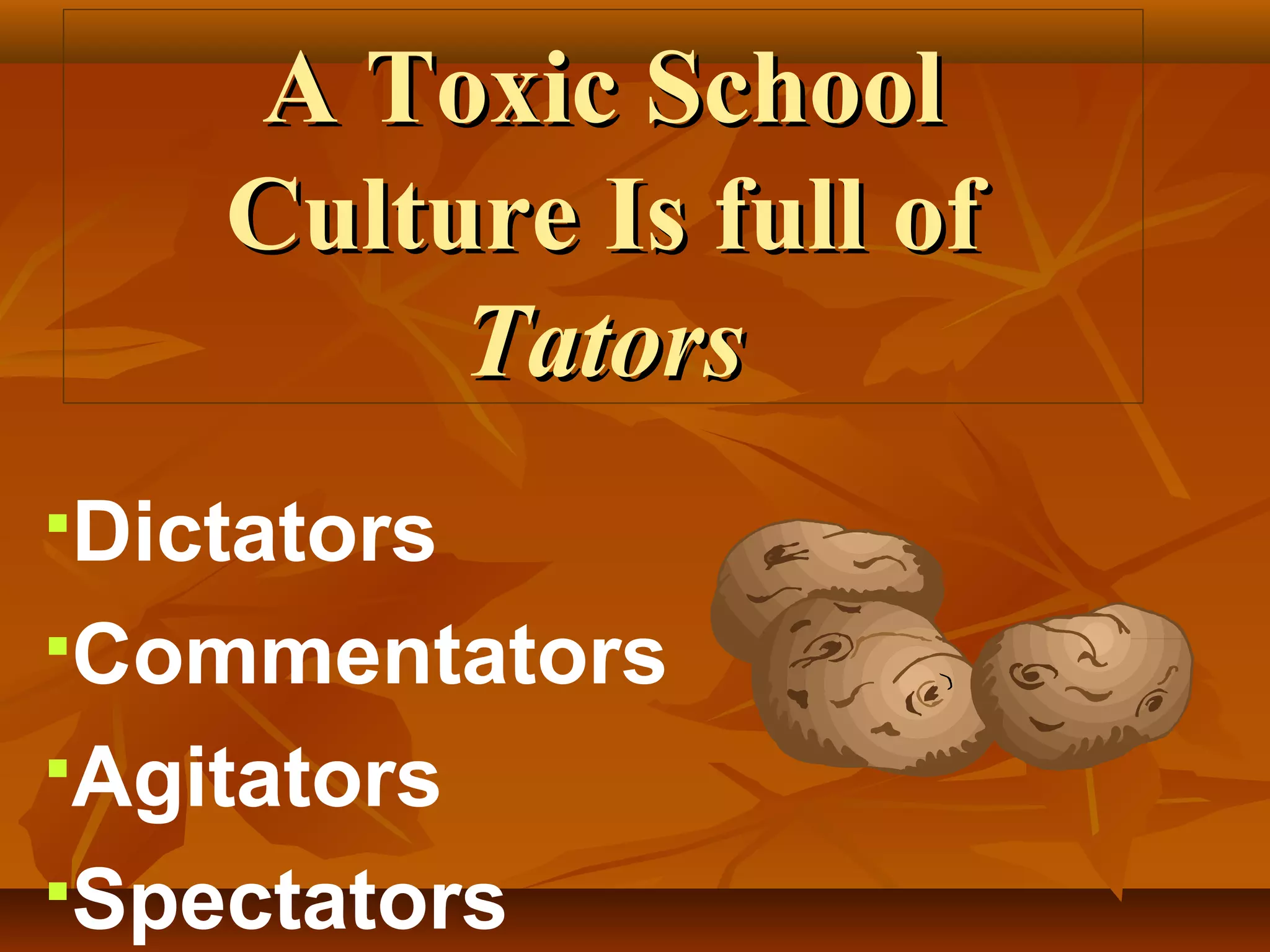
A Toxic School
Culture Is full of
Tators
Dictators
Commentators
Agitators
Spectators
Why Is School
Culture Important?
What research tells us:
“Positive learning can only take place in a
positive culture. A healthy school culture will
affect more student and teacher success than
any other reform or school improvement effort
currently being employed.”
-Gary Phillips
TO CHANGE YOUR
SCHOOL’S CULTURE
Promote your mission, vision, values
and goals.
Togetherness and Connectivity.
Sustain the culture through
communication.
Persist.
Confront problems.
Positive School Culture/Climate
Mission IS about student and teacher
learning



Rich sense of history and purpose



Core values of collegiality, performance, and



improvement centered around quality,
achievement, and learning for ALL students
Positive and Proactive Approaches for staff


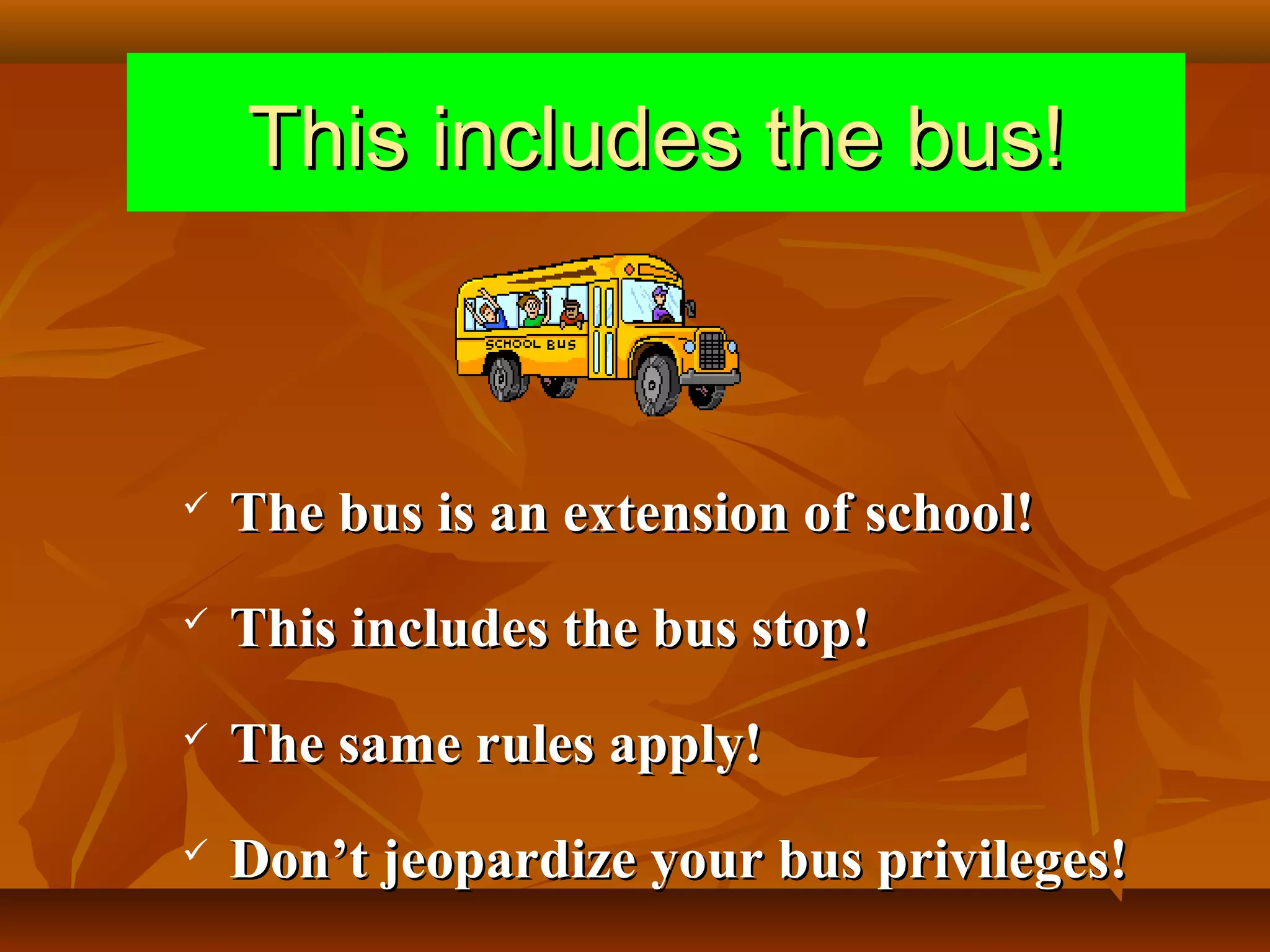
This includes the bus!



The bus is an extension of school!



This includes the bus stop!



The same rules apply!



Don’t jeopardize your bus privileges!
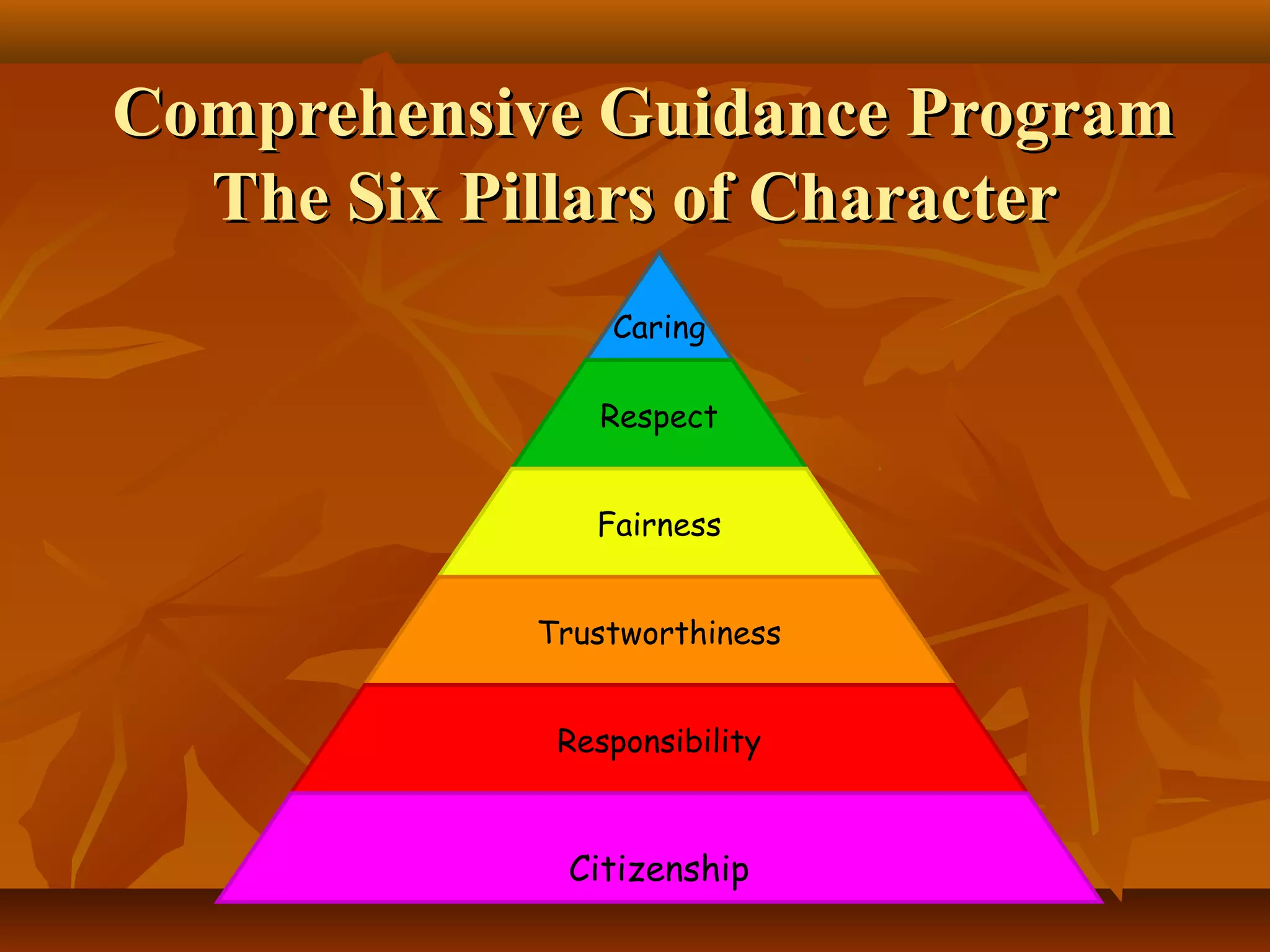
Comprehensive Guidance Program
The Six Pillars of Character
Caring
Respect
Fairness
Trustworthiness
Responsibility

Citizenship
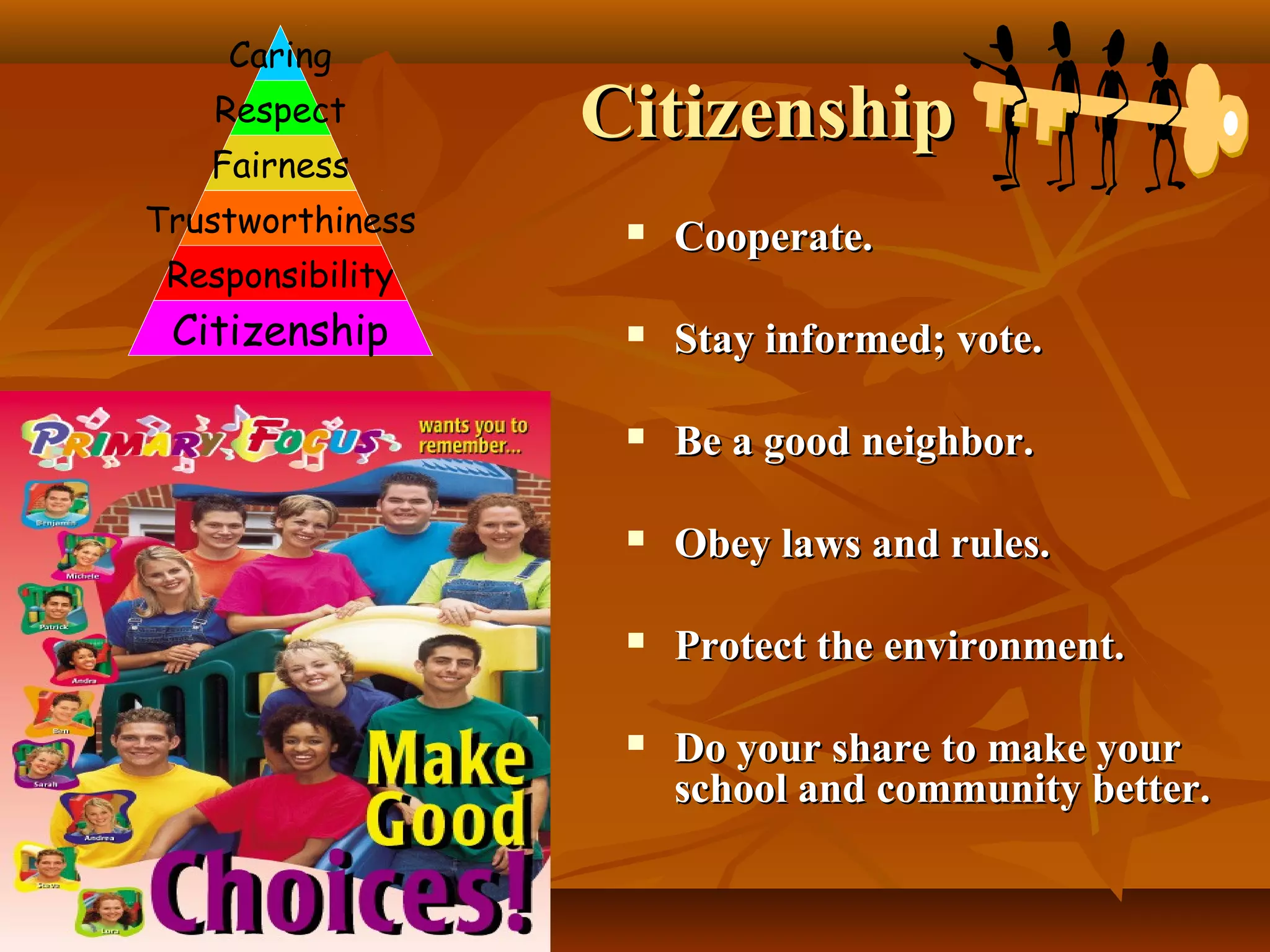
Caring
Respect
Fairness
Trustworthiness

Citizenship


Cooperate.



Stay informed; vote.



Be a good neighbor.



Obey laws and rules.



Protect the environment.



Do your share to make your
school and community better.

Responsibility

Citizenship
Caring

Responsibility

Respect
Fairness
Trustworthiness

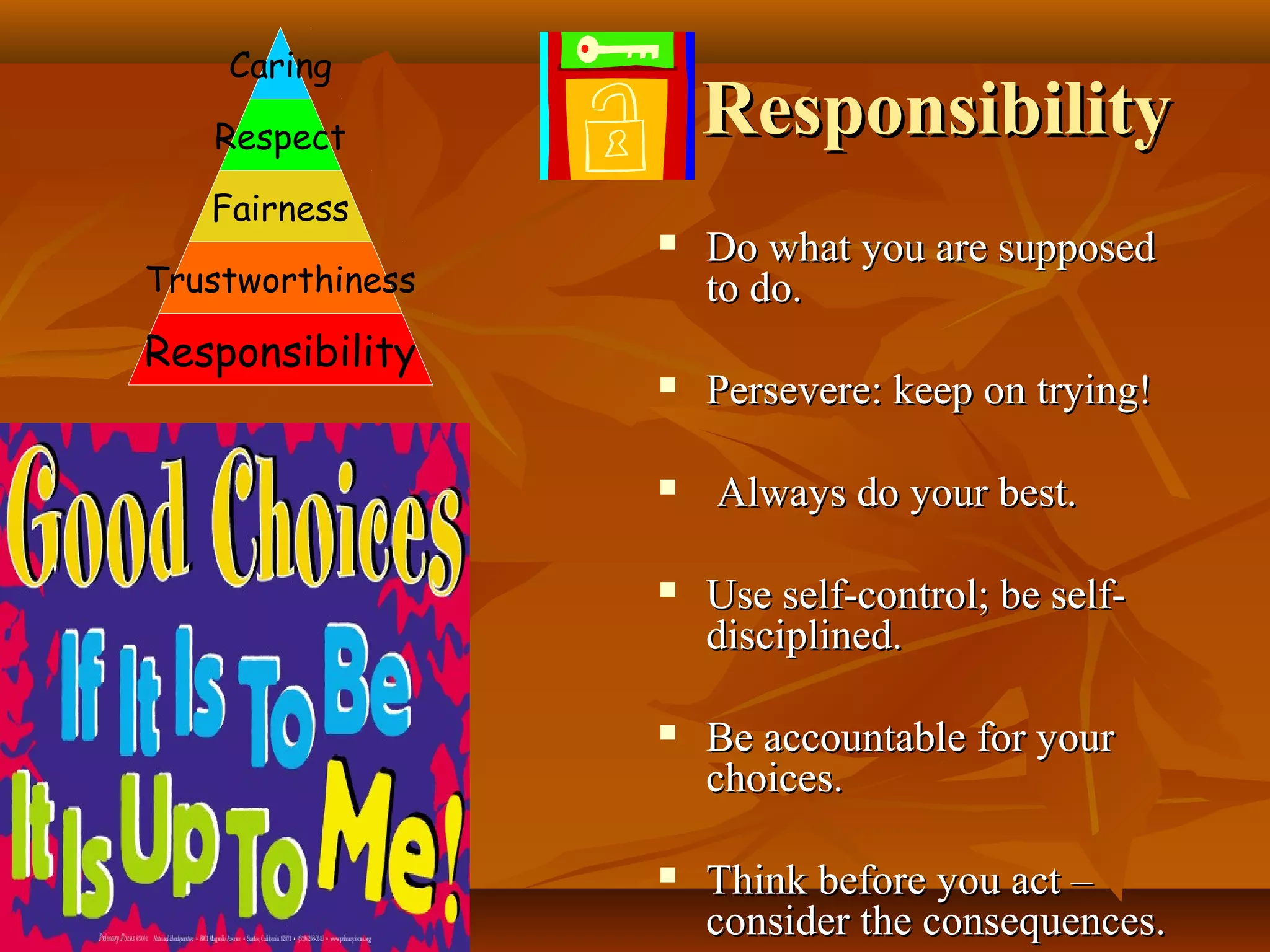
Responsibility



Do what you are supposed
to do.



Persevere: keep on trying!



Always do your best.



Use self-control; be selfdisciplined.



Be accountable for your
choices.



Think before you act –
consider the consequences.
Caring

Trustworthiness

Respect
Fairness

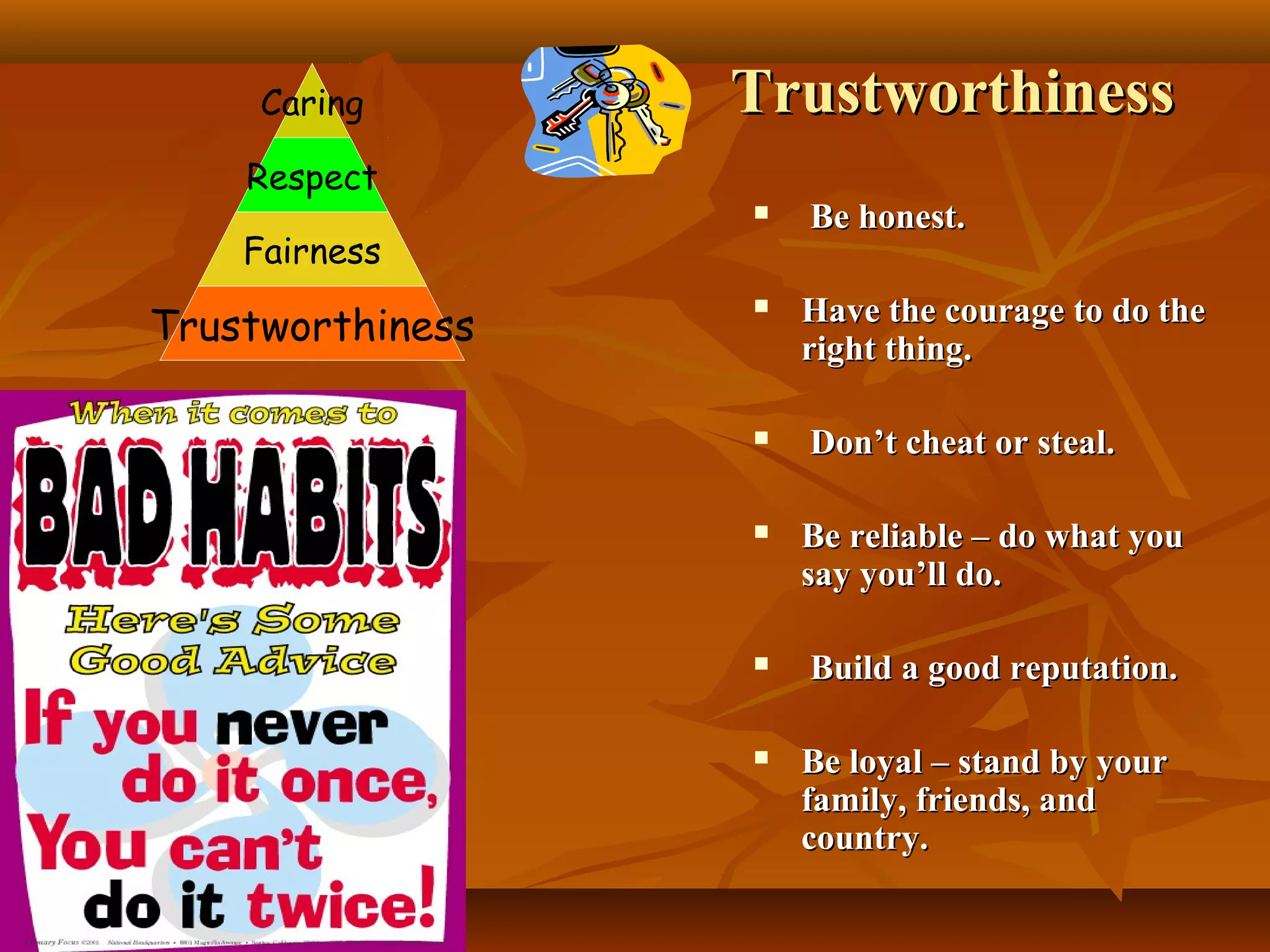
Trustworthiness







Be honest.
Have the courage to do the
right thing.
Don’t cheat or steal.



Be reliable – do what you
say you’ll do.



Build a good reputation.



Be loyal – stand by your
family, friends, and
country.
Caring

Fairness

Respect

Fairness

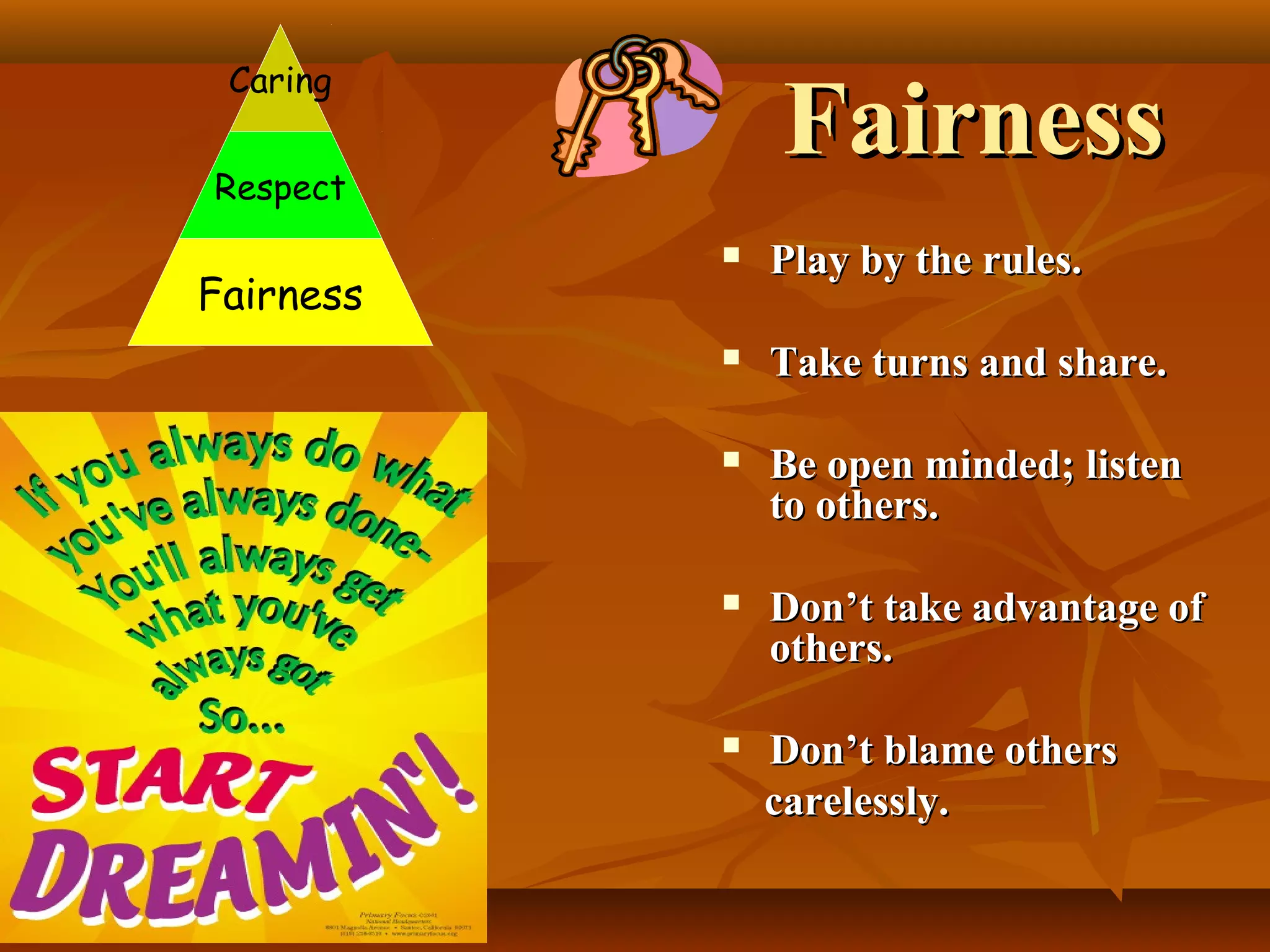


Play by the rules.



Take turns and share.



Be open minded; listen
to others.



Don’t take advantage of
others.



Don’t blame others
carelessly.
Respect

Caring

Respect







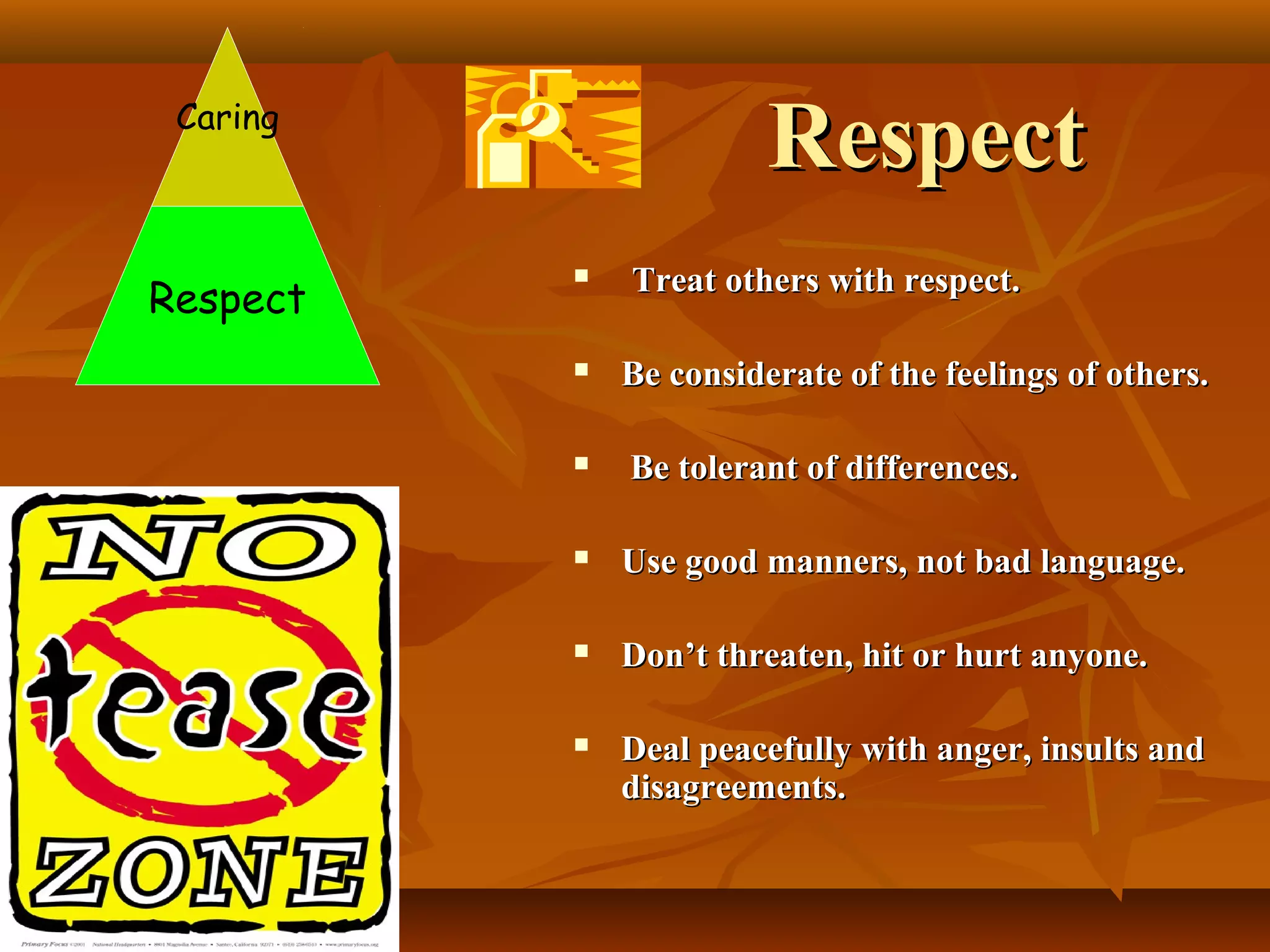
Treat others with respect.
Be considerate of the feelings of others.
Be tolerant of differences.



Use good manners, not bad language.



Don’t threaten, hit or hurt anyone.



Deal peacefully with anger, insults and
disagreements.
Caring
Caring





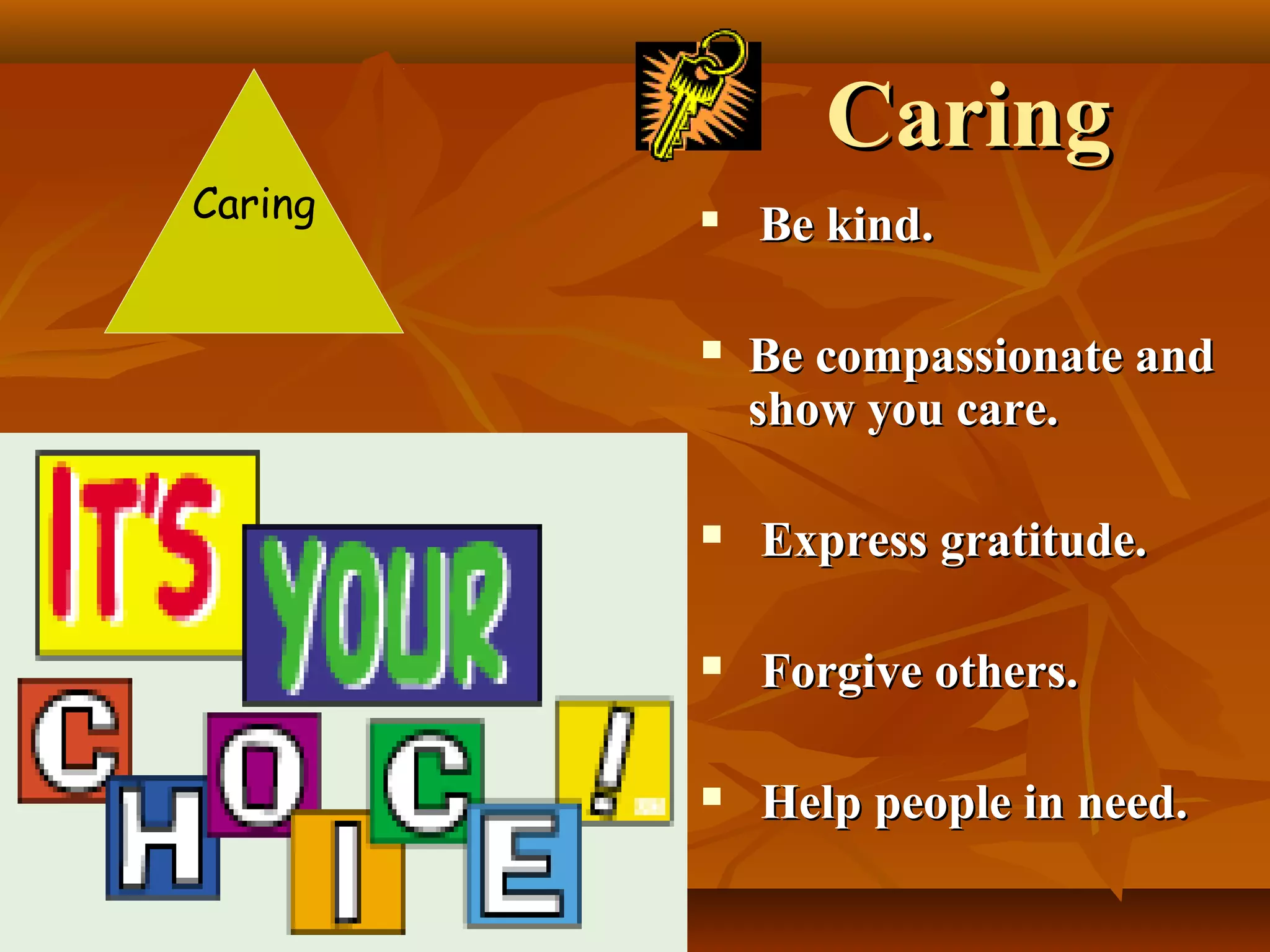
Be kind.
Be compassionate and
show you care.



Express gratitude.



Forgive others.



Help people in need.
TO IMPROVE YOUR
CULTURE…
YOU MUST FIRST ASSESS
YOUR CULTURE!
It’s difficult to change school
culture,
but remain optimistic
A Final Thought
“Self-renewing school cultures are collaborative
places where adults care about one another,
share common goals and values, and have the
skills and knowledge to plan together, solve
problems together, and fight passionately but
gracefully for ideas to improve instruction.”
-Robert Garmston & Bruce Wellman
If All The Trees Were Oaks
What if all trees were oaks,
How plain the world would seem;
No maple syrup, banana splits,
And how would orange juice be?
Wouldn’t it be a boring place,
If all the people were the same;
Just one color one language,
Just one family name!
If the forest were the world,
And all people were the trees;
Palm and pine, bamboo and willow,
Live and grow in harmony.
Aren’t you glad, my good friend,
Different though we be;
We are here to help each other,
I learn from you, and you, from me.
-Author Unknown
THANK YOU

School Culture and Climate-BBPSTC

  • 1.
    School Culture and Climate AshaPrabhakar Principal Bal Bharati Public School Sector-21, Noida
  • 2.
     Culture Tells people whatis truly important Tells people how they are to act  Norms  Beliefs  Values that make up the  Rituals persona of the school  Ceremonies  Symbols  Stories 
  • 3.
    Culture Continual sharing ofideas  Collaboration  Egalitarianism  Practicality  Acceptability  Readiness  Realistic approach  Innovation 
  • 4.
  • 5.
    The Principal Isthe C.C.S. Chief Culture Shaper
  • 6.
    The Principal IsThe Key *What does the principal plan for? * What does the principal monitor? * What does the principal model? *What does the principal reinforce through recognition and celebration? *What behavior is the principal willing to confront?
  • 7.
    Principals in HealthyCultures        Are visible to all stakeholders Communicate regularly and purposefully Never forget that they are role models Are passionate about their work Accept responsibility for the school’s culture Are organized Exhibit a positive outlook
  • 8.
    Principals In HealthyCultures Take pride in the physical environment of the school  Empower others appropriately  Demonstrate stewardship – they protect their school and its people 
  • 9.
    Every school has:  AFormal Culture (job descriptions, traditions, mission statement values, defined by symbols[school mascot, song] )  An Informal Culture – how people interact with each other, share information, how work gets done and by whom  Subcultures – grade levels, departments, young teachers, old teachers, fine arts.
  • 10.
    So….. Identifying school cultureis a complex undertaking. It cannot be reduced to merely having members of the community list their beliefs, values, and assumptions.
  • 11.
    The Markers ofSchool Culture  The mission statement  Student programs  Programs for teachers  The physical building (the learning environment)
  • 12.
    Culture is themost powerful source of leverage for bringing about change in a school – or any organization, for that matter.
  • 13.
    Characteristics of aHealthy Culture A Healthy Culture can: *Unify people within the school and its many communities *Assist with establishment of a plan for school improvement *Focus people on the future and point to what the school wants to become *Promote growth in the folks who work there
  • 14.
    Healthy Cultures      Marked byprofessional collaboration Teachers and administrators share their knowledge and develop plans together to achieve organizational goals Principals work with teachers – they have a shared mission and vision Principals and teachers focus on student learning The school is aligned….goals and objectives are consistent with the mission
  • 15.
    School Culture isover a period of time…the history Climate is now, it’s the perceptions/emotions being evoked
  • 16.
    School Climate isthe communication of its norms, beliefs, and values through various behaviors and interactions and their effect on others, with the primary focus being on students. School Climate is driven by and reflected in the daily interactions of staff, administration, students, support staff, and the outside community.
  • 17.
    Difference Between Culture andClimate     Both are related to organizational behavior and productivity “Personality is to the individual what climate is to the organization.” School climate is the social atmosphere in which people interact with others and the school environment Climate includes perceptions that people have of the environment (safety, high expectations, relationships with teachers, students, parents, and administrators)
  • 18.
    Climate continued…. The qualityof interactions in the teacher’s lounge  The noise levels in the hallways and cafeteria  Physical comfort levels (heating, cooling, lighting)  How safe people feel  How easy it is for students, teachers to interact with one another informally (size of school affects this) 
  • 19.
    Two Dimensions of Climate AcademicClimate Social Climate
  • 20.
    Academic Climate Results fromhow the school uses rewards and praise  Results from the effectiveness of the teachers and principal  Results from the collaborative processes that exist within the school 
  • 21.
    Social Climate Results fromthe appearance, comfort, and orderliness of the school facility  Results from the opportunities students have to participate in the school programs  Results from the peer norms that are present  Results from the nature of the administrative staff-student cohesion and support systems 
  • 22.
    Leadership Builds the Cultureand Climate   Healthy cultures and positive climates do not magically occur! Strong cultures emerge due to the efforts of the components - support and nurture people - connect and align people and programs - launch a vision rooted in the belief that all children can learn - empower each other
  • 23.
    The Twelve Normsof School Culture 1. 2. 3. 4. 5. 6. Collegiality Experimentation Reaching Out To The Knowledge Base Appreciation and Recognition Caring, Celebration & Humor Traditions
  • 24.
    7. 8. 9. 10. 11. 12. High Expectations Protecting What’sImportant Tangible Support Trust, Respect & Confidence Involvement in Decision Making Open and Honest Communication
  • 25.
    Principals in UnhealthyCultures Are rarely seen outside their office  Find little time for communication  Feel that other people are responsible for their school building’s physical needs  Take passive roles in decorating or furnishing their schools 
  • 26.
    Principals in UnhealthyCultures See themselves as the lone leader or “boss” of the school  Never empower teachers to lead  Are poorly organized  Habitually make excuses for their school’s shortcomings  Blame inadequacies on outside influences (Fiore, 2001) 
  • 27.
    The Toxic Culture Markedwith dysfunctional patterns of behavior  Toxic cultures deplete members’ energy, damage the members, make it impossible to be collaborative  Reinforce negativity (values & beliefs are negative)  Rituals and traditions are joyless 
  • 28.
    Toxic Cultures      Evolve overtime Have staffs that are fragmented Serve the adults in the schools rather than the students Are places where negative values and hopelessness reigns Are a wasteland for students, teachers, and others, both internal and external constituents
  • 29.
    A Toxic School CultureIs full of Tators Dictators Commentators Agitators Spectators
  • 30.
    Why Is School CultureImportant? What research tells us: “Positive learning can only take place in a positive culture. A healthy school culture will affect more student and teacher success than any other reform or school improvement effort currently being employed.” -Gary Phillips
  • 31.
    TO CHANGE YOUR SCHOOL’SCULTURE Promote your mission, vision, values and goals. Togetherness and Connectivity. Sustain the culture through communication. Persist. Confront problems.
  • 32.
    Positive School Culture/Climate MissionIS about student and teacher learning  Rich sense of history and purpose  Core values of collegiality, performance, and  improvement centered around quality, achievement, and learning for ALL students Positive and Proactive Approaches for staff 
  • 33.
    This includes thebus!  The bus is an extension of school!  This includes the bus stop!  The same rules apply!  Don’t jeopardize your bus privileges!
  • 34.
    Comprehensive Guidance Program TheSix Pillars of Character Caring Respect Fairness Trustworthiness Responsibility Citizenship
  • 35.
    Caring Respect Fairness Trustworthiness Citizenship  Cooperate.  Stay informed; vote.  Bea good neighbor.  Obey laws and rules.  Protect the environment.  Do your share to make your school and community better. Responsibility Citizenship
  • 36.
    Caring Responsibility Respect Fairness Trustworthiness Responsibility  Do what youare supposed to do.  Persevere: keep on trying!  Always do your best.  Use self-control; be selfdisciplined.  Be accountable for your choices.  Think before you act – consider the consequences.
  • 37.
    Caring Trustworthiness Respect Fairness Trustworthiness    Be honest. Have thecourage to do the right thing. Don’t cheat or steal.  Be reliable – do what you say you’ll do.  Build a good reputation.  Be loyal – stand by your family, friends, and country.
  • 38.
    Caring Fairness Respect Fairness  Play by therules.  Take turns and share.  Be open minded; listen to others.  Don’t take advantage of others.  Don’t blame others carelessly.
  • 39.
    Respect Caring Respect    Treat others withrespect. Be considerate of the feelings of others. Be tolerant of differences.  Use good manners, not bad language.  Don’t threaten, hit or hurt anyone.  Deal peacefully with anger, insults and disagreements.
  • 40.
    Caring Caring   Be kind. Be compassionateand show you care.  Express gratitude.  Forgive others.  Help people in need.
  • 42.
    TO IMPROVE YOUR CULTURE… YOUMUST FIRST ASSESS YOUR CULTURE!
  • 43.
    It’s difficult tochange school culture, but remain optimistic
  • 44.
    A Final Thought “Self-renewingschool cultures are collaborative places where adults care about one another, share common goals and values, and have the skills and knowledge to plan together, solve problems together, and fight passionately but gracefully for ideas to improve instruction.” -Robert Garmston & Bruce Wellman
  • 45.
    If All TheTrees Were Oaks What if all trees were oaks, How plain the world would seem; No maple syrup, banana splits, And how would orange juice be? Wouldn’t it be a boring place, If all the people were the same; Just one color one language, Just one family name! If the forest were the world, And all people were the trees; Palm and pine, bamboo and willow, Live and grow in harmony. Aren’t you glad, my good friend, Different though we be; We are here to help each other, I learn from you, and you, from me. -Author Unknown
  • 46.