Early Identification for Prior
Learning Assessment (IITG Panel)
SUNY CIT Presentation, May 2024
Lisa D’Adamo-Weinstein, Carl Burkart, and Amy Giaculli
Agenda
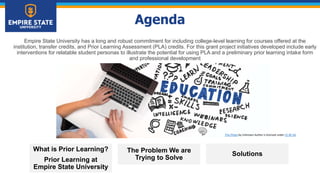
Empire State University has a long and robust commitment for including college-level learning for courses offered at the
institution, transfer credits, and Prior Learning Assessment (PLA) credits. For this grant project initiatives developed include early
interventions for relatable student personas to illustrate the potential for using PLA and a preliminary prior learning intake form
and professional development
What is Prior Learning?
Prior Learning at
Empire State University
The Problem We are
Trying to Solve
Solutions
This Photo by Unknown Author is licensed under CC BY-SA
What is Prior Learning Assessment
(PLA)?
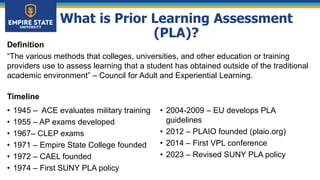
Definition
“The various methods that colleges, universities, and other education or training
providers use to assess learning that a student has obtained outside of the traditional
academic environment” – Council for Adult and Experiential Learning.
Timeline
• 1945 – ACE evaluates military training
• 1955 – AP exams developed
• 1967– CLEP exams
• 1971 – Empire State College founded
• 1972 – CAEL founded
• 1974 – First SUNY PLA policy
• 2004-2009 – EU develops PLA
guidelines
• 2012 – PLAIO founded (plaio.org)
• 2014 – First VPL conference
• 2023 – Revised SUNY PLA policy
PLA at Empire State University
Since 1971, Empire State University has maintained a robust commitment to
the idea that students should be awarded credit for verifiable college-level
learning regardless of where or how it was acquired.
We use the umbrella term of Prior Learning Assessment (PLA) to describe the
process that allows students to earn credits from:
• standardized exams
• portfolio assessment [individualized prior learning (iPLA)]
• pre-evaluated credentials and training [professional learning evaluations
(PLE)]
Credit is awarded for what students know, not for what they have done.
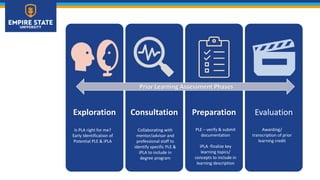
Exploration Consultation Preparation Evaluation
Is PLA right for me?
Early Identification of
Potential PLE & iPLA
Prior Learning Assessment Phases
Collaborating with
mentor/advisor and
professional staff to
identify specific PLE &
iPLA to include in
degree program
PLE – verify & submit
documentation
iPLA -finalize key
learning topics/
concepts to include in
learning description
Awarding/
transcription of prior
learning credit
The Problem We Are Trying To Solve
The problem:
• No comprehensive system to collect potential PLA at beginning of student
lifecycle.
• Students may take unnecessary classes
• PLA is a multifaceted and an unfamiliar concept
• Barriers exist at different stages of the student lifecycle.
The solution:
• Creating early interventions and resources stemming from the
recommendations from the Office of Academic Affairs’ Action Plan.
Our Process
• Retreats/Consultation/Stakeholder input (for each stage) – OAA Action Plan Committee that
was a follow-up to committee work – Intake form discussed and mocked-up in 2022/2023 then
grant
• Personas – committee work and consultation with support staff, professionals, and faculty
across units and student life span – OneStop, Recruitment, Student Success, AS, Faculty,
Careers, etc. PLA expertise and marketing expertise – student compilation
• PLE – Problem identified and the started working on searchable database with Registrar’s
Office categories identified at the retreat
• Intake Form – 1st mock-up with 2022/2023 committee, converted to WebForms and included
multiple opportunities for feedback loops – Fall Academic Presentation 2023 & Annual Meeting
2024 presentation
• Professional Development – Survey & Presentations - with look at form, asked for faculty and
staff to give open ended feedback and input into PD needs, etc.
• Orientation data – currently two questions are asked in the online orientation:
• Based upon what you have learned about prior learning, do you think you may pursue credit for prior learning?
• Please share a few words about the field(s) in which you may pursue credit for prior learning (open textbox).
Solutions
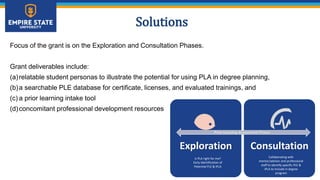
Focus of the grant is on the Exploration and Consultation Phases.
Grant deliverables include:
(a)relatable student personas to illustrate the potential for using PLA in degree planning,
(b)a searchable PLE database for certificate, licenses, and evaluated trainings, and
(c) a prior learning intake tool
(d)concomitant professional development resources
Exploration Consultation
Is PLA right for me?
Early Identification of
Potential PLE & iPLA
Prior Learning Assessment Phases
Collaborating with
mentor/advisor and professional
staff to identify specific PLE &
iPLA to include in degree
program
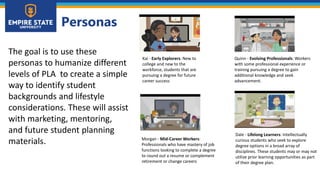
Personas
Kai - Early Explorers: New to
college and new to the
workforce, students that are
pursuing a degree for future
career success
The goal is to use these
personas to humanize different
levels of PLA to create a simple
way to identify student
backgrounds and lifestyle
considerations. These will assist
with marketing, mentoring,
and future student planning
materials. Morgan - Mid-Career Workers:
Professionals who have mastery of job
functions looking to complete a degree
to round out a resume or complement
retirement or change careers
Quinn - Evolving Professionals: Workers
with some professional experience or
training pursuing a degree to gain
additional knowledge and seek
advancement.
Dale - Lifelong Learners: Intellectually
curious students who seek to explore
degree options in a broad array of
disciplines. These students may or may not
utilize prior learning opportunities as part
of their degree plan.
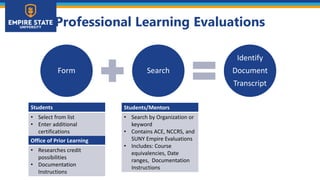
Professional Learning Evaluations
Form Search
Identify
Document
Transcript
Students
• Select from list
• Enter additional
certifications
Office of Prior Learning
• Researches credit
possibilities
• Documentation
Instructions
Students/Mentors
• Search by Organization or
keyword
• Contains ACE, NCCRS, and
SUNY Empire Evaluations
• Includes: Course
equivalencies, Date
ranges, Documentation
Instructions
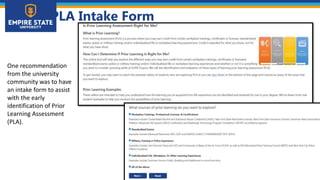
PLA Intake Form
One recommendation
from the university
community was to have
an intake form to assist
with the early
identification of Prior
Learning Assessment
(PLA).
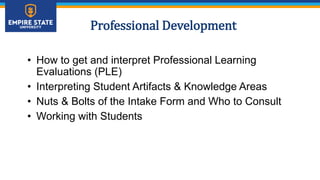
Professional Development
• How to get and interpret Professional Learning
Evaluations (PLE)
• Interpreting Student Artifacts & Knowledge Areas
• Nuts & Bolts of the Intake Form and Who to Consult
• Working with Students
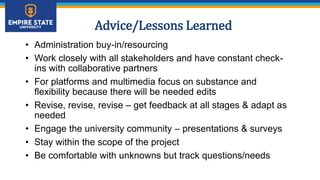
Advice/Lessons Learned
• Administration buy-in/resourcing
• Work closely with all stakeholders and have constant check-
ins with collaborative partners
• For platforms and multimedia focus on substance and
flexibility because there will be needed edits
• Revise, revise, revise – get feedback at all stages & adapt as
needed
• Engage the university community – presentations & surveys
• Stay within the scope of the project
• Be comfortable with unknowns but track questions/needs
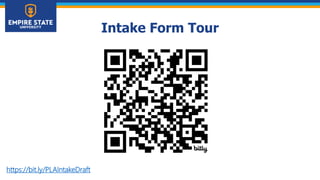
Intake Form Tour
https://bit.ly/PLAIntakeDraft
Q & A

Final Early Identification for Prior Learning Assessment (IITG Panel) Presentation.pptx

  • 1.
    Early Identification forPrior Learning Assessment (IITG Panel) SUNY CIT Presentation, May 2024 Lisa D’Adamo-Weinstein, Carl Burkart, and Amy Giaculli
  • 2.
    Agenda Empire State Universityhas a long and robust commitment for including college-level learning for courses offered at the institution, transfer credits, and Prior Learning Assessment (PLA) credits. For this grant project initiatives developed include early interventions for relatable student personas to illustrate the potential for using PLA and a preliminary prior learning intake form and professional development What is Prior Learning? Prior Learning at Empire State University The Problem We are Trying to Solve Solutions This Photo by Unknown Author is licensed under CC BY-SA
  • 3.
    What is PriorLearning Assessment (PLA)? Definition “The various methods that colleges, universities, and other education or training providers use to assess learning that a student has obtained outside of the traditional academic environment” – Council for Adult and Experiential Learning. Timeline • 1945 – ACE evaluates military training • 1955 – AP exams developed • 1967– CLEP exams • 1971 – Empire State College founded • 1972 – CAEL founded • 1974 – First SUNY PLA policy • 2004-2009 – EU develops PLA guidelines • 2012 – PLAIO founded (plaio.org) • 2014 – First VPL conference • 2023 – Revised SUNY PLA policy
  • 4.
    PLA at EmpireState University Since 1971, Empire State University has maintained a robust commitment to the idea that students should be awarded credit for verifiable college-level learning regardless of where or how it was acquired. We use the umbrella term of Prior Learning Assessment (PLA) to describe the process that allows students to earn credits from: • standardized exams • portfolio assessment [individualized prior learning (iPLA)] • pre-evaluated credentials and training [professional learning evaluations (PLE)] Credit is awarded for what students know, not for what they have done.
  • 5.
    Exploration Consultation PreparationEvaluation Is PLA right for me? Early Identification of Potential PLE & iPLA Prior Learning Assessment Phases Collaborating with mentor/advisor and professional staff to identify specific PLE & iPLA to include in degree program PLE – verify & submit documentation iPLA -finalize key learning topics/ concepts to include in learning description Awarding/ transcription of prior learning credit
  • 6.
    The Problem WeAre Trying To Solve The problem: • No comprehensive system to collect potential PLA at beginning of student lifecycle. • Students may take unnecessary classes • PLA is a multifaceted and an unfamiliar concept • Barriers exist at different stages of the student lifecycle. The solution: • Creating early interventions and resources stemming from the recommendations from the Office of Academic Affairs’ Action Plan.
  • 7.
    Our Process • Retreats/Consultation/Stakeholderinput (for each stage) – OAA Action Plan Committee that was a follow-up to committee work – Intake form discussed and mocked-up in 2022/2023 then grant • Personas – committee work and consultation with support staff, professionals, and faculty across units and student life span – OneStop, Recruitment, Student Success, AS, Faculty, Careers, etc. PLA expertise and marketing expertise – student compilation • PLE – Problem identified and the started working on searchable database with Registrar’s Office categories identified at the retreat • Intake Form – 1st mock-up with 2022/2023 committee, converted to WebForms and included multiple opportunities for feedback loops – Fall Academic Presentation 2023 & Annual Meeting 2024 presentation • Professional Development – Survey & Presentations - with look at form, asked for faculty and staff to give open ended feedback and input into PD needs, etc. • Orientation data – currently two questions are asked in the online orientation: • Based upon what you have learned about prior learning, do you think you may pursue credit for prior learning? • Please share a few words about the field(s) in which you may pursue credit for prior learning (open textbox).
  • 8.
    Solutions Focus of thegrant is on the Exploration and Consultation Phases. Grant deliverables include: (a)relatable student personas to illustrate the potential for using PLA in degree planning, (b)a searchable PLE database for certificate, licenses, and evaluated trainings, and (c) a prior learning intake tool (d)concomitant professional development resources Exploration Consultation Is PLA right for me? Early Identification of Potential PLE & iPLA Prior Learning Assessment Phases Collaborating with mentor/advisor and professional staff to identify specific PLE & iPLA to include in degree program
  • 9.
    Personas Kai - EarlyExplorers: New to college and new to the workforce, students that are pursuing a degree for future career success The goal is to use these personas to humanize different levels of PLA to create a simple way to identify student backgrounds and lifestyle considerations. These will assist with marketing, mentoring, and future student planning materials. Morgan - Mid-Career Workers: Professionals who have mastery of job functions looking to complete a degree to round out a resume or complement retirement or change careers Quinn - Evolving Professionals: Workers with some professional experience or training pursuing a degree to gain additional knowledge and seek advancement. Dale - Lifelong Learners: Intellectually curious students who seek to explore degree options in a broad array of disciplines. These students may or may not utilize prior learning opportunities as part of their degree plan.
  • 10.
    Professional Learning Evaluations FormSearch Identify Document Transcript Students • Select from list • Enter additional certifications Office of Prior Learning • Researches credit possibilities • Documentation Instructions Students/Mentors • Search by Organization or keyword • Contains ACE, NCCRS, and SUNY Empire Evaluations • Includes: Course equivalencies, Date ranges, Documentation Instructions
  • 11.
    PLA Intake Form Onerecommendation from the university community was to have an intake form to assist with the early identification of Prior Learning Assessment (PLA).
  • 12.
    Professional Development • Howto get and interpret Professional Learning Evaluations (PLE) • Interpreting Student Artifacts & Knowledge Areas • Nuts & Bolts of the Intake Form and Who to Consult • Working with Students
  • 13.
    Advice/Lessons Learned • Administrationbuy-in/resourcing • Work closely with all stakeholders and have constant check- ins with collaborative partners • For platforms and multimedia focus on substance and flexibility because there will be needed edits • Revise, revise, revise – get feedback at all stages & adapt as needed • Engage the university community – presentations & surveys • Stay within the scope of the project • Be comfortable with unknowns but track questions/needs
  • 14.
  • 15.

Editor's Notes

  • #2 Lisa
  • #3 Lisa
  • #4 Carl SUNY initially issued the Award of Academic Credit by Evaluation policy in 1976. In 2023, SUNY revised the policy and expanded the types of verifiable college-level learning to be recognized, including, but not limited to: performance on standardized published exams; military education and training; professional and industry certifications and licenses or other credentials; non-credit and continuing education study; on-the-job training/education; and work experience. This policy revision is informed by research demonstrating that the award of credit by evaluation can increase access to, and success in, higher education by decreasing time to degree completion that results in cost savings.
  • #5 Amy We define the process as an opportunity for students to earn credit from certain workplace trainings, certificates or licenses; standardized exams; volunteer work, individual study, police or military training; and/or individualized life or workplace learning experiences.
  • #6 Amy
  • #7 Lisa Lacking the ability to systematically assess potential prior learning early would help students engage in the PLA process as well as enhance the ability of faculty and professionals to provide the best and most customized/individualized academic advising. When students and faculty understand what prior learning can be credit-worthy, students will not take unnecessary classes, thereby saving time and money to complete their degrees. Example = Addiction studies – might have CASAC and if don’t volunteer then take unnecessary classes
  • #8 Lisa
  • #9 Lisa
  • #10 Amy – show one video in total from download/online as tech allows – Quinn video
  • #11 Carl – search – show the functionality of the search The creation of tools designed to increase the early identification and documentation of credits available from SUNY Empire Professional Learning Evaluations, ACE evaluations, and NCCRS evaluations. The PLE section of the form focuses on identifying prospective SUNY Empire PLEs and common ACE/NCCRS evaluations. The goal is to encourage students to submit documentation so that these credits can be added to the student records in the in the degree planning process (similar to transfer credits from regionally accredited institutions) Project with Registers Office and ITS to create a searchable online database of SUNY Empire Professional Learning Evaluaitons and common ACE and NCCRS evaluations. This tool is based on the current TES website with more robust search capabilities.
  • #12 Amy – talk it through How We Developed Identified and created profiles of the various types of learners Four Student Personas were identified to showcase the various types of learners we serve at the college and personalize the process. Each persona has a different need for, and approach to including PLA in their degree programs. The personas were developed through collaboration with faculty and professionals who serve in various capacities at the university.
  • #13 Amy Identifying PLE and Subtopics A PD - how to get and interpret PLE 1 Searching web and ACE - OPL consult 2 Documentation & Degree Planning - DP Planner and Possibilities of Potential Topics 3 PLE for specialized areas - Currency - here is what to do if out of date- what is common, etc 4 Interpretation of what PLE means and potential for duplication in DP, etc. 5 Specialized topics - CASAC, etc. B Interpreting Student Artifacts & Knowledge Areas 1 Brainstorming and currency - potential credits, lib/non-lib 2 Reading a resume for PLA topics - mentor's guide 3 PLA Interview 4 How to network to assist students - who, where, etc. to look/consult 5 Specialized topics - language is one example C Nuts & Bolts 1 timeline and checklist 2 Using the Intake Form 3 Where resources live 4 Who can I consult with? 5 How do you determine credits for mentors - where to look and what tools to use D Working with Students 1 Motivating students to try & persist 2 PLA Interview engaging in … 3 Who can I consult with? 4 How to help students identify potential PLA - learning at college level - Global Learning Qualifications (See Susan OER) & Guidelines for degree vs. electives/Gen Ed
  • #14 Carl Identifying PLE and Subtopics A PD - how to get and interpret PLE 1 Searching web and ACE - OPL consult 2 Documentation & Degree Planning - DP Planner and Possibilities of Potential Topics 3 PLE for specialized areas - Currency - here is what to do if out of date- what is common, etc 4 Interpretation of what PLE means and potential for duplication in DP, etc. 5 Specialized topics - CASAC, etc. B Interpreting Student Artifacts & Knowledge Areas 1 Brainstorming and currency - potential credits, lib/non-lib 2 Reading a resume for PLA topics - mentor's guide 3 PLA Interview 4 How to network to assist students - who, where, etc. to look/consult 5 Specialized topics - language is one example C Nuts & Bolts 1 timeline and checklist 2 Using the Intake Form 3 Where resources live 4 Who can I consult with? 5 How do you determine credits for mentors - where to look and what tools to use D Working with Students 1 Motivating students to try & persist 2 PLA Interview engaging in … 3 Who can I consult with? 4 How to help students identify potential PLA - learning at college level - Global Learning Qualifications (See Susan OER) & Guidelines for degree vs. electives/Gen Ed
  • #15 Lisa tech and start and all talk it through
  • #16 SUNY initially issued the Award of Academic Credit by Evaluation policy in 1976. In 2023, SUNY revised the policy and expanded the types of verifiable college-level learning to be recognized, including, but not limited to: performance on standardized published exams; military education and training; professional and industry certifications and licenses or other credentials; non-credit and continuing education study; on-the-job training/education; and work experience. This policy revision is informed by research demonstrating that the award of credit by evaluation can increase access to, and success in, higher education by decreasing time to degree completion that results in cost savings.