Melding the Nitty Gritty of
Critical Thinking and Information Literacy into
English Developmental & Composition Classes
Mark Thompson,
Library Director
Middlesex County College
“Intervention” brings library services, staff, and

skills to a point of need outside of the library
proper.





Question: Can we place ourselves wherever
and whenever there is an intersection of help
& student need?
Today, let’s do a review–
◦ What’s been considered or done before?
◦ Uncover the whole spectrum.
◦ Your feedback on possibilities or accomplishments.


New Perspectives on Library Values

◦ Focus on institutional goals, such as student
learning outcomes, student success, and student
retention



Bridge the gap to poor performers

◦ Serve “reluctants,” non-users and attendees at help
sessions -- wherever intervention is already
occurring



Help other service depts

◦ Tutoring / EOF / Minority Affairs / Writing Center /
Learning Center / Developmental Classes Lab /
Counseling




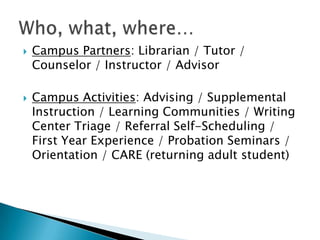
Campus Partners: Librarian / Tutor /
Counselor / Instructor / Advisor
Campus Activities: Advising / Supplemental
Instruction / Learning Communities / Writing
Center Triage / Referral Self-Scheduling /
First Year Experience / Probation Seminars /
Orientation / CARE (returning adult student)
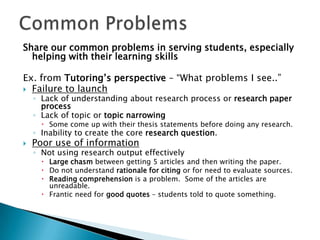
Share our common problems in serving students, especially
helping with their learning skills
Ex. from Tutoring’s perspective – “What problems I see..”
 Failure to launch

◦ Lack of understanding about research process or research paper
process
◦ Lack of topic or topic narrowing

 Some come up with their thesis statements before doing any research.

◦ Inability to create the core research question.



Poor use of information

◦ Not using research output effectively

 Large chasm between getting 5 articles and then writing the paper.
 Do not understand rationale for citing or for need to evaluate sources.
 Reading comprehension is a problem. Some of the articles are
unreadable.
 Frantic need for good quotes – students told to quote something.
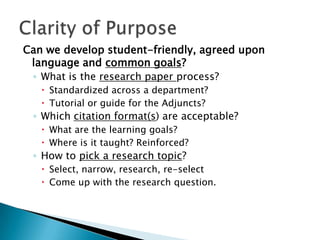
Can we develop student-friendly, agreed upon
language and common goals?
◦ What is the research paper process?
 Standardized across a department?
 Tutorial or guide for the Adjuncts?

◦ Which citation format(s) are acceptable?
 What are the learning goals?
 Where is it taught? Reinforced?

◦ How to pick a research topic?
 Select, narrow, research, re-select
 Come up with the research question.


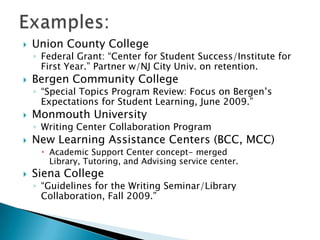
Union County College

◦ Federal Grant: “Center for Student Success/Institute for
First Year.” Partner w/NJ City Univ. on retention.



Bergen Community College

◦ “Special Topics Program Review: Focus on Bergen’s
Expectations for Student Learning, June 2009.”



Monmouth University

◦ Writing Center Collaboration Program



New Learning Assistance Centers (BCC, MCC)
 Academic Support Center concept- merged
Library, Tutoring, and Advising service center.



Siena College

◦ “Guidelines for the Writing Seminar/Library
Collaboration, Fall 2009.”


Books:

◦ Elmborg, James K., and Sheril Hook. Centers for

Learning: Writing Centers and Libraries in
Collaboration. Publications in Librarianship, no.58.
Chicago: ACRL, 2005. Print.

◦ Geller, Anne Ellen, et. al. The Everyday Writing
Center: A Community of Practice. Logan, Utah:
Utah State University Press, 2007. Print.


Articles:

 Andrade, Maureen S. “Learning Communities: Examining
Positive Outcomes.” Journal of College Student Retention 9:1
(2007-2008): 1-20. Print.
 Brady, Laura, et. Al. “A Collaborative Approach to Information
Literacy: First-Year Composition, Writing Center, and Library
Partnerships at West Virginia University.” Composition
Forum, Spring, 2009. Web. 2 June 2010.
 Kuhlthau, Carol C. and Leslie K. Maniotes. “Building Guided
Inquiry Teams for 21st Century Learners.” School Library
Monthly. 26:5 (Jan 2010):18-21. Print.
 Landsberger, Joe. “Academic Support Centers: Quo Vadis?”
TechTrends 49:4 (Jul/Aug 2005). 8-12. Print.
 Mahaffy, Mardi. “Exploring Common Ground: US Writing
Center/Library Collaboration.” New Library World. 109:3/4.
2007. 173-181. Print.
 Roselle, Ann. “Community College Library Practices in
Developmental Education.” Journal of Developmental Education.
32:2 (Winter 2008). 24-32. Print.















Tutoring Centers
Learning Communities
Peer Leaders
Writing Centers
First Year Experience
Joint Workshops
Scoring Rubrics
Academic Support Centers
Developmental Education
Outcomes Assessment
Learning-College Concept
And more….
How can we assist in providing help? What mix
will work for both of us?
1. Joint staff meetings

 Librarians coach or train all new tutors
 During faculty and new faculty plenary sessions; and
faculty development days: joint library/tutoring sessions

2. Share knowledge

 National Tutoring Association (NTA)

3. Special techniques





Referrals
Learning Communities
Supplemental Instruction
Which curriculum? Writing Center?
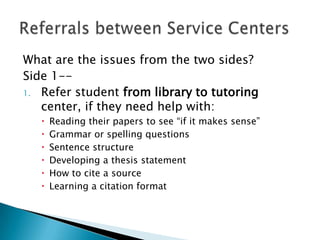
What are the issues from the two sides?
Side 1-1. Refer student from library to tutoring
center, if they need help with:







Reading their papers to see “if it makes sense”
Grammar or spelling questions
Sentence structure
Developing a thesis statement
How to cite a source
Learning a citation format
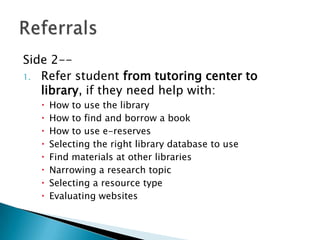
Side 2-1. Refer student from tutoring center to
library, if they need help with:









How to use the library
How to find and borrow a book
How to use e-reserves
Selecting the right library database to use
Find materials at other libraries
Narrowing a research topic
Selecting a resource type
Evaluating websites
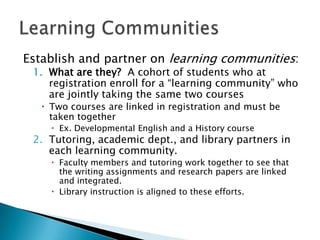
Establish and partner on learning communities:
1. What are they? A cohort of students who at
registration enroll for a “learning community” who
are jointly taking the same two courses
 Two courses are linked in registration and must be
taken together
 Ex. Developmental English and a History course

2. Tutoring, academic dept., and library partners in
each learning community.
 Faculty members and tutoring work together to see that
the writing assignments and research papers are linked
and integrated.
 Library instruction is aligned to these efforts.
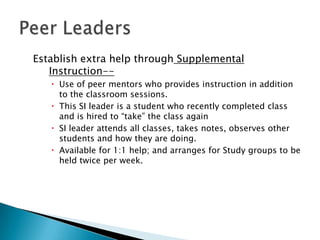
Establish extra help through Supplemental
Instruction- Use of peer mentors who provides instruction in addition
to the classroom sessions.
 This SI leader is a student who recently completed class
and is hired to “take” the class again
 SI leader attends all classes, takes notes, observes other
students and how they are doing.
 Available for 1:1 help; and arranges for Study groups to be
held twice per week.


How can we help? What mix will work for
both of us?
1. Periodic co-location of staff


Ex. Librarians are available twice a week

2. Instant Referrals



Ex. Joint appointment scheduling through
system, e.g. TutorTrac
Or self-scheduling with students scheduling
themselves for tutoring or 1:1 library help.

3. Joint troubleshooting


Resolve database selection, search problems, citation
process, evaluating sources.








First Year Experience
Joint Workshops
Scoring Rubrics
First Year Experience
Academic Support Centers
Learning College
How can we help? What mix will work for both of us?
1.
Students enrolled for their very first semester at the
college
 Or whoever is enrolled in at least two developmental courses
(math, writing, reading)

Give them their first exposure to college
Raise the bar

2.
3.

 Basic student success curriculum
 Study habits; taking tests; etc.

 Information literacy

 Three assignments/2-3 library sessions

Include info lit assignment

4.

◦

Librarian either teaches library session; some teach the
entire class section.


Other service center offerings:
◦
◦
◦
◦
◦
◦
◦
◦
◦

College: Not What I Thought It Would Be
Preparation for Mid-Term Exams
Strategic Planning for Academic Success
Job Search Basics
Ingredients for Success
The Way to an A
How to Write an A Paper
Choosing your College Major
Stress Management


Library offerings:

Welcome to Library 2.0
What’s valuable in the non-Google world?
Getting an A on your research paper
Finding the information you need
Using 1:1 library help
Ready for your interview:? Researching a potential
employer
◦ Searching for scholarships
◦ Avoiding plagiarism
◦ How to cite your sources
◦
◦
◦
◦
◦
◦


Outcomes Assessment
◦ Focus on Student Learning Objectives
◦ Develop joint measurements (scoring rubrics) for
how well a student did in their paper, as regards
several factors, ex.
research, synthesis, concepts, organization…
◦ Both faculty and librarian review both paper and
bibliography.
◦ Score and review.
◦ Develop norms and benchmarks
◦ Assess ways to improve outcomes
Can we combine operations?
1. Co-located or 2. Integrated into a
“Learning Assistance Center” /”Academic
Support Center”

Using a holistic approach to learning and
development, the Learning Assistance Center supports
students in becoming independent and successful
learners by providing skill-based tutoring across
disciplines… Through collaboration with
programs, departments and the larger campus
community, the Center works to respond to the diverse
needs of the students.
Source: San Francisco State Univ.
Many community colleges embraced the concept of
the Learning College which "places learning first
and provides educational experiences for learners
anyway, anyplace, anytime." -- Presidents of the
League's Alliance for Community College
Innovation (www.league.org)
Terry O’Banion’s book, Focus on Learning.
Team:
◦
◦
◦
◦
◦

Writing Center Supervisor
Tutoring Center Supervisor
Library Instruction Coordinator
Writing Center Faculty Liaison
Student Support or Student Services Coordinator


Discussion
◦ What initiatives or mandates are you under?
◦ How well do you work with Tutoring, Writing
Center, Developmental Center?
◦ What has worked on your campus?
Thanks,
Mark Thompson, mthompson@middlesexcc.edu
Library, Middlesex Community College, Edison, NJ
732-906-4252

Information Literacy and Critical Thinking

  • 1.
    Melding the NittyGritty of Critical Thinking and Information Literacy into English Developmental & Composition Classes Mark Thompson, Library Director Middlesex County College
  • 2.
    “Intervention” brings libraryservices, staff, and skills to a point of need outside of the library proper.   Question: Can we place ourselves wherever and whenever there is an intersection of help & student need? Today, let’s do a review– ◦ What’s been considered or done before? ◦ Uncover the whole spectrum. ◦ Your feedback on possibilities or accomplishments.
  • 3.
     New Perspectives onLibrary Values ◦ Focus on institutional goals, such as student learning outcomes, student success, and student retention  Bridge the gap to poor performers ◦ Serve “reluctants,” non-users and attendees at help sessions -- wherever intervention is already occurring  Help other service depts ◦ Tutoring / EOF / Minority Affairs / Writing Center / Learning Center / Developmental Classes Lab / Counseling
  • 4.
      Campus Partners: Librarian/ Tutor / Counselor / Instructor / Advisor Campus Activities: Advising / Supplemental Instruction / Learning Communities / Writing Center Triage / Referral Self-Scheduling / First Year Experience / Probation Seminars / Orientation / CARE (returning adult student)
  • 5.
    Share our commonproblems in serving students, especially helping with their learning skills Ex. from Tutoring’s perspective – “What problems I see..”  Failure to launch ◦ Lack of understanding about research process or research paper process ◦ Lack of topic or topic narrowing  Some come up with their thesis statements before doing any research. ◦ Inability to create the core research question.  Poor use of information ◦ Not using research output effectively  Large chasm between getting 5 articles and then writing the paper.  Do not understand rationale for citing or for need to evaluate sources.  Reading comprehension is a problem. Some of the articles are unreadable.  Frantic need for good quotes – students told to quote something.
  • 6.
    Can we developstudent-friendly, agreed upon language and common goals? ◦ What is the research paper process?  Standardized across a department?  Tutorial or guide for the Adjuncts? ◦ Which citation format(s) are acceptable?  What are the learning goals?  Where is it taught? Reinforced? ◦ How to pick a research topic?  Select, narrow, research, re-select  Come up with the research question.
  • 7.
     Union County College ◦Federal Grant: “Center for Student Success/Institute for First Year.” Partner w/NJ City Univ. on retention.  Bergen Community College ◦ “Special Topics Program Review: Focus on Bergen’s Expectations for Student Learning, June 2009.”  Monmouth University ◦ Writing Center Collaboration Program  New Learning Assistance Centers (BCC, MCC)  Academic Support Center concept- merged Library, Tutoring, and Advising service center.  Siena College ◦ “Guidelines for the Writing Seminar/Library Collaboration, Fall 2009.”
  • 8.
     Books: ◦ Elmborg, JamesK., and Sheril Hook. Centers for Learning: Writing Centers and Libraries in Collaboration. Publications in Librarianship, no.58. Chicago: ACRL, 2005. Print. ◦ Geller, Anne Ellen, et. al. The Everyday Writing Center: A Community of Practice. Logan, Utah: Utah State University Press, 2007. Print.
  • 9.
     Articles:  Andrade, MaureenS. “Learning Communities: Examining Positive Outcomes.” Journal of College Student Retention 9:1 (2007-2008): 1-20. Print.  Brady, Laura, et. Al. “A Collaborative Approach to Information Literacy: First-Year Composition, Writing Center, and Library Partnerships at West Virginia University.” Composition Forum, Spring, 2009. Web. 2 June 2010.  Kuhlthau, Carol C. and Leslie K. Maniotes. “Building Guided Inquiry Teams for 21st Century Learners.” School Library Monthly. 26:5 (Jan 2010):18-21. Print.  Landsberger, Joe. “Academic Support Centers: Quo Vadis?” TechTrends 49:4 (Jul/Aug 2005). 8-12. Print.  Mahaffy, Mardi. “Exploring Common Ground: US Writing Center/Library Collaboration.” New Library World. 109:3/4. 2007. 173-181. Print.  Roselle, Ann. “Community College Library Practices in Developmental Education.” Journal of Developmental Education. 32:2 (Winter 2008). 24-32. Print.
  • 10.
                Tutoring Centers Learning Communities PeerLeaders Writing Centers First Year Experience Joint Workshops Scoring Rubrics Academic Support Centers Developmental Education Outcomes Assessment Learning-College Concept And more….
  • 11.
    How can weassist in providing help? What mix will work for both of us? 1. Joint staff meetings  Librarians coach or train all new tutors  During faculty and new faculty plenary sessions; and faculty development days: joint library/tutoring sessions 2. Share knowledge  National Tutoring Association (NTA) 3. Special techniques     Referrals Learning Communities Supplemental Instruction Which curriculum? Writing Center?
  • 12.
    What are theissues from the two sides? Side 1-1. Refer student from library to tutoring center, if they need help with:       Reading their papers to see “if it makes sense” Grammar or spelling questions Sentence structure Developing a thesis statement How to cite a source Learning a citation format
  • 13.
    Side 2-1. Referstudent from tutoring center to library, if they need help with:         How to use the library How to find and borrow a book How to use e-reserves Selecting the right library database to use Find materials at other libraries Narrowing a research topic Selecting a resource type Evaluating websites
  • 14.
    Establish and partneron learning communities: 1. What are they? A cohort of students who at registration enroll for a “learning community” who are jointly taking the same two courses  Two courses are linked in registration and must be taken together  Ex. Developmental English and a History course 2. Tutoring, academic dept., and library partners in each learning community.  Faculty members and tutoring work together to see that the writing assignments and research papers are linked and integrated.  Library instruction is aligned to these efforts.
  • 15.
    Establish extra helpthrough Supplemental Instruction- Use of peer mentors who provides instruction in addition to the classroom sessions.  This SI leader is a student who recently completed class and is hired to “take” the class again  SI leader attends all classes, takes notes, observes other students and how they are doing.  Available for 1:1 help; and arranges for Study groups to be held twice per week.
  • 16.
     How can wehelp? What mix will work for both of us? 1. Periodic co-location of staff  Ex. Librarians are available twice a week 2. Instant Referrals   Ex. Joint appointment scheduling through system, e.g. TutorTrac Or self-scheduling with students scheduling themselves for tutoring or 1:1 library help. 3. Joint troubleshooting  Resolve database selection, search problems, citation process, evaluating sources.
  • 17.
          First Year Experience JointWorkshops Scoring Rubrics First Year Experience Academic Support Centers Learning College
  • 18.
    How can wehelp? What mix will work for both of us? 1. Students enrolled for their very first semester at the college  Or whoever is enrolled in at least two developmental courses (math, writing, reading) Give them their first exposure to college Raise the bar 2. 3.  Basic student success curriculum  Study habits; taking tests; etc.  Information literacy  Three assignments/2-3 library sessions Include info lit assignment 4. ◦ Librarian either teaches library session; some teach the entire class section.
  • 19.
     Other service centerofferings: ◦ ◦ ◦ ◦ ◦ ◦ ◦ ◦ ◦ College: Not What I Thought It Would Be Preparation for Mid-Term Exams Strategic Planning for Academic Success Job Search Basics Ingredients for Success The Way to an A How to Write an A Paper Choosing your College Major Stress Management
  • 20.
     Library offerings: Welcome toLibrary 2.0 What’s valuable in the non-Google world? Getting an A on your research paper Finding the information you need Using 1:1 library help Ready for your interview:? Researching a potential employer ◦ Searching for scholarships ◦ Avoiding plagiarism ◦ How to cite your sources ◦ ◦ ◦ ◦ ◦ ◦
  • 21.
     Outcomes Assessment ◦ Focuson Student Learning Objectives ◦ Develop joint measurements (scoring rubrics) for how well a student did in their paper, as regards several factors, ex. research, synthesis, concepts, organization… ◦ Both faculty and librarian review both paper and bibliography. ◦ Score and review. ◦ Develop norms and benchmarks ◦ Assess ways to improve outcomes
  • 22.
    Can we combineoperations? 1. Co-located or 2. Integrated into a “Learning Assistance Center” /”Academic Support Center” Using a holistic approach to learning and development, the Learning Assistance Center supports students in becoming independent and successful learners by providing skill-based tutoring across disciplines… Through collaboration with programs, departments and the larger campus community, the Center works to respond to the diverse needs of the students. Source: San Francisco State Univ.
  • 23.
    Many community collegesembraced the concept of the Learning College which "places learning first and provides educational experiences for learners anyway, anyplace, anytime." -- Presidents of the League's Alliance for Community College Innovation (www.league.org) Terry O’Banion’s book, Focus on Learning. Team: ◦ ◦ ◦ ◦ ◦ Writing Center Supervisor Tutoring Center Supervisor Library Instruction Coordinator Writing Center Faculty Liaison Student Support or Student Services Coordinator
  • 24.
     Discussion ◦ What initiativesor mandates are you under? ◦ How well do you work with Tutoring, Writing Center, Developmental Center? ◦ What has worked on your campus? Thanks, Mark Thompson, mthompson@middlesexcc.edu Library, Middlesex Community College, Edison, NJ 732-906-4252