Lead Yourself First
Student Leadership Institute Presentation
November 2018
Dr. Lisa D’Adamo-Weinstein, dean
Division of Student Affairs
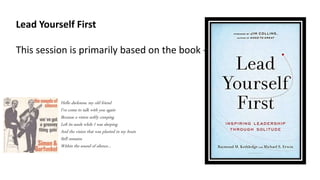
Lead Yourself First
This session is primarily based on the book -
Hello darkness, my old friend
I've come to talk with you again
Because a vision softly creeping
Left its seeds while I was sleeping
And the vision that was planted in my brain
Still remains
Within the sound of silence…
To lead others, you must first lead yourself.
Prioritize Yourself.
Solitude allows you to
renew; it allows you
time to think about
thinking.
Solitude creates clarity and clarity creates meaning.
Just Listen.
One of the challenges with solitude is listening to the self. Listen to
yourself. Listen to your mind, listen to your body and do something about it
if you don’t like what you hear. Listening can free you up and help you
think about new ways to approach an issue.
Listen to yourself to lead yourself. Then respond.
Get Over It.
One of the
misconceptions
about solitude is that
making time for
yourself is selfish;
that there are things
to do, people who
depend on you and if
you don’t fulfill your
responsibilities, then
you’re letting them
down.
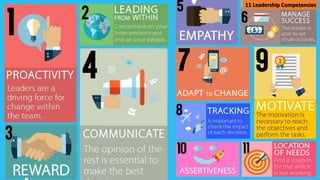
11 Leadership Competencies
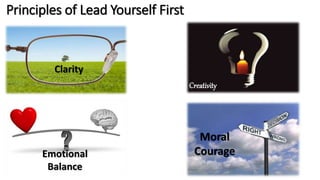
Principles of Lead Yourself First
Clarity
Creativity
Emotional
Balance
Moral
Courage
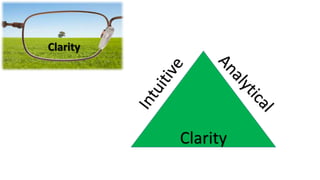
Clarity
Clarity
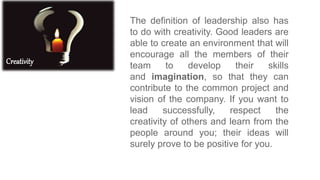
Creativity
The definition of leadership also has
to do with creativity. Good leaders are
able to create an environment that will
encourage all the members of their
team to develop their skills
and imagination, so that they can
contribute to the common project and
vision of the company. If you want to
lead successfully, respect the
creativity of others and learn from the
people around you; their ideas will
surely prove to be positive for you.
Emotional
Balance
Reflection,
Catharsis,
Acceptance,
Stepping away from external stimuli,
&
Questioning the legitimacy of fear.
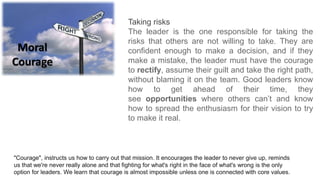
Moral
Courage
Taking risks
The leader is the one responsible for taking the
risks that others are not willing to take. They are
confident enough to make a decision, and if they
make a mistake, the leader must have the courage
to rectify, assume their guilt and take the right path,
without blaming it on the team. Good leaders know
how to get ahead of their time, they
see opportunities where others can’t and know
how to spread the enthusiasm for their vision to try
to make it real.
"Courage", instructs us how to carry out that mission. It encourages the leader to never give up, reminds
us that we're never really alone and that fighting for what's right in the face of what's wrong is the only
option for leaders. We learn that courage is almost impossible unless one is connected with core values.
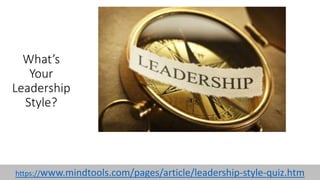
What’s
Your
Leadership
Style?
https://www.mindtools.com/pages/article/leadership-style-quiz.htm
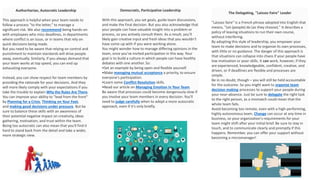
Authoritarian, Autocratic Leadership
This approach is helpful when your team needs to
follow a process "to the letter," to manage a
significant risk. We also recommend being hands-on
with employees who miss deadlines, in departments
where conflict is an issue, or in teams that rely on
quick decisions being made.
But you need to be aware that relying on control and
punishment to maintain standards will drive people
away, eventually. Similarly, if you always demand that
your team works at top speed, you can end up
exhausting everyone.
Instead, you can show respect for team members by
providing the rationale for your decisions. And they
will more likely comply with your expectations if you
take the trouble to explain Why the Rules Are There.
You can improve your ability to "lead from the front"
by Planning for a Crisis, Thinking on Your Feet,
and making good decisions under pressure. But be
sure to balance these skills with an awareness of
their potential negative impact on creativity, ideas
gathering, motivation, and trust within the team.
Being too autocratic can also mean that you'll find it
hard to stand back from the detail and take a wider,
more strategic view.
Democratic, Participative Leadership
With this approach, you set goals, guide team discussions,
and make the final decision. But you also acknowledge that
your people can have valuable insight into a problem or
process, so you actively consult them. As a result, you'll
likely gain creative input and fresh ideas that you wouldn't
have come up with if you were working alone.
You might wonder how to manage differing opinions in the
team, once you've invited participation in this way. Your
goal is to build a culture in which people can have healthy
debates with one another. So:
•Set an example by being open and flexible yourself.
•Make managing mutual acceptance a priority, to ensure
everyone's participation.
•Learn some Conflict Resolution skills.
•Read our article on Managing Emotion in Your Team.
Be aware that processes could become dangerously slow if
you involve your team members in every decision. You'll
need to judge carefully when to adopt a more autocratic
approach, even if it's only briefly.
The Delegating, "Laissez Faire" Leader
"Laissez faire" is a French phrase adopted into English that
means, "Let (people) do (as they choose)." It describes a
policy of leaving situations to run their own course,
without interfering.
By adopting this style of leadership, you empower your
team to make decisions and to organize its own processes,
with little or no guidance. The danger of this approach is
that situations can collapse into chaos if your people have
low motivation or poor skills. It can work, however, if they
are experienced, knowledgeable, confident, creative, and
driven, or if deadlines are flexible and processes are
simple.
Be in no doubt, though – you will still be held accountable
for the outcome. So you might want to organize team
decision making processes to support your people during
your near-absence. Just be sure to delegate the right task
to the right person, as a mismatch could mean that the
whole team fails.
Avoid becoming too remote, even with a high-performing,
highly autonomous team. Change can occur at any time in
business, so your organization's requirements for your
team might shift after your initial brief. Be sure to stay in
touch, and to communicate clearly and promptly if this
happens. Remember, you can offer your support without
becoming a micromanager!
https://www.mindtools.com/pages/main/SelfTestsIndex.htm
https://www.linkedin.com/pulse/lead-yourself-first-inspiring-leadership-through-de-sousa-mba/
https://ideas.ted.com/why-we-owe-it-to-ourselves-to-spend-quiet-time-alone-every-day/
https://www.ted.com/talks/simon_sinek_how_great_leaders_inspire_action?referrer=playlist-tips_for_inclusive_leadership
Self-tests
Lead Yourself First Resources
T.E.D. Resources
https://www.ted.com/talks/drew_dudley_everyday_leadership
RESOURCES
https://www.game-learn.com/what-is-leadership-ways-to-define
Leadership Definitions
Top 11 Leadership Competencies That Will Make You Indestructible in 2016 (Infographic)

Lead yourself first sli nov 2018

  • 1.
    Lead Yourself First StudentLeadership Institute Presentation November 2018 Dr. Lisa D’Adamo-Weinstein, dean Division of Student Affairs
  • 2.
    Lead Yourself First Thissession is primarily based on the book - Hello darkness, my old friend I've come to talk with you again Because a vision softly creeping Left its seeds while I was sleeping And the vision that was planted in my brain Still remains Within the sound of silence…
  • 3.
    To lead others,you must first lead yourself.
  • 4.
    Prioritize Yourself. Solitude allowsyou to renew; it allows you time to think about thinking. Solitude creates clarity and clarity creates meaning.
  • 5.
    Just Listen. One ofthe challenges with solitude is listening to the self. Listen to yourself. Listen to your mind, listen to your body and do something about it if you don’t like what you hear. Listening can free you up and help you think about new ways to approach an issue. Listen to yourself to lead yourself. Then respond.
  • 6.
    Get Over It. Oneof the misconceptions about solitude is that making time for yourself is selfish; that there are things to do, people who depend on you and if you don’t fulfill your responsibilities, then you’re letting them down.
  • 7.
  • 8.
    Principles of LeadYourself First Clarity Creativity Emotional Balance Moral Courage
  • 9.
  • 10.
    Creativity The definition ofleadership also has to do with creativity. Good leaders are able to create an environment that will encourage all the members of their team to develop their skills and imagination, so that they can contribute to the common project and vision of the company. If you want to lead successfully, respect the creativity of others and learn from the people around you; their ideas will surely prove to be positive for you.
  • 11.
    Emotional Balance Reflection, Catharsis, Acceptance, Stepping away fromexternal stimuli, & Questioning the legitimacy of fear.
  • 12.
    Moral Courage Taking risks The leaderis the one responsible for taking the risks that others are not willing to take. They are confident enough to make a decision, and if they make a mistake, the leader must have the courage to rectify, assume their guilt and take the right path, without blaming it on the team. Good leaders know how to get ahead of their time, they see opportunities where others can’t and know how to spread the enthusiasm for their vision to try to make it real. "Courage", instructs us how to carry out that mission. It encourages the leader to never give up, reminds us that we're never really alone and that fighting for what's right in the face of what's wrong is the only option for leaders. We learn that courage is almost impossible unless one is connected with core values.
  • 13.
  • 14.
    Authoritarian, Autocratic Leadership Thisapproach is helpful when your team needs to follow a process "to the letter," to manage a significant risk. We also recommend being hands-on with employees who miss deadlines, in departments where conflict is an issue, or in teams that rely on quick decisions being made. But you need to be aware that relying on control and punishment to maintain standards will drive people away, eventually. Similarly, if you always demand that your team works at top speed, you can end up exhausting everyone. Instead, you can show respect for team members by providing the rationale for your decisions. And they will more likely comply with your expectations if you take the trouble to explain Why the Rules Are There. You can improve your ability to "lead from the front" by Planning for a Crisis, Thinking on Your Feet, and making good decisions under pressure. But be sure to balance these skills with an awareness of their potential negative impact on creativity, ideas gathering, motivation, and trust within the team. Being too autocratic can also mean that you'll find it hard to stand back from the detail and take a wider, more strategic view. Democratic, Participative Leadership With this approach, you set goals, guide team discussions, and make the final decision. But you also acknowledge that your people can have valuable insight into a problem or process, so you actively consult them. As a result, you'll likely gain creative input and fresh ideas that you wouldn't have come up with if you were working alone. You might wonder how to manage differing opinions in the team, once you've invited participation in this way. Your goal is to build a culture in which people can have healthy debates with one another. So: •Set an example by being open and flexible yourself. •Make managing mutual acceptance a priority, to ensure everyone's participation. •Learn some Conflict Resolution skills. •Read our article on Managing Emotion in Your Team. Be aware that processes could become dangerously slow if you involve your team members in every decision. You'll need to judge carefully when to adopt a more autocratic approach, even if it's only briefly. The Delegating, "Laissez Faire" Leader "Laissez faire" is a French phrase adopted into English that means, "Let (people) do (as they choose)." It describes a policy of leaving situations to run their own course, without interfering. By adopting this style of leadership, you empower your team to make decisions and to organize its own processes, with little or no guidance. The danger of this approach is that situations can collapse into chaos if your people have low motivation or poor skills. It can work, however, if they are experienced, knowledgeable, confident, creative, and driven, or if deadlines are flexible and processes are simple. Be in no doubt, though – you will still be held accountable for the outcome. So you might want to organize team decision making processes to support your people during your near-absence. Just be sure to delegate the right task to the right person, as a mismatch could mean that the whole team fails. Avoid becoming too remote, even with a high-performing, highly autonomous team. Change can occur at any time in business, so your organization's requirements for your team might shift after your initial brief. Be sure to stay in touch, and to communicate clearly and promptly if this happens. Remember, you can offer your support without becoming a micromanager!
  • 15.
    https://www.mindtools.com/pages/main/SelfTestsIndex.htm https://www.linkedin.com/pulse/lead-yourself-first-inspiring-leadership-through-de-sousa-mba/ https://ideas.ted.com/why-we-owe-it-to-ourselves-to-spend-quiet-time-alone-every-day/ https://www.ted.com/talks/simon_sinek_how_great_leaders_inspire_action?referrer=playlist-tips_for_inclusive_leadership Self-tests Lead Yourself FirstResources T.E.D. Resources https://www.ted.com/talks/drew_dudley_everyday_leadership RESOURCES https://www.game-learn.com/what-is-leadership-ways-to-define Leadership Definitions Top 11 Leadership Competencies That Will Make You Indestructible in 2016 (Infographic)

Editor's Notes

  • #8 Source - https://www.game-learn.com/leadership-competencies-indestructible/
  • #9 Clarity – Analytical and Intuitive Creativity Emotional Balance – Acceptance and Catharsis and Magnanimity Moral Courage – Rise above, Never Alone & Dignity to not Conform
  • #10 Clarity – Analytical and Intuitive Creativity Emotional Balance – Acceptance and Catharsis and Magnanimity Moral Courage – Rise above, Never Alone & Dignity to not Conform
  • #11 Clarity – Analytical and Intuitive Creativity Emotional Balance – Acceptance and Catharsis and Magnanimity Moral Courage – Rise above, Never Alone & Dignity to not Conform
  • #12 Clarity – Analytical and Intuitive Creativity Emotional Balance – Acceptance and Catharsis and Magnanimity Moral Courage – Rise above, Never Alone & Dignity to not Conform
  • #13 Clarity – Analytical and Intuitive Creativity Emotional Balance – Acceptance and Catharsis and Magnanimity Moral Courage – Rise above, Never Alone & Dignity to not Conform