
Effective Communication
Strategies Workshop
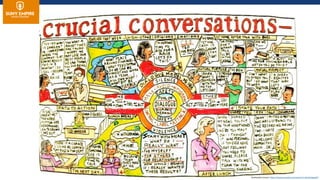
Communicating effectively is not always easy. Communicating well during highly
emotional, high stakes situations is extremely difficult. Drawing from Kerry
Patterson's book Crucial Conversations: Tools for Talking When Stakes Are High, this
session will focus on strategies and tools for managing effect communication skills and
crucial conversations within all aspects of our lives - family/friends, community, and
workplace.
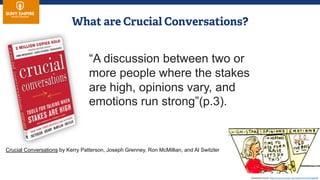
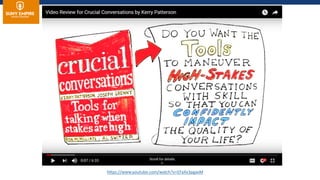
Crucial Conversations by Kerry Patterson, Joseph Grenney, Ron McMillian, and Al Switzler
“A discussion between two or
more people where the stakes
are high, opinions vary, and
emotions run strong”(p.3).
Screenshot source: https://www.youtube.com/watch?v=EFaXx3pgaxM
Crucial Conversations: Past & Future
Think about a recent conversation that could have gone better and
one that might be coming up that you want to go well.
This could be professional or personal situations with your boss,
coworker, direct report, friend, or family member.
A challenging conversation is as difficult for the person
you're speaking with as it is for you.
Go in assuming that you have something to learn.
Don't presume that you know what someone else
thinks or how they feel in a given situation.
Screenshot source: https://www.youtube.com/watch?v=EFaXx3pgaxM
https://www.youtube.com/watch?v=EFaXx3pgaxM
https://brocku.ca/vp-academic/wp-content/uploads/sites/65/Crucial-Conversations-Resources.pdf
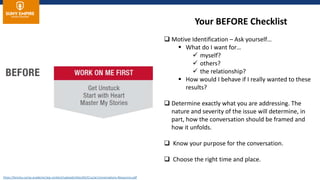
Your BEFORE Checklist
 Motive Identification – Ask yourself…
 What do I want for…
 myself?
 others?
 the relationship?
 How would I behave if I really wanted to these
results?
 Determine exactly what you are addressing. The
nature and severity of the issue will determine, in
part, how the conversation should be framed and
how it unfolds.
 Know your purpose for the conversation.
 Choose the right time and place.
https://brocku.ca/vp-academic/wp-content/uploads/sites/65/Crucial-Conversations-Resources.pdf
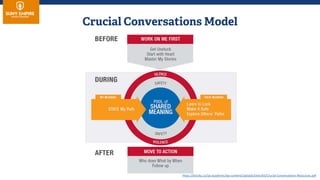
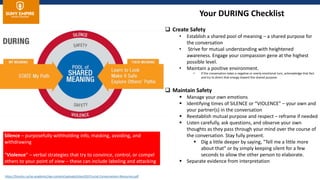
Your DURING Checklist
 Create Safety
• Establish a shared pool of meaning – a shared purpose for
the conversation
• Strive for mutual understanding with heightened
awareness. Engage your compassion gene at the highest
possible level.
• Maintain a positive environment.
• If the conversation takes a negative or overly emotional turn, acknowledge that fact
and try to direct that energy toward the shared purpose.
 Maintain Safety
 Manage your own emotions
 Identifying times of SILENCE or “VIOLENCE” – your own and
your partner(s) in the conversation
 Reestablish mutual purpose and respect – reframe if needed
 Listen carefully, ask questions, and observe your own
thoughts as they pass through your mind over the course of
the conversation. Stay fully present.
 Dig a little deeper by saying, "Tell me a little more
about that" or by simply keeping silent for a few
seconds to allow the other person to elaborate.
 Separate evidence from interpretation
Silence – purposefully withholding info, masking, avoiding, and
withdrawing
“Violence” – verbal strategies that try to convince, control, or compel
others to your point of view – these can include labeling and attacking
https://brocku.ca/vp-academic/wp-content/uploads/sites/65/Crucial-Conversations-Resources.pdf
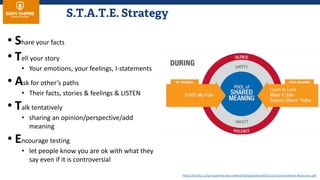
• Share your facts
• Tell your story
• Your emotions, your feelings, I-statements
• Ask for other’s paths
• Their facts, stories & feelings & LISTEN
• Talk tentatively
• sharing an opinion/perspective/add
meaning
• Encourage testing
• let people know you are ok with what they
say even if it is controversial
• Avoid situations or dodging encounters.
• Holding back what's really on your mind or say yes when you mean no just to keep the peace.
• Use sarcasm or jokes.
• Cut people off or change the subject when a conversation doesn't go in the direction you'd like.
• Become competitive and attempt to "win" or be seen as "right" at all cost, making it hard for the other person to express
their views.
• Become defensive and redirect the conversation toward what's "wrong" with someone instead of
dealing with an issue.
• Use sweeping generalizations (e.g., “Everybody agrees…” or "You always ..." or "You never...")
• Hurl personal insults in an attempt to shut another person down.
• Be unwilling to look critically at your own position or behavior and how it's impacting the situation.
• Go silent (or become quietly angry) and justify doing so by concluding that the other person has no clue, will never be
open to your point of view, or isn't smart enough or interested enough to participate in resolving the issue.
https://brocku.ca/vp-academic/wp-content/uploads/sites/65/Crucial-Conversations-Resources.pdf
Assess your Style Under Stress - free of charge on line at www.crucialconversations.com
https://www.lynda.com/Business-tutorials/High-Stakes-Communication/5022324-2.html
https://thepowermoves.com/crucial-conversations-summary/

Effective communication strategies

  • 2.
    Effective Communication Strategies Workshop Communicatingeffectively is not always easy. Communicating well during highly emotional, high stakes situations is extremely difficult. Drawing from Kerry Patterson's book Crucial Conversations: Tools for Talking When Stakes Are High, this session will focus on strategies and tools for managing effect communication skills and crucial conversations within all aspects of our lives - family/friends, community, and workplace.
  • 3.
    Crucial Conversations byKerry Patterson, Joseph Grenney, Ron McMillian, and Al Switzler “A discussion between two or more people where the stakes are high, opinions vary, and emotions run strong”(p.3). Screenshot source: https://www.youtube.com/watch?v=EFaXx3pgaxM
  • 4.
    Crucial Conversations: Past& Future Think about a recent conversation that could have gone better and one that might be coming up that you want to go well. This could be professional or personal situations with your boss, coworker, direct report, friend, or family member.
  • 5.
    A challenging conversationis as difficult for the person you're speaking with as it is for you. Go in assuming that you have something to learn. Don't presume that you know what someone else thinks or how they feel in a given situation.
  • 6.
  • 7.
  • 8.
  • 9.
    https://brocku.ca/vp-academic/wp-content/uploads/sites/65/Crucial-Conversations-Resources.pdf Your BEFORE Checklist Motive Identification – Ask yourself…  What do I want for…  myself?  others?  the relationship?  How would I behave if I really wanted to these results?  Determine exactly what you are addressing. The nature and severity of the issue will determine, in part, how the conversation should be framed and how it unfolds.  Know your purpose for the conversation.  Choose the right time and place.
  • 10.
    https://brocku.ca/vp-academic/wp-content/uploads/sites/65/Crucial-Conversations-Resources.pdf Your DURING Checklist Create Safety • Establish a shared pool of meaning – a shared purpose for the conversation • Strive for mutual understanding with heightened awareness. Engage your compassion gene at the highest possible level. • Maintain a positive environment. • If the conversation takes a negative or overly emotional turn, acknowledge that fact and try to direct that energy toward the shared purpose.  Maintain Safety  Manage your own emotions  Identifying times of SILENCE or “VIOLENCE” – your own and your partner(s) in the conversation  Reestablish mutual purpose and respect – reframe if needed  Listen carefully, ask questions, and observe your own thoughts as they pass through your mind over the course of the conversation. Stay fully present.  Dig a little deeper by saying, "Tell me a little more about that" or by simply keeping silent for a few seconds to allow the other person to elaborate.  Separate evidence from interpretation Silence – purposefully withholding info, masking, avoiding, and withdrawing “Violence” – verbal strategies that try to convince, control, or compel others to your point of view – these can include labeling and attacking
  • 11.
    https://brocku.ca/vp-academic/wp-content/uploads/sites/65/Crucial-Conversations-Resources.pdf • Share yourfacts • Tell your story • Your emotions, your feelings, I-statements • Ask for other’s paths • Their facts, stories & feelings & LISTEN • Talk tentatively • sharing an opinion/perspective/add meaning • Encourage testing • let people know you are ok with what they say even if it is controversial
  • 12.
    • Avoid situationsor dodging encounters. • Holding back what's really on your mind or say yes when you mean no just to keep the peace. • Use sarcasm or jokes. • Cut people off or change the subject when a conversation doesn't go in the direction you'd like. • Become competitive and attempt to "win" or be seen as "right" at all cost, making it hard for the other person to express their views. • Become defensive and redirect the conversation toward what's "wrong" with someone instead of dealing with an issue. • Use sweeping generalizations (e.g., “Everybody agrees…” or "You always ..." or "You never...") • Hurl personal insults in an attempt to shut another person down. • Be unwilling to look critically at your own position or behavior and how it's impacting the situation. • Go silent (or become quietly angry) and justify doing so by concluding that the other person has no clue, will never be open to your point of view, or isn't smart enough or interested enough to participate in resolving the issue.
  • 13.
  • 14.
    Assess your StyleUnder Stress - free of charge on line at www.crucialconversations.com https://www.lynda.com/Business-tutorials/High-Stakes-Communication/5022324-2.html https://thepowermoves.com/crucial-conversations-summary/