Physician Presenter Disclaimer
Products, services, or therapies discussed in this
presentation may be subject to regulatory
approval/clearance and therefore labeling may
change.
Opinions given during this presentation are my
personal, professional opinion.
(Note to physician: Review disclaimer and insert appropriate language and/or
content changes to fit your individual circumstances and address any content
changes.)
[Physician Name]
• [Credentials/Specialty/Title]
• [Practice Name/Hospital]
‒ [Locations]
‒ [Contact Information]
• [Education]
• [Affiliations]
[Physician]
• Specializes in
‒ [Include additional information about your practice]
Prostate Overview
What is the Prostate?1
• Walnut sized gland at base
of male bladder
• Surrounds the urethra
• Produces fluid that
transports sperm during
ejaculation
• Prostate grows to its normal
adult size in a man’s early
20s; it begins to grow again
during the mid-40s
What Can Happen to the Prostate?2
• Enlarged Prostate or Benign Prostatic
Hyperplasia (BPH)
• Prostatitis
• Prostate Cancer
Each condition affects the prostate differently.
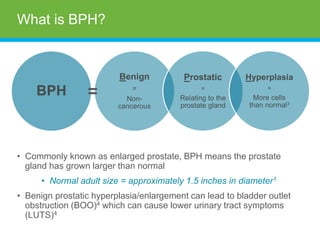
What is BPH?
• Commonly known as enlarged prostate, BPH means the prostate
gland has grown larger than normal
• Normal adult size = approximately 1.5 inches in diameter1
• Benign prostatic hyperplasia/enlargement can lead to bladder outlet
obstruction (BOO)4 which can cause lower urinary tract symptoms
(LUTS)4
BPH
Benign
=
Non-
cancerous
Prostatic
=
Relating to the
prostate gland
Hyperplasia
=
More cells
than normal3
=
Does BPH Mean I Have Prostate Cancer?
BPH’s Relation to Prostate Cancer
• BPH is not prostate cancer5
• BPH does not cause prostate cancer5
• BPH symptoms are similar to those of cancer1
• BPH may co-exist with prostate cancer1
• Prostate-Specific Antigen (PSA) levels alone do not
distinguish BPH from prostate cancer.1 Both BPH and
prostate cancer can cause elevated PSA levels.1
Normal vs. Enlarged Prostate
• As the prostate enlarges,
pressure can be put on the
urethra causing urinary
problems (LUTS)1
• Prostate size does not
correlate with degree of
obstruction or severity of
symptoms.3
Normal Prostate Enlarged Prostate
What are the Symptoms of BPH?1
• Frequent urination during the day and/or night
• Sudden urge to urinate
• Burning, painful urination
• Weak urine flow
• Sensation the bladder is not empty after urination
• Inability to urinate
• Trouble stopping and starting of urine flow
BPH Can Affect Quality of Life
Many men who suffer from BPH may
experience a reduction in quality of life.
• Up to 95% of men with moderate symptoms
are unhappy and don’t want to spend the
rest of their life with these symptoms9
• 51% of men say BPH interferes with one
aspect of their normal life6
• Studies show 49% of men experience
sexual problems associated with LUTS8
• BPH also affects men’s partners quality of
life, daily routines and relationships7
How Does BPH Affect Quality of Life?6
Who Can Get BPH?
• BPH affects 50% of men over 5010
• Affects 40-50% of men ages 51-6011
• Affects 80%+ men over age 8011
• Obesity, higher body mass index (BMI) and lack of
exercise may increase the risk of BPH3
How is an Enlarged Prostate Diagnosed?12
• Medical History
• Physical Exam*
‒ Prostate Exam
• Digital rectal exam (DRE)
‒ Urinary Output Testing
• Peak urinary flow (Qmax) testing
• Post-void urine volume testing
• Self Evaluation of Symptoms
‒ American Urological Association Symptom Index (AUA-SI)
‒ International Prostate Symptom Score (IPSS)
‒ Quality of Life (QoL) Questions
‒ Bladder Impact Index (BII)
*Additional testing is optional and may be done at physician’s discretion and/or depending on patient symptoms
Treatment Options
Treatment Options Overview
WATCHFUL WAITING/
MEDICAL THERAPIES
MINIMALLY INVASIVE
SURGERY
INVASIVE
SURGERY
Alpha Blockers
5 Alpha-Reductase
Inhibitors
Microwave Therapy
(TUMT)
Laser
TURP
(Monopolar, Bipolar,
Button)
Open Prostatectomy
Complementary and Alternative Medicines
American Urological Association (AUA)
Recommendation
• No dietary supplement, combination phytotherapeutic agent, or other
nonconventional therapy is recommended for the management of LUTS
secondary to BPH. This includes saw palmetto and urtica dioica.12
Treatment Options
• Characteristics12
‒ Best for men with mild symptoms
‒ Consists of yearly exams and no active intervention
‒ No surgery
‒ No drugs
‒ May involve lifestyle modification such as adjusting diet, evening fluid
intake, medication use and exercise patterns
• Side Effects
‒ Symptoms may worsen or remain unchanged without lifestyle modification1
Watchful Waiting/Medical Therapies
Treatment Options
Characteristics
• Intended for men with mild to
severe symptoms12
• Provides relief of BPH
symptoms13*
• Works almost immediately1
• Proactive form of treatment14
*when daily dosages are taken as directed
Medication
Alpha-Blockers1
Side Effects**
• May experience drop in blood
pressure13
• Dizziness and/or fainting13
• Fatigue13
• Nasal Congestion13
• Abnormal ejaculation14
• Can have drug interactions with
other medications1
**Side effects to ≥ 2%
Treatment Options
Medication
5-Alpha Reductase Inhibitors1
Characteristics
• Intended for men with
demonstrable prostatic
enlargement12,13
• Reduces the risk of the need for
surgery1,12,13
• Relives the symptoms of BPH12,13
*when daily dosages are taken as directed
Side Effects
• Erectile dysfunction
(ED)/Impotence13**
• Lowered sexual drive/libido13**
• Ejaculation disorders13**
• Lowers PSA levels up to 50%;
can interfere with prostate
cancer detection.1
**Side effects ≥ to 2%
Treatment Options
Characteristics
• Intended for men with moderate
to severe symptoms12
• Non surgical procedure12
• Outpatient capability12
• Lack of sexual side-effects12
• Performed with local anesthetic1
Side Effects
• Average catheterization time:
between 2 and 14 days1
• Urinary retention and
incontinence1
• Urinary Tract Infections1
• May require retreatment1
• Slow improvement of
symptoms15
Minimally Invasive Therapy
Transurethral Microwave Therapy (TUMT)
Involves the use of a microwave antennae mounted on a urethral catheter to heat the prostate.
Treatment Options
Characteristics12
• Intended for men with moderate to severe
symptoms
• Performed under general or spinal
anesthesia
• Typically requires post-operative
hospitalization ≥ 2 days1
• Post-void residual
• Improved Quality of Life scores
• Provides symptoms relief
• Demonstrated improved Qmax (volume of
urine per sec)
• Demonstrated improved prostate volume
Side Effects
• TUR Syndrome12
• Sexual problems/ED1
• Urinary retention1
• Urethral strictures1
• Prolonged catheterization1
• Bladder neck contracture12
• Retrograde ejaculation1
• Bleeding requiring transfusion12
Minimally Invasive Surgery
TURP
Uses electricity to superheat a thin metal band that cuts the prostate tissue into small chunks.
Treatment Options
Characteristics
• Intended for men with BPH14
• Typically done in an outpatient
setting16
• Provides sustainable symptom relief17
• Rapid urine flow improvement after
the procedure17
• Minimal blood loss1
Side Effects
• Retrograde ejaculation17
• Urgency/frequency16
• Dysuria14
• Hematuria/blood in the urine16
• Urinary Retention16
Minimally Invasive Surgery
Laser Therapy
Uses a laser to vaporize away the prostate tissue.
Treatment Options
Characteristics12
• Typically is performed on patients with
larger prostate volumes (>80 - 100 mL)
• Effective for men with:
• Very enlarged prostate glands
• Bladder diverticula (pockets)
• Stones
Side Effects12
• Associated with a longer hospital
stay
• Risk of blood loss, transfusion
significantly greater than with
transurethral procedures
Invasive Surgery
Involves surgical removal of the inner portion of the prostate via a suprapubic or retropubic
incision in the lower abdominal area.
Open Prostatectomy
Insurance Coverage
• It is the responsibility of the
patient to contact their insurance
provider for specific coverage
information.
In Summary
• What is the prostate and how does it work?
• Enlarged prostate = BPH
• Treatment Options
‒ Watchful Waiting/Medical Therapy
• Minimally Invasive Surgical Therapy
• Heat Therapy
• TURP
• Laser Therapy
• Surgical Therapy
• Open Prostatectomy
Next Steps
• Consultation with your Urologist is
required to determine what
therapy option is the best
treatment option for you.
References
1. Carter HB. Prostate Disorders: the Johns Hopkins White Papers. Baltimore, MD: Johns Hopkins Medicine; 2010: 1, 3.
2. Kidney and Urinary System Disorders-Prostate Disease.
http://www.hopkinsmedicine.org/healthlibrary/conditions/adult/kidney_and_urinary_system_disorders/prostate_disease_85,P01492. Accessed
6/14/12.
3. Roehrborn, C. Benign Prostatic Hyperplasia: Etiology, Pathophysiology, Epidemiology, and Natural History. Campbell-Walsh Urology Tenth
Edition. Philadelphia, PA: Saunders, an Imprint of Elsevier, Inc.; 2012;91:2579.
4. Kirby, R., Gilling, P. Fast Facts: Benign Prostatic Hyperplasia, Sixth Edition. United Kingdom: Health Press; 2010:14, 16, 19. 5
5. Clinical Practice Guideline-Treating Your Enlarged Prostate. U.S. Department of Health and Human Services. Rockville, MD: Agency for Health
Care Policy and Research (AHCPR) Publication No. 943-0584. February 1994; Number 8:1.
6. Garraway, WM, McKelvie, GB, Russell, EBAW, Hehir, M., Lee, R., Rogers ACN, et. Al. Impact of previously unrecognized benign prostatic
hyperplasia on the daily activities of middle-aged and elderly men. British Journal of General Practice. 1993:43:318.
7. Shvartzman, P., Borkan, J., Stoliar, L., Peleg, A., Nakar, S., Nir, G., et. A. Second-hand prostatism: effects of prostatic volumes in spouses’ quality
of life, daily routines and family relationships. Family Practice. 2001;18-6:610-612.
8. Rosen, R., Update on the relationship between sexual dysfunction and lower urinary tract symptoms/benign prostatic hyperplasia. Current Opinion
in Urology. 2006; 16:11-12,15.
9. Bertaccini, A., Vassallo, F., Martino, F., Luzzi, L., Rossetti, S., Di Silverio, F., et. Al. Symptoms, bothersomeness and quality of life in patients with
LUTS suggestive of BPH. Eur Urol. 2001;40 (Suppl 1):16.
10. Berry, S, Coffey, D, Walsh, P, Ewing, J, The Development of Human Benign Prostatic Hyperplasia with Age. Journal of Urology 1984; 132:1-6.
11. http://kidney.niddk.nih.gov/KUDiseases/pubs/kustats/index.aspx. Accessed 6/13/12.
12. American Urological Association Education Research, Inc. American Urological Association Guideline: Management of Benign Prostatic
Hyperplasia (BPH), Revised, 2010:Appendix 280, 283-285.
13. Cambio, AJ, Evans, CP. Outcomes and quality of life issues in the pharmacological management of benign prostatic hyperplasia (BPH). Ther Clin
Risk Manag. March 2007;3-1:193.
14. Wojcik, M., Dennison, D. Home Study Program-Photoselective vaporization of the prostate in ambulatory surgery. AORN Journal. February
2006;83-2:332.
15. Johns Hopkins Health Alert, Prostate on BPH Treatment Options: Special Report, Minimally Invasive Treatments for BPH (Benign Prostatic
Hyperplasia) http://www.johnshopkinshealthalerts.com/reports/prostate_disorders/140-1.html Accessed 01/31/14.
16. Te, A., Malloy, Stein, B., Ulchaker, J., Nseyo, U., Hai, M., Malek, R. Photoselective Vaporization of the Prostate for the Treatment of Benign
Prostatic Hyperplasia: 12-Month Results from the First United States Multicenter Prospective Trial. The Journal of Urology. 2004;172:1406.
17. Sarica, K., Alkan, E., Luleci, H., Tasci, A. Photoselective Vaporization of the Enlarged Prostate with KTP Laser: Long-Term Results in 240
Patients. Journal of Endourology. 2005;19-10:1200-1201.
© 2014 American Medical Systems, Inc. (“AMS”).
The grant of permission to use AMS’s copyrighted material does not constitute
endorsement by AMS of any persons, products, services or organizations.
BPH-00977(2)b/March 2014
Thank You

BPH

  • 2.
    Physician Presenter Disclaimer Products,services, or therapies discussed in this presentation may be subject to regulatory approval/clearance and therefore labeling may change. Opinions given during this presentation are my personal, professional opinion. (Note to physician: Review disclaimer and insert appropriate language and/or content changes to fit your individual circumstances and address any content changes.)
  • 3.
    [Physician Name] • [Credentials/Specialty/Title] •[Practice Name/Hospital] ‒ [Locations] ‒ [Contact Information] • [Education] • [Affiliations]
  • 4.
    [Physician] • Specializes in ‒[Include additional information about your practice]
  • 5.
  • 6.
    What is theProstate?1 • Walnut sized gland at base of male bladder • Surrounds the urethra • Produces fluid that transports sperm during ejaculation • Prostate grows to its normal adult size in a man’s early 20s; it begins to grow again during the mid-40s
  • 7.
    What Can Happento the Prostate?2 • Enlarged Prostate or Benign Prostatic Hyperplasia (BPH) • Prostatitis • Prostate Cancer Each condition affects the prostate differently.
  • 8.
    What is BPH? •Commonly known as enlarged prostate, BPH means the prostate gland has grown larger than normal • Normal adult size = approximately 1.5 inches in diameter1 • Benign prostatic hyperplasia/enlargement can lead to bladder outlet obstruction (BOO)4 which can cause lower urinary tract symptoms (LUTS)4 BPH Benign = Non- cancerous Prostatic = Relating to the prostate gland Hyperplasia = More cells than normal3 =
  • 9.
    Does BPH MeanI Have Prostate Cancer? BPH’s Relation to Prostate Cancer • BPH is not prostate cancer5 • BPH does not cause prostate cancer5 • BPH symptoms are similar to those of cancer1 • BPH may co-exist with prostate cancer1 • Prostate-Specific Antigen (PSA) levels alone do not distinguish BPH from prostate cancer.1 Both BPH and prostate cancer can cause elevated PSA levels.1
  • 10.
    Normal vs. EnlargedProstate • As the prostate enlarges, pressure can be put on the urethra causing urinary problems (LUTS)1 • Prostate size does not correlate with degree of obstruction or severity of symptoms.3 Normal Prostate Enlarged Prostate
  • 11.
    What are theSymptoms of BPH?1 • Frequent urination during the day and/or night • Sudden urge to urinate • Burning, painful urination • Weak urine flow • Sensation the bladder is not empty after urination • Inability to urinate • Trouble stopping and starting of urine flow
  • 12.
    BPH Can AffectQuality of Life Many men who suffer from BPH may experience a reduction in quality of life. • Up to 95% of men with moderate symptoms are unhappy and don’t want to spend the rest of their life with these symptoms9 • 51% of men say BPH interferes with one aspect of their normal life6 • Studies show 49% of men experience sexual problems associated with LUTS8 • BPH also affects men’s partners quality of life, daily routines and relationships7
  • 13.
    How Does BPHAffect Quality of Life?6
  • 14.
    Who Can GetBPH? • BPH affects 50% of men over 5010 • Affects 40-50% of men ages 51-6011 • Affects 80%+ men over age 8011 • Obesity, higher body mass index (BMI) and lack of exercise may increase the risk of BPH3
  • 15.
    How is anEnlarged Prostate Diagnosed?12 • Medical History • Physical Exam* ‒ Prostate Exam • Digital rectal exam (DRE) ‒ Urinary Output Testing • Peak urinary flow (Qmax) testing • Post-void urine volume testing • Self Evaluation of Symptoms ‒ American Urological Association Symptom Index (AUA-SI) ‒ International Prostate Symptom Score (IPSS) ‒ Quality of Life (QoL) Questions ‒ Bladder Impact Index (BII) *Additional testing is optional and may be done at physician’s discretion and/or depending on patient symptoms
  • 16.
  • 17.
    Treatment Options Overview WATCHFULWAITING/ MEDICAL THERAPIES MINIMALLY INVASIVE SURGERY INVASIVE SURGERY Alpha Blockers 5 Alpha-Reductase Inhibitors Microwave Therapy (TUMT) Laser TURP (Monopolar, Bipolar, Button) Open Prostatectomy
  • 18.
    Complementary and AlternativeMedicines American Urological Association (AUA) Recommendation • No dietary supplement, combination phytotherapeutic agent, or other nonconventional therapy is recommended for the management of LUTS secondary to BPH. This includes saw palmetto and urtica dioica.12
  • 19.
    Treatment Options • Characteristics12 ‒Best for men with mild symptoms ‒ Consists of yearly exams and no active intervention ‒ No surgery ‒ No drugs ‒ May involve lifestyle modification such as adjusting diet, evening fluid intake, medication use and exercise patterns • Side Effects ‒ Symptoms may worsen or remain unchanged without lifestyle modification1 Watchful Waiting/Medical Therapies
  • 20.
    Treatment Options Characteristics • Intendedfor men with mild to severe symptoms12 • Provides relief of BPH symptoms13* • Works almost immediately1 • Proactive form of treatment14 *when daily dosages are taken as directed Medication Alpha-Blockers1 Side Effects** • May experience drop in blood pressure13 • Dizziness and/or fainting13 • Fatigue13 • Nasal Congestion13 • Abnormal ejaculation14 • Can have drug interactions with other medications1 **Side effects to ≥ 2%
  • 21.
    Treatment Options Medication 5-Alpha ReductaseInhibitors1 Characteristics • Intended for men with demonstrable prostatic enlargement12,13 • Reduces the risk of the need for surgery1,12,13 • Relives the symptoms of BPH12,13 *when daily dosages are taken as directed Side Effects • Erectile dysfunction (ED)/Impotence13** • Lowered sexual drive/libido13** • Ejaculation disorders13** • Lowers PSA levels up to 50%; can interfere with prostate cancer detection.1 **Side effects ≥ to 2%
  • 22.
    Treatment Options Characteristics • Intendedfor men with moderate to severe symptoms12 • Non surgical procedure12 • Outpatient capability12 • Lack of sexual side-effects12 • Performed with local anesthetic1 Side Effects • Average catheterization time: between 2 and 14 days1 • Urinary retention and incontinence1 • Urinary Tract Infections1 • May require retreatment1 • Slow improvement of symptoms15 Minimally Invasive Therapy Transurethral Microwave Therapy (TUMT) Involves the use of a microwave antennae mounted on a urethral catheter to heat the prostate.
  • 23.
    Treatment Options Characteristics12 • Intendedfor men with moderate to severe symptoms • Performed under general or spinal anesthesia • Typically requires post-operative hospitalization ≥ 2 days1 • Post-void residual • Improved Quality of Life scores • Provides symptoms relief • Demonstrated improved Qmax (volume of urine per sec) • Demonstrated improved prostate volume Side Effects • TUR Syndrome12 • Sexual problems/ED1 • Urinary retention1 • Urethral strictures1 • Prolonged catheterization1 • Bladder neck contracture12 • Retrograde ejaculation1 • Bleeding requiring transfusion12 Minimally Invasive Surgery TURP Uses electricity to superheat a thin metal band that cuts the prostate tissue into small chunks.
  • 24.
    Treatment Options Characteristics • Intendedfor men with BPH14 • Typically done in an outpatient setting16 • Provides sustainable symptom relief17 • Rapid urine flow improvement after the procedure17 • Minimal blood loss1 Side Effects • Retrograde ejaculation17 • Urgency/frequency16 • Dysuria14 • Hematuria/blood in the urine16 • Urinary Retention16 Minimally Invasive Surgery Laser Therapy Uses a laser to vaporize away the prostate tissue.
  • 25.
    Treatment Options Characteristics12 • Typicallyis performed on patients with larger prostate volumes (>80 - 100 mL) • Effective for men with: • Very enlarged prostate glands • Bladder diverticula (pockets) • Stones Side Effects12 • Associated with a longer hospital stay • Risk of blood loss, transfusion significantly greater than with transurethral procedures Invasive Surgery Involves surgical removal of the inner portion of the prostate via a suprapubic or retropubic incision in the lower abdominal area. Open Prostatectomy
  • 26.
    Insurance Coverage • Itis the responsibility of the patient to contact their insurance provider for specific coverage information.
  • 27.
    In Summary • Whatis the prostate and how does it work? • Enlarged prostate = BPH • Treatment Options ‒ Watchful Waiting/Medical Therapy • Minimally Invasive Surgical Therapy • Heat Therapy • TURP • Laser Therapy • Surgical Therapy • Open Prostatectomy
  • 28.
    Next Steps • Consultationwith your Urologist is required to determine what therapy option is the best treatment option for you.
  • 29.
    References 1. Carter HB.Prostate Disorders: the Johns Hopkins White Papers. Baltimore, MD: Johns Hopkins Medicine; 2010: 1, 3. 2. Kidney and Urinary System Disorders-Prostate Disease. http://www.hopkinsmedicine.org/healthlibrary/conditions/adult/kidney_and_urinary_system_disorders/prostate_disease_85,P01492. Accessed 6/14/12. 3. Roehrborn, C. Benign Prostatic Hyperplasia: Etiology, Pathophysiology, Epidemiology, and Natural History. Campbell-Walsh Urology Tenth Edition. Philadelphia, PA: Saunders, an Imprint of Elsevier, Inc.; 2012;91:2579. 4. Kirby, R., Gilling, P. Fast Facts: Benign Prostatic Hyperplasia, Sixth Edition. United Kingdom: Health Press; 2010:14, 16, 19. 5 5. Clinical Practice Guideline-Treating Your Enlarged Prostate. U.S. Department of Health and Human Services. Rockville, MD: Agency for Health Care Policy and Research (AHCPR) Publication No. 943-0584. February 1994; Number 8:1. 6. Garraway, WM, McKelvie, GB, Russell, EBAW, Hehir, M., Lee, R., Rogers ACN, et. Al. Impact of previously unrecognized benign prostatic hyperplasia on the daily activities of middle-aged and elderly men. British Journal of General Practice. 1993:43:318. 7. Shvartzman, P., Borkan, J., Stoliar, L., Peleg, A., Nakar, S., Nir, G., et. A. Second-hand prostatism: effects of prostatic volumes in spouses’ quality of life, daily routines and family relationships. Family Practice. 2001;18-6:610-612. 8. Rosen, R., Update on the relationship between sexual dysfunction and lower urinary tract symptoms/benign prostatic hyperplasia. Current Opinion in Urology. 2006; 16:11-12,15. 9. Bertaccini, A., Vassallo, F., Martino, F., Luzzi, L., Rossetti, S., Di Silverio, F., et. Al. Symptoms, bothersomeness and quality of life in patients with LUTS suggestive of BPH. Eur Urol. 2001;40 (Suppl 1):16. 10. Berry, S, Coffey, D, Walsh, P, Ewing, J, The Development of Human Benign Prostatic Hyperplasia with Age. Journal of Urology 1984; 132:1-6. 11. http://kidney.niddk.nih.gov/KUDiseases/pubs/kustats/index.aspx. Accessed 6/13/12. 12. American Urological Association Education Research, Inc. American Urological Association Guideline: Management of Benign Prostatic Hyperplasia (BPH), Revised, 2010:Appendix 280, 283-285. 13. Cambio, AJ, Evans, CP. Outcomes and quality of life issues in the pharmacological management of benign prostatic hyperplasia (BPH). Ther Clin Risk Manag. March 2007;3-1:193. 14. Wojcik, M., Dennison, D. Home Study Program-Photoselective vaporization of the prostate in ambulatory surgery. AORN Journal. February 2006;83-2:332. 15. Johns Hopkins Health Alert, Prostate on BPH Treatment Options: Special Report, Minimally Invasive Treatments for BPH (Benign Prostatic Hyperplasia) http://www.johnshopkinshealthalerts.com/reports/prostate_disorders/140-1.html Accessed 01/31/14. 16. Te, A., Malloy, Stein, B., Ulchaker, J., Nseyo, U., Hai, M., Malek, R. Photoselective Vaporization of the Prostate for the Treatment of Benign Prostatic Hyperplasia: 12-Month Results from the First United States Multicenter Prospective Trial. The Journal of Urology. 2004;172:1406. 17. Sarica, K., Alkan, E., Luleci, H., Tasci, A. Photoselective Vaporization of the Enlarged Prostate with KTP Laser: Long-Term Results in 240 Patients. Journal of Endourology. 2005;19-10:1200-1201. © 2014 American Medical Systems, Inc. (“AMS”). The grant of permission to use AMS’s copyrighted material does not constitute endorsement by AMS of any persons, products, services or organizations. BPH-00977(2)b/March 2014
  • 30.