Urine retention
Lecture-9
By Dr-C
definition
• Inability to pass urine voluntarily.
• There are multiple causes for urine retention.
Acute retention
• Acute urinary retention (AUR) is the sudden inability to
pass urine. It is usually painful
Chronic retention
• Non painful bladder that remains palpable after voiding
• inability to completely empty the bladder despite
maintaining an ability to urinate, which results in
elevated postvoidal residual (PVR) urine volumes
Causes of Urine retention
• Obstructive
• Infectious and inflammatory
• Drug induced
• neurological
• Other causes.
Obstructive causes common to men
• Benign prostatic hyperplasia;
• meatal stenosis;
• paraphimosis;
• penile constricting bands;
• phimosis;
• prostate cancer
Obstructive causes of Urine retention common
to females.
• Organ prolapse (cystocele, rectocele, uterine prolapse);
• pelvic mass (gynecologic malignancy, uterine fibroid,
ovarian cyst);
• Retroverted gravid uterus
Obstructive causes common to both genders
• Aneurysmal dilation;
• bladder calculi;
• bladder neoplasm;
• fecal impaction;
• gastrointestinal or
retroperitoneal
malignancy/mass;
• urethral strictures,
• foreign bodies,
• stones,
• edema
Infectious and inflammatory
Men
• Balanitis;
• prostatic abscess;
• prostatitis
Women
• Acute vulvovaginitis;
• vaginal lichen planus;
• vaginal lichen sclerosis;
• vaginal pemphigus
Infectious and inflammatory-both genders
• cystitis;
• echinococcosis;
• Guillain-Barré syndrome;
• herpes simplex virus;
• Lyme disease;
• periurethral abscess;
• transverses myelitis;
• tubercular cystitis;
• urethritis;
• varicella-zoster virus
• Schistosomiasis
Drug induced-(both acute and chronic
retention) 10%AUR drugs related
• Anticholinergics (eg, antipsychotic
drugs, antidepressant agents,
anticholinergic respiratory agents).
• Opioids and anaesthetics.
• Alpha-adrenoceptor agonists.
• Benzodiazepines.
• Non-steroidal anti-inflammatory drugs.
• Detrusor relaxants.
• Calcium-channel blockers.
• Antihistamines.
• Alcohol.
Neurological
• More often causing chronic retention but may cause AUR:
• Autonomic or peripheral nerve (eg, autonomic neuropathy, diabetes
mellitus, Guillain-Barré syndrome, pernicious anaemia, poliomyelitis,
radical pelvic surgery, spinal cord trauma, tabes dorsalis).
• Brain (eg, cardiovascular disease (CVD), multiple sclerosis (MS),
neoplasm, normal pressure hydrocephalus, Parkinson's disease).
• Spinal cord (eg, invertebral disc disease, meningomyelocele, MS, spina
bifida occulta, spinal cord haematoma or abscess, spinal cord trauma,
spinal stenosis, spinovascular disease, transverse myelitis, tumours, cauda
equina).
Other causes
• In men - penile trauma, fracture or laceration.
• In women - postpartum complications (increased risk
with instrumental delivery, prolonged labour and
caesarean section);[2]urethral sphincter dysfunction
(Fowler's syndrome).
• In both - pelvic trauma, iatrogenic, psychogenic.
Features of acute retention
• Pain in abdomen
• History of inability to pass urine
• Distended bladder on palpation
BPH one of the common causes of urine
retention
• lower urinary tract voiding symptoms, including
frequency, urgency, nocturia, straining to void,
weak urinary stream, hesitancy, sensation of
incomplete bladder emptying, and stopping and
starting of urinary stream(LUTS)
BPH
• Usually causes a chronic retention but usually these
people comes to the attention when they get an Acute on
Chronic retention
• Otherwise these people most of the time unaware about
the LUTS which are due to the BPH
History taking. Pay attention about….
• Course of development including onset and progression.
• Have you any fever?
• Any previous episodes? Any history of BPH?
• LUTS?
• Past medical history, neurological disease, other medical
conditions.
• Take the drug history.
• Ask about alcohol, constipation, long travel, low fluid intake, high
fluid intakes.
Examination
• Is the patient warm?-fever
• Abdominal - a tender enlarged bladder with dullness to percussion well above the
symphysis pubis, often almost to the level of the umbilicus.
• Look for phymosis, meatal stenosis and look for signs of infections in genitalia.
• In females- look for cystoceles, rectoceles, UV prolapsy, do a Vaginal examination
and look for pelvic mases. Look for vulval infections and inflammations, gravid
uterus obvious thing.
• Do a DRE/PR examination in males. Look for enlarged prostate.
• Do a neurological examination to detect neurogenic bladder.
Blood tests:
•FBC.
•U&E, creatinine, estimated glomerular filtration rate
(eGFR).
•Blood glucose.
•Prostate-specific antigen (PSA).
NB: this is elevated in the setting of AUR so is of
limited use at this stage.
Imaging studies.
• Ultrasound - commonly used, as it can provide a measure of post-void
residual urine as well as looking for hydronephrosis and other
structural abnormalities of the renal system.
• CT scan-exclude intra abdominal masses.
• MRI/CT brain scan-exclude Space occupying lesions in brain.
• MRI scan of the spine - used to look for disc prolapse, cauda equina
syndrome, spinal tumours, spinal cord compression, MS.
• cystoscopy, retrograde cystourethrography or urodynamic studies
management
• Acute urine retention should be managed immediately.
• Decompression by a suitable catheter.
• If possible, the use of chronic urethral indwelling catheters should be avoided
• If the initial cauterization attempts are failed call a doctor familiar with advanced
catheterization techniques.-angulated Coude catheter or a suprapubic catheter
• For people with BPH the duration of the cauterization yet remain under investigations
and studies. For an example while the author was a intern doctor catheterization for
AUR done and the catheter kept in for 2 weeks with an alpha blocker like tamsulosin.
• If the prostate Is palpable in a PR/DRE finesteride can be started with tamsulosin.
• neurogenic bladder related urine retention should be managed with clean
intermittent self catheterization.
Few useful comments by American association
of family physicians.
• In a patient with a AUR due to BPH start a alfablocker at the time of catheterization.
• Men with urinary retention from benign prostatic hyperplasia should undergo at least one
trial of voiding without catheter before surgical intervention is considered
• Prevention of acute urinary retention in men with benign prostatic hyperplasia may be
achieved by long-term treatment with 5-alpha reductase inhibitors.ex-finesteride.
• Silver alloy-impregnated urethral catheters reduce the incidence of urinary tract infections in
hospitalized patients requiring catheterization for up to 14 days.
• Suprapubic catheters improve patient comfort and decrease bacteriuria and recatheterization
in patients requiring catheterization for up to 14 days.
• Low-friction, hydrophilic-coated catheters increased patient satisfaction and decreased
urinary tract infection and hematuria in patients with neurogenic bladder who practice clean,
intermittent self-catheterization.
As the management have a major role with
catheterization knowledge about catheterization is
vital.
• Do not harm!-direction or the order for catheterization always should taken by a
qualified doctor.
• DON’T ALLOW ANYONE TO CATHERIZE A PATIENT IF HE/SHE HAS NO
KNOWLEDGE ABOUT GENITAL ANATOMY AND URINARY TRACTS. (you are the
doctor don’t be hesitate to lead or do whatever the procedure you have the skill to
do when there is a good indication. You are the major role in hospital.)
• SELF CATHERIZATION-patients obviously need a training.
• Difficult catheterization? Take senior opinion, A Surgeon, a senior medical officer
who has a practice with advancer urinary catheter techniques.
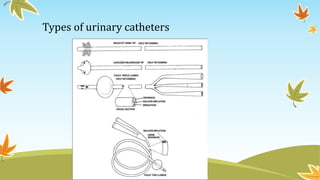
Types of urinary catheters
Be familiar about the Gauge of the catheters.
Contra indications for catheterization.
• Urethral trauma
• Patients with pelvic fractures.
• Blood at meatus.
• DRE-high riding prostate.
• Scrotal haematoma.
TWOC-trial without catheter
• Consider for people who is especially presented with BPH.
• It is done to confirm the patients ability to pass urine him self without difficulty.
• In a TWOC patient can send home without catheter or some times re
catheterization is needed.
• A supra pubic catheter will be clamped before the procedure.
• Procedure takes 4-6 hours.
• Cather will be removed some water will be provided to drink. you will be asked to
urinate when you have a urge.
• Then a doctor will be perform a USS to confirm postvoidal urine volumes in
bladder.
TWOC
• The trial is successful if you pass urine by 4-6 hours and
have less than 150ml urine left behind in the bladder. You
can then go home.
• Take 1-2 liters of fluids when you go home for a day.
• Urinate every 4-5 hours.
• Keep patients informed who has indwelling
catheters about care, possible complications like
UTIs.
• Read more about the catheter care.
Thank you

Urine Retention

  • 1.
  • 2.
    definition • Inability topass urine voluntarily. • There are multiple causes for urine retention.
  • 3.
    Acute retention • Acuteurinary retention (AUR) is the sudden inability to pass urine. It is usually painful
  • 4.
    Chronic retention • Nonpainful bladder that remains palpable after voiding • inability to completely empty the bladder despite maintaining an ability to urinate, which results in elevated postvoidal residual (PVR) urine volumes
  • 5.
    Causes of Urineretention • Obstructive • Infectious and inflammatory • Drug induced • neurological • Other causes.
  • 6.
    Obstructive causes commonto men • Benign prostatic hyperplasia; • meatal stenosis; • paraphimosis; • penile constricting bands; • phimosis; • prostate cancer
  • 7.
    Obstructive causes ofUrine retention common to females. • Organ prolapse (cystocele, rectocele, uterine prolapse); • pelvic mass (gynecologic malignancy, uterine fibroid, ovarian cyst); • Retroverted gravid uterus
  • 8.
    Obstructive causes commonto both genders • Aneurysmal dilation; • bladder calculi; • bladder neoplasm; • fecal impaction; • gastrointestinal or retroperitoneal malignancy/mass; • urethral strictures, • foreign bodies, • stones, • edema
  • 9.
    Infectious and inflammatory Men •Balanitis; • prostatic abscess; • prostatitis Women • Acute vulvovaginitis; • vaginal lichen planus; • vaginal lichen sclerosis; • vaginal pemphigus
  • 10.
    Infectious and inflammatory-bothgenders • cystitis; • echinococcosis; • Guillain-Barré syndrome; • herpes simplex virus; • Lyme disease; • periurethral abscess; • transverses myelitis; • tubercular cystitis; • urethritis; • varicella-zoster virus • Schistosomiasis
  • 11.
    Drug induced-(both acuteand chronic retention) 10%AUR drugs related • Anticholinergics (eg, antipsychotic drugs, antidepressant agents, anticholinergic respiratory agents). • Opioids and anaesthetics. • Alpha-adrenoceptor agonists. • Benzodiazepines. • Non-steroidal anti-inflammatory drugs. • Detrusor relaxants. • Calcium-channel blockers. • Antihistamines. • Alcohol.
  • 12.
    Neurological • More oftencausing chronic retention but may cause AUR: • Autonomic or peripheral nerve (eg, autonomic neuropathy, diabetes mellitus, Guillain-Barré syndrome, pernicious anaemia, poliomyelitis, radical pelvic surgery, spinal cord trauma, tabes dorsalis). • Brain (eg, cardiovascular disease (CVD), multiple sclerosis (MS), neoplasm, normal pressure hydrocephalus, Parkinson's disease). • Spinal cord (eg, invertebral disc disease, meningomyelocele, MS, spina bifida occulta, spinal cord haematoma or abscess, spinal cord trauma, spinal stenosis, spinovascular disease, transverse myelitis, tumours, cauda equina).
  • 13.
    Other causes • Inmen - penile trauma, fracture or laceration. • In women - postpartum complications (increased risk with instrumental delivery, prolonged labour and caesarean section);[2]urethral sphincter dysfunction (Fowler's syndrome). • In both - pelvic trauma, iatrogenic, psychogenic.
  • 14.
    Features of acuteretention • Pain in abdomen • History of inability to pass urine • Distended bladder on palpation
  • 15.
    BPH one ofthe common causes of urine retention • lower urinary tract voiding symptoms, including frequency, urgency, nocturia, straining to void, weak urinary stream, hesitancy, sensation of incomplete bladder emptying, and stopping and starting of urinary stream(LUTS)
  • 16.
    BPH • Usually causesa chronic retention but usually these people comes to the attention when they get an Acute on Chronic retention • Otherwise these people most of the time unaware about the LUTS which are due to the BPH
  • 17.
    History taking. Payattention about…. • Course of development including onset and progression. • Have you any fever? • Any previous episodes? Any history of BPH? • LUTS? • Past medical history, neurological disease, other medical conditions. • Take the drug history. • Ask about alcohol, constipation, long travel, low fluid intake, high fluid intakes.
  • 18.
    Examination • Is thepatient warm?-fever • Abdominal - a tender enlarged bladder with dullness to percussion well above the symphysis pubis, often almost to the level of the umbilicus. • Look for phymosis, meatal stenosis and look for signs of infections in genitalia. • In females- look for cystoceles, rectoceles, UV prolapsy, do a Vaginal examination and look for pelvic mases. Look for vulval infections and inflammations, gravid uterus obvious thing. • Do a DRE/PR examination in males. Look for enlarged prostate. • Do a neurological examination to detect neurogenic bladder.
  • 19.
    Blood tests: •FBC. •U&E, creatinine,estimated glomerular filtration rate (eGFR). •Blood glucose. •Prostate-specific antigen (PSA). NB: this is elevated in the setting of AUR so is of limited use at this stage.
  • 20.
    Imaging studies. • Ultrasound- commonly used, as it can provide a measure of post-void residual urine as well as looking for hydronephrosis and other structural abnormalities of the renal system. • CT scan-exclude intra abdominal masses. • MRI/CT brain scan-exclude Space occupying lesions in brain. • MRI scan of the spine - used to look for disc prolapse, cauda equina syndrome, spinal tumours, spinal cord compression, MS. • cystoscopy, retrograde cystourethrography or urodynamic studies
  • 21.
    management • Acute urineretention should be managed immediately. • Decompression by a suitable catheter. • If possible, the use of chronic urethral indwelling catheters should be avoided • If the initial cauterization attempts are failed call a doctor familiar with advanced catheterization techniques.-angulated Coude catheter or a suprapubic catheter • For people with BPH the duration of the cauterization yet remain under investigations and studies. For an example while the author was a intern doctor catheterization for AUR done and the catheter kept in for 2 weeks with an alpha blocker like tamsulosin. • If the prostate Is palpable in a PR/DRE finesteride can be started with tamsulosin. • neurogenic bladder related urine retention should be managed with clean intermittent self catheterization.
  • 22.
    Few useful commentsby American association of family physicians. • In a patient with a AUR due to BPH start a alfablocker at the time of catheterization. • Men with urinary retention from benign prostatic hyperplasia should undergo at least one trial of voiding without catheter before surgical intervention is considered • Prevention of acute urinary retention in men with benign prostatic hyperplasia may be achieved by long-term treatment with 5-alpha reductase inhibitors.ex-finesteride. • Silver alloy-impregnated urethral catheters reduce the incidence of urinary tract infections in hospitalized patients requiring catheterization for up to 14 days. • Suprapubic catheters improve patient comfort and decrease bacteriuria and recatheterization in patients requiring catheterization for up to 14 days. • Low-friction, hydrophilic-coated catheters increased patient satisfaction and decreased urinary tract infection and hematuria in patients with neurogenic bladder who practice clean, intermittent self-catheterization.
  • 23.
    As the managementhave a major role with catheterization knowledge about catheterization is vital. • Do not harm!-direction or the order for catheterization always should taken by a qualified doctor. • DON’T ALLOW ANYONE TO CATHERIZE A PATIENT IF HE/SHE HAS NO KNOWLEDGE ABOUT GENITAL ANATOMY AND URINARY TRACTS. (you are the doctor don’t be hesitate to lead or do whatever the procedure you have the skill to do when there is a good indication. You are the major role in hospital.) • SELF CATHERIZATION-patients obviously need a training. • Difficult catheterization? Take senior opinion, A Surgeon, a senior medical officer who has a practice with advancer urinary catheter techniques.
  • 24.
  • 26.
    Be familiar aboutthe Gauge of the catheters.
  • 27.
    Contra indications forcatheterization. • Urethral trauma • Patients with pelvic fractures. • Blood at meatus. • DRE-high riding prostate. • Scrotal haematoma.
  • 28.
    TWOC-trial without catheter •Consider for people who is especially presented with BPH. • It is done to confirm the patients ability to pass urine him self without difficulty. • In a TWOC patient can send home without catheter or some times re catheterization is needed. • A supra pubic catheter will be clamped before the procedure. • Procedure takes 4-6 hours. • Cather will be removed some water will be provided to drink. you will be asked to urinate when you have a urge. • Then a doctor will be perform a USS to confirm postvoidal urine volumes in bladder.
  • 29.
    TWOC • The trialis successful if you pass urine by 4-6 hours and have less than 150ml urine left behind in the bladder. You can then go home. • Take 1-2 liters of fluids when you go home for a day. • Urinate every 4-5 hours.
  • 30.
    • Keep patientsinformed who has indwelling catheters about care, possible complications like UTIs. • Read more about the catheter care. Thank you