c l i n i c a l n u r s i n g s k i l l s
(ACADEMIC FORUM)
weekly series presentation on:
BENIGN PROSTATic HyPERTROPHY (BPH)
PREPARED BY
COMR. NR. ABDULMALIK UMAR DALA
Contents
INTRODUCTION
OVERVIEW OF THE PROSTATE GLAND
DEFINITION
CAUSES AND RISK FACTORS
PATHOPHYSIOLOGY
CLINICAL MANIFESTATIONS
DIAGNOSIS
MEDICAL MANAGEMENTS
SURGICAL MANAGEMENTS
NURSING MANAGEMENTS
NURSING DIAGNOSIS
COMPLICATIONS
REFERENCES
INTRODUCTION
Benign prostatic hypertrophy (BPH) belongs to the most frequent diseases in ageing
men.
In the 4th decade of life, BPH is demonstrable in 30–40% of men, and its prevalence
increases almost linearly to 70–80% in those older than 80 years.
BPH (benign prostatic hypertrophy) is the most common prostate disease. BPH is a
non-cancerous enlargement or growth of the prostate gland.
The cause is not well understood, but evidence suggests hormonal involvement.
As the prostate surrounds the top part of the urethra, enlargement of the prostate
makes the urethra narrower and puts pressure on the base of the bladder.
Narrowing of the urethra can affect the passing of urine in a number of ways.
It can also cause bothersome lower urinary tract symptoms that affect quality of life
by interfering with daily normal activities and sleep pattern.
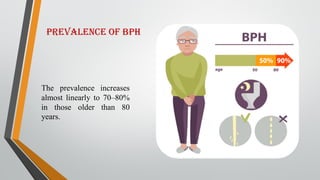
Prevalence of bph
The prevalence increases
almost linearly to 70–80%
in those older than 80
years.
OVERVIEW OF THE
PROSTATE GLAND
The word prostate derived from the greek
“prostates” meaning “one who stands before”,
“protector” or “guidance”.
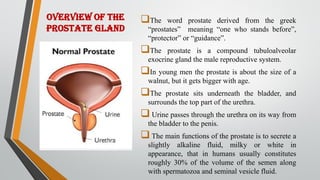
The prostate is a compound tubuloalveolar
exocrine gland the male reproductive system.
In young men the prostate is about the size of a
walnut, but it gets bigger with age.
The prostate sits underneath the bladder, and
surrounds the top part of the urethra.
 Urine passes through the urethra on its way from
the bladder to the penis.
 The main functions of the prostate is to secrete a
slightly alkaline fluid, milky or white in
appearance, that in humans usually constitutes
roughly 30% of the volume of the semen along
with spermatozoa and seminal vesicle fluid.
DEFINITION
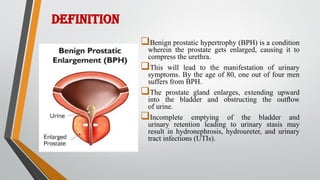
Benign prostatic hypertrophy (BPH) is a condition
wherein the prostate gets enlarged, causing it to
compress the urethra.
This will lead to the manifestation of urinary
symptoms. By the age of 80, one out of four men
suffers from BPH.
The prostate gland enlarges, extending upward
into the bladder and obstructing the outflow
of urine.
Incomplete emptying of the bladder and
urinary retention leading to urinary stasis may
result in hydronephrosis, hydroureter, and urinary
tract infections (UTIs).
CAUSES AND RISK FACTORS
The cause of BPH is not well understood, but testicular androgens have been
implicated.
Elevated estrogen levels: BPH generally occurs when men have elevated
estrogen levels and when prostate tissue becomes more sensitive.
Smoking: Smoking increases the risk of acquiring BPH.
Reduced activity level: A sedentary lifestyle could also lead to the
development of BPH.
Western diet: A diet high in animal fat and protein and refined
carbohydrates while low in fiber predisposes a man to BPH.
Pathophysiology
Studies show that the aging process and androgens may contribute to
the advancement of benign prostatic hypertrophy.
As the prostate enlarges, nodules are formed out of the prostatic tissue.
The normal appearance of the outer capsule of the prostate is
commonly fibrous and thin in nature.
However, it turns into spongy and thick when the prostate increases in
size.
As it progresses, the prostatic urethra becomes constricted, causing the
muscles of the bladder to exert more effort to expel the urine.
Chronic effects of the obstruction may lead to the formation of cords
called trabeculation of the bladder wall.
Trabeculation can decrease the bladder wall’s elasticity.
CLINICAL
MANIFESTATIONS
Urinary frequency: Frequent trips to the
bathroom to urinate may be an early sign of a
developing BPH.
Urinary urgency: This is the sudden
and immediate urge to urinate.
Nocturia: Urinating frequently at night is called
nocturia.
Weak urinary stream: Decreased and intermittent
force of stream is a sign of BPH.
Dribbling urine: Urine dribbles out after
urination.
Straining: There is presence of abdominal
straining upon urination
DIAGNOSIS
There are several ways to diagnose benign prostatic hypertrophy some of
which includes the following:
Digital rectal examination (DRE): A DRE often reveals a large, rubbery,
and nontender prostate gland.
Urinalysis: A urinalysis to screen for hematuria and UTI is recommended.
Prostate specific antigen levels: A PSA level is obtained if the patient has
at least a 10-year life expectancy and for whom knowledge of the presence
of prostate cancer would change management.
Urinalysis: Color: Yellow, dark brown, dark or bright red (bloody);
appearance may be cloudy. pH 7 or greater (suggests infection); bacteria,
WBCs, RBCs may be present microscopically.
Urine culture: May reveal Staphylococcus aureus, Proteus, Klebsiella,
Pseudomonas, or Escherichia coli.
Cont.
Urine cytology: To rule out bladder cancer.
BUN/Cr: Elevated if renal function is compromised.
Prostate-specific antigen (PSA): Glycoprotein contained in the cytoplasm
of prostatic epithelial cells, detected in the blood of adult men. Level is
greatly increased in prostatic cancer but can also be elevated in BPH.
Note: Research suggests elevated PSA levels with a low percentage of free PSA
are more likely associated with prostate cancer than with a benign prostate
condition.
WBC: May be more than 11,000/mm3, indicating infection if patient is not
immunosuppressed.
Uroflowmetry: Assesses degree of bladder obstruction.
Cont.
IVP with post voiding film: Shows delayed emptying of bladder, varying
degrees of urinary tract obstruction, and presence of prostatic enlargement,
bladder diverticula, and abnormal thickening of bladder muscle.
Voiding cystourethrography: May be used instead of IVP to visualize
bladder and urethra because it uses local dyes.
Cystometrogram: Measures pressure and volume in the bladder to identify
bladder dysfunction unrelated to BPH.
Cystourethroscopy: To view degree of prostatic enlargement and bladder-
wall changes (bladder diverticulum).
Cystometry: Evaluates detrusor muscle function and tone.
Transrectal prostatic ultrasound: Measures size of prostate and amount of
residual urine; locates lesions unrelated to BPH
medical managements
The goals of medical management of BPH are to improve the quality of life and
treatment depends on the severity of symptoms.
Catheterization: If a patient is admitted on an emergency basis because he
is unable to void, he is immediately catheterized.
Cystostomy: An incision into the bladder may be needed to provide urinary
drainage.
Pharmacologic management:
• Alpha-adrenergic blockers such as Prazosin (Minipress), Doxazosin
(Cardura) and Terazosin (Hytrin) aid in relaxing the smooth muscle of
the prostate and base of the bladder.
• Finasteride (Proscar) causes anti-androgenic effects on the cells of the
prostate, averts hyperplasia and prevents the conversion
of testosterone to dihydrotestosterone (DHT).
Surgical Management
The other treatment options include minimally invasive procedures and
resection of the prostate gland.
Transurethral microwave heat treatment: This therapy involves the
application of heat to prostatic tissue.
Transurethral needle ablation (TUNA): TUNA uses low-level radio
frequencies delivered by thin needles placed in the prostate gland to produce
localized heat that destroys prostate tissue while sparing other tissues.
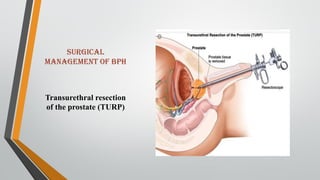
Transurethral resection of the prostate (TURP): TURP involves the
surgical removal of the inner portion of the prostate through an endoscope
inserted through the urethra.
Open prostatectomy: Open prostatectomy involves the surgical removal of
the inner portion of the prostate via a suprapubic, retropubic, or perineal
approach for large prostate glands.
SURGICAL
MANAGEMENT OF BPH
Transurethral resection
of the prostate (TURP)
NURSING MANAGEMENTS
Preoperative and postoperative nursing care for a patient with BPH are as
follows:
Reduce anxiety: The nurse should familiarize the patient with the
preoperative and postoperative routines and initiate measures to reduce
anxiety.
Relieve discomfort: Bed rest and analgesics are prescribed if a patient
experiences discomfort.
Provide instruction: Before the surgery, the nurse reviews with the patient
the anatomy of the affected structures and their function in relation to the
urinary and reproductive systems.
Maintain fluid balance: Fluid balance should be restored to normal.
Nursing Diagnosis
Based on the assessment data, the appropriate nursing diagnoses for a patient
with BPH are:
Urinary retention related to obstruction in the bladder neck or urethra.
Acute pain related to bladder distention.
Anxiety related to the surgical procedure.
COMPLICATIONS
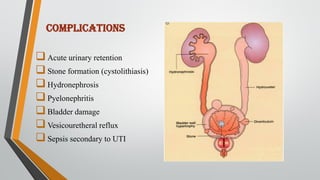
Acute urinary retention
Stone formation (cystolithiasis)
Hydronephrosis
Pyelonephritis
Bladder damage
Vesicouretheral reflux
Sepsis secondary to UTI
C l i n i c a l n u r s i n g s k i l l s
(ACADEMIC FORUM)
THANK YOU FOR READING
Prepared by comr. Nr. Abdulmalik umar dala
FOR MORE INFOR CONTACT THE PRESENTER AT:
PHONE NUMBER: 08165385343
EMAIL: nursinghealthconsult@gmail.com

BENIGN PROSTATE HYPERTROPHY.pdf

  • 1.
    c l in i c a l n u r s i n g s k i l l s (ACADEMIC FORUM) weekly series presentation on: BENIGN PROSTATic HyPERTROPHY (BPH) PREPARED BY COMR. NR. ABDULMALIK UMAR DALA
  • 2.
    Contents INTRODUCTION OVERVIEW OF THEPROSTATE GLAND DEFINITION CAUSES AND RISK FACTORS PATHOPHYSIOLOGY CLINICAL MANIFESTATIONS DIAGNOSIS MEDICAL MANAGEMENTS SURGICAL MANAGEMENTS NURSING MANAGEMENTS NURSING DIAGNOSIS COMPLICATIONS REFERENCES
  • 3.
    INTRODUCTION Benign prostatic hypertrophy(BPH) belongs to the most frequent diseases in ageing men. In the 4th decade of life, BPH is demonstrable in 30–40% of men, and its prevalence increases almost linearly to 70–80% in those older than 80 years. BPH (benign prostatic hypertrophy) is the most common prostate disease. BPH is a non-cancerous enlargement or growth of the prostate gland. The cause is not well understood, but evidence suggests hormonal involvement. As the prostate surrounds the top part of the urethra, enlargement of the prostate makes the urethra narrower and puts pressure on the base of the bladder. Narrowing of the urethra can affect the passing of urine in a number of ways. It can also cause bothersome lower urinary tract symptoms that affect quality of life by interfering with daily normal activities and sleep pattern.
  • 4.
    Prevalence of bph Theprevalence increases almost linearly to 70–80% in those older than 80 years.
  • 5.
    OVERVIEW OF THE PROSTATEGLAND The word prostate derived from the greek “prostates” meaning “one who stands before”, “protector” or “guidance”. The prostate is a compound tubuloalveolar exocrine gland the male reproductive system. In young men the prostate is about the size of a walnut, but it gets bigger with age. The prostate sits underneath the bladder, and surrounds the top part of the urethra.  Urine passes through the urethra on its way from the bladder to the penis.  The main functions of the prostate is to secrete a slightly alkaline fluid, milky or white in appearance, that in humans usually constitutes roughly 30% of the volume of the semen along with spermatozoa and seminal vesicle fluid.
  • 6.
    DEFINITION Benign prostatic hypertrophy(BPH) is a condition wherein the prostate gets enlarged, causing it to compress the urethra. This will lead to the manifestation of urinary symptoms. By the age of 80, one out of four men suffers from BPH. The prostate gland enlarges, extending upward into the bladder and obstructing the outflow of urine. Incomplete emptying of the bladder and urinary retention leading to urinary stasis may result in hydronephrosis, hydroureter, and urinary tract infections (UTIs).
  • 7.
    CAUSES AND RISKFACTORS The cause of BPH is not well understood, but testicular androgens have been implicated. Elevated estrogen levels: BPH generally occurs when men have elevated estrogen levels and when prostate tissue becomes more sensitive. Smoking: Smoking increases the risk of acquiring BPH. Reduced activity level: A sedentary lifestyle could also lead to the development of BPH. Western diet: A diet high in animal fat and protein and refined carbohydrates while low in fiber predisposes a man to BPH.
  • 8.
    Pathophysiology Studies show thatthe aging process and androgens may contribute to the advancement of benign prostatic hypertrophy. As the prostate enlarges, nodules are formed out of the prostatic tissue. The normal appearance of the outer capsule of the prostate is commonly fibrous and thin in nature. However, it turns into spongy and thick when the prostate increases in size. As it progresses, the prostatic urethra becomes constricted, causing the muscles of the bladder to exert more effort to expel the urine. Chronic effects of the obstruction may lead to the formation of cords called trabeculation of the bladder wall. Trabeculation can decrease the bladder wall’s elasticity.
  • 9.
    CLINICAL MANIFESTATIONS Urinary frequency: Frequenttrips to the bathroom to urinate may be an early sign of a developing BPH. Urinary urgency: This is the sudden and immediate urge to urinate. Nocturia: Urinating frequently at night is called nocturia. Weak urinary stream: Decreased and intermittent force of stream is a sign of BPH. Dribbling urine: Urine dribbles out after urination. Straining: There is presence of abdominal straining upon urination
  • 10.
    DIAGNOSIS There are severalways to diagnose benign prostatic hypertrophy some of which includes the following: Digital rectal examination (DRE): A DRE often reveals a large, rubbery, and nontender prostate gland. Urinalysis: A urinalysis to screen for hematuria and UTI is recommended. Prostate specific antigen levels: A PSA level is obtained if the patient has at least a 10-year life expectancy and for whom knowledge of the presence of prostate cancer would change management. Urinalysis: Color: Yellow, dark brown, dark or bright red (bloody); appearance may be cloudy. pH 7 or greater (suggests infection); bacteria, WBCs, RBCs may be present microscopically. Urine culture: May reveal Staphylococcus aureus, Proteus, Klebsiella, Pseudomonas, or Escherichia coli.
  • 11.
    Cont. Urine cytology: Torule out bladder cancer. BUN/Cr: Elevated if renal function is compromised. Prostate-specific antigen (PSA): Glycoprotein contained in the cytoplasm of prostatic epithelial cells, detected in the blood of adult men. Level is greatly increased in prostatic cancer but can also be elevated in BPH. Note: Research suggests elevated PSA levels with a low percentage of free PSA are more likely associated with prostate cancer than with a benign prostate condition. WBC: May be more than 11,000/mm3, indicating infection if patient is not immunosuppressed. Uroflowmetry: Assesses degree of bladder obstruction.
  • 12.
    Cont. IVP with postvoiding film: Shows delayed emptying of bladder, varying degrees of urinary tract obstruction, and presence of prostatic enlargement, bladder diverticula, and abnormal thickening of bladder muscle. Voiding cystourethrography: May be used instead of IVP to visualize bladder and urethra because it uses local dyes. Cystometrogram: Measures pressure and volume in the bladder to identify bladder dysfunction unrelated to BPH. Cystourethroscopy: To view degree of prostatic enlargement and bladder- wall changes (bladder diverticulum). Cystometry: Evaluates detrusor muscle function and tone. Transrectal prostatic ultrasound: Measures size of prostate and amount of residual urine; locates lesions unrelated to BPH
  • 13.
    medical managements The goalsof medical management of BPH are to improve the quality of life and treatment depends on the severity of symptoms. Catheterization: If a patient is admitted on an emergency basis because he is unable to void, he is immediately catheterized. Cystostomy: An incision into the bladder may be needed to provide urinary drainage. Pharmacologic management: • Alpha-adrenergic blockers such as Prazosin (Minipress), Doxazosin (Cardura) and Terazosin (Hytrin) aid in relaxing the smooth muscle of the prostate and base of the bladder. • Finasteride (Proscar) causes anti-androgenic effects on the cells of the prostate, averts hyperplasia and prevents the conversion of testosterone to dihydrotestosterone (DHT).
  • 14.
    Surgical Management The othertreatment options include minimally invasive procedures and resection of the prostate gland. Transurethral microwave heat treatment: This therapy involves the application of heat to prostatic tissue. Transurethral needle ablation (TUNA): TUNA uses low-level radio frequencies delivered by thin needles placed in the prostate gland to produce localized heat that destroys prostate tissue while sparing other tissues. Transurethral resection of the prostate (TURP): TURP involves the surgical removal of the inner portion of the prostate through an endoscope inserted through the urethra. Open prostatectomy: Open prostatectomy involves the surgical removal of the inner portion of the prostate via a suprapubic, retropubic, or perineal approach for large prostate glands.
  • 15.
    SURGICAL MANAGEMENT OF BPH Transurethralresection of the prostate (TURP)
  • 16.
    NURSING MANAGEMENTS Preoperative andpostoperative nursing care for a patient with BPH are as follows: Reduce anxiety: The nurse should familiarize the patient with the preoperative and postoperative routines and initiate measures to reduce anxiety. Relieve discomfort: Bed rest and analgesics are prescribed if a patient experiences discomfort. Provide instruction: Before the surgery, the nurse reviews with the patient the anatomy of the affected structures and their function in relation to the urinary and reproductive systems. Maintain fluid balance: Fluid balance should be restored to normal.
  • 17.
    Nursing Diagnosis Based onthe assessment data, the appropriate nursing diagnoses for a patient with BPH are: Urinary retention related to obstruction in the bladder neck or urethra. Acute pain related to bladder distention. Anxiety related to the surgical procedure.
  • 18.
    COMPLICATIONS Acute urinary retention Stoneformation (cystolithiasis) Hydronephrosis Pyelonephritis Bladder damage Vesicouretheral reflux Sepsis secondary to UTI
  • 19.
    C l in i c a l n u r s i n g s k i l l s (ACADEMIC FORUM) THANK YOU FOR READING Prepared by comr. Nr. Abdulmalik umar dala FOR MORE INFOR CONTACT THE PRESENTER AT: PHONE NUMBER: 08165385343 EMAIL: nursinghealthconsult@gmail.com