Brain tumor
A brain tumor is a localized
intracranial lesion that
occupies space within the
skull.
Definition
Broad Classification
▸ Primary
▸ Secondary
According to Tissue of origine
1. Glioma : with in the brain tissue
▸ Astrocytoma – Low to moderate
grade Malignancy
▸ Glioblastoma – Highly malignant and
invasive
▸ Oligodendroma- Benign
▸ Ependymoma - Benign or Highly
Malignant
2. Meningioma -Benign or Malignant
3. Acoustic neuroma -Benign or law
grade malignancy
4. Pituitary Adenoma -Benign
5. Haemangioblastoma - Rare and
benign
6. Primary CNS Lymphoma
7. Metastatic Tumors
Etiology
▸ No clear factor
▸ Familial tendency
▸ Immune suppression
▸ Environmental factors
▸ Research studies shows use of
cellular phones, hair dyes, head
trauma can lead to brain tumors
Clinical Features
▸ Headache
▸ Nausea/Vomiting
▸ Papilledema
▸ Mental Status Changes
▸ Seizures
Localized Manifestations
▸ Focal Weakness
▸ Sensory disturbances
▸ Language disturbances
▸ Coordination disturbances
▸ Visual disturbances
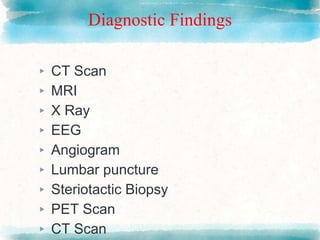
Diagnostic Findings
▸ CT Scan
▸ MRI
▸ X Ray
▸ EEG
▸ Angiogram
▸ Lumbar puncture
▸ Steriotactic Biopsy
▸ PET Scan
▸ CT Scan
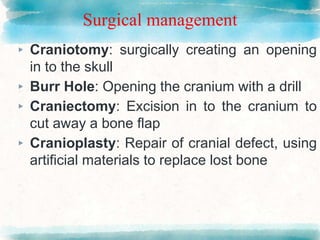
Surgical management
▸ Craniotomy: surgically creating an opening
in to the skull
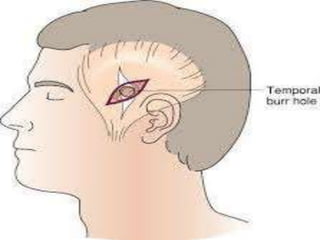
▸ Burr Hole: Opening the cranium with a drill
▸ Craniectomy: Excision in to the cranium to
cut away a bone flap
▸ Cranioplasty: Repair of cranial defect, using
artificial materials to replace lost bone
▸ Stereotaxis: It uses computer
guided apparatus to precisely target
an area of the brain
▸ Shunt procedures: redirecting CSF
from one area to another
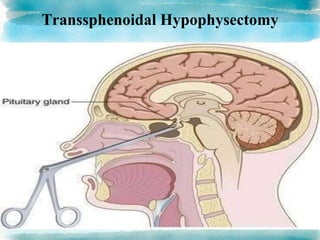
Transsphenoidal Hypophysectomy
Chemotherapy
▸ Temozolomide: oral
chemotherapeutic agent
▸ Nitrosoureas-: Carmustine,
lomustine
▸ Inj Mannitol
Radiation Therapy
▸ Interstitial radiation
▸ Stereotactic radio surgery
▸ Radiation sensitizing therapy
▸ Intraoperative radiation
▸ Radioactive monoclonal antibodies

Brain tumor

  • 1.
  • 2.
    A brain tumoris a localized intracranial lesion that occupies space within the skull. Definition
  • 3.
  • 4.
    According to Tissueof origine 1. Glioma : with in the brain tissue ▸ Astrocytoma – Low to moderate grade Malignancy ▸ Glioblastoma – Highly malignant and invasive ▸ Oligodendroma- Benign ▸ Ependymoma - Benign or Highly Malignant
  • 5.
    2. Meningioma -Benignor Malignant 3. Acoustic neuroma -Benign or law grade malignancy 4. Pituitary Adenoma -Benign 5. Haemangioblastoma - Rare and benign 6. Primary CNS Lymphoma 7. Metastatic Tumors
  • 6.
    Etiology ▸ No clearfactor ▸ Familial tendency ▸ Immune suppression ▸ Environmental factors ▸ Research studies shows use of cellular phones, hair dyes, head trauma can lead to brain tumors
  • 12.
    Clinical Features ▸ Headache ▸Nausea/Vomiting ▸ Papilledema ▸ Mental Status Changes ▸ Seizures
  • 13.
    Localized Manifestations ▸ FocalWeakness ▸ Sensory disturbances ▸ Language disturbances ▸ Coordination disturbances ▸ Visual disturbances
  • 14.
    Diagnostic Findings ▸ CTScan ▸ MRI ▸ X Ray ▸ EEG ▸ Angiogram ▸ Lumbar puncture ▸ Steriotactic Biopsy ▸ PET Scan ▸ CT Scan
  • 15.
    Surgical management ▸ Craniotomy:surgically creating an opening in to the skull ▸ Burr Hole: Opening the cranium with a drill ▸ Craniectomy: Excision in to the cranium to cut away a bone flap ▸ Cranioplasty: Repair of cranial defect, using artificial materials to replace lost bone
  • 16.
    ▸ Stereotaxis: Ituses computer guided apparatus to precisely target an area of the brain ▸ Shunt procedures: redirecting CSF from one area to another
  • 18.
  • 19.
    Chemotherapy ▸ Temozolomide: oral chemotherapeuticagent ▸ Nitrosoureas-: Carmustine, lomustine ▸ Inj Mannitol
  • 20.
    Radiation Therapy ▸ Interstitialradiation ▸ Stereotactic radio surgery ▸ Radiation sensitizing therapy ▸ Intraoperative radiation ▸ Radioactive monoclonal antibodies