Evans Syndrome
By,
Ms. Ekta S Patel,
Assistant Professor.
“
▪ Evans syndrome is an autoimmune
disease in which an
individual's immune system attacks
their own red blood cells, white
blood cells, and/or platelets.
▪ These events may occur
simultaneously or one may follow
on from the other.
“▪ Evans syndrome was
first described in the
medical literature in
1951 by Dr. Robert
Evans and associates
▪ Affected people often
experience thrombocytopenia (too few platelets)
and Coombs' positive hemolytic
anemia (premature destruction of red blood cells).
▪ The best treatment options for Evans syndrome
depend on many factors, including the severity of
the condition; the signs and symptoms present;
and each person's response to certain therapies
Definition:
▪ Evans syndrome is a rare chronic hematologic
disorder characterized by the simultaneous or
sequential association of autoimmune hemolytic
anemia with immune thrombocytopenic purpura and
occasionally autoimmune neutropenia, in the
absence of a known underlying etiology.
Etiology:
▪ The exact cause of Evans syndrome is not known.
▪ Disorders of the immune system like Evans
syndrome occur when the immune system
produces antibodies that mistakenly attack
healthy tissue, specifically red blood
cells, platelets, and white blood cells.
▪ Evans syndrome may occur in combination with another
disorder as a secondary condition.
▪ autoimmune lymphoproliferative syndrome(ALPS),
▪ lupus,
▪ antiphospholipid syndrome,
▪ Sjogren (Show-grins) syndrome,
▪ common variable immunodeficiency,
▪ IgA deficiency,
▪ certain lymphomas,
▪ chronic lymphocytic leukemia.
Clinical Manifestation:
▪ The signs and symptoms of Evans syndrome vary
from person to person and largely depend on
which type(s) of blood cells are affected (i.e. red
blood cells, platelets, and/or white blood cells).
▪ If a person does not have enough healthy red
blood cells (anemia), they may experience;
▪ Weakness,
▪ Fatigue,
▪ Paleness,
▪ Light-headedness,
▪ Shortness of breath, or rapid heartbeat.
▪ Low platelets (thrombocytopenia) can cause
▪ Easy or unexplained bruising;
▪ Red or purple spots on the skin (petechiae);
▪ Prolonged bleeding from small cuts
▪ Purpura.
▪ People with a low white blood cell count
(neutropenia) may be;
▪ More susceptible to infections,
▪ May experience symptoms such as fever
▪ Sores inside the mouth.
▪ Many people with Evans syndrome go through
periods of remission in which the signs and
symptoms of the condition temporarily disappear
or become less severe (usually induced
temporarily by treatment).
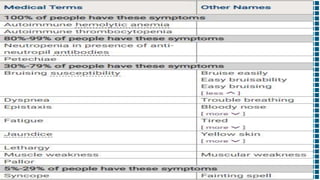
▪ This table lists symptoms that people with this
disease may have.
▪ This information comes from a database called
the Human Phenotype Ontology (HPO) .
Diagnostic Evaluation:
▪ Various blood tests,
▪ CBC
▪ Reticulocyte count
▪ Coombs test
▪ Test for antineutrophil and antiplatelet antibody
▪ Lupus antibody and antinuclear antibody (ANA)
test
▪ Measurements of serum immunoglobulin
▪ Flow cytometry of blood sample
▪ Gene mutation study.
▪ Bone marrow aspiration,
Treatment:
▪ Treatment for Evans syndrome depends on many
factors, including the severity of the condition;
the signs and symptoms present; and each
person's response to certain therapies.
▪ For example, people who need to be hospitalized
due to severe anemia or thrombocytopenia are
often treated with blood transfusions followed
by therapy with corticosteroids or intravenous
(IV) immune globulin.
▪ Other treatment options include
immunosuppressive drugs.
▪ Most affected individuals respond to these
treatments; however, relapse is frequent.
▪ In people who do not respond to standard
treatments, therapy with rituximab may be
considered.
▪ Some people with Evans syndrome respond well
to rituximab treatment and experience an
extended period of remission, while others have
little to no response
▪ The role of splenectomy in treating Evans
syndrome is not clearly established.
▪ While splenectomy may lead to immediate
improvement, relapses are common and usually
occur within 1-2 months after the procedure.
▪ For cases that are very severe and difficult to
treat, a stem cell transplant may be used to
provide a long-term cure.
▪ Autologous and allogeneic stem
cell transplantation have been used in a small
number of patients with mixed results.

Evans syndrome

  • 1.
    Evans Syndrome By, Ms. EktaS Patel, Assistant Professor.
  • 2.
    “ ▪ Evans syndromeis an autoimmune disease in which an individual's immune system attacks their own red blood cells, white blood cells, and/or platelets. ▪ These events may occur simultaneously or one may follow on from the other.
  • 3.
    “▪ Evans syndromewas first described in the medical literature in 1951 by Dr. Robert Evans and associates
  • 4.
    ▪ Affected peopleoften experience thrombocytopenia (too few platelets) and Coombs' positive hemolytic anemia (premature destruction of red blood cells). ▪ The best treatment options for Evans syndrome depend on many factors, including the severity of the condition; the signs and symptoms present; and each person's response to certain therapies
  • 5.
    Definition: ▪ Evans syndromeis a rare chronic hematologic disorder characterized by the simultaneous or sequential association of autoimmune hemolytic anemia with immune thrombocytopenic purpura and occasionally autoimmune neutropenia, in the absence of a known underlying etiology.
  • 6.
    Etiology: ▪ The exactcause of Evans syndrome is not known. ▪ Disorders of the immune system like Evans syndrome occur when the immune system produces antibodies that mistakenly attack healthy tissue, specifically red blood cells, platelets, and white blood cells.
  • 7.
    ▪ Evans syndromemay occur in combination with another disorder as a secondary condition. ▪ autoimmune lymphoproliferative syndrome(ALPS), ▪ lupus, ▪ antiphospholipid syndrome, ▪ Sjogren (Show-grins) syndrome, ▪ common variable immunodeficiency, ▪ IgA deficiency, ▪ certain lymphomas, ▪ chronic lymphocytic leukemia.
  • 8.
    Clinical Manifestation: ▪ Thesigns and symptoms of Evans syndrome vary from person to person and largely depend on which type(s) of blood cells are affected (i.e. red blood cells, platelets, and/or white blood cells).
  • 9.
    ▪ If aperson does not have enough healthy red blood cells (anemia), they may experience; ▪ Weakness, ▪ Fatigue, ▪ Paleness, ▪ Light-headedness, ▪ Shortness of breath, or rapid heartbeat.
  • 10.
    ▪ Low platelets(thrombocytopenia) can cause ▪ Easy or unexplained bruising; ▪ Red or purple spots on the skin (petechiae); ▪ Prolonged bleeding from small cuts ▪ Purpura.
  • 11.
    ▪ People witha low white blood cell count (neutropenia) may be; ▪ More susceptible to infections, ▪ May experience symptoms such as fever ▪ Sores inside the mouth.
  • 12.
    ▪ Many peoplewith Evans syndrome go through periods of remission in which the signs and symptoms of the condition temporarily disappear or become less severe (usually induced temporarily by treatment).
  • 13.
    ▪ This tablelists symptoms that people with this disease may have. ▪ This information comes from a database called the Human Phenotype Ontology (HPO) .
  • 15.
    Diagnostic Evaluation: ▪ Variousblood tests, ▪ CBC ▪ Reticulocyte count ▪ Coombs test ▪ Test for antineutrophil and antiplatelet antibody
  • 16.
    ▪ Lupus antibodyand antinuclear antibody (ANA) test ▪ Measurements of serum immunoglobulin ▪ Flow cytometry of blood sample ▪ Gene mutation study. ▪ Bone marrow aspiration,
  • 17.
    Treatment: ▪ Treatment forEvans syndrome depends on many factors, including the severity of the condition; the signs and symptoms present; and each person's response to certain therapies.
  • 18.
    ▪ For example,people who need to be hospitalized due to severe anemia or thrombocytopenia are often treated with blood transfusions followed by therapy with corticosteroids or intravenous (IV) immune globulin.
  • 19.
    ▪ Other treatmentoptions include immunosuppressive drugs. ▪ Most affected individuals respond to these treatments; however, relapse is frequent.
  • 20.
    ▪ In peoplewho do not respond to standard treatments, therapy with rituximab may be considered. ▪ Some people with Evans syndrome respond well to rituximab treatment and experience an extended period of remission, while others have little to no response
  • 21.
    ▪ The roleof splenectomy in treating Evans syndrome is not clearly established. ▪ While splenectomy may lead to immediate improvement, relapses are common and usually occur within 1-2 months after the procedure.
  • 22.
    ▪ For casesthat are very severe and difficult to treat, a stem cell transplant may be used to provide a long-term cure. ▪ Autologous and allogeneic stem cell transplantation have been used in a small number of patients with mixed results.