Topical
Medications
Administration
By,
Ms. Ekta S Patel,
Assistant Professor.
“
“
“
‐ Topical medications are
applied directly to the body
surfaces, including the skin
and mucous membranes
of the eyes, ears, nose,
vagina, and rectum.
‐ There are many classes of topical
medications, such as creams,
ointments, lotions, patches, and
aerosol sprays.
‐ Medications that are applied to the
skin to produce slow, controlled,
systemic effect are also referred to
as transdermal.
‐ Medications that can be administered
via a topical route include antibiotics,
narcotics, hormones, and even
chemotherapeutics.
‐ This requires adherence to the ten
"rights" of medication administration
and three checks during the
administration process to ensure the
safe administration of these
medications.
‐ Also, the administration of the topical
medications requires wearing
gloves to protect the healthcare
provider from accidental exposure
and absorption of the medication.
‐ Topical medications should never be
applied with the bare hands.
PROCEDURE
1. General medication
administration considerations.
‐ In the patient's room, review the
patient's medical history for
medication allergies and previous
administration times in the electronic
Medication Administration Record
(MAR).
‐ Confirm any patient preferences
regarding topical transdermal
patch administration, such as
preferred site of application, any
previous side effects, and previous
applications of transdermal patches.
‐ Disinfect the hands by washing with
soap and warm water, or by using a
hand sanitizer if the hands are not
visibly soiled; apply vigorous friction
for at least 20 s.
‐ From this point on, you must
maintain a distraction/disruption-
free environment to prevent
medication errors while dispensing
and administering medications.
‐ Acquire the topical medications from
the medication dispensing device,
using the ten "rights" during the first
safety check.
2. Complete the second safety
check using the ten "rights" of
medication administration.
‐ Complete the "Right Patient" for the
second safety check by confirming
that you have acquired topical
transdermal, optic, and/or otic
medications for the right patient on
the MAR.
‐ Compare the medication names
listed on the label with the
medication names listed on the MAR.
‐ At this point, the "Right Medication"
step is complete.
‐ Complete the "Right Dose" step by
comparing the topical
dose/concentrations listed on the
label with the dose/concentrations
listed on the MAR.
‐ Some prescriptions specify the exact
amount to be applied, and these are
generally supplied as single-dose
applications in a patch form.
‐ If the medication is in an ointment
tube, such as nitroglycerin, the MAR
will describe the amount to be
applied (e.g., "squeeze out one inch
of medication").
‐ The medication will be secured to the
skin with an occlusive dressing to
allow for gradual absorption.
‐ Verify that the medication routes
listed on the label are consistent with
the routes listed on the MAR. At this
point, the "Right Route" step is
complete.
‐ Review the MAR to confirm that it is
the right time for administration. At
this point, the "Right Time" step is
complete.
3. Gather the necessary
supplies, such as clean
gloves and sterile gauze for
cleaning.
‐ Additional supplies, like cottons balls,
sterile swabs, or occlusive dressing
may be necessary in certain cases.
‐ Cotton balls may be needed for
eardrop administration.
‐ Topical antibiotic medications should
be applied using swabs to prevent
cross-contamination of the
application site with environmental
contaminants.
Complete the third safety check
using the ten "rights" of
medication administration.
‐ Verify that the patient is wearing the
correct name band by asking him/her to
state his/her name and date of birth.
5. Teach the patient about the
topical medication.
6. Administer the topical
transdermal patch medication.
‐ Inform the patient that application of
the topical transdermal patch
medication will require exposing the
application site.
‐ Ensure the patient's privacy and
dignity by covering intimate body
sites as much as possible with a
blanket or towel during
administration.
‐ In the case of transdermal patch
application, determine the last site of
administration.
‐ Carefully remove the previously
applied patch and clean the skin of
any remaining medication.
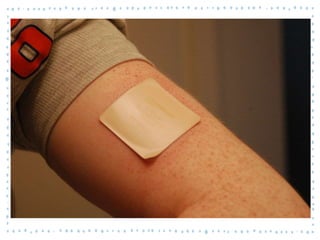
‐ Apply the new patch by carefully
removing the outer packaging,
removing the clear protective liner,
and placing it in an area free of
hair and that undergoes little
movement.
‐ If using ointment topical
medication, such as nitroglycerin,
squeeze out the appropriate
amount of topical percutaneous
medication onto a measurement
and application device.
‐ Apply clear, occlusive dressing over
the ointment application device,
securing it to the skin. Never rub or
message ointment into the skin, as
this may increase the absorption
rate.
‐ Label the transdermal patch
medication with the initials, time, and
date of application using an indelible
marker.
7. Administering ophthalmic
(eye) medication.
‐ Describe the application process and
ensure patient privacy
‐ Wash hands and don clean gloves
‐ Assist the patient to lie back, with the
head tilted and neck extended. If
neck injuries are present, do not
extend the neck.
‐ Assess the eyelids and inner canthus
for crusts or drainage.
‐ If drainage or crusts are present,
gently cleanse the area with normal
saline and gauze pads.
‐ Administering ophthalmic (eye)
drops.
‐ While holding the eye drop
medication in the dominant hand,
gently rest the heal of the hand on
the patient's forehead.
‐ Hold the medication approximately 1-
2 cm above the lower lid.
‐ With the non-dominant hand, gently
pull the lower lid down to expose the
conjunctival sac.
‐ Ask the patient to look up towards
the ceiling.
‐ A cotton ball or tissue may be used
to hold the lower lid down.
‐ Allow the prescribed number of drops
to fall into the conjunctival sac.
‐ If drips do not fall with gravity, you
may need to gently squeeze the
medication bottle
‐ Never allow the tip of the bottle to
touch the conjunctival sac or eye.
‐ If drops fall outside the lid or the
patient blinks, causing a drop to miss
the eye, repeat the procedure.
‐ Release the lower eyelid and ask the
patient to gently close his/her eyes.
Administering ophthalmic
(eye) ointment.
‐ Again, rest the heal of the dominant hand on
patient forehead while holding the ointment
medication 1-2 cm above the lower lid.
‐ With the non-dominant hand, gently expose the
inner conjunctiva of the lower lid using a fingertip
or a cotton ball.
‐ Gently squeeze a thin line of ointment medication
along the inner conjunctiva, from inner canthus to
the outer canthus. Make sure to break the ribbon
of ointment by turning the hand before lifting
away, as the medication may otherwise pull away
from the conjunctiva.
‐ Release the lower eyelid and ask the patient to
blink and gently rub the eyelid to disperse the
medication.
8. Administering otic (ear)
drops
‐ Patient education on the
administration procedure and hand
hygiene with glove application should
be completed.
‐ The patient may experience a
feeling of water or hear bubbling in
the ear as the medication is
administered.
‐ Ask the patient to lie on his/her side,
with the affected ear (i.e., the ear that
requires medication administration)
towards the ceiling
‐ Gently roll the medication between
both hands for 10-20 s to both re-
suspend particles and to warm the
medication prior to administration.
‐ Cold ear medications may cause
dizziness or nausea when
administered.
‐ Using the non-dominant hand, gently
pull the ear auricle up and outward to
straighten the ear canal.
‐ For children 3 years old and younger,
grasp the pinna and pull down and
back to straighten the canal.
‐ Hold the medication bottle with the
dominant hand approximately 1 cm
above the ear canal and instill the
prescribed number of drops.
‐ Never allow the tip of the medication
bottle to touch the ear or the ear
canal.
‐ Release the ear and gently place the
medication bottle on the bedside
table.
‐ Ask the patient to remain on his/her
side for 2-3 min to aid in medication
absorption.
Document the medication
administrations.
10. Prior to leaving the room,
remind the patient about any
side effects/adverse effects
or considerations for which
he/she should notify the
nurse.
11. Upon exiting the patient
room, disinfect your hands
again, as has been described
earlier.
Caution!
‐ While the administration of topical
medications may appear to be simple
and harmless, it is associated with
many side effects if not performed
properly.
‐ Unexpected inflammation and
irritation should be reported to
medical staff to prevent further tissue
damage.
‐ A common mistake is administrating
topical medication at a concentration
unsuitable for the application site.
‐ For instance, a topical antibiotic has
formulations for both the skin and
eyes and, if applied incorrectly, could
result in the loss of vision.
‐ Cool or cold otic medications may
also cause dizziness and nausea.

Topical medications administration

  • 1.
  • 2.
  • 3.
  • 4.
    “ ‐ Topical medicationsare applied directly to the body surfaces, including the skin and mucous membranes of the eyes, ears, nose, vagina, and rectum.
  • 5.
    ‐ There aremany classes of topical medications, such as creams, ointments, lotions, patches, and aerosol sprays.
  • 6.
    ‐ Medications thatare applied to the skin to produce slow, controlled, systemic effect are also referred to as transdermal.
  • 7.
    ‐ Medications thatcan be administered via a topical route include antibiotics, narcotics, hormones, and even chemotherapeutics.
  • 8.
    ‐ This requiresadherence to the ten "rights" of medication administration and three checks during the administration process to ensure the safe administration of these medications.
  • 9.
    ‐ Also, theadministration of the topical medications requires wearing gloves to protect the healthcare provider from accidental exposure and absorption of the medication. ‐ Topical medications should never be applied with the bare hands.
  • 10.
  • 11.
    1. General medication administrationconsiderations. ‐ In the patient's room, review the patient's medical history for medication allergies and previous administration times in the electronic Medication Administration Record (MAR).
  • 12.
    ‐ Confirm anypatient preferences regarding topical transdermal patch administration, such as preferred site of application, any previous side effects, and previous applications of transdermal patches.
  • 14.
    ‐ Disinfect thehands by washing with soap and warm water, or by using a hand sanitizer if the hands are not visibly soiled; apply vigorous friction for at least 20 s. ‐ From this point on, you must maintain a distraction/disruption- free environment to prevent medication errors while dispensing and administering medications.
  • 15.
    ‐ Acquire thetopical medications from the medication dispensing device, using the ten "rights" during the first safety check.
  • 16.
    2. Complete thesecond safety check using the ten "rights" of medication administration. ‐ Complete the "Right Patient" for the second safety check by confirming that you have acquired topical transdermal, optic, and/or otic medications for the right patient on the MAR.
  • 17.
    ‐ Compare themedication names listed on the label with the medication names listed on the MAR. ‐ At this point, the "Right Medication" step is complete.
  • 18.
    ‐ Complete the"Right Dose" step by comparing the topical dose/concentrations listed on the label with the dose/concentrations listed on the MAR.
  • 19.
    ‐ Some prescriptionsspecify the exact amount to be applied, and these are generally supplied as single-dose applications in a patch form.
  • 20.
    ‐ If themedication is in an ointment tube, such as nitroglycerin, the MAR will describe the amount to be applied (e.g., "squeeze out one inch of medication"). ‐ The medication will be secured to the skin with an occlusive dressing to allow for gradual absorption.
  • 21.
    ‐ Verify thatthe medication routes listed on the label are consistent with the routes listed on the MAR. At this point, the "Right Route" step is complete.
  • 22.
    ‐ Review theMAR to confirm that it is the right time for administration. At this point, the "Right Time" step is complete.
  • 23.
    3. Gather thenecessary supplies, such as clean gloves and sterile gauze for cleaning. ‐ Additional supplies, like cottons balls, sterile swabs, or occlusive dressing may be necessary in certain cases.
  • 24.
    ‐ Cotton ballsmay be needed for eardrop administration. ‐ Topical antibiotic medications should be applied using swabs to prevent cross-contamination of the application site with environmental contaminants.
  • 25.
    Complete the thirdsafety check using the ten "rights" of medication administration. ‐ Verify that the patient is wearing the correct name band by asking him/her to state his/her name and date of birth.
  • 26.
    5. Teach thepatient about the topical medication.
  • 27.
    6. Administer thetopical transdermal patch medication. ‐ Inform the patient that application of the topical transdermal patch medication will require exposing the application site. ‐ Ensure the patient's privacy and dignity by covering intimate body sites as much as possible with a blanket or towel during administration.
  • 28.
    ‐ In thecase of transdermal patch application, determine the last site of administration. ‐ Carefully remove the previously applied patch and clean the skin of any remaining medication.
  • 29.
    ‐ Apply thenew patch by carefully removing the outer packaging, removing the clear protective liner, and placing it in an area free of hair and that undergoes little movement.
  • 30.
    ‐ If usingointment topical medication, such as nitroglycerin, squeeze out the appropriate amount of topical percutaneous medication onto a measurement and application device.
  • 31.
    ‐ Apply clear,occlusive dressing over the ointment application device, securing it to the skin. Never rub or message ointment into the skin, as this may increase the absorption rate.
  • 32.
    ‐ Label thetransdermal patch medication with the initials, time, and date of application using an indelible marker.
  • 33.
    7. Administering ophthalmic (eye)medication. ‐ Describe the application process and ensure patient privacy ‐ Wash hands and don clean gloves ‐ Assist the patient to lie back, with the head tilted and neck extended. If neck injuries are present, do not extend the neck.
  • 34.
    ‐ Assess theeyelids and inner canthus for crusts or drainage. ‐ If drainage or crusts are present, gently cleanse the area with normal saline and gauze pads.
  • 35.
    ‐ Administering ophthalmic(eye) drops. ‐ While holding the eye drop medication in the dominant hand, gently rest the heal of the hand on the patient's forehead. ‐ Hold the medication approximately 1- 2 cm above the lower lid.
  • 36.
    ‐ With thenon-dominant hand, gently pull the lower lid down to expose the conjunctival sac. ‐ Ask the patient to look up towards the ceiling. ‐ A cotton ball or tissue may be used to hold the lower lid down.
  • 37.
    ‐ Allow theprescribed number of drops to fall into the conjunctival sac. ‐ If drips do not fall with gravity, you may need to gently squeeze the medication bottle
  • 38.
    ‐ Never allowthe tip of the bottle to touch the conjunctival sac or eye. ‐ If drops fall outside the lid or the patient blinks, causing a drop to miss the eye, repeat the procedure.
  • 39.
    ‐ Release thelower eyelid and ask the patient to gently close his/her eyes.
  • 41.
    Administering ophthalmic (eye) ointment. ‐Again, rest the heal of the dominant hand on patient forehead while holding the ointment medication 1-2 cm above the lower lid. ‐ With the non-dominant hand, gently expose the inner conjunctiva of the lower lid using a fingertip or a cotton ball. ‐ Gently squeeze a thin line of ointment medication along the inner conjunctiva, from inner canthus to the outer canthus. Make sure to break the ribbon of ointment by turning the hand before lifting away, as the medication may otherwise pull away from the conjunctiva. ‐ Release the lower eyelid and ask the patient to blink and gently rub the eyelid to disperse the medication.
  • 42.
    8. Administering otic(ear) drops ‐ Patient education on the administration procedure and hand hygiene with glove application should be completed. ‐ The patient may experience a feeling of water or hear bubbling in the ear as the medication is administered.
  • 43.
    ‐ Ask thepatient to lie on his/her side, with the affected ear (i.e., the ear that requires medication administration) towards the ceiling
  • 44.
    ‐ Gently rollthe medication between both hands for 10-20 s to both re- suspend particles and to warm the medication prior to administration. ‐ Cold ear medications may cause dizziness or nausea when administered.
  • 45.
    ‐ Using thenon-dominant hand, gently pull the ear auricle up and outward to straighten the ear canal. ‐ For children 3 years old and younger, grasp the pinna and pull down and back to straighten the canal.
  • 46.
    ‐ Hold themedication bottle with the dominant hand approximately 1 cm above the ear canal and instill the prescribed number of drops. ‐ Never allow the tip of the medication bottle to touch the ear or the ear canal.
  • 47.
    ‐ Release theear and gently place the medication bottle on the bedside table. ‐ Ask the patient to remain on his/her side for 2-3 min to aid in medication absorption.
  • 48.
  • 49.
    10. Prior toleaving the room, remind the patient about any side effects/adverse effects or considerations for which he/she should notify the nurse.
  • 50.
    11. Upon exitingthe patient room, disinfect your hands again, as has been described earlier.
  • 51.
    Caution! ‐ While theadministration of topical medications may appear to be simple and harmless, it is associated with many side effects if not performed properly.
  • 52.
    ‐ Unexpected inflammationand irritation should be reported to medical staff to prevent further tissue damage.
  • 53.
    ‐ A commonmistake is administrating topical medication at a concentration unsuitable for the application site. ‐ For instance, a topical antibiotic has formulations for both the skin and eyes and, if applied incorrectly, could result in the loss of vision.
  • 54.
    ‐ Cool orcold otic medications may also cause dizziness and nausea.