










OVERVIEW
•Benign prostatic hyperplasia (BPH) is a health
issue that becomes more common with age.
• It's also called an enlarged prostate.
•The prostate is a small gland that helps make
semen.
OVERVIEW
•It's found just below the bladder. And it often gets
bigger as you get older.
•An enlarged prostate can cause symptoms that
may bother you, such as blocking the flow of urine
out of the bladder.
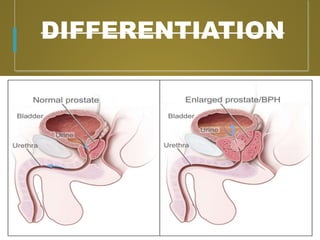
DIFFERENTIATION
CAUSES
•The actual cause of prostate enlargement is
unknown
RISK FACTORS
Aging.
Family history.
Diabetes and
heart disease.
Lifestyle.
RISK FACTORS
• Aging. An enlarged prostate gland rarely causes symptoms
before age 40. After that, the chance of having an enlarged
prostate and related symptoms starts to rise.
• Family history. Having a blood relative with prostate problems
makes you more likely to have problems with your prostate.
• Diabetes and heart disease. Studies show that diabetes might
raise the risk of BPH. So might heart disease.
• Lifestyle. Obesity raises the risk of BPH. Exercise can help
lower the risk
SYMPTOMS
Frequent or
urgent need to
pee, also
called
urination.
Peeing more
often at night.
Trouble
starting to
pee.
Weak urine
stream, or a
stream that
stops and
starts.
Dribbling at
the end of
urination.
Not being able
to fully empty
the bladder.
Common symptoms of BPH include:
Less common symptoms include:
Urinary tract
infection.
Not being
able to pee.
Blood in the
urine.
INVESTIGATIONS
• Digital rectal exam. The provider inserts a finger into your
rectum to check prostate is enlarged or not.
• Urine test. A lab checks a sample of your urine to find out if you
have an illness or other problems that can cause the same
symptoms as those of BPH.
• Blood test. The results can show if you have kidney problems.
After that, you might need other tests that can help
confirm an enlarged prostate. These tests include:
• Prostate-specific antigen (PSA) blood test. PSA is a protein made in
the prostate. PSA levels go up when the prostate becomes enlarged.
But higher PSA levels also can be due to recent procedures, illnesses,
surgery or prostate cancer.
• Urinary flow test. You pee into a container attached to a machine. The
machine measures how strong your urine flow is and how much urine
you pass. Test results can show over time whether your condition is
getting better or worse.
• Postvoid residual volume test. This test measures whether you can
empty your bladder fully. The test can be done using an imaging exam
called ultrasound. Or it can be done with a tube called a catheter placed
into your bladder after you pee to measure how much urine is left in
the bladder.
• 24-hour voiding diary. This involves noting how often and how much
you pee. It might be extra helpful if you make more than a third of your
daily urine at night.
If your health problem is more complex, you
may need tests including:
• Transrectal ultrasound. A device that uses sound waves to make
pictures is inserted into the rectum. It measures and checks the prostate.
• Prostate biopsy. Transrectal ultrasound guides needles that are used to
take tissue samples of the prostate. Checking the tissue can help your
provider find out if you have prostate cancer.
• Urodynamic and pressure flow studies. A catheter is
threaded through the urethra into the bladder. Water — or,
less often, air — is slowly sent into the bladder to measure
bladder pressure and check how well the bladder muscles
work.
• Cystoscopy. A lighted, flexible tool is placed into the urethra.
It lets a provider see inside the urethra and bladder. Before
this test, you will be given a medicine that keeps you from
feeling pain.
TREATMENT
• Many treatments are available for enlarged prostate. These
include medicines, surgery and procedures that involve
smaller, fewer or no cuts. The best treatment choice depends
on:
• The size of your prostate.
• age.
• overall health.
• How serious your symptoms are.
MEDICINES FOR AN ENLARGED
PROSTATE
• Taking medicine is the most common treatment for mild to moderate
symptoms of an enlarged prostate. Options include:
• Alpha blockers. Alpha blockers work by relaxing the smooth muscle
of the bladder neck and prostate. This makes peeing easier. Alpha
blockers include alfuzosin (Uroxatral), doxazosin (Cardura),
tamsulosin (Flomax) silodosin (Rapaflo) and terazosin. They often
work quickly in people with somewhat smaller prostates. Side effects
might include dizziness. They also may include a harmless issue in
which semen goes back into the bladder instead of out the tip of the
penis. This is called retrograde ejaculation.
• 5-alpha reductase inhibitors. These medicines shrink the
prostate. They do this by preventing hormone changes that
cause the prostate to grow. Examples include finasteride
(Proscar) and dutasteride (Avodart). They might take up to
six months to work well and can cause sexual side effects.
• Combination therapy. Your health care provider might suggest
that you take an alpha blocker and a 5-alpha reductase inhibitor
at the same time if either medicine alone doesn't help enough.
• Tadalafil (Cialis). This medicine is often used to treat erectile
dysfunction. Studies suggest it also can treat an enlarged
prostate.
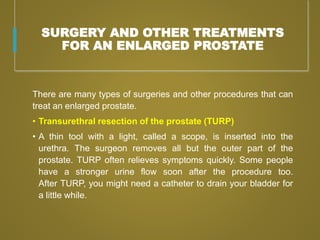
SURGERY AND OTHER TREATMENTS
FOR AN ENLARGED PROSTATE
There are many types of surgeries and other procedures that can
treat an enlarged prostate.
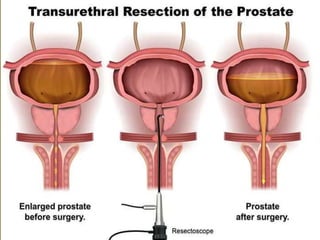
• Transurethral resection of the prostate (TURP)
• A thin tool with a light, called a scope, is inserted into the
urethra. The surgeon removes all but the outer part of the
prostate. TURP often relieves symptoms quickly. Some people
have a stronger urine flow soon after the procedure too.
After TURP, you might need a catheter to drain your bladder for
a little while.
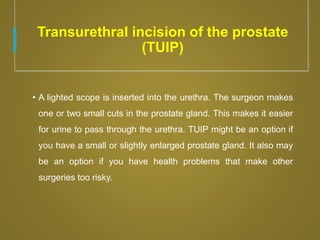
Transurethral incision of the prostate
(TUIP)
• A lighted scope is inserted into the urethra. The surgeon makes
one or two small cuts in the prostate gland. This makes it easier
for urine to pass through the urethra. TUIP might be an option if
you have a small or slightly enlarged prostate gland. It also may
be an option if you have health problems that make other
surgeries too risky.
Transurethral microwave thermotherapy
(TUMT)
• A special catheter is placed through the urethra
into the prostate area. Microwave energy from
the catheter destroys the inner portion of the
enlarged prostate gland. This shrinks the
prostate and eases urine flow. TUMT might
relieve only some of your symptoms. It also
might take some time before you notice results.
In general, this surgery is used only on small
prostates in special situations because the
treatment might be needed again.
Laser therapy
• A high-energy laser destroys or removes overgrown prostate
tissue. Laser therapy has a lower risk of side effects than
does nonlaser surgery. It might be used in people who
shouldn't have other prostate procedures because they take
blood-thinning medicines.
Laser therapy options include:
• Ablative procedures. These destroy prostate tissue that blocks urine
flow. Types of these procedures include photoselective vaporization of
the prostate (PVP) and holmium laser ablation of the prostate. Ablative
procedures can cause irritating symptoms after surgery. In rare cases,
another procedure to remove prostate tissue might be needed at some
point.
• Enucleative procedures. These treatments include holmium laser
enucleation of the prostate (HoLEP). In general, they remove all the
prostate tissue blocking urine flow and prevent tissue from growing
back. The removed tissue can be checked for prostate cancer and other
health problems.
• Prostate lift
• Special tags are used to compress the sides of the prostate.
This can improve the flow of urine. A prostate lift might be an
option if the middle section of the prostate gland doesn't get
in the way of urine flow. It's less likely to cause sexual side
effects than are many other surgical treatments.
• Embolization
• In this experimental procedure, the blood supply to or from
the prostate is blocked in chosen areas. This causes the
prostate to get smaller. Long-term data on how well this
procedure works isn't available.
• Water vapor thermal therapy (WVTT)
• A device is placed in the urethra. It turns water into steam. This
wears away extra prostate tissue. WVTT can ease symptoms of an
enlarged prostate. It is less likely to cause sexual side effects
compared with many other surgical treatments.
• Robotic waterjet treatment
• This procedure uses imaging tests and robotic tools to guide a
device into the urethra. The device releases tiny, powerful jets of
water to remove extra prostate tissue. This can ease symptoms of
an enlarged prostate. Robotic waterjet treatment can cause some
of the same side effects that TURP can cause.
• Open or robot-assisted prostatectomy
• One or more cuts are made in the lower stomach area. This
lets the surgeon reach the prostate and remove tissue. In
general, this type of surgery is done if you have a large or
very large prostate. A short hospital stay is often needed
afterward. The surgery is linked with a higher risk of needing
donated blood due to bleeding.
COMPLICATIONS
• Not being able to pee. This also is called urinary retention. You
might need to have a tube called a catheter placed into your
bladder to drain the urine. Some people with an enlarged prostate
need surgery to get relief.
• Urinary tract infections (UTIs). Not being able to fully empty the
bladder can raise the risk of infection in the urinary tract. If you
often get UTIs, you might need surgery to remove part of the
prostate.
• Bladder stones. These are most often caused by being unable to
fully empty the bladder. Bladder stones can cause illness, bladder
irritation, blood in the urine and blocked urine flow.
• Bladder damage. A bladder that doesn't empty fully can
stretch and weaken over time. As a result, the muscular wall
of the bladder no longer squeezes properly to force urine out.
And this makes it harder to fully empty the bladder.
• Kidney damage. Pressure in the bladder from not being able
to pee can damage the kidneys or let bladder infections reach
the kidneys.
LIFESTYLE AND HOME REMEDIES
• You can do things at home to help control the symptoms of an
enlarged prostate.
• Try to make healthy diet and exercise changes:
• Drink less at night. Don't drink anything for an hour or two before
bedtime. This helps prevent trips to the bathroom overnight.
• Limit caffeine and alcohol. They can cause the body to make
more urine, irritate the bladder and make symptoms worse.
• Watch what you eat. Foods with lots of seasoning can irritate the
bladder.
• Become more active. Exercise can help reduce urinary
problems caused by an enlarged prostate.
• Stay at a healthy weight. Obesity is linked with an enlarged
prostate.
Nursing Assessment
• Obtain history of voiding symptoms, including onset, frequency of
day and nighttime urination, presence of urgency, dysuria,
sensation of incomplete bladder emptying, and decreased force of
stream. Determine impact on quality of life.
• Perform rectal (palpate size, shape, and consistency) and abdominal
examination to detect distended bladder, degree of prostatic
enlargement.
• Perform simple urodynamic measures—uroflowmetry and
measurement of postvoid residual, if indicated.
Nursing Diagnosis
• Impaired Urinary Elimination related to surgical procedure
and urinary catheter
• Risk for Infection related to surgical incision, immobility, and
urinary catheter
• Acute Pain related to surgical procedure
• Anxiety related to urinary incontinence, difficulty voiding, and
erectile dysfunction
Nursing Interventions
Facilitating Urinary Drainage
• Maintain patency of urethral catheter placed after surgery.
• Monitor flow of three-way closed irrigation and drainage system (see
Figure 21-4) if used. Continuous irrigation helps prevent clot
formation, which can obstruct catheter, cause painful bladder
spasms, and lead to infection.
• Perform manual irrigation with 50 mL irrigating fluid using aseptic
technique.
• Avoid overdistention of bladder, which could lead to hemorrhage.
• Administer anticholinergic medications to reduce bladder spasms,
as ordered.
• Assess degree of hematuria and any clot formation; drainage
should become light pink within 24 hours.
• Report bright red bleeding with increased viscosity (arterial)—may
require surgical intervention.
• Report increase in dark red bleeding (venous)—may require
traction of the catheter so the inflated balloon applies pressure to
prostatic fossa.
• Prepare for blood transfusion if bleeding persists.
• Administer I.V. fluids as ordered, and encourage oral fluids
when tolerated to ensure hydration and urine output.
Preventing Infection
• After open prostatectomy, maintain bed rest for the first 24 hours with
frequent monitoring of vital signs, intake and output, and observation of
incisional dressing, if present.
• After 24 hours, encourage ambulation to prevent venous thrombosis,
pulmonary embolism, and hypostatic pneumonia.
• Observe urine for cloudiness or odor, and obtain urine for evaluation of
infection as ordered.
• Administer antibiotics as prescribed.
• Report testicular pain, swelling, and tenderness, which could indicate
epididymitis from spreading infection.
• Assist with perineal care if perineal incision is present to prevent
contamination by feces.
Relieving Pain
• Administer pain medication, or monitor PCA as directed.
• Position the patient for comfort, and tell him to avoid
straining, which will increase pelvic venous congestion and
may cause hemorrhage.
• Administer stool softeners to prevent discomfort from
constipation.
• Make sure catheter is secured to patient's thigh and tubing is
not creating traction on catheter, which will cause pain and
potential hemorrhage.
Reducing Anxiety
• Reassure patient that urinary incontinence and frequency, urgency,
and dysuria are expected after removal of catheter and should
gradually subside.
• Reassure patient that there may be measures to help.
• Reinforce the risks for impotence as told by the surgeon. Remind
patient that erectile function may not return for as long as 6 months.
• Encourage patient to express fears and anxieties related to
potential loss of sexual function, and to discuss concerns with
partner.
• Advise that options are available to restore sexual function if
impotence persists.
Benign Prostate Hypertrophy_Abhijit.pptx

Benign Prostate Hypertrophy_Abhijit.pptx

  • 2.
    OVERVIEW •Benign prostatic hyperplasia(BPH) is a health issue that becomes more common with age. • It's also called an enlarged prostate. •The prostate is a small gland that helps make semen.
  • 3.
    OVERVIEW •It's found justbelow the bladder. And it often gets bigger as you get older. •An enlarged prostate can cause symptoms that may bother you, such as blocking the flow of urine out of the bladder.
  • 4.
  • 5.
    CAUSES •The actual causeof prostate enlargement is unknown
  • 6.
    RISK FACTORS Aging. Family history. Diabetesand heart disease. Lifestyle.
  • 7.
    RISK FACTORS • Aging.An enlarged prostate gland rarely causes symptoms before age 40. After that, the chance of having an enlarged prostate and related symptoms starts to rise. • Family history. Having a blood relative with prostate problems makes you more likely to have problems with your prostate. • Diabetes and heart disease. Studies show that diabetes might raise the risk of BPH. So might heart disease. • Lifestyle. Obesity raises the risk of BPH. Exercise can help lower the risk
  • 8.
    SYMPTOMS Frequent or urgent needto pee, also called urination. Peeing more often at night. Trouble starting to pee. Weak urine stream, or a stream that stops and starts. Dribbling at the end of urination. Not being able to fully empty the bladder. Common symptoms of BPH include:
  • 9.
    Less common symptomsinclude: Urinary tract infection. Not being able to pee. Blood in the urine.
  • 10.
    INVESTIGATIONS • Digital rectalexam. The provider inserts a finger into your rectum to check prostate is enlarged or not. • Urine test. A lab checks a sample of your urine to find out if you have an illness or other problems that can cause the same symptoms as those of BPH. • Blood test. The results can show if you have kidney problems.
  • 11.
    After that, youmight need other tests that can help confirm an enlarged prostate. These tests include: • Prostate-specific antigen (PSA) blood test. PSA is a protein made in the prostate. PSA levels go up when the prostate becomes enlarged. But higher PSA levels also can be due to recent procedures, illnesses, surgery or prostate cancer. • Urinary flow test. You pee into a container attached to a machine. The machine measures how strong your urine flow is and how much urine you pass. Test results can show over time whether your condition is getting better or worse.
  • 12.
    • Postvoid residualvolume test. This test measures whether you can empty your bladder fully. The test can be done using an imaging exam called ultrasound. Or it can be done with a tube called a catheter placed into your bladder after you pee to measure how much urine is left in the bladder. • 24-hour voiding diary. This involves noting how often and how much you pee. It might be extra helpful if you make more than a third of your daily urine at night.
  • 13.
    If your healthproblem is more complex, you may need tests including: • Transrectal ultrasound. A device that uses sound waves to make pictures is inserted into the rectum. It measures and checks the prostate. • Prostate biopsy. Transrectal ultrasound guides needles that are used to take tissue samples of the prostate. Checking the tissue can help your provider find out if you have prostate cancer.
  • 14.
    • Urodynamic andpressure flow studies. A catheter is threaded through the urethra into the bladder. Water — or, less often, air — is slowly sent into the bladder to measure bladder pressure and check how well the bladder muscles work. • Cystoscopy. A lighted, flexible tool is placed into the urethra. It lets a provider see inside the urethra and bladder. Before this test, you will be given a medicine that keeps you from feeling pain.
  • 15.
    TREATMENT • Many treatmentsare available for enlarged prostate. These include medicines, surgery and procedures that involve smaller, fewer or no cuts. The best treatment choice depends on: • The size of your prostate. • age. • overall health. • How serious your symptoms are.
  • 16.
    MEDICINES FOR ANENLARGED PROSTATE • Taking medicine is the most common treatment for mild to moderate symptoms of an enlarged prostate. Options include: • Alpha blockers. Alpha blockers work by relaxing the smooth muscle of the bladder neck and prostate. This makes peeing easier. Alpha blockers include alfuzosin (Uroxatral), doxazosin (Cardura), tamsulosin (Flomax) silodosin (Rapaflo) and terazosin. They often work quickly in people with somewhat smaller prostates. Side effects might include dizziness. They also may include a harmless issue in which semen goes back into the bladder instead of out the tip of the penis. This is called retrograde ejaculation.
  • 17.
    • 5-alpha reductaseinhibitors. These medicines shrink the prostate. They do this by preventing hormone changes that cause the prostate to grow. Examples include finasteride (Proscar) and dutasteride (Avodart). They might take up to six months to work well and can cause sexual side effects.
  • 18.
    • Combination therapy.Your health care provider might suggest that you take an alpha blocker and a 5-alpha reductase inhibitor at the same time if either medicine alone doesn't help enough. • Tadalafil (Cialis). This medicine is often used to treat erectile dysfunction. Studies suggest it also can treat an enlarged prostate.
  • 19.
    SURGERY AND OTHERTREATMENTS FOR AN ENLARGED PROSTATE There are many types of surgeries and other procedures that can treat an enlarged prostate. • Transurethral resection of the prostate (TURP) • A thin tool with a light, called a scope, is inserted into the urethra. The surgeon removes all but the outer part of the prostate. TURP often relieves symptoms quickly. Some people have a stronger urine flow soon after the procedure too. After TURP, you might need a catheter to drain your bladder for a little while.
  • 21.
    Transurethral incision ofthe prostate (TUIP) • A lighted scope is inserted into the urethra. The surgeon makes one or two small cuts in the prostate gland. This makes it easier for urine to pass through the urethra. TUIP might be an option if you have a small or slightly enlarged prostate gland. It also may be an option if you have health problems that make other surgeries too risky.
  • 22.
    Transurethral microwave thermotherapy (TUMT) •A special catheter is placed through the urethra into the prostate area. Microwave energy from the catheter destroys the inner portion of the enlarged prostate gland. This shrinks the prostate and eases urine flow. TUMT might relieve only some of your symptoms. It also might take some time before you notice results. In general, this surgery is used only on small prostates in special situations because the treatment might be needed again.
  • 23.
    Laser therapy • Ahigh-energy laser destroys or removes overgrown prostate tissue. Laser therapy has a lower risk of side effects than does nonlaser surgery. It might be used in people who shouldn't have other prostate procedures because they take blood-thinning medicines.
  • 24.
    Laser therapy optionsinclude: • Ablative procedures. These destroy prostate tissue that blocks urine flow. Types of these procedures include photoselective vaporization of the prostate (PVP) and holmium laser ablation of the prostate. Ablative procedures can cause irritating symptoms after surgery. In rare cases, another procedure to remove prostate tissue might be needed at some point. • Enucleative procedures. These treatments include holmium laser enucleation of the prostate (HoLEP). In general, they remove all the prostate tissue blocking urine flow and prevent tissue from growing back. The removed tissue can be checked for prostate cancer and other health problems.
  • 25.
    • Prostate lift •Special tags are used to compress the sides of the prostate. This can improve the flow of urine. A prostate lift might be an option if the middle section of the prostate gland doesn't get in the way of urine flow. It's less likely to cause sexual side effects than are many other surgical treatments. • Embolization • In this experimental procedure, the blood supply to or from the prostate is blocked in chosen areas. This causes the prostate to get smaller. Long-term data on how well this procedure works isn't available.
  • 26.
    • Water vaporthermal therapy (WVTT) • A device is placed in the urethra. It turns water into steam. This wears away extra prostate tissue. WVTT can ease symptoms of an enlarged prostate. It is less likely to cause sexual side effects compared with many other surgical treatments. • Robotic waterjet treatment • This procedure uses imaging tests and robotic tools to guide a device into the urethra. The device releases tiny, powerful jets of water to remove extra prostate tissue. This can ease symptoms of an enlarged prostate. Robotic waterjet treatment can cause some of the same side effects that TURP can cause.
  • 27.
    • Open orrobot-assisted prostatectomy • One or more cuts are made in the lower stomach area. This lets the surgeon reach the prostate and remove tissue. In general, this type of surgery is done if you have a large or very large prostate. A short hospital stay is often needed afterward. The surgery is linked with a higher risk of needing donated blood due to bleeding.
  • 28.
    COMPLICATIONS • Not beingable to pee. This also is called urinary retention. You might need to have a tube called a catheter placed into your bladder to drain the urine. Some people with an enlarged prostate need surgery to get relief. • Urinary tract infections (UTIs). Not being able to fully empty the bladder can raise the risk of infection in the urinary tract. If you often get UTIs, you might need surgery to remove part of the prostate. • Bladder stones. These are most often caused by being unable to fully empty the bladder. Bladder stones can cause illness, bladder irritation, blood in the urine and blocked urine flow.
  • 29.
    • Bladder damage.A bladder that doesn't empty fully can stretch and weaken over time. As a result, the muscular wall of the bladder no longer squeezes properly to force urine out. And this makes it harder to fully empty the bladder. • Kidney damage. Pressure in the bladder from not being able to pee can damage the kidneys or let bladder infections reach the kidneys.
  • 30.
    LIFESTYLE AND HOMEREMEDIES • You can do things at home to help control the symptoms of an enlarged prostate. • Try to make healthy diet and exercise changes: • Drink less at night. Don't drink anything for an hour or two before bedtime. This helps prevent trips to the bathroom overnight. • Limit caffeine and alcohol. They can cause the body to make more urine, irritate the bladder and make symptoms worse. • Watch what you eat. Foods with lots of seasoning can irritate the bladder.
  • 31.
    • Become moreactive. Exercise can help reduce urinary problems caused by an enlarged prostate. • Stay at a healthy weight. Obesity is linked with an enlarged prostate.
  • 32.
    Nursing Assessment • Obtainhistory of voiding symptoms, including onset, frequency of day and nighttime urination, presence of urgency, dysuria, sensation of incomplete bladder emptying, and decreased force of stream. Determine impact on quality of life. • Perform rectal (palpate size, shape, and consistency) and abdominal examination to detect distended bladder, degree of prostatic enlargement. • Perform simple urodynamic measures—uroflowmetry and measurement of postvoid residual, if indicated.
  • 33.
    Nursing Diagnosis • ImpairedUrinary Elimination related to surgical procedure and urinary catheter • Risk for Infection related to surgical incision, immobility, and urinary catheter • Acute Pain related to surgical procedure • Anxiety related to urinary incontinence, difficulty voiding, and erectile dysfunction
  • 34.
    Nursing Interventions Facilitating UrinaryDrainage • Maintain patency of urethral catheter placed after surgery. • Monitor flow of three-way closed irrigation and drainage system (see Figure 21-4) if used. Continuous irrigation helps prevent clot formation, which can obstruct catheter, cause painful bladder spasms, and lead to infection. • Perform manual irrigation with 50 mL irrigating fluid using aseptic technique. • Avoid overdistention of bladder, which could lead to hemorrhage. • Administer anticholinergic medications to reduce bladder spasms, as ordered.
  • 35.
    • Assess degreeof hematuria and any clot formation; drainage should become light pink within 24 hours. • Report bright red bleeding with increased viscosity (arterial)—may require surgical intervention. • Report increase in dark red bleeding (venous)—may require traction of the catheter so the inflated balloon applies pressure to prostatic fossa. • Prepare for blood transfusion if bleeding persists. • Administer I.V. fluids as ordered, and encourage oral fluids when tolerated to ensure hydration and urine output.
  • 36.
    Preventing Infection • Afteropen prostatectomy, maintain bed rest for the first 24 hours with frequent monitoring of vital signs, intake and output, and observation of incisional dressing, if present. • After 24 hours, encourage ambulation to prevent venous thrombosis, pulmonary embolism, and hypostatic pneumonia. • Observe urine for cloudiness or odor, and obtain urine for evaluation of infection as ordered. • Administer antibiotics as prescribed. • Report testicular pain, swelling, and tenderness, which could indicate epididymitis from spreading infection. • Assist with perineal care if perineal incision is present to prevent contamination by feces.
  • 37.
    Relieving Pain • Administerpain medication, or monitor PCA as directed. • Position the patient for comfort, and tell him to avoid straining, which will increase pelvic venous congestion and may cause hemorrhage. • Administer stool softeners to prevent discomfort from constipation. • Make sure catheter is secured to patient's thigh and tubing is not creating traction on catheter, which will cause pain and potential hemorrhage.
  • 38.
    Reducing Anxiety • Reassurepatient that urinary incontinence and frequency, urgency, and dysuria are expected after removal of catheter and should gradually subside. • Reassure patient that there may be measures to help. • Reinforce the risks for impotence as told by the surgeon. Remind patient that erectile function may not return for as long as 6 months. • Encourage patient to express fears and anxieties related to potential loss of sexual function, and to discuss concerns with partner. • Advise that options are available to restore sexual function if impotence persists.