1
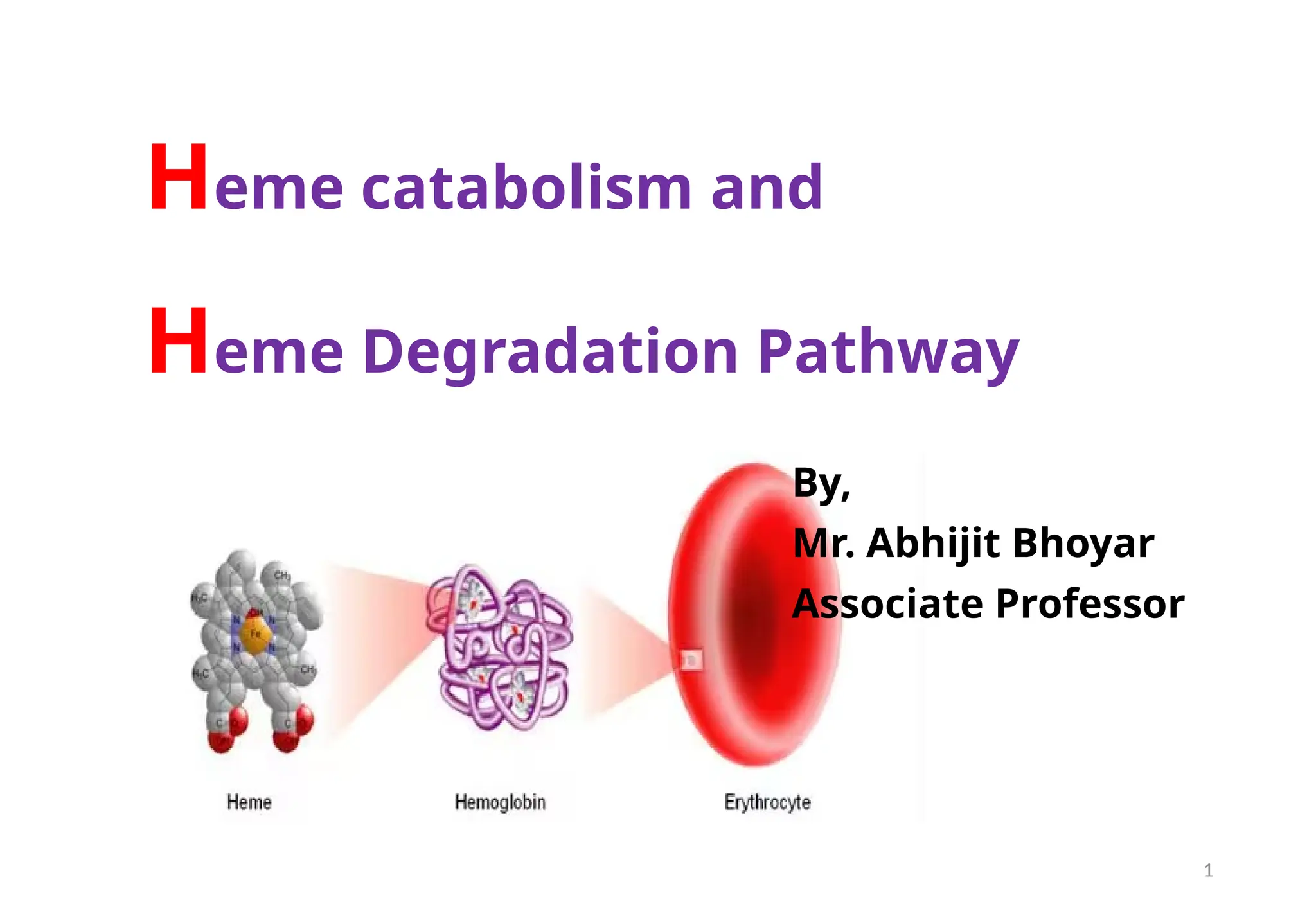
Heme catabolism and
Heme Degradation Pathway
By,
Mr. Abhijit Bhoyar
Associate Professor
Specific Learning objectives
At the end of the lecture students will be able to
• Describe the heme structure
• Explain the structure & function of hemoglobin
• Discuss the role of nucleic acids
• Illustrate biosynthesis of proteins
Introduction
• Hemoglobin – red coloring matter of blood Present in RBC
• Conjugated protein – heme & globin
• Molecular weight = 64,450
• Can combine with O
• Transport of O within blood
• Combination of two structures
• Structure of Heme
• Structure of globin – protein
Structure of Hemoglobin
Structure of Heme
• An iron porphyrin – cyclic compound
• Porphyrin = tetra pyrrole ring like structure
• 4 pyrrole rings are linked through methylene or
methylidene bridges
• Outer C atoms are not linked and numbered as 1-8
Structure of Heme
• Iron in the ferrous state is bound to nitrogen atom of the pyrrole
rings
Structure of Globin
• Globin is protein part of hemoglobin
• Composed of 4 parallel layers of closely packed polypeptide chians
• 2 chains have identical AA composition of 141 AA
• Remaining 2 have 146 AA each
• Total no. of AA in globin is 574
Structure of Globin
• Alpha chains 2 chain
• Beta chains 2 chain
• Hb molecule & sub-units contain hydrophobic AA
internally & hydrophyllic AA on their surfaces
• The resulting heme pockets provide for entry of O2
Properties of Hemoglobin
• Oxyhemoglobin – Hb + O2 - Transport of O to different parts of
the body
• Formaton of Carbamino compound – Hb+C O2
• Reaction with CO – Forms Carboxy-hemoglobin – prevents
formation of oxyhemoglobin – dangerous to inhale even small
amounts of CO
• Buffering Action – Hb + O2
• Buffering Action – 1 mole of Hb contains 35 histidine
residues – exerts buffering action – Hb play imp in
regulating acid-base balance of blood
• Formation of methemoglobin – by oxidaton of Hb – cannot
carry O – methemoglobin is reduced to Hb by Vit. C
Biosynthesis of hemoglobin
• In bone marrow – erythroid cell during development of
erythrocyte
• Iron in Ferrous state incorporated into protoporphyrin
to form Heme
• Heme attached to newly formed Globin = Hb
Biosynthesis of Proteins
• 3 phases
1)Initiation
• Dissociation of ribosomes
• Formation of 40s preinitiation complex
• Formation of 40s initiation complex
• Formation of 80s initiation complex
2)Elongation
• Binding of Aminoacyl - tRNA to A siter
• Peptide bond formation
• Translocation
3)Termination
Role of Nucleic Acids in Biosynthesis of
proteins
2 types of NA
• DNA
• Deoxyribonucleic acid
• RNA
• Ribonucleic acid
Functions of Nucleic acids
• DNA - chemical basis for heredity
• Reserve bank of genetic information
• Responsible for maintaining the identity of different species
• Control every cellular function
• Organized into genes – the fundamental units of genetic
information
• Control protein synthesis through mediation of RNA
Components of Nucleic acids
• NA – polymers of nucleotides
• Nucleotides – composed of a nitrogenous base, a
pentose sugar & a phosphate
• A nitrogenous base + a pentose sugar = nucleoside
• Nucleotide = nucleoside + phosphate
• Nitrogenous bases – aromatic, heterocyclic compounds
Functions of Nucleotides
• Building blocks of nucleic acids
• Structural components of several coenzymes
• Serve as carriers of high energy intermediates in the
biosynthesis of CHO, lipids & proteins
Functions of Nucleotides
• Involved in the energy reactions of the cell – ATP is
energy currency
• As allosteric regulators – control several metabolic
reactions
• Cyclic AMP & Cyclic GMP = second messengers in
hormonal functions
Structure of Nucleotides
• Nitrogenous bases – two types
• Purines
• Adenine (A)
• Guanine (G)
• Pyrimidines
• Cytosine (C) found in both DNA & RNA
• Thymine (T) in DNA
• Uracil (U) in RNA
Difference between DNA & RNA
DNA
1. Sugar – deoxyribose
2. Pyrimidine – thymine
3. Double stranded
structure
4. Number of Guanine
equals Number of
cytosine = Chargaff’s rule
- obeyed
5. Reservoir of genetic
information
RNA
1. Ribose sugar
2. Pyrimidine – uracil
3. Usually single stranded structure
4. Guanine content is not equal to
cytosine = Chargaff’s rule – not
obeyed
5. Identified by Orcinol color reaction
6. 3 different types – based on cellular
composition
7. Responsible for transfer of genetic
material
Types of RNA
• Messenger RNA = mRNA
• Synthesized in nucleus
• Enter the cytoplasm to participate in protein synthesis
• High molecular weight with short half-life
• Transfer RNA = tRNA
• Molecular wt = 25000
• 20 species of tRNA corresponding to 20AA
• Contains 4 arms
• Structure resembles clover leaf
• Ribosomal RNA = rRNA
• Ribosomes = factories of protein synthesis
• Play significant role in binding of mRNA to ribosomes
• Responsible for protein synthesis
Expected Question
• Essay /Situation Question
• Explain the structure & function of hemoglobin
• Explain Nucleic Acids in Biosynthesis of proteins
• Short Question
• Explain heme and chlorophylls.
• Describe biosynthesis of proteins in the cells and role of
nucleic acids in protein synthesis.
• Defference between DNA&RNA
THANK YOU

Heme degradation pathway- I.pptx_Nursing students

  • 1.
    1 Heme catabolism and HemeDegradation Pathway By, Mr. Abhijit Bhoyar Associate Professor
  • 2.
    Specific Learning objectives Atthe end of the lecture students will be able to • Describe the heme structure • Explain the structure & function of hemoglobin • Discuss the role of nucleic acids • Illustrate biosynthesis of proteins
  • 3.
    Introduction • Hemoglobin –red coloring matter of blood Present in RBC • Conjugated protein – heme & globin • Molecular weight = 64,450 • Can combine with O • Transport of O within blood
  • 4.
    • Combination oftwo structures • Structure of Heme • Structure of globin – protein Structure of Hemoglobin
  • 5.
    Structure of Heme •An iron porphyrin – cyclic compound • Porphyrin = tetra pyrrole ring like structure • 4 pyrrole rings are linked through methylene or methylidene bridges • Outer C atoms are not linked and numbered as 1-8
  • 6.
    Structure of Heme •Iron in the ferrous state is bound to nitrogen atom of the pyrrole rings Structure of Globin • Globin is protein part of hemoglobin • Composed of 4 parallel layers of closely packed polypeptide chians • 2 chains have identical AA composition of 141 AA • Remaining 2 have 146 AA each • Total no. of AA in globin is 574
  • 7.
    Structure of Globin •Alpha chains 2 chain • Beta chains 2 chain • Hb molecule & sub-units contain hydrophobic AA internally & hydrophyllic AA on their surfaces • The resulting heme pockets provide for entry of O2
  • 8.
    Properties of Hemoglobin •Oxyhemoglobin – Hb + O2 - Transport of O to different parts of the body • Formaton of Carbamino compound – Hb+C O2 • Reaction with CO – Forms Carboxy-hemoglobin – prevents formation of oxyhemoglobin – dangerous to inhale even small amounts of CO • Buffering Action – Hb + O2
  • 9.
    • Buffering Action– 1 mole of Hb contains 35 histidine residues – exerts buffering action – Hb play imp in regulating acid-base balance of blood • Formation of methemoglobin – by oxidaton of Hb – cannot carry O – methemoglobin is reduced to Hb by Vit. C
  • 10.
    Biosynthesis of hemoglobin •In bone marrow – erythroid cell during development of erythrocyte • Iron in Ferrous state incorporated into protoporphyrin to form Heme • Heme attached to newly formed Globin = Hb
  • 11.
    Biosynthesis of Proteins •3 phases 1)Initiation • Dissociation of ribosomes • Formation of 40s preinitiation complex • Formation of 40s initiation complex • Formation of 80s initiation complex
  • 12.
    2)Elongation • Binding ofAminoacyl - tRNA to A siter • Peptide bond formation • Translocation 3)Termination
  • 13.
    Role of NucleicAcids in Biosynthesis of proteins 2 types of NA • DNA • Deoxyribonucleic acid • RNA • Ribonucleic acid
  • 14.
    Functions of Nucleicacids • DNA - chemical basis for heredity • Reserve bank of genetic information • Responsible for maintaining the identity of different species • Control every cellular function • Organized into genes – the fundamental units of genetic information • Control protein synthesis through mediation of RNA
  • 15.
    Components of Nucleicacids • NA – polymers of nucleotides • Nucleotides – composed of a nitrogenous base, a pentose sugar & a phosphate • A nitrogenous base + a pentose sugar = nucleoside • Nucleotide = nucleoside + phosphate • Nitrogenous bases – aromatic, heterocyclic compounds
  • 16.
    Functions of Nucleotides •Building blocks of nucleic acids • Structural components of several coenzymes • Serve as carriers of high energy intermediates in the biosynthesis of CHO, lipids & proteins
  • 17.
    Functions of Nucleotides •Involved in the energy reactions of the cell – ATP is energy currency • As allosteric regulators – control several metabolic reactions • Cyclic AMP & Cyclic GMP = second messengers in hormonal functions
  • 18.
    Structure of Nucleotides •Nitrogenous bases – two types • Purines • Adenine (A) • Guanine (G) • Pyrimidines • Cytosine (C) found in both DNA & RNA • Thymine (T) in DNA • Uracil (U) in RNA
  • 19.
    Difference between DNA& RNA DNA 1. Sugar – deoxyribose 2. Pyrimidine – thymine 3. Double stranded structure 4. Number of Guanine equals Number of cytosine = Chargaff’s rule - obeyed 5. Reservoir of genetic information RNA 1. Ribose sugar 2. Pyrimidine – uracil 3. Usually single stranded structure 4. Guanine content is not equal to cytosine = Chargaff’s rule – not obeyed 5. Identified by Orcinol color reaction 6. 3 different types – based on cellular composition 7. Responsible for transfer of genetic material
  • 20.
    Types of RNA •Messenger RNA = mRNA • Synthesized in nucleus • Enter the cytoplasm to participate in protein synthesis • High molecular weight with short half-life • Transfer RNA = tRNA • Molecular wt = 25000 • 20 species of tRNA corresponding to 20AA • Contains 4 arms • Structure resembles clover leaf
  • 21.
    • Ribosomal RNA= rRNA • Ribosomes = factories of protein synthesis • Play significant role in binding of mRNA to ribosomes • Responsible for protein synthesis
  • 22.
    Expected Question • Essay/Situation Question • Explain the structure & function of hemoglobin • Explain Nucleic Acids in Biosynthesis of proteins • Short Question • Explain heme and chlorophylls. • Describe biosynthesis of proteins in the cells and role of nucleic acids in protein synthesis. • Defference between DNA&RNA
  • 23.