





DISCIPLINE
By
Mr. Abhijit Bhoyar
INTRODUCTION
ONE METHOD BY WHICH A NURSE
MANAGER CAN CONTROL
SUBORDINATES BEHAVIOUR IS TO
INVOKE OFFICIAL DISCIPLINARY
PROCEDURE.
DISCIPLINE CAN BE SELF-CONTROL BY WHICH AN
EMPLOYEE BRINGS HIS OR HER BEHAVIOUR INTO
AGREEMENT WITH THE AGENCYโ€˜S OFFICIAL BEHAVIOUR
CODE
DEFINITION
Discipline is defined as a training
or moulding of the mind and
character to bring about desired
behaviours.
AIMS AND OBJECTIVES OF
DISCIPLINE
โ€ข To obtain a willing acceptance of the rules,
regulations and procedures of an
organization so that organizational goals
can be achieved.
โ€ข To impart an element of certainty despite
several differences in informal behavior
patterns and other related changes in an
organization
โ€ข To develop among the employees a spirit
of tolerance and a desire to make
adjustments
AIMS AND OBJECTIVES
OF DISCIPLINE
โ€ข To give and seek direction and
responsibility
โ€ข To create an atmosphere of respect
for the human personality and human
relations
โ€ข To increase the working efficiency
and morale of the employees so that
their productivity is stepped up, the
cost of production brought down and
the quality of production improved.
PRINCIPLES OF
DISCIPLINARY ACTION
1. Have a positive
attitude
2. Investigate
carefully
3. Be prompt
4. Protect privacy
5. Focus on the act
6. Enforce rules
consistently
7. Be flexible
8. Advise the
employee
9. Take corrective,
consistent action
10.Follow up
Have a positive attitude
โ€ข The managerโ€˜s attitude is very important in
preventing or correcting undesirable
behavior.
โ€ข People tend to do what is expected of them.
Therefore the manager must maintain a
positive attitude by expecting the best from
the staff.
Investigate carefully
โ€ข The ramifications of a disciplinary action are
serious.
โ€ข If a staff nurse is disciplined unfairly or
unnecessarily, the effects on the entire staff nurse
may be severe. Therefore managers must proceed
with caution.
โ€ข They should collect facts, check allegations, and
even ask the accused employees for their side of
the story
Be prompt
โ€ข If the disciplinary action is
delayed, the relationship
between the punishment and
the offense becomes less clear
Protect privacy
โ€ข Disciplinary actions affect the ego of the staff
nurse.
โ€ข Discussing the situation in private, causes less
resentment and greater chance for future co-
operation. However, a public reprimand may be
necessary for the nurse who does not take
private criticism seriously
Focus on the act
โ€ข When disciplining a staff nurse, the
manager should emphasize that it was the
act that was unacceptable, not the
employee
Enforce rules
consistently
โ€ข Consistency reduces the possibility of
favoritism, promotes predictability, and
fosters acceptance of penalties.
โ€ข Be flexible: individuals and
circumstances are never the same. A
penalty should be determined only after
the entire record is reviewed.
โ€ข Advise the employee: The employees
must be informed that their conduct is
not acceptable. Anecdoctal notes can
be of little value if the staff nurse is not
informed of the contents promptly.
Take corrective, consistent action: The manager should be sure that
the staff nurse understands that the behavior was contrary to the
organizations requirements.
Follow up: The manager should quietly investigate to determine
whether the staff nurse behavior has changed. If not, the manager
should determine the reason for the nurseโ€˜s attitude.
COMPONENTS OF A
DISCIPLINARY ACTION
PROGRAM
1. CODES OF CONDUCT
2. AUTHORISED PENALTIES
3. RECORDS OF OFFENCES AND CORRECTIVE
MEASURES
4. RIGHT OF APPEAL
APPROACHES OF
DISCIPLINE
โ€ข TRADITIONAL APPROACH
โ€ข DEVELOPMENTAL APPROACH
โ€ข POSITIVE DISCIPLINE APPROACH
โ€ข SELF CONTROLLED DISCIPLINE APPROACH
โ€ข ENFORCED DISCIPLINE APPROACH
TRADITIONAL
APPROACH
โ€ข It emphasizes punishment for undesirable behaviour.
โ€ข The purposes of traditional discipline are punishment for
sin, enforce conformity to custom, and strengthen
authority of the old over the young.
โ€ข Here discipline is always applied by superiors to
subordinates, the severity of punishments is designed to
be proportional to the severity of the offense, and when
no single individual admits to the violation, the whole
group is punished to motivate group members to identify
the violator or punish him or her themselves
DEVELOPMENTAL
APPROACH
โ€ข It emphasizes discipline as a shaper of desirable
behavior.
โ€ข The purpose of developmental discipline is to
shape behaviour by providing favourable
consequences for the right behavior and
unfavorable consequences for the wrong
behavior; and avoidance of physical punishment,
protection of the rights of the accused and
replacement of arbitrary individual judgments of
guilt
POSITIVE DISCIPLINE APPROACH
It is based on the assumption that an employee with self-respect, respect for authority, and
interest in the job will adhere to high quality work standards; and when an interested,
respectful and self-respecting worker temporarily strays from his/ her usually highs
standards, a friendly reminder is enough to redirect their efforts in the desired direction
Organisations that have employed a positive discipline have noted a subsequent decrease
in absences, dissmisals, disciplinary actions, grievances and arbitration, along with
improvement of employee morale.
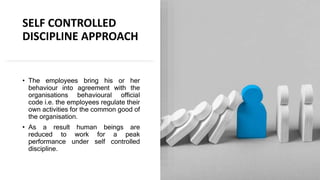
SELF CONTROLLED
DISCIPLINE APPROACH
โ€ข The employees bring his or her
behaviour into agreement with the
organisations behavioural official
code i.e. the employees regulate their
own activities for the common good of
the organisation.
โ€ข As a result human beings are
reduced to work for a peak
performance under self controlled
discipline.
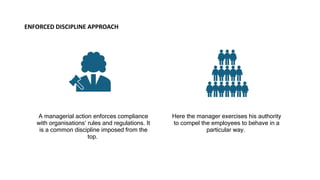
ENFORCED DISCIPLINE APPROACH
A managerial action enforces compliance
with organisationsโ€˜ rules and regulations. It
is a common discipline imposed from the
top.
Here the manager exercises his authority
to compel the employees to behave in a
particular way.
DEALING WITH
DISCIPLINARY
PROBLEMS
โ€ข Disciplinary action may be ineffective
because of methodological weakness or of
procedural omissions by the manager.
Methodological problems result from
improper documentation of disciplinary
interview and procedural problems from
failure to apply discipline in a timely fashion
and to follow due process.
1. DISCIPLINARY
CONFERENCE
โ€ข It is a group discussion using both
directive and non-directive interview
techniques. It is damaging to
employeeโ€˜s self-esteem to receive
criticism from an authoritative figure.
Thus a disciplinary conference is
anxiety provoking situation for both
employee and the manager.
2.
DISCIPLINARY LETTER
โ€ข It is a letter send to the
nurse/employee immediately after the
conference, documenting the
interview content from the
managers viewpoint. It is needed as
sometimes employeeโ€˜s anxiety may
block perception of the painful
feedback offered by the manager.
3. MODEL
STANDING ORDERS
โ€ข It specifies the terms and conditions
which govern day to day employer-
employee relationship, infringement
of which could result in a charge
of misconduct
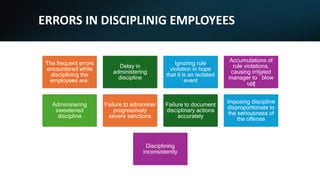
ERRORS IN DISCIPLINIG EMPLOYEES
The frequent errors
encountered while
disciplining the
employees are:
Delay in
administering
discipline
Ignoring rule
violation in hope
that it is an isolated
event
Accumulations of
rule violations,
causing irritated
manager to โ€•blow
upโ€–
Administering
sweetened
discipline
Failure to administer
progressively
severe sanctions
Failure to document
disciplinary actions
accurately
Imposing discipline
disproportionate to
the seriousness of
the offense
Disciplining
inconsistently
DISCIPLINARY
PROCEEDINGS
ENQUIRY IN
MANAGEMENT
โ€ข CSR(CENTRAL CIVIL
SERVICES RULES) AND
KCSR(KARNATAKA CIVIL
SERVICES RULES)
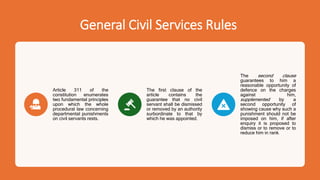
General Civil Services Rules
Article 311 of the
constitution enumerates
two fundamental principles
upon which the whole
procedural law concerning
departmental punishments
on civil servants rests.
The first clause of the
article contains the
guarantee that no civil
servant shall be dismissed
or removed by an authority
surbordinate to that by
which he was appointed.
The second clause
guarantees to him a
reasonable opportunity of
defence on the charges
against him,
supplemented by a
second opportunity of
showing cause why such a
punishment should not be
imposed on him, if after
enquiry it is proposed to
dismiss or to remove or to
reduce him in rank.
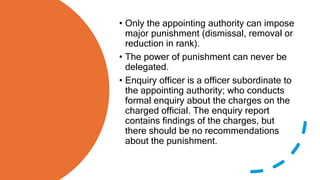
โ€ข Only the appointing authority can impose
major punishment (dismissal, removal or
reduction in rank).
โ€ข The power of punishment can never be
delegated.
โ€ข Enquiry officer is a officer subordinate to
the appointing authority; who conducts
formal enquiry about the charges on the
charged official. The enquiry report
contains findings of the charges, but
there should be no recommendations
about the punishment.
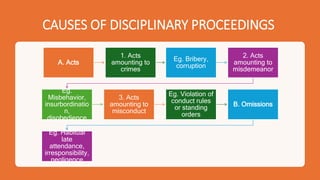
CAUSES OF DISCIPLINARY PROCEEDINGS
A. Acts
1. Acts
amounting to
crimes
Eg. Bribery,
corruption
2. Acts
amounting to
misdemeanor
Eg.
Misbehavior,
insurbordinatio
n,
disobedience
3. Acts
amounting to
misconduct
Eg. Violation of
conduct rules
or standing
orders
B. Omissions
Eg. Habitual
late
attendance,
irresponsibility,
negligence
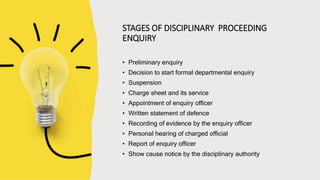
STAGES OF DISCIPLINARY PROCEEDING
ENQUIRY
โ€ข Preliminary enquiry
โ€ข Decision to start formal departmental enquiry
โ€ข Suspension
โ€ข Charge sheet and its service
โ€ข Appointment of enquiry officer
โ€ข Written statement of defence
โ€ข Recording of evidence by the enquiry officer
โ€ข Personal hearing of charged official
โ€ข Report of enquiry officer
โ€ข Show cause notice by the disciplinary authority
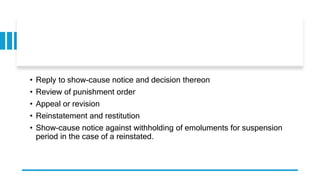
โ€ข Reply to show-cause notice and decision thereon
โ€ข Review of punishment order
โ€ข Appeal or revision
โ€ข Reinstatement and restitution
โ€ข Show-cause notice against withholding of emoluments for suspension
period in the case of a reinstated.
Thank you

Discipline. pptx (Nursing management) nursing

  • 1.
  • 2.
    INTRODUCTION ONE METHOD BYWHICH A NURSE MANAGER CAN CONTROL SUBORDINATES BEHAVIOUR IS TO INVOKE OFFICIAL DISCIPLINARY PROCEDURE. DISCIPLINE CAN BE SELF-CONTROL BY WHICH AN EMPLOYEE BRINGS HIS OR HER BEHAVIOUR INTO AGREEMENT WITH THE AGENCYโ€˜S OFFICIAL BEHAVIOUR CODE
  • 3.
    DEFINITION Discipline is definedas a training or moulding of the mind and character to bring about desired behaviours.
  • 4.
    AIMS AND OBJECTIVESOF DISCIPLINE โ€ข To obtain a willing acceptance of the rules, regulations and procedures of an organization so that organizational goals can be achieved. โ€ข To impart an element of certainty despite several differences in informal behavior patterns and other related changes in an organization โ€ข To develop among the employees a spirit of tolerance and a desire to make adjustments
  • 5.
    AIMS AND OBJECTIVES OFDISCIPLINE โ€ข To give and seek direction and responsibility โ€ข To create an atmosphere of respect for the human personality and human relations โ€ข To increase the working efficiency and morale of the employees so that their productivity is stepped up, the cost of production brought down and the quality of production improved.
  • 6.
    PRINCIPLES OF DISCIPLINARY ACTION 1.Have a positive attitude 2. Investigate carefully 3. Be prompt 4. Protect privacy 5. Focus on the act 6. Enforce rules consistently 7. Be flexible 8. Advise the employee 9. Take corrective, consistent action 10.Follow up
  • 7.
    Have a positiveattitude โ€ข The managerโ€˜s attitude is very important in preventing or correcting undesirable behavior. โ€ข People tend to do what is expected of them. Therefore the manager must maintain a positive attitude by expecting the best from the staff.
  • 8.
    Investigate carefully โ€ข Theramifications of a disciplinary action are serious. โ€ข If a staff nurse is disciplined unfairly or unnecessarily, the effects on the entire staff nurse may be severe. Therefore managers must proceed with caution. โ€ข They should collect facts, check allegations, and even ask the accused employees for their side of the story
  • 9.
    Be prompt โ€ข Ifthe disciplinary action is delayed, the relationship between the punishment and the offense becomes less clear
  • 10.
    Protect privacy โ€ข Disciplinaryactions affect the ego of the staff nurse. โ€ข Discussing the situation in private, causes less resentment and greater chance for future co- operation. However, a public reprimand may be necessary for the nurse who does not take private criticism seriously
  • 11.
    Focus on theact โ€ข When disciplining a staff nurse, the manager should emphasize that it was the act that was unacceptable, not the employee
  • 12.
    Enforce rules consistently โ€ข Consistencyreduces the possibility of favoritism, promotes predictability, and fosters acceptance of penalties.
  • 13.
    โ€ข Be flexible:individuals and circumstances are never the same. A penalty should be determined only after the entire record is reviewed. โ€ข Advise the employee: The employees must be informed that their conduct is not acceptable. Anecdoctal notes can be of little value if the staff nurse is not informed of the contents promptly.
  • 14.
    Take corrective, consistentaction: The manager should be sure that the staff nurse understands that the behavior was contrary to the organizations requirements. Follow up: The manager should quietly investigate to determine whether the staff nurse behavior has changed. If not, the manager should determine the reason for the nurseโ€˜s attitude.
  • 15.
    COMPONENTS OF A DISCIPLINARYACTION PROGRAM 1. CODES OF CONDUCT 2. AUTHORISED PENALTIES 3. RECORDS OF OFFENCES AND CORRECTIVE MEASURES 4. RIGHT OF APPEAL
  • 16.
    APPROACHES OF DISCIPLINE โ€ข TRADITIONALAPPROACH โ€ข DEVELOPMENTAL APPROACH โ€ข POSITIVE DISCIPLINE APPROACH โ€ข SELF CONTROLLED DISCIPLINE APPROACH โ€ข ENFORCED DISCIPLINE APPROACH
  • 17.
    TRADITIONAL APPROACH โ€ข It emphasizespunishment for undesirable behaviour. โ€ข The purposes of traditional discipline are punishment for sin, enforce conformity to custom, and strengthen authority of the old over the young. โ€ข Here discipline is always applied by superiors to subordinates, the severity of punishments is designed to be proportional to the severity of the offense, and when no single individual admits to the violation, the whole group is punished to motivate group members to identify the violator or punish him or her themselves
  • 18.
    DEVELOPMENTAL APPROACH โ€ข It emphasizesdiscipline as a shaper of desirable behavior. โ€ข The purpose of developmental discipline is to shape behaviour by providing favourable consequences for the right behavior and unfavorable consequences for the wrong behavior; and avoidance of physical punishment, protection of the rights of the accused and replacement of arbitrary individual judgments of guilt
  • 19.
    POSITIVE DISCIPLINE APPROACH Itis based on the assumption that an employee with self-respect, respect for authority, and interest in the job will adhere to high quality work standards; and when an interested, respectful and self-respecting worker temporarily strays from his/ her usually highs standards, a friendly reminder is enough to redirect their efforts in the desired direction Organisations that have employed a positive discipline have noted a subsequent decrease in absences, dissmisals, disciplinary actions, grievances and arbitration, along with improvement of employee morale.
  • 20.
    SELF CONTROLLED DISCIPLINE APPROACH โ€ขThe employees bring his or her behaviour into agreement with the organisations behavioural official code i.e. the employees regulate their own activities for the common good of the organisation. โ€ข As a result human beings are reduced to work for a peak performance under self controlled discipline.
  • 21.
    ENFORCED DISCIPLINE APPROACH Amanagerial action enforces compliance with organisationsโ€˜ rules and regulations. It is a common discipline imposed from the top. Here the manager exercises his authority to compel the employees to behave in a particular way.
  • 22.
    DEALING WITH DISCIPLINARY PROBLEMS โ€ข Disciplinaryaction may be ineffective because of methodological weakness or of procedural omissions by the manager. Methodological problems result from improper documentation of disciplinary interview and procedural problems from failure to apply discipline in a timely fashion and to follow due process.
  • 23.
    1. DISCIPLINARY CONFERENCE โ€ข Itis a group discussion using both directive and non-directive interview techniques. It is damaging to employeeโ€˜s self-esteem to receive criticism from an authoritative figure. Thus a disciplinary conference is anxiety provoking situation for both employee and the manager.
  • 24.
    2. DISCIPLINARY LETTER โ€ข Itis a letter send to the nurse/employee immediately after the conference, documenting the interview content from the managers viewpoint. It is needed as sometimes employeeโ€˜s anxiety may block perception of the painful feedback offered by the manager.
  • 25.
    3. MODEL STANDING ORDERS โ€ขIt specifies the terms and conditions which govern day to day employer- employee relationship, infringement of which could result in a charge of misconduct
  • 26.
    ERRORS IN DISCIPLINIGEMPLOYEES The frequent errors encountered while disciplining the employees are: Delay in administering discipline Ignoring rule violation in hope that it is an isolated event Accumulations of rule violations, causing irritated manager to โ€•blow upโ€– Administering sweetened discipline Failure to administer progressively severe sanctions Failure to document disciplinary actions accurately Imposing discipline disproportionate to the seriousness of the offense Disciplining inconsistently
  • 27.
    DISCIPLINARY PROCEEDINGS ENQUIRY IN MANAGEMENT โ€ข CSR(CENTRALCIVIL SERVICES RULES) AND KCSR(KARNATAKA CIVIL SERVICES RULES)
  • 28.
    General Civil ServicesRules Article 311 of the constitution enumerates two fundamental principles upon which the whole procedural law concerning departmental punishments on civil servants rests. The first clause of the article contains the guarantee that no civil servant shall be dismissed or removed by an authority surbordinate to that by which he was appointed. The second clause guarantees to him a reasonable opportunity of defence on the charges against him, supplemented by a second opportunity of showing cause why such a punishment should not be imposed on him, if after enquiry it is proposed to dismiss or to remove or to reduce him in rank.
  • 29.
    โ€ข Only theappointing authority can impose major punishment (dismissal, removal or reduction in rank). โ€ข The power of punishment can never be delegated. โ€ข Enquiry officer is a officer subordinate to the appointing authority; who conducts formal enquiry about the charges on the charged official. The enquiry report contains findings of the charges, but there should be no recommendations about the punishment.
  • 30.
    CAUSES OF DISCIPLINARYPROCEEDINGS A. Acts 1. Acts amounting to crimes Eg. Bribery, corruption 2. Acts amounting to misdemeanor Eg. Misbehavior, insurbordinatio n, disobedience 3. Acts amounting to misconduct Eg. Violation of conduct rules or standing orders B. Omissions Eg. Habitual late attendance, irresponsibility, negligence
  • 31.
    STAGES OF DISCIPLINARYPROCEEDING ENQUIRY โ€ข Preliminary enquiry โ€ข Decision to start formal departmental enquiry โ€ข Suspension โ€ข Charge sheet and its service โ€ข Appointment of enquiry officer โ€ข Written statement of defence โ€ข Recording of evidence by the enquiry officer โ€ข Personal hearing of charged official โ€ข Report of enquiry officer โ€ข Show cause notice by the disciplinary authority
  • 32.
    โ€ข Reply toshow-cause notice and decision thereon โ€ข Review of punishment order โ€ข Appeal or revision โ€ข Reinstatement and restitution โ€ข Show-cause notice against withholding of emoluments for suspension period in the case of a reinstated.
  • 33.