Latest approaches to
Nursing Education
By.
Mr. Abhijit Bhoyar
Associate Professor
• Recent trends in education emphasize student-centered, active learning
approaches like inquiry-based learning, flipped classrooms, and
collaborative learning, alongside integrating technology and focusing
on social-emotional learning.
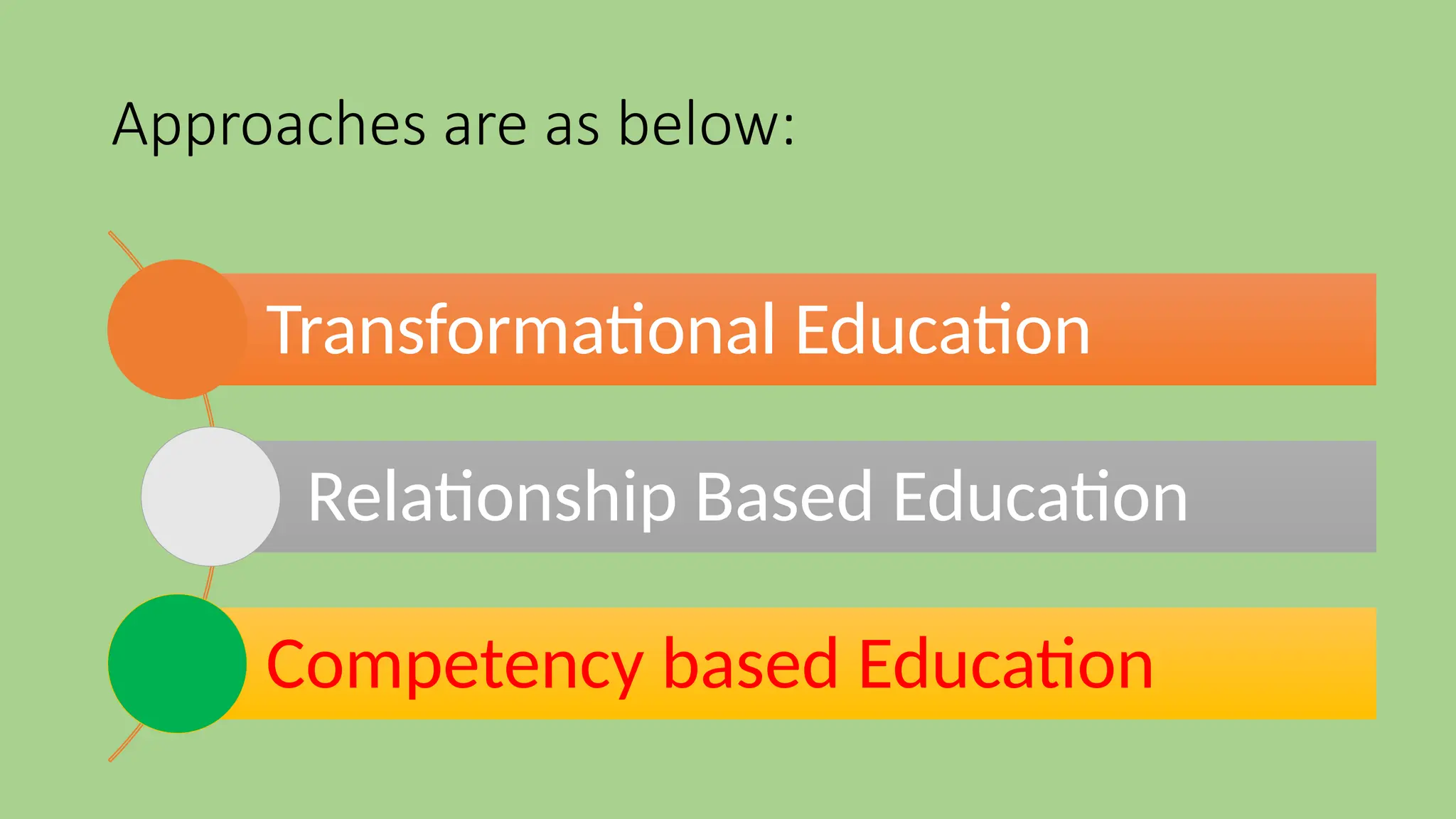
Approaches are as below:
Transformational Education
Relationship Based Education
Competency based Education
Transformational Education
• Transformative education is a teaching and learning approach that helps students
develop the skills and values to address global challenges.
• It's a lifelong process that can be applied at all ages.
• For example, when students are learning about world religions, teachers can
introduce literature and articles that discuss different religions, helping them gain
new perspectives and understanding
Who develop it?
• Sociologist Jack Mezirow developed the theory of transformative
learning
Goals
• To help students become active global citizens
• To help students build a sense of belonging to a common humanity
• To help students develop empathy and appreciation for diversity
• To help students develop skills to take action towards building more
inclusive, peaceful, and sustainable societies
How it's achieved
• By teaching students to read and write, collaborate, and solve complex problems
• By helping students connect with other people and nature
• By creating learning environments that are meaningful in the natural, political,
economic, and cultural contexts
• By preventing and addressing bullying, gender-based violence, and health and
gender-related discrimination
Benefits
• Helps students develop soft skills that are in high demand in the labor market
• Helps students become better equipped to adapt to job and workplace transitions
• Helps students challenge their beliefs and assumptions
• Helps students undergo personal or social transformation
Relationship Based Education
• Relationship-based education emphasizes building strong, trusting connections
between educators and students, recognizing that these relationships are crucial
for fostering emotional well-being, improving behavior, and ultimately, promoting
successful learning.
• Strong teacher-student relationships can act as a "secure base" for students,
allowing them to feel safe when making mistakes and comfortable taking on
academic challenges.
• A nursing example of RBE would be a nurse actively listening to a
patient's concerns and preferences, involving them in decision-
making, and fostering a sense of trust and empathy, rather than
simply focusing on medical procedures.
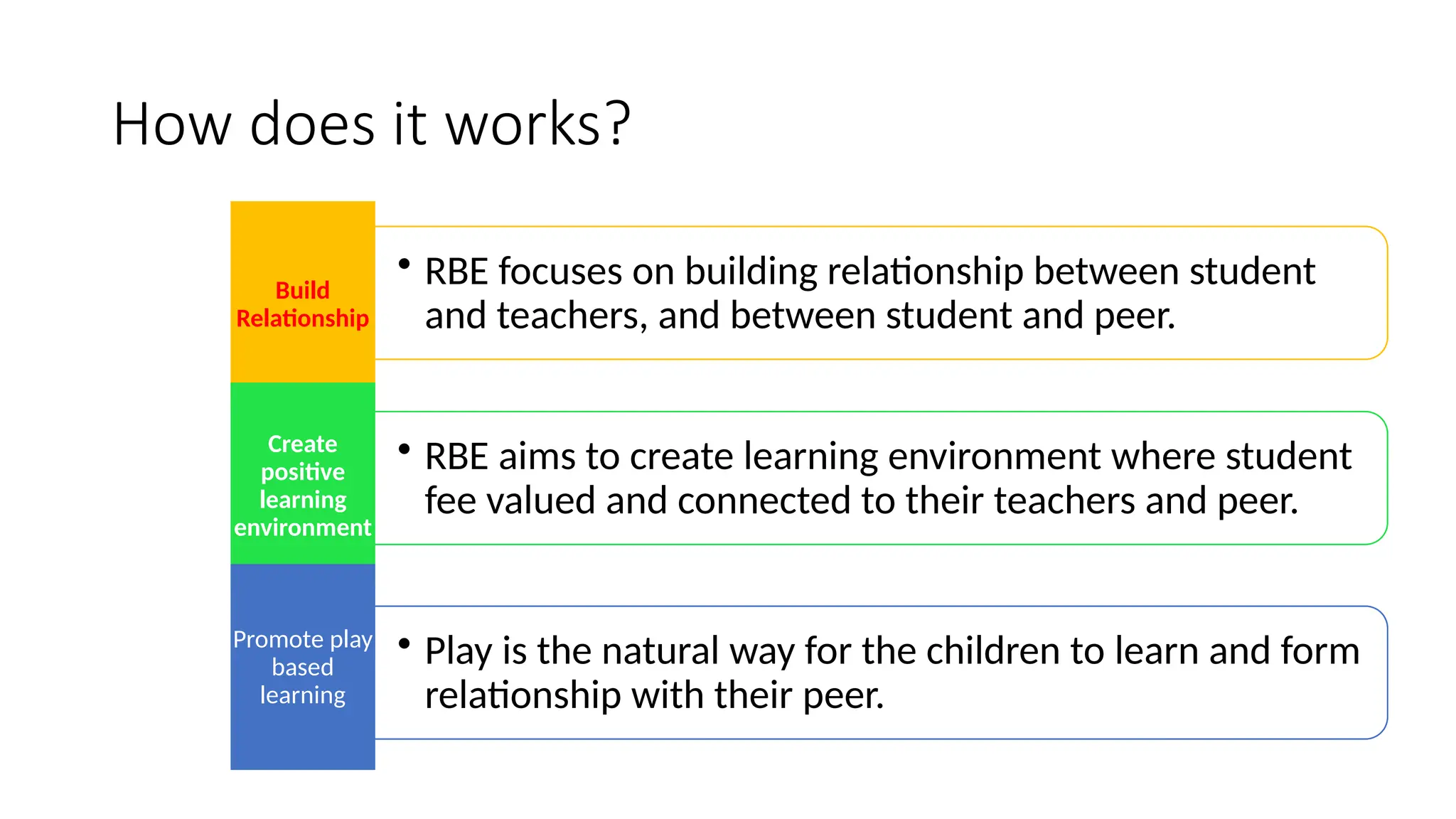
How does it works?
Build
Relationship
• RBE focuses on building relationship between student
and teachers, and between student and peer.
Create
positive
learning
environment
• RBE aims to create learning environment where student
fee valued and connected to their teachers and peer.
Promote play
based
learning
• Play is the natural way for the children to learn and form
relationship with their peer.
Competency-based learning (CBL)
• Competency-based learning (CBL) focuses on students demonstrating
mastery of specific skills and knowledge, rather than solely relying on
time spent in class or traditional grading systems
• For example, a student might be assessed on their ability to
administer medication accurately and safely, rather than just
attending lectures on pharmacology
Benefits of Competency-Based Learning:
• Increased Student Engagement:
• By focusing on real-world application and personalized learning, CBL can increase
student motivation and engagement.
• Improved Learning Outcomes:
• CBL can lead to deeper and more meaningful learning, as students are able to focus
on mastering specific skills and knowledge.
• Greater Flexibility and Accessibility:
• CBL allows for more flexible and accessible learning pathways, catering to diverse
learning needs and abilities.
• Enhanced Teacher-Student Relationships:
• CBL can foster stronger teacher-student relationships, as teachers are able to provide
more personalized support and feedback.
3-Latest Approaches to education technology.pptx

3-Latest Approaches to education technology.pptx

  • 1.
    Latest approaches to NursingEducation By. Mr. Abhijit Bhoyar Associate Professor
  • 2.
    • Recent trendsin education emphasize student-centered, active learning approaches like inquiry-based learning, flipped classrooms, and collaborative learning, alongside integrating technology and focusing on social-emotional learning.
  • 3.
    Approaches are asbelow: Transformational Education Relationship Based Education Competency based Education
  • 4.
    Transformational Education • Transformativeeducation is a teaching and learning approach that helps students develop the skills and values to address global challenges. • It's a lifelong process that can be applied at all ages. • For example, when students are learning about world religions, teachers can introduce literature and articles that discuss different religions, helping them gain new perspectives and understanding
  • 5.
    Who develop it? •Sociologist Jack Mezirow developed the theory of transformative learning
  • 6.
    Goals • To helpstudents become active global citizens • To help students build a sense of belonging to a common humanity • To help students develop empathy and appreciation for diversity • To help students develop skills to take action towards building more inclusive, peaceful, and sustainable societies
  • 7.
    How it's achieved •By teaching students to read and write, collaborate, and solve complex problems • By helping students connect with other people and nature • By creating learning environments that are meaningful in the natural, political, economic, and cultural contexts • By preventing and addressing bullying, gender-based violence, and health and gender-related discrimination
  • 8.
    Benefits • Helps studentsdevelop soft skills that are in high demand in the labor market • Helps students become better equipped to adapt to job and workplace transitions • Helps students challenge their beliefs and assumptions • Helps students undergo personal or social transformation
  • 9.
    Relationship Based Education •Relationship-based education emphasizes building strong, trusting connections between educators and students, recognizing that these relationships are crucial for fostering emotional well-being, improving behavior, and ultimately, promoting successful learning. • Strong teacher-student relationships can act as a "secure base" for students, allowing them to feel safe when making mistakes and comfortable taking on academic challenges.
  • 10.
    • A nursingexample of RBE would be a nurse actively listening to a patient's concerns and preferences, involving them in decision- making, and fostering a sense of trust and empathy, rather than simply focusing on medical procedures.
  • 11.
    How does itworks? Build Relationship • RBE focuses on building relationship between student and teachers, and between student and peer. Create positive learning environment • RBE aims to create learning environment where student fee valued and connected to their teachers and peer. Promote play based learning • Play is the natural way for the children to learn and form relationship with their peer.
  • 12.
    Competency-based learning (CBL) •Competency-based learning (CBL) focuses on students demonstrating mastery of specific skills and knowledge, rather than solely relying on time spent in class or traditional grading systems • For example, a student might be assessed on their ability to administer medication accurately and safely, rather than just attending lectures on pharmacology
  • 13.
    Benefits of Competency-BasedLearning: • Increased Student Engagement: • By focusing on real-world application and personalized learning, CBL can increase student motivation and engagement. • Improved Learning Outcomes: • CBL can lead to deeper and more meaningful learning, as students are able to focus on mastering specific skills and knowledge. • Greater Flexibility and Accessibility: • CBL allows for more flexible and accessible learning pathways, catering to diverse learning needs and abilities. • Enhanced Teacher-Student Relationships: • CBL can foster stronger teacher-student relationships, as teachers are able to provide more personalized support and feedback.