Mr. Abhijjt Pandurang Bhoyar
Asst. Professor
LIPOPROTEINS
At the end of the lecture students will be able to
• Define lipoprotein.
• Explain the structure of lipoprotein.
• Describe the functions of lipoprotein.
• Explain the clinical significance of lipoprotein.
Specific Learning objectives
Introduction
• Lipoproteins are molecular complexes that consist of lipids and
proteins (conjugated proteins).
• Function is as transport vehicles for lipids in blood plasma.
• Lipoproteins deliver the lipid components (cholesterol,
triacylglycerol etc.) to various tissues for utilization.
• The proteins serve to emulsify the lipid molecules.
• Many enzymes, transporters, structural proteins, antigens, and
toxins are lipoproteins.
Definition
A lipoprotein is a biochemical assembly that contains both
proteins and lipids, bound to the proteins, which allow fats to
move through the water inside and outside cells.
Structure of lipoproteins
• A lipoprotein basically consists of a neutral lipid core (with
triacylglycerol and/or cholesteryl ester) surrounded by a coat
shell of phospholipids, apoproteins and cholesterol.
• The polar portions (amphiphilic) of phospholipids and
cholesterol are exposed on the surface of lipoproteins so that
lipoprotein is soluble in aqueous solution.
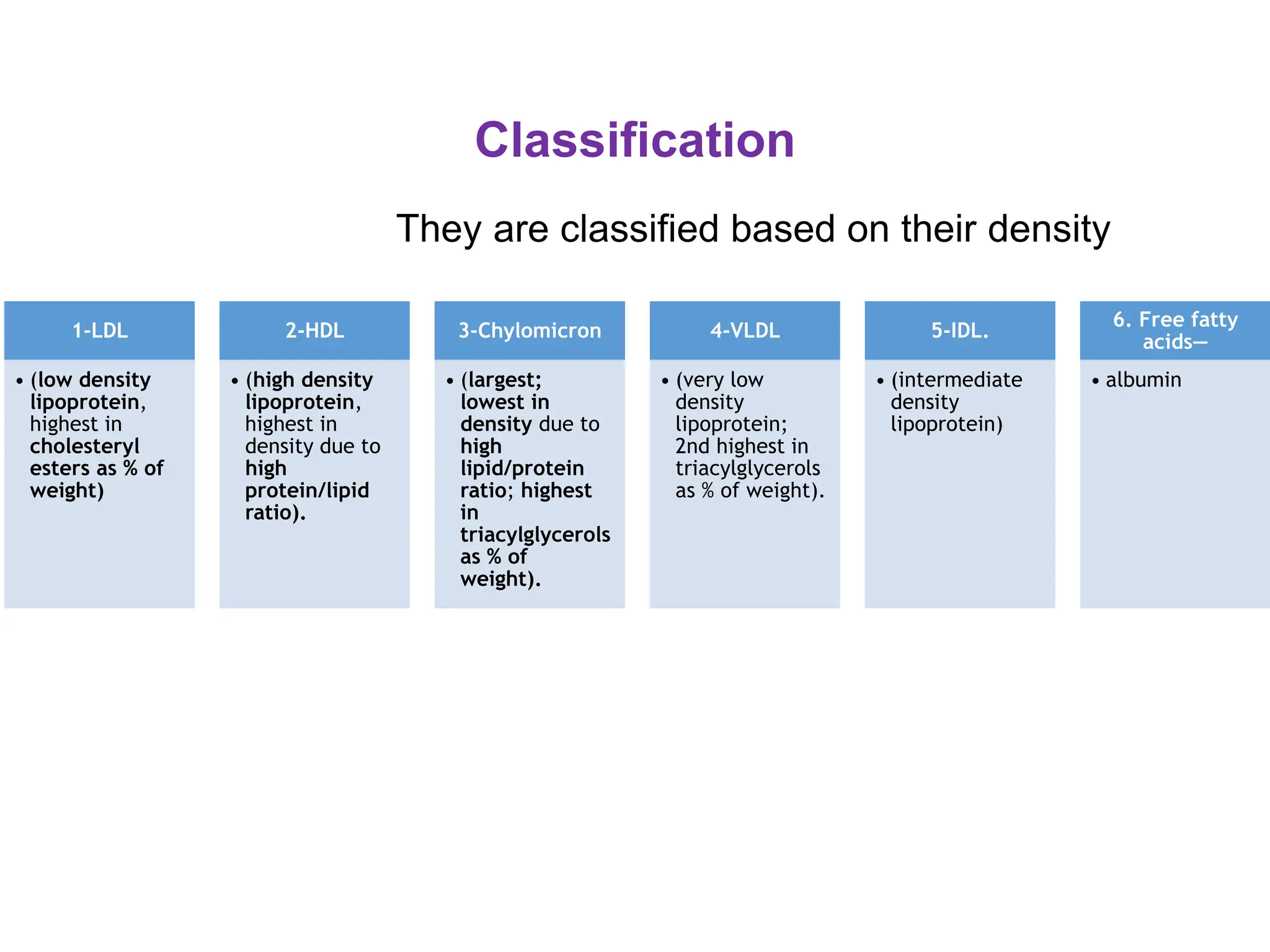
1-LDL
• (low density
lipoprotein,
highest in
cholesteryl
esters as % of
weight)
2-HDL
• (high density
lipoprotein,
highest in
density due to
high
protein/lipid
ratio).
3-Chylomicron
• (largest;
lowest in
density due to
high
lipid/protein
ratio; highest
in
triacylglycerols
as % of
weight).
4-VLDL
• (very low
density
lipoprotein;
2nd highest in
triacylglycerols
as % of weight).
5-IDL.
• (intermediate
density
lipoprotein)
6. Free fatty
acids—
• albumin
Classification
They are classified based on their density
Chylomicron
• Chylomicron (from the Greek chylo, meaning juice or
milky fluid, and micron, meaning small particle)
• They are lipoprotein particles that consist of
Triglycerides (85–92%),
Phospholipids (6–12%),
Cholesterol (1–3%),
Proteins (1–2%).
Cont….
• They are synthesized in the intestine and transport exogenous
(dietary) triacylglycerol to various tissues.
• They consist of highest (99%) quantity of lipid and lowest (1%)
concentration of protein.
• The chylomicrons are the least in density and the largest in size,
among the lipoproteins.
Functions
• Chylomicrons are small lipoproteins transported from the intestine
into the bloodstream.
• Chylomicrons transport lipids absorbed from the intestine to
adipose cardiac, and skeletal muscle tissue, where their
triglyceride components are hydrolyzed by the activity of the
lipoprotein lipase, allowing the released free fatty acids to be
absorbed by the tissues.
Cont…..
• When a large portion of the triacylglycerol core have been
hydrolyzed, chylomicron remnants are formed and are taken up by
the liver, hereby transferring dietary fat also to the liver.
• It transports dietary fats and cholesterol from intestines to tissues
Clinical significance of Chylomicron
• Defective synthesis- Due to deficiency of apo-B 48 protein. The
triglyceride may accumulate in intestinal cells.
• Chyluria- Due to an abnormal connection between urinary tract and
lymphatic drainage system of the intestines, forming Chylous fistula.
Characterized by passage of Milky urine.
• Chylothorax- There is an abnormal connection between pleural
space and the lymphatic drainage of small intestine resulting in
accumulation of lymph in pleural cavity giving Milky pleural effusion
2. Very low density lipoproteins (VLDL)
• They are produced in liver and intestine and are
responsible for the transport of endogenously
synthesized triacylglycerols.
Function Of VLDL
• VLDL transports endogenous triglycerides , phospholipids,
cholesterol, and cholesteryl esters.
• It functions as the body's internal transport mechanism for lipids.
• In addition it serves for long-range transport of hydrophobic
intercellular messengers, like the morphogen.
Clinical significance of VLDL
• VLDL contains the highest amount of triglycerides. VLDL is a type
of "bad cholesterol" because it helps cholesterol build up on the
walls of arteries.
• A lab test is used to measure the amount of VLDL in your blood
IDL (Intermediate Density Lipoprotein).
• The VLDL remnant is called IDL, or Intermediate Density
Lipoprotein.
• It’s formed from the degradation of very low- density lipoproteins.
• Their size is, in general, 25 to 35 nm in diameter, and they contain
primarily a range of triacylglycerols and cholesterol esters.
Function of IDL (intermediate density
lipoprotein).
• It enables fats and cholesterol to move within the water-based
solution of the bloodstream.
• Each native IDL particle consists of protein that encircles various
fatty acids, enabling, as a water-soluble particle, these fatty
acids to travel in the aqueous blood environment as part of the
fat transport system within the body.
• In general, IDL, somewhat similar to low-density lipoprotein (LDL),
transports a variety of triglyceride fats and cholesterol and, like LDL,
can also promote the growth of atheroma.
3. Low density lipoproteins (LDL)
• They are formed from VLDL in the blood circulation.
They transport cholesterol from liver to other tissues.
Function of LDL
• 75% of plasma cholesterol is incorporated into LDL particles.
• LDL transports cholesterol from liver to peripheral tissues.
• The transported cholesterol has following fates:
For synthesis of steroids.
Incorporated into membranes.
Esterified to MUFA & stored.
Forward & reverse transport of cholesterol
Clinical significance of LDLs
• LDL concentration is increased in cardiovascular diseases.
• Small fraction of cholesterol is taken up by macrophages.
• Increased levels of LDL or modified LDL or oxidized LDL
increases the fraction of cholesterol taken by macrophages.
• There is an LDL infiltration through arterial walls & taken up by
macrophages .
Cont….
• This is starting event of atherosclerosis, leading to MI.
• These cells become engorged with cholesterol, foam cells are formed.
• These are deposited in sub-endothelial space triggering the formation
of atheromatous plaque. Leads to thrombosis & coronary artery
disease.
• LDL is a bad-cholesterol.
• Defects in LDL receptor synthesis leads to familial
hypercholesterolemia.
4. High density lipoproteins (HDL)
• They are mostly synthesized in liver. Three different fractions of
HDL (1, 2 and 3) can be identified by ultracentrifugation.
• HDL particles transport cholesterol from peripheral tissues to liver
(reverse cholesterol transport).
Functions of HDL
• HDL is the transports cholesterol from peripheral tissues to liver,
called as reverse cholesterol transport.
• Cholesterol is excreted through bile.
• Cholesterol excretion needs prior esterification with PUFA.
• PUFA reduces serum cholesterol levels.
• PUFA is anti-atherogenic.
Clinical Significance
• Serum HDL levels are inversely related to the incidence of MI.
• HDL is “anti-atherogenic” or protective in nature.
• It is a good cholesterol.
• HDL levels <35mg/dl increases risk, >65mg/dl reduces the risk of
CAD.
5. Free fatty acids—albumin
• Free fatty acids in the circulation are in a bound form to albumin.
• Each molecule of albumin can hold about 20-30 molecules of free
fatty acids.
• This lipoprotein cannot be separated by electrophoresis.
Lipid Profile
• A lipid profile usually includes the levels of total cholesterol, high-
density lipoprotein (HDL) cholesterol, triglycerides, low- density
lipoprotein and Very low- density lipoprotein a in ordered to
determine the risk of heart disease.
• Lipids are different from most tests in that it is not used to
diagnose or monitor a disease but is used to estimate risk of
developing a disease — specifically heart disease.
Lipid Profile Test
• The lipid profile test measures the levels of different types of lipids
in the blood.
• Lipids are fats or fat like substances which are
Important components of the cells
Source of energy for the body
Components of a Lipid Profile test
● Total Cholesterol
● Low Density Lipoproteins (LDL cholesterol)
● High Density Lipoproteins (HDL cholesterol)
● Triglycerides (TGs)
● Very Low Density Lipoproteins (VLDL cholesterol)
Why is Lipid profile done?
1. To screen for suspected heart diseases like
• Coronary artery disease
• Stroke
2. To monitor the efficacy of
• Lipid lowering therapy like statins
• Lifestyle changes like diet or exercise on the lipid levels
Cont….
• Lipid Profile is also done in patients with risk factors like
Smoking
Obesity
High blood pressure
Sedentary lifestyle
Diabetes
Family history or previous history of heart diseases
What does results of Lipid Profile mean?
• High levels of total cholesterol, LDL cholesterol, triglycerides
and low levels of HDL indicates high risk of atherosclerosis
and heart diseases like heart attack, or stroke
• Low levels of total cholesterol, LDL cholesterol, triglycerides
and high HDL cholesterol levels indicates low risk of
atherosclerosis and heart diseases like heart attack, or
stroke.
How is Lipid profile done?
• Lipid profile is done on a blood sample withdrawn from a vein of
your arm
• Typically, a fasting of 8 to 12 hours is required before the test.
THANK YOU

Lipoproteins & Lipid Profile .pptx

  • 1.
    Mr. Abhijjt PandurangBhoyar Asst. Professor LIPOPROTEINS
  • 2.
    At the endof the lecture students will be able to • Define lipoprotein. • Explain the structure of lipoprotein. • Describe the functions of lipoprotein. • Explain the clinical significance of lipoprotein. Specific Learning objectives
  • 3.
    Introduction • Lipoproteins aremolecular complexes that consist of lipids and proteins (conjugated proteins). • Function is as transport vehicles for lipids in blood plasma. • Lipoproteins deliver the lipid components (cholesterol, triacylglycerol etc.) to various tissues for utilization. • The proteins serve to emulsify the lipid molecules. • Many enzymes, transporters, structural proteins, antigens, and toxins are lipoproteins.
  • 4.
    Definition A lipoprotein isa biochemical assembly that contains both proteins and lipids, bound to the proteins, which allow fats to move through the water inside and outside cells.
  • 5.
    Structure of lipoproteins •A lipoprotein basically consists of a neutral lipid core (with triacylglycerol and/or cholesteryl ester) surrounded by a coat shell of phospholipids, apoproteins and cholesterol. • The polar portions (amphiphilic) of phospholipids and cholesterol are exposed on the surface of lipoproteins so that lipoprotein is soluble in aqueous solution.
  • 7.
    1-LDL • (low density lipoprotein, highestin cholesteryl esters as % of weight) 2-HDL • (high density lipoprotein, highest in density due to high protein/lipid ratio). 3-Chylomicron • (largest; lowest in density due to high lipid/protein ratio; highest in triacylglycerols as % of weight). 4-VLDL • (very low density lipoprotein; 2nd highest in triacylglycerols as % of weight). 5-IDL. • (intermediate density lipoprotein) 6. Free fatty acids— • albumin Classification They are classified based on their density
  • 8.
    Chylomicron • Chylomicron (fromthe Greek chylo, meaning juice or milky fluid, and micron, meaning small particle) • They are lipoprotein particles that consist of Triglycerides (85–92%), Phospholipids (6–12%), Cholesterol (1–3%), Proteins (1–2%).
  • 9.
    Cont…. • They aresynthesized in the intestine and transport exogenous (dietary) triacylglycerol to various tissues. • They consist of highest (99%) quantity of lipid and lowest (1%) concentration of protein. • The chylomicrons are the least in density and the largest in size, among the lipoproteins.
  • 10.
    Functions • Chylomicrons aresmall lipoproteins transported from the intestine into the bloodstream. • Chylomicrons transport lipids absorbed from the intestine to adipose cardiac, and skeletal muscle tissue, where their triglyceride components are hydrolyzed by the activity of the lipoprotein lipase, allowing the released free fatty acids to be absorbed by the tissues.
  • 11.
    Cont….. • When alarge portion of the triacylglycerol core have been hydrolyzed, chylomicron remnants are formed and are taken up by the liver, hereby transferring dietary fat also to the liver. • It transports dietary fats and cholesterol from intestines to tissues
  • 12.
    Clinical significance ofChylomicron • Defective synthesis- Due to deficiency of apo-B 48 protein. The triglyceride may accumulate in intestinal cells. • Chyluria- Due to an abnormal connection between urinary tract and lymphatic drainage system of the intestines, forming Chylous fistula. Characterized by passage of Milky urine. • Chylothorax- There is an abnormal connection between pleural space and the lymphatic drainage of small intestine resulting in accumulation of lymph in pleural cavity giving Milky pleural effusion
  • 13.
    2. Very lowdensity lipoproteins (VLDL) • They are produced in liver and intestine and are responsible for the transport of endogenously synthesized triacylglycerols.
  • 14.
    Function Of VLDL •VLDL transports endogenous triglycerides , phospholipids, cholesterol, and cholesteryl esters. • It functions as the body's internal transport mechanism for lipids. • In addition it serves for long-range transport of hydrophobic intercellular messengers, like the morphogen.
  • 15.
    Clinical significance ofVLDL • VLDL contains the highest amount of triglycerides. VLDL is a type of "bad cholesterol" because it helps cholesterol build up on the walls of arteries. • A lab test is used to measure the amount of VLDL in your blood
  • 16.
    IDL (Intermediate DensityLipoprotein). • The VLDL remnant is called IDL, or Intermediate Density Lipoprotein. • It’s formed from the degradation of very low- density lipoproteins. • Their size is, in general, 25 to 35 nm in diameter, and they contain primarily a range of triacylglycerols and cholesterol esters.
  • 17.
    Function of IDL(intermediate density lipoprotein). • It enables fats and cholesterol to move within the water-based solution of the bloodstream. • Each native IDL particle consists of protein that encircles various fatty acids, enabling, as a water-soluble particle, these fatty acids to travel in the aqueous blood environment as part of the fat transport system within the body. • In general, IDL, somewhat similar to low-density lipoprotein (LDL), transports a variety of triglyceride fats and cholesterol and, like LDL, can also promote the growth of atheroma.
  • 18.
    3. Low densitylipoproteins (LDL) • They are formed from VLDL in the blood circulation. They transport cholesterol from liver to other tissues.
  • 19.
    Function of LDL •75% of plasma cholesterol is incorporated into LDL particles. • LDL transports cholesterol from liver to peripheral tissues. • The transported cholesterol has following fates: For synthesis of steroids. Incorporated into membranes. Esterified to MUFA & stored. Forward & reverse transport of cholesterol
  • 20.
    Clinical significance ofLDLs • LDL concentration is increased in cardiovascular diseases. • Small fraction of cholesterol is taken up by macrophages. • Increased levels of LDL or modified LDL or oxidized LDL increases the fraction of cholesterol taken by macrophages. • There is an LDL infiltration through arterial walls & taken up by macrophages .
  • 21.
    Cont…. • This isstarting event of atherosclerosis, leading to MI. • These cells become engorged with cholesterol, foam cells are formed. • These are deposited in sub-endothelial space triggering the formation of atheromatous plaque. Leads to thrombosis & coronary artery disease. • LDL is a bad-cholesterol. • Defects in LDL receptor synthesis leads to familial hypercholesterolemia.
  • 22.
    4. High densitylipoproteins (HDL) • They are mostly synthesized in liver. Three different fractions of HDL (1, 2 and 3) can be identified by ultracentrifugation. • HDL particles transport cholesterol from peripheral tissues to liver (reverse cholesterol transport).
  • 23.
    Functions of HDL •HDL is the transports cholesterol from peripheral tissues to liver, called as reverse cholesterol transport. • Cholesterol is excreted through bile. • Cholesterol excretion needs prior esterification with PUFA. • PUFA reduces serum cholesterol levels. • PUFA is anti-atherogenic.
  • 24.
    Clinical Significance • SerumHDL levels are inversely related to the incidence of MI. • HDL is “anti-atherogenic” or protective in nature. • It is a good cholesterol. • HDL levels <35mg/dl increases risk, >65mg/dl reduces the risk of CAD.
  • 25.
    5. Free fattyacids—albumin • Free fatty acids in the circulation are in a bound form to albumin. • Each molecule of albumin can hold about 20-30 molecules of free fatty acids. • This lipoprotein cannot be separated by electrophoresis.
  • 27.
    Lipid Profile • Alipid profile usually includes the levels of total cholesterol, high- density lipoprotein (HDL) cholesterol, triglycerides, low- density lipoprotein and Very low- density lipoprotein a in ordered to determine the risk of heart disease. • Lipids are different from most tests in that it is not used to diagnose or monitor a disease but is used to estimate risk of developing a disease — specifically heart disease.
  • 28.
    Lipid Profile Test •The lipid profile test measures the levels of different types of lipids in the blood. • Lipids are fats or fat like substances which are Important components of the cells Source of energy for the body
  • 29.
    Components of aLipid Profile test ● Total Cholesterol ● Low Density Lipoproteins (LDL cholesterol) ● High Density Lipoproteins (HDL cholesterol) ● Triglycerides (TGs) ● Very Low Density Lipoproteins (VLDL cholesterol)
  • 30.
    Why is Lipidprofile done? 1. To screen for suspected heart diseases like • Coronary artery disease • Stroke 2. To monitor the efficacy of • Lipid lowering therapy like statins • Lifestyle changes like diet or exercise on the lipid levels
  • 31.
    Cont…. • Lipid Profileis also done in patients with risk factors like Smoking Obesity High blood pressure Sedentary lifestyle Diabetes Family history or previous history of heart diseases
  • 32.
    What does resultsof Lipid Profile mean? • High levels of total cholesterol, LDL cholesterol, triglycerides and low levels of HDL indicates high risk of atherosclerosis and heart diseases like heart attack, or stroke • Low levels of total cholesterol, LDL cholesterol, triglycerides and high HDL cholesterol levels indicates low risk of atherosclerosis and heart diseases like heart attack, or stroke.
  • 33.
    How is Lipidprofile done? • Lipid profile is done on a blood sample withdrawn from a vein of your arm • Typically, a fasting of 8 to 12 hours is required before the test.
  • 37.