Second year Nurse Student
Topic: Benign prostate Hyperplasia
Course: Surgery and Surgical Nursing ll
Presented by: Solace Chabala
𝐈𝐍𝐓𝐑𝐎𝐃𝐔𝐂𝐓𝐈𝐎𝐍
The human reproductive system of the male is a series of
organs located outside the body and around the pelvic region,
that contributes towards the male reproductive process. The
primary direct function of the male reproductive system is to
provide the male gamete or spermatozoa for fertilization of the
ovum. Furthermore this presentation will focus on the
fascinating aspect of Prostate Vaporization as a surgical
treatment under benign Prostatic Hyperplasia (BPH) that will be
illustrated more.
GENERAL OBJECTIVE
● At the end of the lecture student nurses should
be able to have an understanding on malaria
SPECIFIC OBJECTIVE
● Overview of BPH
● Anatomic View of the Prostate Gland
● Types of laser surgery
● Advantages & Disadvantage of Prostate Vaporization
● Medical & Nursing Management
𝐃𝐄𝐅𝐈𝐍𝐀𝐓𝐈𝐎𝐍 𝐎𝐅 𝐓𝐄𝐑𝐌𝐒
Urogenital: Are the organs of the reproductive and urinary
system, they are grouped together because of their
proximity to each other in usage of some pathway in males
Ejaculation: the release of sperm cells and seminal plasma from
the male reproductive system
Cont…
Retrograde Ejaculation : The release of semen during
ejaculation into the bladder rather than out of the penis
Haematuria : The presence of blood or blood cells in urine.
Transurethral resection :is a surgery to remove the inside part
of the prostate gland
Prostectomy; a medical term refers to the surgical removal of
all or part of the prostate gland
Over view of the male reproductive system
This system consists of a pair of testes and a network of
excretory ducts (epididymis, ductus deferens (vas
deferens), and ejaculatory ducts), seminal vesicles, the
prostate, the bulbourethral glands, and the penis (Waugh
& Grant, 2001).
BENIGN PROSTATIC HYPERPLASIA (BPH),
Definition
BPH is an increase in size of the prostate is an increase in size
of the prostate which involves hyperplasia of prostatic
stromal is an increase in size of the prostate which involves
hyperplasia of prostatic stromal and epithelial is an increase
in size of the prostate which involves hyperplasia of prostatic
stromal and epithelial cells, resulting in the formation of
CONT…
large, fairly discrete nodules in the periurethral region of the
prostate which usually compress the urethral is an increase in
size of the prostate which involves hyperplasia of prostatic
stromal and epithelial cells, resulting in the formation of large,
fairly discrete nodules in the periurethral region of the
prostate which usually compress the urethral canal to cause
partial, or sometimes virtually complete, obstruction of the
urethra, interfering with the normal flow of urine.
CAUSES
BPH begins with the enlargement of the glandular tissue.
Although the cause is not completely understood, it is
thought that the increased number of cells result from
endocrine changes associated with aging.
In many patients older than 50years the prostate enlarges
extending upward into the bladder and obstructing the
outflow of urine by encroaching on the vesicle orifice.
SiGNS AND SYMPTOMS
● Weak urinary stream
● Prolonged emptying of the bladder
● Abdominal straining
● Hesitancy
● Irregular need to urinate
● Incomplete bladder emptying
● Post-urination dribble
● Irritation during urination
● Frequent urination
COMPLICATIONS
● Hydroureters resulting from urinary retention.
● Hydronephrosis resulting from the back pressure of
urine
● Pyelonephrosis due to infection
● Renal Failure due to Pyelonephrosis and
Hydronephrosis
● Azotemia Accumulation of Nitrogenous waste products
PROSTATE GLAND
The prostate gland is the largest accessory gland in the male
reproductive system, it secrets a thin milky fluid which
contains proteolytic enzymes that makes about 30% of semen
and gives it's milky appearance, it's slightly alkaline which
provides a protective local environment for semen arrival in
the acidic Virgina and the proteolytic enzyme also breaks down
clotting factors in
Cont…
ejaculation which allows the semen to remain in a flouid
state throughout it's movement in the female
reproductive tract for potential fertilization .
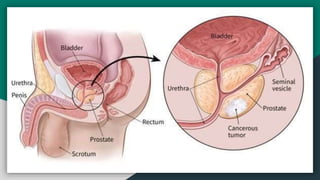
Anatomy and physiology of the prostate
gland
The prostate gland is an encapsulated gland weighing about
20 grams that encircles the urethra below the neck of the
bladder. In the young adult male, the prostate gland is
encased in a thin capsular membrane which is closely
adherent to the underlying tissue. In benign prostrate
hypertrophy, this tissue gradually begins to enlarge with new
growths (hyperplasia) and the
Cont…
capsule of the prostate gland becomes thick and is loosely
attached to the underlying tissue. This tissue can easily be
stripped off leaving the thickened capsule intact. The enlarging
prostate gland encroaches on the urethra and the base of the
bladder producing certain obstructive symptoms
PROSTATE VAPORIZATION
Prostate Vaporization also know as Prostate laser surgery, is
used to receive moderate to severe urinary symptoms caused
by enlarged prostate gland a condition known as benign
Prostatic Hyperplasia (BPH).
During prostate laser surgery a scope is inserted through the
tip of the penis into the urethra, the prostate surrounds the
urethra, and if the prostate is enlarged, it restricts urine flow
from the bladder
ENLARGED PROSTATE
CONT…
A Laser passed through the scope delivers energy that
shrinks or removes excess tissue from the prostate that
is preventing urine flow. Lasers use concentrated light to
generate precise and intense heat. There are several
different types of Prostate laser surgery include:
Photoselecitive Vaporization of the prostate
(PVP)
A Laser is used to meltdown (vaporize) excess Prostate
tissue and enlarge the urinary channel. This procedure is
generally used to treat Prostate that are mild to
moderate enlarged
Holmium laser ablation of the prostate
(HoLAP)
This procedure is similar to PVP but uses a different type of
laser, the procedure uses a laser to remove tissue that is
blocking urine flow through the prostate. A separate instrument
is then used to cut the prostate tissue into easily removable
fragments.
CONT..
Holmium laser enucleation of the prostate (
HoLAP)
A Laser is used to cut and remove the excess Prostate tissue that
is blocking the urethra, into small pieces that are easy removed
HoLEP can be an option for men who have severely enlarged
prostate
The type of surgery that Is recommended would depend on
serveral factors which would include;
CONT…
● The Size of Prostate
● The patients health
● The type of equipment available (Laser)
The Purposes of Prostate Vaporization
Prostate laser surgery helps reduce urinary system causes by
benign prostate hyplasia (BPH) including;
CONT…
● Frequent urgent need to urinate
● Difficulty starting urination
● Slow (prolonged) urination
● Increased of urination at night (Nocturia)
● Stopping and starting again while urinating
● The feeling of inability to completely empty bladder
● Urinary tract infections
Treat/Prevent Complications
Laser surgery might also be done to treat or prevent complications
die to blocked urine such as;
● Recurring urinary infections
● Kidney or bladder damage
● Inability to control urination or inability to urinate at all
● Bladder stones
● Blood in urine
Advantage of laser surgery
Laser surgery can offer serveral advantage over other methods
of treating BPH. It can take weeks to months to see the
noticable Improvements with medications, although
improvement in urinary system based on symptoms from laser
surgery are noticable right away the advantages over
traditional surgery such transurethral resection of Prostate
(TURP)
CONT…
And open prostectomy include;
● Lower risk of bleeding; Laser surgery can be a good option for
men who take medication to thin their blood or who have blood
disorders that inhibits blood to clot normally.
● Shorter or no hospital stay; Laser surgery can be done on an out
patient basis or with just an overnight hospital stay
● Recovery is quick; Recovery from laser surgery generally takes
less time than recovery from transurethral resection of the
prostate
CONT…
(TURP) or prostectomy (open surgery)
● Less need for a catheter; Procedure to treat an enlarged
prostate generally require the use of a catheter to drain
urine from the bladder after surgery, with laser surgery a
catheter is generally needed for less than 24 hours
Disadvantage
CONT…
● Dry orgasm; A common and long term effect of any
type of Prostate surgery is release semen during
ejaculation into the bladder rather than out of the
penis (Retrograde ejaculation) dry orgasm isn't harmful
and generally does not affect sexual pleasure but can
interfere with inability to father a child
CONT…
● Narrowing (Strictures) of the Urethra; Scars after Prostate
surgery can block urine flow, leading to additional
treatment
● Erectile Distinction; The risk of erectile Distinction is there
but is generally low than with traditional surgery.
● Urinary tract infections; these come about due to
prolonged catheter insertion in place and antibiotics are
needed to combat infections
CONT…
Temporary Difficulty Urinating; A catheter is inserted due to
the fact the patient will be having trouble urinating and
should be removed after patient can discharge urine on their
own
DIAGNOSIS/INVESTIGATIONS
HISTORY TAKING
This is usually taken from the patient of the
presenting signs symptoms plays a very
important role in the diagnosis of an enlarged
prostate gland.
DIGITAL RECTAL EXAMINATION (DRE)
This examination is usually the first test done.
The doctor inserts a gloved finger into the
rectum and feels the part of the prostate next
to the rectum. This examination gives the
doctor a general idea of the size and condition
of the gland.
PROSTATE-SPECIFIC ANTIGEN (PSA) BLOOD
TEST
To rule out cancer as a cause of urinary
symptoms, the doctor may recommend a PSA
blood test. PSA, a protein produced by
prostate cells, is frequently present at elevated
levels in the blood of men who have prostate
cancer.
URINE FLOW STUDY
The doctor may ask the patient to urinate
into a special device (urometer) that
measures how quickly the urine is
flowing. A reduced flow often suggests
BPH.
CYSTOSCOPY
In this examination, the doctor inserts a small
tube through the opening of the urethra in
the penis. This test allows the doctor to
determine the size of the gland and identify
the location and degree of the obstruction.
DRUG TREATMENT
1.Finasteride (Proscar) and dutasteride
(Avodart), inhibit production of the
hormone DHT(dihydrotestosterone ),
which is involved with prostate
enlargement.
2.Terazosin (Hytrin), doxazosin (Cardura),
tamsulosin (Flomax) and alfuzosin (Uroxatral)
of which act by relaxing the smooth muscle of
the prostate and bladder neck to improve
urine flow and to reduce bladder outlet
obstruction.
The drugs belong to the class known as
alpha blockers. Terazosin and doxazosin
were developed first to treat high blood
pressure. Tamsulosin and alfuzosin were
developed specifically to treat BPH.
ASPIRIN;
Presentation; tablet containing 200mg, 400mg syrup
containing 125mg/5ml
Indication; fever and pain in children mild to moderate pain
in dysmenorrhea and post operative analgesia
Dose; Oral 200 - 400mg three times a day (tds) after food
Children 20mg /kg body weight
Side effects; nausea & vomiting, fatigue, insomnia, anorexia
● Diclofenac (Non Steroidal anti inflammatory Drug) NSAID
Presentation; Table containing 25mg and injection
containing 25mg/ml
Indication; Pain and Inflammation , acute gout and post
operative care
Dose; By mouth 75mg - 150 mg Intramuscular injection
75mg, in ureteric pain 75mg then 75mg after 30 minutes
Side Effects; Rectal irritation and injection cause site reaction
● Codeine Phosphate
Presentation; Oral solution 15mg/ml tablet 30mg, 60 mg
Indication; Moderate to severe pain
Dosage; 15mg to 60mg P.o
Side effects; Suppression of respiratory center, increased
Intercranial pressure, Sedation, nausea & Vomiting
CONT..
Caution; Not to be used in acute pain repeatedly as
dependence and tolerance occurs
Contraindications; Head injury, severe abdominal pain,
bronchial asthma, hypersensitivity to drug, alcoholism
Drug Interaction; Sedative, ethanol, tranquilizer
NURSING CARE
ELECTIVE PRE-OPERATIVE CARE
AIMS
● To prepare and ensure that the patient is physically fit and in
good mental condition before undergoing surgery
● To treat or control existing conditions before surgery
● To prevent complications
Admission of patient
● Patient will be admitted in a surgical ward for easy observation
● Ensure patient is is oriented to the environment convenient
purpose and allay anxiety
● Ensure the environment is well lit for easy observation
● Ensure the environment is well ventilated to allow air circulation
and prevent upper respiratory infections
● Allow the patient to be in any comfortable position of choice as
long as the inguinal area isn't compressed
Phycological Care
● Explain the condition to the patient to allay anxiety and for
co-operation.
● Explain the type of surgery to the patient to allay anxiety and
for co-operation purposes.
● Allow the he patient to ask questions for clarification and
consultation purposes
● Allow someone who has gone through similar surgery to talk
to the patient regarding the benefits to allay anxiety
Involve others significantly for moral support
Informed Consent;
● Allow the patient to sign the consent form to ensure the
patient is aware of risk and benefits associated
● If the patient is below 18years, ask the next of kin to sign
on behalf
● Ensure the consent form is signed before operation
because it is a legal document that protects the health
workers.
INVESTIGATIONS
● Collect blood for hemoglobin levels to rule out anemia
● Collect blood for grouping in order to know patients
blood group incase need for blood group arises.
● Collect blood for full blood count to rule out infections
or elevated blood cells
● Urinalysis to detect urinary tract infections and
glucose levels which will be a sign of diabetesmellitus
Nutrition;
● Advice the patient on the importance of consuming
food rich in proteins such as chicken, meat,
caterpillars which will help repair worn out tissue
● Advice on the importance of consuming food rich in
vitamins such as vegetable and fruits which will aid in
improvement of the immunity
Observations;
● Check the patients vitals to rule out abnormalities such as
○ Temperature to rule out fever which can be a sign
of infection or inflammation
○ Pulse rate to rule out trachycardia which can be a
sign of shock or infections
○ Blood pressure to rule out hypertension or
hypotension which can be a sign of shock or
presence of infection
○ Weight to rule out malnutrition and will be used to
calculate drugs for the patient to take
Hygiene;
● Do assisted bath, if patient is ambulant advice patient to
take a bath to promote blood circulation, comfort and
prepare patient for surgery
● Advice the patient to do nail care to promote hygiene
● Advice patient to do oral care to promote dental hygiene
Elimination;
● Advice to take lots of fluids for rehydration purposes
● Administrator intravenous fluids for rehydration purposes
CONT..
Such as normal serine and lingers lactate
● Monitor urine output to assess the functioning of the
kidney to rule out renal failure
● Advice patient to be consuming food rich in fiber to
prevent complications
12 hours before operation;
● Give psychological care to allay anxiety and for co-operation
purposes
● Ensure all investigations are done before going to theater
● Continue monitoring patients vitals to detect any abnormalities
● Check if the patients consent form was signed if not, ensure it
gets signed
Starving of the patient 6-8 hours
● Ensure the patient starves for 6 to 8 hours to avoid risks of
CONT…
Pulmonary aspiration of gastric contents during induction and
maintenance of anesthesia
Day of operation
● Canulate the patient if patient is not canulated
● Prepare all documents for the patient and analyse the
details of the patient to prepare for theater
● Take the patient to theater and give
handover about the patients details
including what was done to the patient in
preparedness for surgery, after clarification
hand the patient to the theater nurse.
CONCLUSION
Prostate Vaporization is minimally invasive treatment
attached to the enlarged prostate which requires the use of
laser to perform selective Vaporization. Prostate Vaporization
is very fascinating and one of the best approaches to treat
benign prostate hyplasia (BPH). This presentation covered the
anatomical structure and position of the prostate as well as
information on Prostate Vaporization including treatment and
Nursing care
THANK YOU

Benign prostate Hyperplasia

  • 1.
    Second year NurseStudent Topic: Benign prostate Hyperplasia Course: Surgery and Surgical Nursing ll Presented by: Solace Chabala
  • 2.
    𝐈𝐍𝐓𝐑𝐎𝐃𝐔𝐂𝐓𝐈𝐎𝐍 The human reproductivesystem of the male is a series of organs located outside the body and around the pelvic region, that contributes towards the male reproductive process. The primary direct function of the male reproductive system is to provide the male gamete or spermatozoa for fertilization of the ovum. Furthermore this presentation will focus on the fascinating aspect of Prostate Vaporization as a surgical treatment under benign Prostatic Hyperplasia (BPH) that will be illustrated more.
  • 3.
    GENERAL OBJECTIVE ● Atthe end of the lecture student nurses should be able to have an understanding on malaria
  • 4.
    SPECIFIC OBJECTIVE ● Overviewof BPH ● Anatomic View of the Prostate Gland ● Types of laser surgery ● Advantages & Disadvantage of Prostate Vaporization ● Medical & Nursing Management
  • 5.
    𝐃𝐄𝐅𝐈𝐍𝐀𝐓𝐈𝐎𝐍 𝐎𝐅 𝐓𝐄𝐑𝐌𝐒 Urogenital:Are the organs of the reproductive and urinary system, they are grouped together because of their proximity to each other in usage of some pathway in males Ejaculation: the release of sperm cells and seminal plasma from the male reproductive system
  • 6.
    Cont… Retrograde Ejaculation :The release of semen during ejaculation into the bladder rather than out of the penis Haematuria : The presence of blood or blood cells in urine. Transurethral resection :is a surgery to remove the inside part of the prostate gland Prostectomy; a medical term refers to the surgical removal of all or part of the prostate gland
  • 7.
    Over view ofthe male reproductive system This system consists of a pair of testes and a network of excretory ducts (epididymis, ductus deferens (vas deferens), and ejaculatory ducts), seminal vesicles, the prostate, the bulbourethral glands, and the penis (Waugh & Grant, 2001).
  • 10.
    BENIGN PROSTATIC HYPERPLASIA(BPH), Definition BPH is an increase in size of the prostate is an increase in size of the prostate which involves hyperplasia of prostatic stromal is an increase in size of the prostate which involves hyperplasia of prostatic stromal and epithelial is an increase in size of the prostate which involves hyperplasia of prostatic stromal and epithelial cells, resulting in the formation of
  • 11.
    CONT… large, fairly discretenodules in the periurethral region of the prostate which usually compress the urethral is an increase in size of the prostate which involves hyperplasia of prostatic stromal and epithelial cells, resulting in the formation of large, fairly discrete nodules in the periurethral region of the prostate which usually compress the urethral canal to cause partial, or sometimes virtually complete, obstruction of the urethra, interfering with the normal flow of urine.
  • 12.
    CAUSES BPH begins withthe enlargement of the glandular tissue. Although the cause is not completely understood, it is thought that the increased number of cells result from endocrine changes associated with aging. In many patients older than 50years the prostate enlarges extending upward into the bladder and obstructing the outflow of urine by encroaching on the vesicle orifice.
  • 13.
    SiGNS AND SYMPTOMS ●Weak urinary stream ● Prolonged emptying of the bladder ● Abdominal straining ● Hesitancy ● Irregular need to urinate ● Incomplete bladder emptying ● Post-urination dribble ● Irritation during urination ● Frequent urination
  • 14.
    COMPLICATIONS ● Hydroureters resultingfrom urinary retention. ● Hydronephrosis resulting from the back pressure of urine ● Pyelonephrosis due to infection ● Renal Failure due to Pyelonephrosis and Hydronephrosis ● Azotemia Accumulation of Nitrogenous waste products
  • 15.
    PROSTATE GLAND The prostategland is the largest accessory gland in the male reproductive system, it secrets a thin milky fluid which contains proteolytic enzymes that makes about 30% of semen and gives it's milky appearance, it's slightly alkaline which provides a protective local environment for semen arrival in the acidic Virgina and the proteolytic enzyme also breaks down clotting factors in
  • 17.
    Cont… ejaculation which allowsthe semen to remain in a flouid state throughout it's movement in the female reproductive tract for potential fertilization .
  • 18.
    Anatomy and physiologyof the prostate gland The prostate gland is an encapsulated gland weighing about 20 grams that encircles the urethra below the neck of the bladder. In the young adult male, the prostate gland is encased in a thin capsular membrane which is closely adherent to the underlying tissue. In benign prostrate hypertrophy, this tissue gradually begins to enlarge with new growths (hyperplasia) and the
  • 20.
    Cont… capsule of theprostate gland becomes thick and is loosely attached to the underlying tissue. This tissue can easily be stripped off leaving the thickened capsule intact. The enlarging prostate gland encroaches on the urethra and the base of the bladder producing certain obstructive symptoms
  • 21.
    PROSTATE VAPORIZATION Prostate Vaporizationalso know as Prostate laser surgery, is used to receive moderate to severe urinary symptoms caused by enlarged prostate gland a condition known as benign Prostatic Hyperplasia (BPH). During prostate laser surgery a scope is inserted through the tip of the penis into the urethra, the prostate surrounds the urethra, and if the prostate is enlarged, it restricts urine flow from the bladder
  • 22.
  • 24.
    CONT… A Laser passedthrough the scope delivers energy that shrinks or removes excess tissue from the prostate that is preventing urine flow. Lasers use concentrated light to generate precise and intense heat. There are several different types of Prostate laser surgery include:
  • 25.
    Photoselecitive Vaporization ofthe prostate (PVP) A Laser is used to meltdown (vaporize) excess Prostate tissue and enlarge the urinary channel. This procedure is generally used to treat Prostate that are mild to moderate enlarged
  • 27.
    Holmium laser ablationof the prostate (HoLAP) This procedure is similar to PVP but uses a different type of laser, the procedure uses a laser to remove tissue that is blocking urine flow through the prostate. A separate instrument is then used to cut the prostate tissue into easily removable fragments.
  • 28.
  • 29.
    Holmium laser enucleationof the prostate ( HoLAP) A Laser is used to cut and remove the excess Prostate tissue that is blocking the urethra, into small pieces that are easy removed HoLEP can be an option for men who have severely enlarged prostate The type of surgery that Is recommended would depend on serveral factors which would include;
  • 31.
    CONT… ● The Sizeof Prostate ● The patients health ● The type of equipment available (Laser) The Purposes of Prostate Vaporization Prostate laser surgery helps reduce urinary system causes by benign prostate hyplasia (BPH) including;
  • 32.
    CONT… ● Frequent urgentneed to urinate ● Difficulty starting urination ● Slow (prolonged) urination ● Increased of urination at night (Nocturia) ● Stopping and starting again while urinating ● The feeling of inability to completely empty bladder ● Urinary tract infections
  • 33.
    Treat/Prevent Complications Laser surgerymight also be done to treat or prevent complications die to blocked urine such as; ● Recurring urinary infections ● Kidney or bladder damage ● Inability to control urination or inability to urinate at all ● Bladder stones ● Blood in urine
  • 34.
    Advantage of lasersurgery Laser surgery can offer serveral advantage over other methods of treating BPH. It can take weeks to months to see the noticable Improvements with medications, although improvement in urinary system based on symptoms from laser surgery are noticable right away the advantages over traditional surgery such transurethral resection of Prostate (TURP)
  • 35.
    CONT… And open prostectomyinclude; ● Lower risk of bleeding; Laser surgery can be a good option for men who take medication to thin their blood or who have blood disorders that inhibits blood to clot normally. ● Shorter or no hospital stay; Laser surgery can be done on an out patient basis or with just an overnight hospital stay ● Recovery is quick; Recovery from laser surgery generally takes less time than recovery from transurethral resection of the prostate
  • 36.
    CONT… (TURP) or prostectomy(open surgery) ● Less need for a catheter; Procedure to treat an enlarged prostate generally require the use of a catheter to drain urine from the bladder after surgery, with laser surgery a catheter is generally needed for less than 24 hours Disadvantage
  • 37.
    CONT… ● Dry orgasm;A common and long term effect of any type of Prostate surgery is release semen during ejaculation into the bladder rather than out of the penis (Retrograde ejaculation) dry orgasm isn't harmful and generally does not affect sexual pleasure but can interfere with inability to father a child
  • 38.
    CONT… ● Narrowing (Strictures)of the Urethra; Scars after Prostate surgery can block urine flow, leading to additional treatment ● Erectile Distinction; The risk of erectile Distinction is there but is generally low than with traditional surgery. ● Urinary tract infections; these come about due to prolonged catheter insertion in place and antibiotics are needed to combat infections
  • 39.
    CONT… Temporary Difficulty Urinating;A catheter is inserted due to the fact the patient will be having trouble urinating and should be removed after patient can discharge urine on their own
  • 40.
    DIAGNOSIS/INVESTIGATIONS HISTORY TAKING This isusually taken from the patient of the presenting signs symptoms plays a very important role in the diagnosis of an enlarged prostate gland.
  • 41.
    DIGITAL RECTAL EXAMINATION(DRE) This examination is usually the first test done. The doctor inserts a gloved finger into the rectum and feels the part of the prostate next to the rectum. This examination gives the doctor a general idea of the size and condition of the gland.
  • 42.
    PROSTATE-SPECIFIC ANTIGEN (PSA)BLOOD TEST To rule out cancer as a cause of urinary symptoms, the doctor may recommend a PSA blood test. PSA, a protein produced by prostate cells, is frequently present at elevated levels in the blood of men who have prostate cancer.
  • 43.
    URINE FLOW STUDY Thedoctor may ask the patient to urinate into a special device (urometer) that measures how quickly the urine is flowing. A reduced flow often suggests BPH.
  • 44.
    CYSTOSCOPY In this examination,the doctor inserts a small tube through the opening of the urethra in the penis. This test allows the doctor to determine the size of the gland and identify the location and degree of the obstruction.
  • 45.
    DRUG TREATMENT 1.Finasteride (Proscar)and dutasteride (Avodart), inhibit production of the hormone DHT(dihydrotestosterone ), which is involved with prostate enlargement.
  • 46.
    2.Terazosin (Hytrin), doxazosin(Cardura), tamsulosin (Flomax) and alfuzosin (Uroxatral) of which act by relaxing the smooth muscle of the prostate and bladder neck to improve urine flow and to reduce bladder outlet obstruction.
  • 47.
    The drugs belongto the class known as alpha blockers. Terazosin and doxazosin were developed first to treat high blood pressure. Tamsulosin and alfuzosin were developed specifically to treat BPH.
  • 48.
    ASPIRIN; Presentation; tablet containing200mg, 400mg syrup containing 125mg/5ml Indication; fever and pain in children mild to moderate pain in dysmenorrhea and post operative analgesia Dose; Oral 200 - 400mg three times a day (tds) after food Children 20mg /kg body weight Side effects; nausea & vomiting, fatigue, insomnia, anorexia
  • 49.
    ● Diclofenac (NonSteroidal anti inflammatory Drug) NSAID Presentation; Table containing 25mg and injection containing 25mg/ml Indication; Pain and Inflammation , acute gout and post operative care Dose; By mouth 75mg - 150 mg Intramuscular injection 75mg, in ureteric pain 75mg then 75mg after 30 minutes
  • 50.
    Side Effects; Rectalirritation and injection cause site reaction ● Codeine Phosphate Presentation; Oral solution 15mg/ml tablet 30mg, 60 mg Indication; Moderate to severe pain Dosage; 15mg to 60mg P.o Side effects; Suppression of respiratory center, increased Intercranial pressure, Sedation, nausea & Vomiting
  • 51.
    CONT.. Caution; Not tobe used in acute pain repeatedly as dependence and tolerance occurs Contraindications; Head injury, severe abdominal pain, bronchial asthma, hypersensitivity to drug, alcoholism Drug Interaction; Sedative, ethanol, tranquilizer
  • 52.
    NURSING CARE ELECTIVE PRE-OPERATIVECARE AIMS ● To prepare and ensure that the patient is physically fit and in good mental condition before undergoing surgery ● To treat or control existing conditions before surgery ● To prevent complications
  • 53.
    Admission of patient ●Patient will be admitted in a surgical ward for easy observation ● Ensure patient is is oriented to the environment convenient purpose and allay anxiety ● Ensure the environment is well lit for easy observation ● Ensure the environment is well ventilated to allow air circulation and prevent upper respiratory infections ● Allow the patient to be in any comfortable position of choice as long as the inguinal area isn't compressed
  • 54.
    Phycological Care ● Explainthe condition to the patient to allay anxiety and for co-operation. ● Explain the type of surgery to the patient to allay anxiety and for co-operation purposes. ● Allow the he patient to ask questions for clarification and consultation purposes ● Allow someone who has gone through similar surgery to talk to the patient regarding the benefits to allay anxiety
  • 55.
    Involve others significantlyfor moral support Informed Consent; ● Allow the patient to sign the consent form to ensure the patient is aware of risk and benefits associated ● If the patient is below 18years, ask the next of kin to sign on behalf ● Ensure the consent form is signed before operation because it is a legal document that protects the health workers.
  • 56.
    INVESTIGATIONS ● Collect bloodfor hemoglobin levels to rule out anemia ● Collect blood for grouping in order to know patients blood group incase need for blood group arises. ● Collect blood for full blood count to rule out infections or elevated blood cells ● Urinalysis to detect urinary tract infections and glucose levels which will be a sign of diabetesmellitus
  • 57.
    Nutrition; ● Advice thepatient on the importance of consuming food rich in proteins such as chicken, meat, caterpillars which will help repair worn out tissue ● Advice on the importance of consuming food rich in vitamins such as vegetable and fruits which will aid in improvement of the immunity
  • 58.
    Observations; ● Check thepatients vitals to rule out abnormalities such as ○ Temperature to rule out fever which can be a sign of infection or inflammation ○ Pulse rate to rule out trachycardia which can be a sign of shock or infections ○ Blood pressure to rule out hypertension or hypotension which can be a sign of shock or presence of infection ○ Weight to rule out malnutrition and will be used to calculate drugs for the patient to take
  • 59.
    Hygiene; ● Do assistedbath, if patient is ambulant advice patient to take a bath to promote blood circulation, comfort and prepare patient for surgery ● Advice the patient to do nail care to promote hygiene ● Advice patient to do oral care to promote dental hygiene Elimination; ● Advice to take lots of fluids for rehydration purposes ● Administrator intravenous fluids for rehydration purposes
  • 60.
    CONT.. Such as normalserine and lingers lactate ● Monitor urine output to assess the functioning of the kidney to rule out renal failure ● Advice patient to be consuming food rich in fiber to prevent complications
  • 61.
    12 hours beforeoperation; ● Give psychological care to allay anxiety and for co-operation purposes ● Ensure all investigations are done before going to theater ● Continue monitoring patients vitals to detect any abnormalities ● Check if the patients consent form was signed if not, ensure it gets signed Starving of the patient 6-8 hours ● Ensure the patient starves for 6 to 8 hours to avoid risks of
  • 62.
    CONT… Pulmonary aspiration ofgastric contents during induction and maintenance of anesthesia Day of operation ● Canulate the patient if patient is not canulated ● Prepare all documents for the patient and analyse the details of the patient to prepare for theater
  • 63.
    ● Take thepatient to theater and give handover about the patients details including what was done to the patient in preparedness for surgery, after clarification hand the patient to the theater nurse.
  • 64.
    CONCLUSION Prostate Vaporization isminimally invasive treatment attached to the enlarged prostate which requires the use of laser to perform selective Vaporization. Prostate Vaporization is very fascinating and one of the best approaches to treat benign prostate hyplasia (BPH). This presentation covered the anatomical structure and position of the prostate as well as information on Prostate Vaporization including treatment and Nursing care
  • 65.