 A basic capacitor has two parallel plates separated by an insulating
material
 A capacitor stores an electrical charge between the two plates
 The unit of capacitance is Farads (F)
 Capacitance values are normally smaller, such as µF, nF or pF
 In a way, a capacitor is a little like a battery. Although they work in
completely different ways, capacitors and batteries both store
electrical energy
 Inside the capacitor, the terminals connect to two metal plates
separated by a non-conducting substance, or dielectric. You can
easily make a capacitor from two pieces of aluminum foil and a
piece of paper. It won't be a particularly good capacitor in terms of
its storage capacity, but it will work.
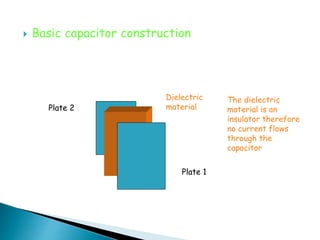
 Basic capacitor construction
Dielectric
material
Plate 1
Plate 2
The dielectric
material is an
insulator therefore
no current flows
through the
capacitor
Storing a charge between
the plates
 Electrons on the left plate
are attracted toward the
positive terminal of the
voltage source
 This leaves an excess of
positively charged holes
 The electrons are pushed
toward the right plate
 Excess electrons leave a
negative charge
+ -
+
_
+ _
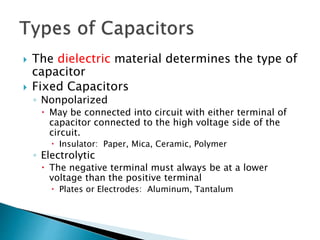
 The dielectric material determines the type of
capacitor
 Fixed Capacitors
◦ Nonpolarized
 May be connected into circuit with either terminal of
capacitor connected to the high voltage side of the
circuit.
 Insulator: Paper, Mica, Ceramic, Polymer
◦ Electrolytic
 The negative terminal must always be at a lower
voltage than the positive terminal
 Plates or Electrodes: Aluminum, Tantalum
 Difficult to make nonpolarized capacitors that
store a large amount of charge or operate at
high voltages.
◦ Tolerance on capacitance values is very large
 +50%/-25% is not unusual
http://www.marvac.com/fun/ceramic_capacitor_codes.a
spx
PSpice Symbol
 Some capacitors are
polarised, they can
only be connected
one way around
 Electrolytic
capacitors are
polarised
 Variable capacitors are
used in communication
equipment, radios,
televisions and VCRs
 They can be adjusted by
consumers by tuning
controls
 Trimmers are internal
adjusted capacitors
that a consumer cannot
adjust
 These variable
capacitors would be
difficult to squeeze
into your mobile
phone and iPod
 Current technology
uses semi-conductor
variable capacitors
called varactors
(varicaps)
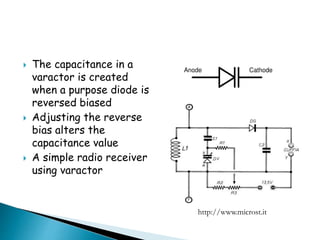
 The capacitance in a
varactor is created
when a purpose diode is
reversed biased
 Adjusting the reverse
bias alters the
capacitance value
 A simple radio receiver
using varactor
http://www.microst.it
 The ceramic capacitor is
a type of capacitor that
is used in many
applications from audio
to RF.. Ceramic
capacitor types are by
far the most commonly
used type of capacitor
being cheap and reliable
and their loss factor is
particularly low
although this is
dependent on the exact
dielectric in use.
Range
Values range from a few
picofarads to around 820
microfarads.
Uses
In view of their
constructional properties,
these capacitors are
widely used both in
leaded and surface mount
formats
Electrolytic
capacitor: Electrolytic
capacitors are a type of
capacitor that is
polarised. they have a
frequency limit if
around 100 kHz.
Range
They are able to offer
high capacitance values
- typically above 1μF
Uses
are most widely used
for low frequency
applications - power
supplies, decoupling
and audio coupling
applications.
 Electrolytic capacitor names after using oxide film
formed electrochemically on electrode surface as
dielectric.
 Aluminum (Al), tantalum (Ta), niobium (Nb), titanium
(Ti), zirconium (Zr), hafnium (Hf) and other metals can
form a fine, highly isolative oxide currently ,the only
two metals in practical application are aluminum and
tantalum.
 Oxide film formed on the surface of electrode 1
becomes an electrical insulator and functions as A
dielectric only when the electrode on which formed
becomes anode.
 Therefore, electrolytic capacitors are, in principle,
capacitors with polarity.
 Tantalum's are a most unusual process
that yields a high reliable electrolytic
with along life.
Tantalum pentoxide powder is mixed
with a manganesedioxide electrolyte and
formed into a "pellet" forming the dielectric
and the positive electrode plate.
 Graphite or silver plating forms the
negative plate. This "pellet' forms a YHU
Like electrolytic capacitors,
tantalum capacitors are also
polarised and. However this
type of capacitor is very
intolerant of being reverse
biased, often exploding
when placed under stress.
This type of capacitor must
also not be subject to high
ripple currents or voltages
above their working voltage.
They are available in both
leaded and surface mount
formats.
 Range
 Offer a very high
capacitance level for
their volume
 Silver mica
capacitors are not as
widely used these
days, but they still
offer very high levels
of stability, low loss
and accuracy where
space is not an
issue. They are
primarily used for RF
applications .
 Range
 They are limited to
maximum values of
1000 pF. 2.2 pF to
47nF.
 Uses
 They are primarily
used for RF
applications
 Polyester film
capacitors are used
where cost is a
consideration as
they do not offer a
high tolerance..
 Uses
 They are generally
only available as
leaded electronics
components.
 This type of capacitor is
a essentially a form of
polyester film capacitor
where the polyester
films themselves are
metallised. The
advantage of using this
process is that because
their electrodes are
thin, the overall
capacitor can be
contained within a
relatively small package
 The metallised
polyester film
capacitors are
generally only
available as leaded
electronics
components.
 Glass
capacitors: As the
name implies, this
capacitor type uses
glass as the
dielectric.
 Although expensive,
these capacitors offer
very high levels or
performance in terms of
extremely low loss, high
RF current capability, no
piezo-electric noise and
other features making
them ideal for many
performance RF
applications.

Capacitors

  • 2.
     A basiccapacitor has two parallel plates separated by an insulating material  A capacitor stores an electrical charge between the two plates  The unit of capacitance is Farads (F)  Capacitance values are normally smaller, such as µF, nF or pF  In a way, a capacitor is a little like a battery. Although they work in completely different ways, capacitors and batteries both store electrical energy  Inside the capacitor, the terminals connect to two metal plates separated by a non-conducting substance, or dielectric. You can easily make a capacitor from two pieces of aluminum foil and a piece of paper. It won't be a particularly good capacitor in terms of its storage capacity, but it will work.
  • 3.
     Basic capacitorconstruction Dielectric material Plate 1 Plate 2 The dielectric material is an insulator therefore no current flows through the capacitor
  • 4.
    Storing a chargebetween the plates  Electrons on the left plate are attracted toward the positive terminal of the voltage source  This leaves an excess of positively charged holes  The electrons are pushed toward the right plate  Excess electrons leave a negative charge + - + _ + _
  • 5.
     The dielectricmaterial determines the type of capacitor  Fixed Capacitors ◦ Nonpolarized  May be connected into circuit with either terminal of capacitor connected to the high voltage side of the circuit.  Insulator: Paper, Mica, Ceramic, Polymer ◦ Electrolytic  The negative terminal must always be at a lower voltage than the positive terminal  Plates or Electrodes: Aluminum, Tantalum
  • 6.
     Difficult tomake nonpolarized capacitors that store a large amount of charge or operate at high voltages. ◦ Tolerance on capacitance values is very large  +50%/-25% is not unusual http://www.marvac.com/fun/ceramic_capacitor_codes.a spx PSpice Symbol
  • 8.
     Some capacitorsare polarised, they can only be connected one way around  Electrolytic capacitors are polarised
  • 9.
     Variable capacitorsare used in communication equipment, radios, televisions and VCRs  They can be adjusted by consumers by tuning controls  Trimmers are internal adjusted capacitors that a consumer cannot adjust
  • 10.
     These variable capacitorswould be difficult to squeeze into your mobile phone and iPod  Current technology uses semi-conductor variable capacitors called varactors (varicaps)
  • 11.
     The capacitancein a varactor is created when a purpose diode is reversed biased  Adjusting the reverse bias alters the capacitance value  A simple radio receiver using varactor http://www.microst.it
  • 12.
     The ceramiccapacitor is a type of capacitor that is used in many applications from audio to RF.. Ceramic capacitor types are by far the most commonly used type of capacitor being cheap and reliable and their loss factor is particularly low although this is dependent on the exact dielectric in use. Range Values range from a few picofarads to around 820 microfarads. Uses In view of their constructional properties, these capacitors are widely used both in leaded and surface mount formats
  • 13.
    Electrolytic capacitor: Electrolytic capacitors area type of capacitor that is polarised. they have a frequency limit if around 100 kHz. Range They are able to offer high capacitance values - typically above 1μF Uses are most widely used for low frequency applications - power supplies, decoupling and audio coupling applications.
  • 14.
     Electrolytic capacitornames after using oxide film formed electrochemically on electrode surface as dielectric.  Aluminum (Al), tantalum (Ta), niobium (Nb), titanium (Ti), zirconium (Zr), hafnium (Hf) and other metals can form a fine, highly isolative oxide currently ,the only two metals in practical application are aluminum and tantalum.  Oxide film formed on the surface of electrode 1 becomes an electrical insulator and functions as A dielectric only when the electrode on which formed becomes anode.  Therefore, electrolytic capacitors are, in principle, capacitors with polarity.
  • 15.
     Tantalum's area most unusual process that yields a high reliable electrolytic with along life. Tantalum pentoxide powder is mixed with a manganesedioxide electrolyte and formed into a "pellet" forming the dielectric and the positive electrode plate.  Graphite or silver plating forms the negative plate. This "pellet' forms a YHU
  • 16.
    Like electrolytic capacitors, tantalumcapacitors are also polarised and. However this type of capacitor is very intolerant of being reverse biased, often exploding when placed under stress. This type of capacitor must also not be subject to high ripple currents or voltages above their working voltage. They are available in both leaded and surface mount formats.  Range  Offer a very high capacitance level for their volume
  • 17.
     Silver mica capacitorsare not as widely used these days, but they still offer very high levels of stability, low loss and accuracy where space is not an issue. They are primarily used for RF applications .  Range  They are limited to maximum values of 1000 pF. 2.2 pF to 47nF.  Uses  They are primarily used for RF applications
  • 18.
     Polyester film capacitorsare used where cost is a consideration as they do not offer a high tolerance..  Uses  They are generally only available as leaded electronics components.
  • 19.
     This typeof capacitor is a essentially a form of polyester film capacitor where the polyester films themselves are metallised. The advantage of using this process is that because their electrodes are thin, the overall capacitor can be contained within a relatively small package  The metallised polyester film capacitors are generally only available as leaded electronics components.
  • 20.
     Glass capacitors: Asthe name implies, this capacitor type uses glass as the dielectric.  Although expensive, these capacitors offer very high levels or performance in terms of extremely low loss, high RF current capability, no piezo-electric noise and other features making them ideal for many performance RF applications.