CAPACITANCE AND CAPACITORS 46
Objectives The student should be able to: Prepare for ASE Electrical/Electronic Systems (A6) certification test content area “A” (General Electrical/Electronic Systems).  Explain capacitance.  Describe how a capacitor can be used to filter electrical noise.
Objectives The student should be able to: Describe how a capacitor can store an electrical charge.  Explain how a capacitor circuit can be used as a timer circuit.
CAPACITANCE
Capacitance Definition Capacitance is the ability of an object or surface to store an electrical charge
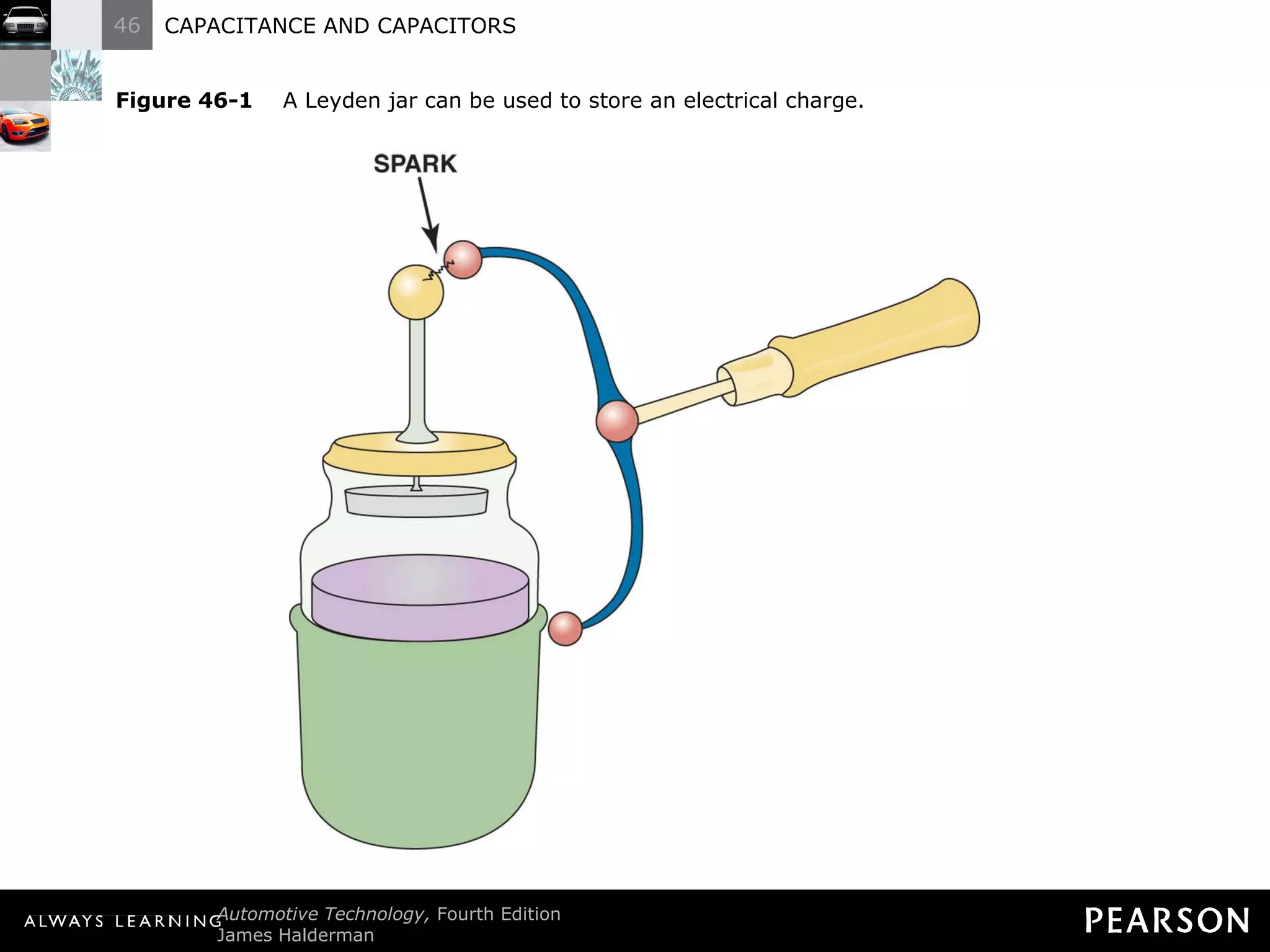
Capacitance Definition Around 1745, Ewald Christian von Kliest and Pieter van Musschenbroek independently discovered capacitance in an electric circuit using a device, now called a Leyden jar (glass jar filled with water, with a nail piercing the stopper and dipping into the water)
Capacitance Definition In 1747, John Bevis lined both the inside and outside of the jar with foil to create a capacitor with two conductors (the inside and outside metal foil layers) equally separated by the insulating glass
Capacitance Definition NOTE: Capacitors are also called condensers. This term developed because electric charges collect, or condense, on the plates of a capacitor much like water vapor collects and condenses on a cold bottle or glass.
Figure 46-1   A Leyden jar can be used to store an electrical charge.
CAPACITOR CONSTRUCTION AND OPERATION
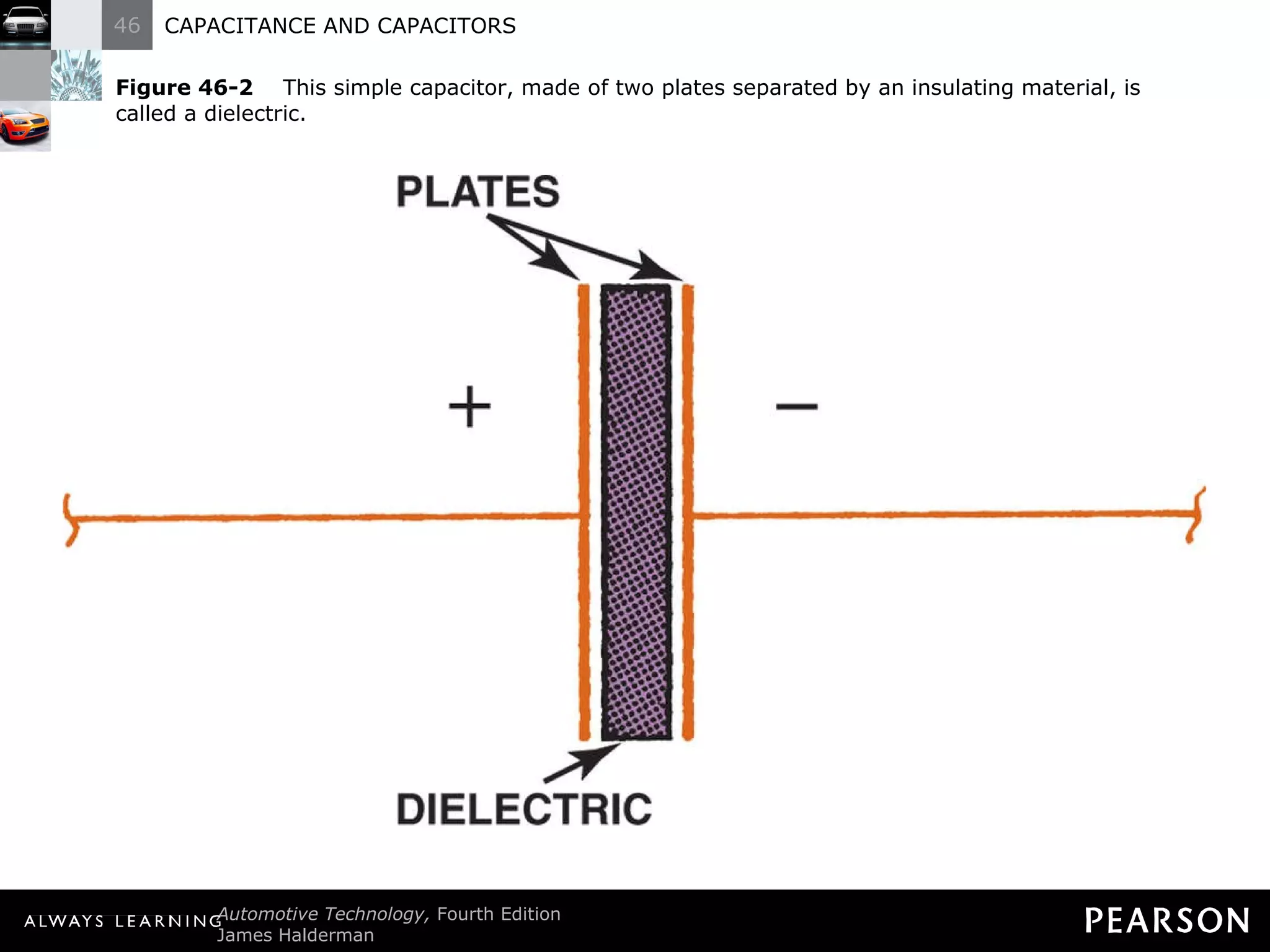
Capacitor Construction and Operation Construction A capacitor (also called a condenser) consists of two conductive plates with an insulating material (commonly called dielectric) between them
Capacitor Construction and Operation Construction This substance is a poor conductor of electricity including air, mica, ceramic, glass, paper, plastic
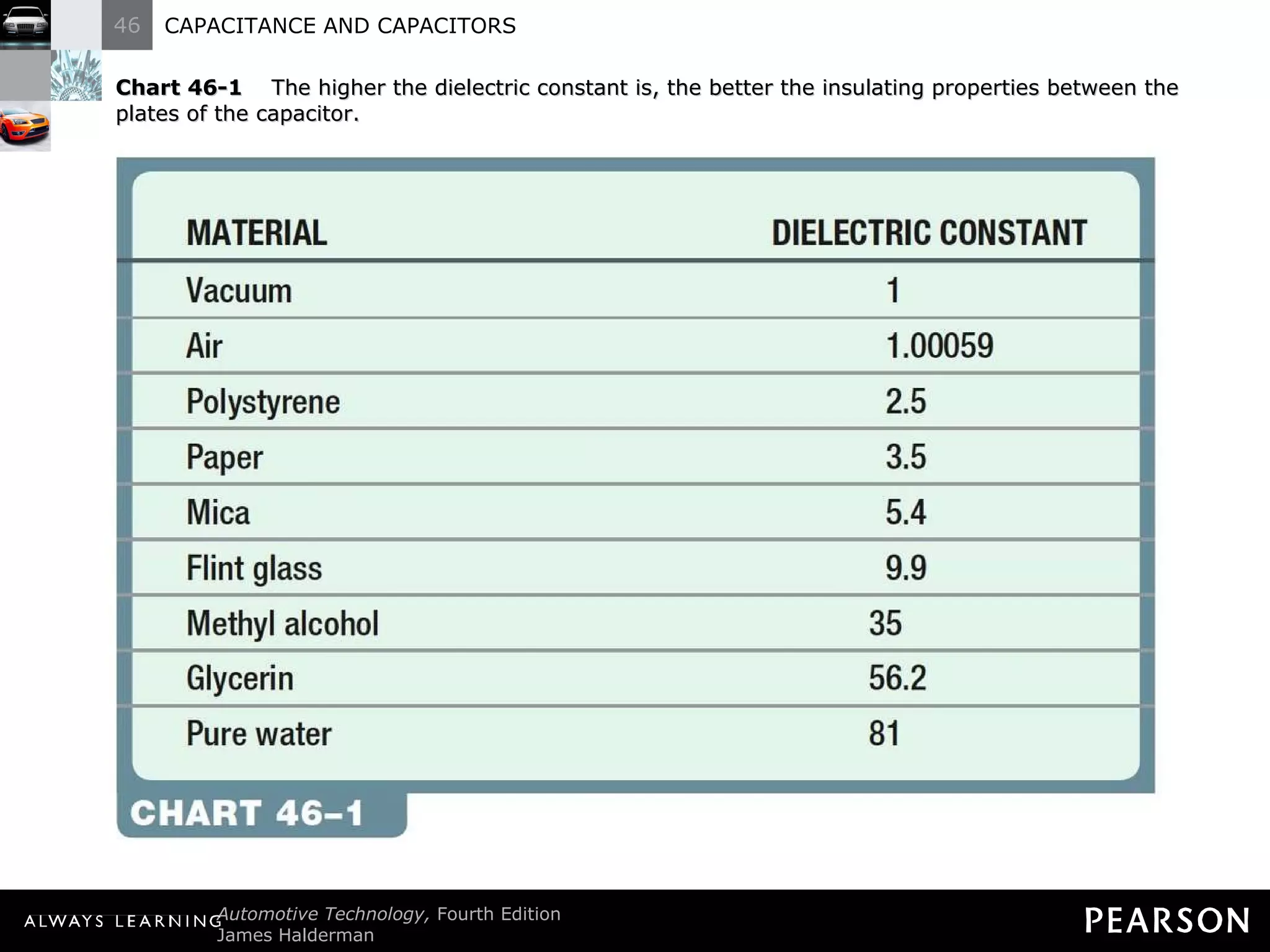
Capacitor Construction and Operation Construction The dielectric constant is the relative strength of a material against the flow of electrical current
Capacitor Construction and Operation Construction The higher the number is, the better the insulating properties
Chart 46-1  The higher the dielectric constant is, the better the insulating properties between the plates of the capacitor.
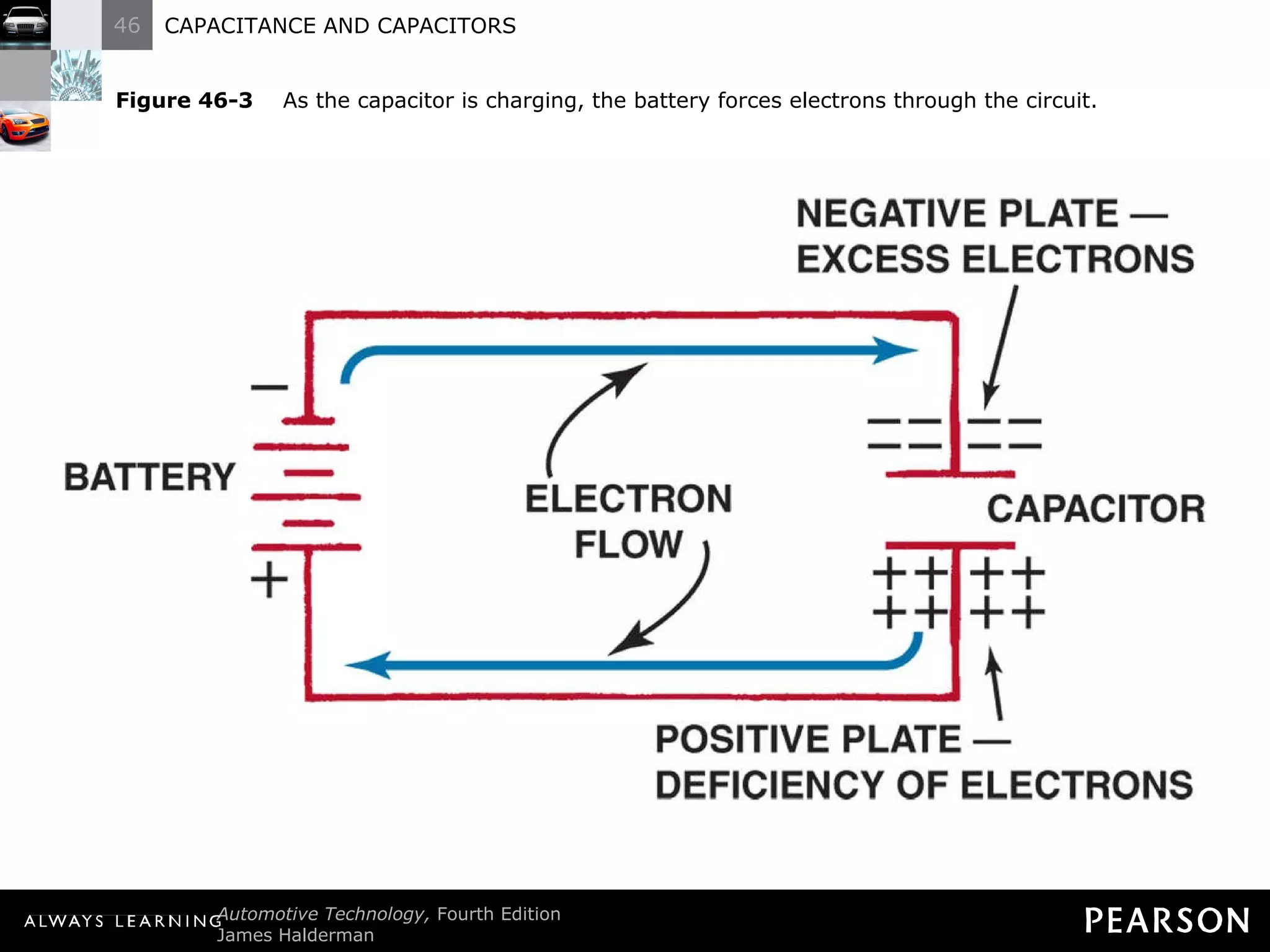
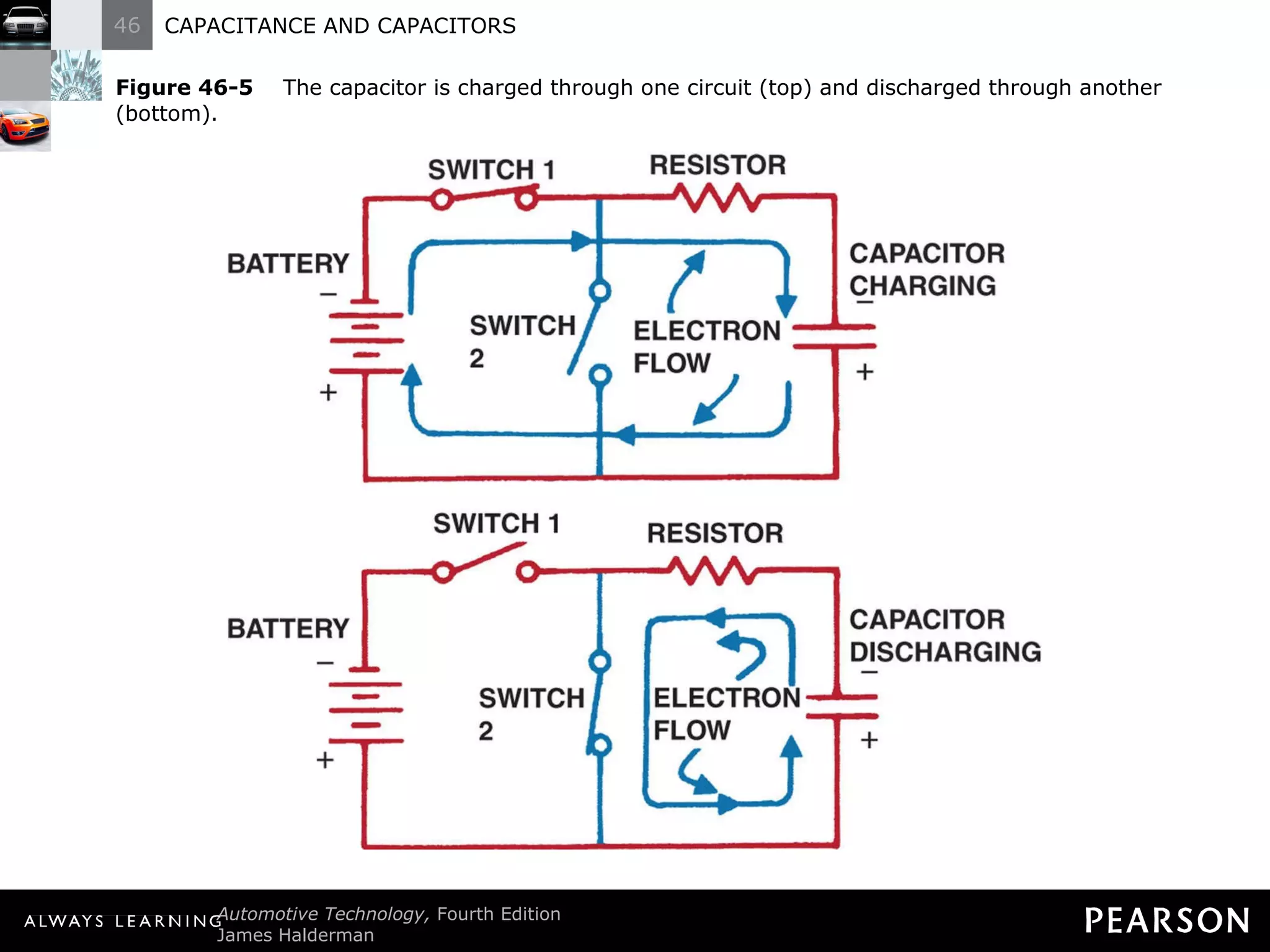
Capacitor Construction and Operation Operation When a capacitor is placed in a closed circuit, the voltage source (battery) forces electrons around the circuit
Capacitor Construction and Operation Operation Excess electrons collect on what becomes the negatively charged plate, while the other plate loses electrons and becomes positively charged
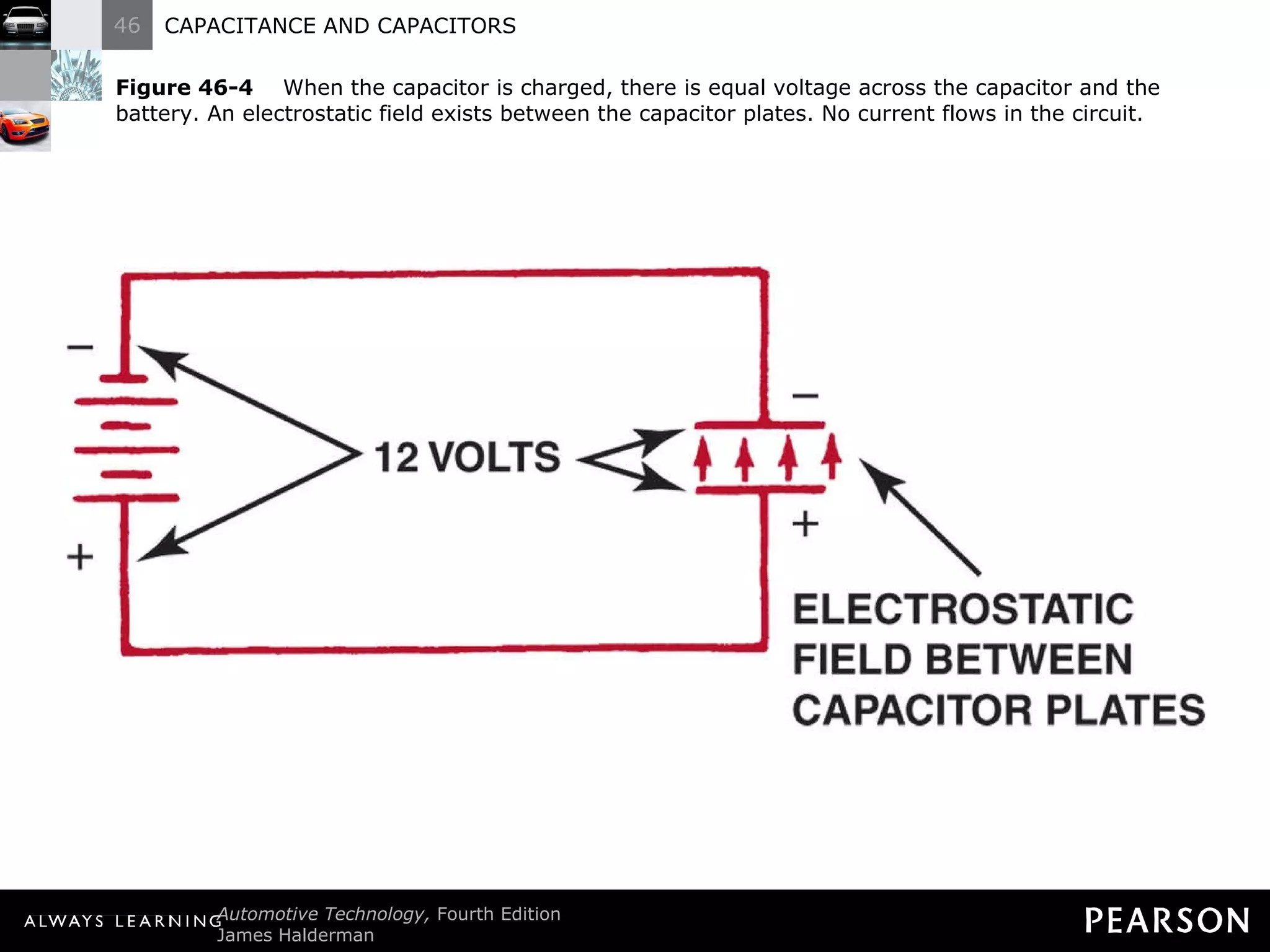
Capacitor Construction and Operation Operation Current continues until the voltage charge across the capacitor plates and the source voltage are the same
Capacitor Construction and Operation Operation The positive plate of the capacitor and the positive terminal of the battery are also at equal positive potentials
Capacitor Construction and Operation Operation The circuit is in balance when there is a voltage charge across the battery terminals and an equal voltage charge across the capacitor plates
Capacitor Construction and Operation Operation An electrostatic field now exists between the capacitor plates  When the charged capacitor is connected to an external circuit, it discharges and both plates of the capacitor are neutral
Capacitor Construction and Operation Operation The charge slowly leaks off the capacitor through the dielectric Capacitors should be treated as if charged until proven to be discharged
Capacitor Construction and Operation Operation To safely discharge a capacitor, use a test light with the clip attached to a good ground, and touch the terminal with the point of the test light ?
Figure 46-2   This simple capacitor, made of two plates separated by an insulating material, is called a dielectric.
Figure 46-3   As the capacitor is charging, the battery forces electrons through the circuit.
Figure 46-4   When the capacitor is charged, there is equal voltage across the capacitor and the battery. An electrostatic field exists between the capacitor plates. No current flows in the circuit.
Figure 46-5   The capacitor is charged through one circuit (top) and discharged through another (bottom).
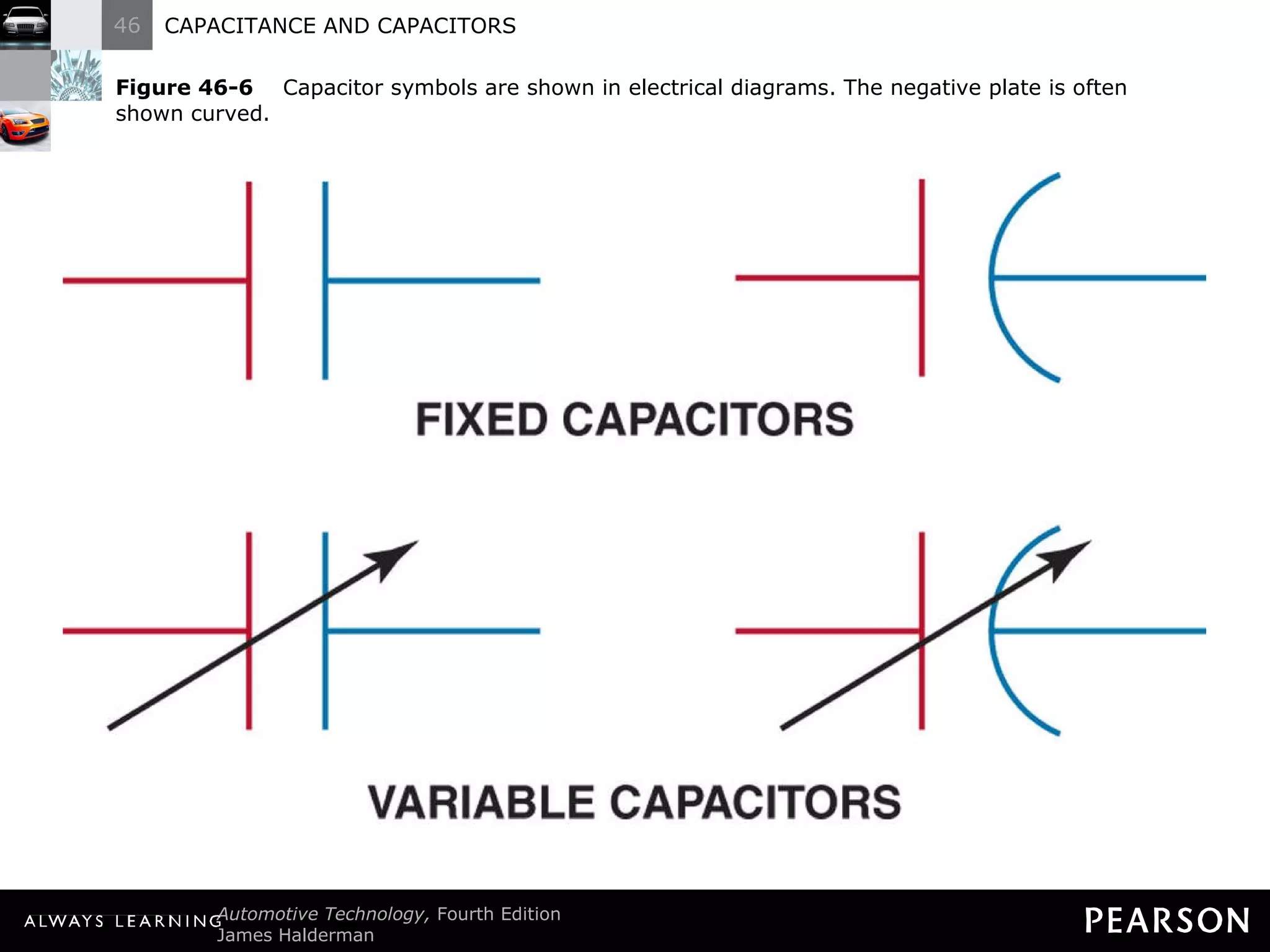
Figure 46-6   Capacitor symbols are shown in electrical diagrams. The negative plate is often shown curved.
FACTORS OF CAPACITANCE
Factors of Capacitance Capacitance is governed by three factors: The surface area of the plates The distance between the plates The dielectric material
Factors of Capacitance The larger the surface area of the plates, the greater the capacitance The closer the plates, the greater the capacitance The insulating qualities of the dielectric material also affect capacitance
Factors of Capacitance Measurement of Capacitance Capacitance is measured in farads, named after Michael Faraday (1791–1867), an English physicist
Factors of Capacitance Measurement of Capacitance The symbol for farads is the letter F If a charge of 1 coulomb is placed on the plates of a capacitor and the potential difference between them is 1 volt, then the capacitance is defined to be 1 farad (1 F)
Factors of Capacitance Measurement of Capacitance A farad is an extremely large quantity of capacitance, so microfarads (0.000001 farad), or μF, are more commonly used
USES FOR CAPACITORS
Uses for Capacitors Spike Suppression A capacitor can be used in parallel to a coil to reduce the voltage spike that occurs when the circuit is opened
Uses for Capacitors Spike Suppression The capacitor absorbs the high voltage and stops it from interfering with other electronic devices
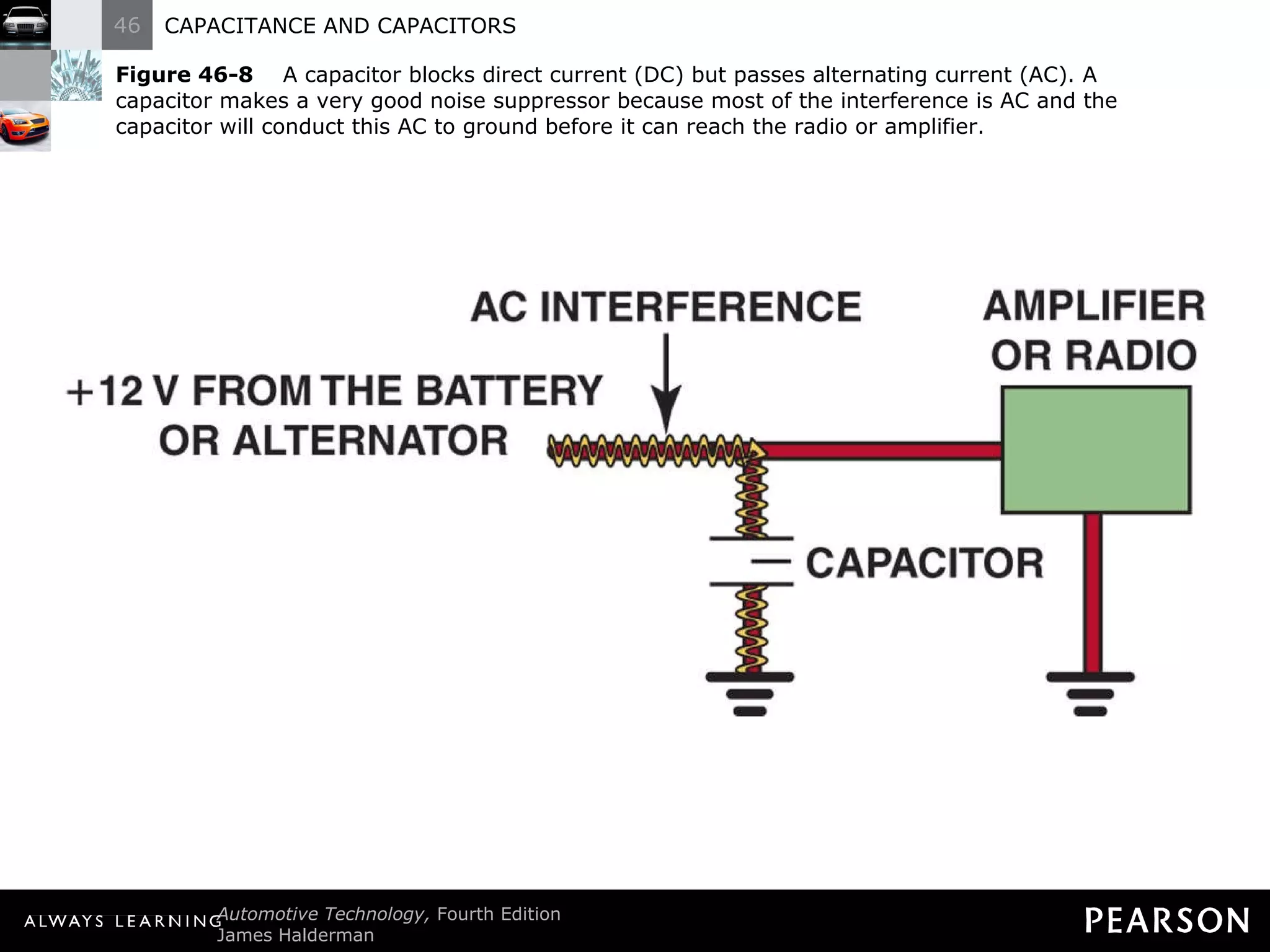
Uses for Capacitors Noise Filtering Interference is usually due to alternating current (AC) voltage created somewhere in the vehicle
Uses for Capacitors Noise Filtering A capacitor does the following: Blocks the flow of direct current (DC) Allows alternating current (AC) to pass
Figure 46-8   A capacitor blocks direct current (DC) but passes alternating current (AC). A capacitor makes a very good noise suppressor because most of the interference is AC and the capacitor will conduct this AC to ground before it can reach the radio or amplifier.
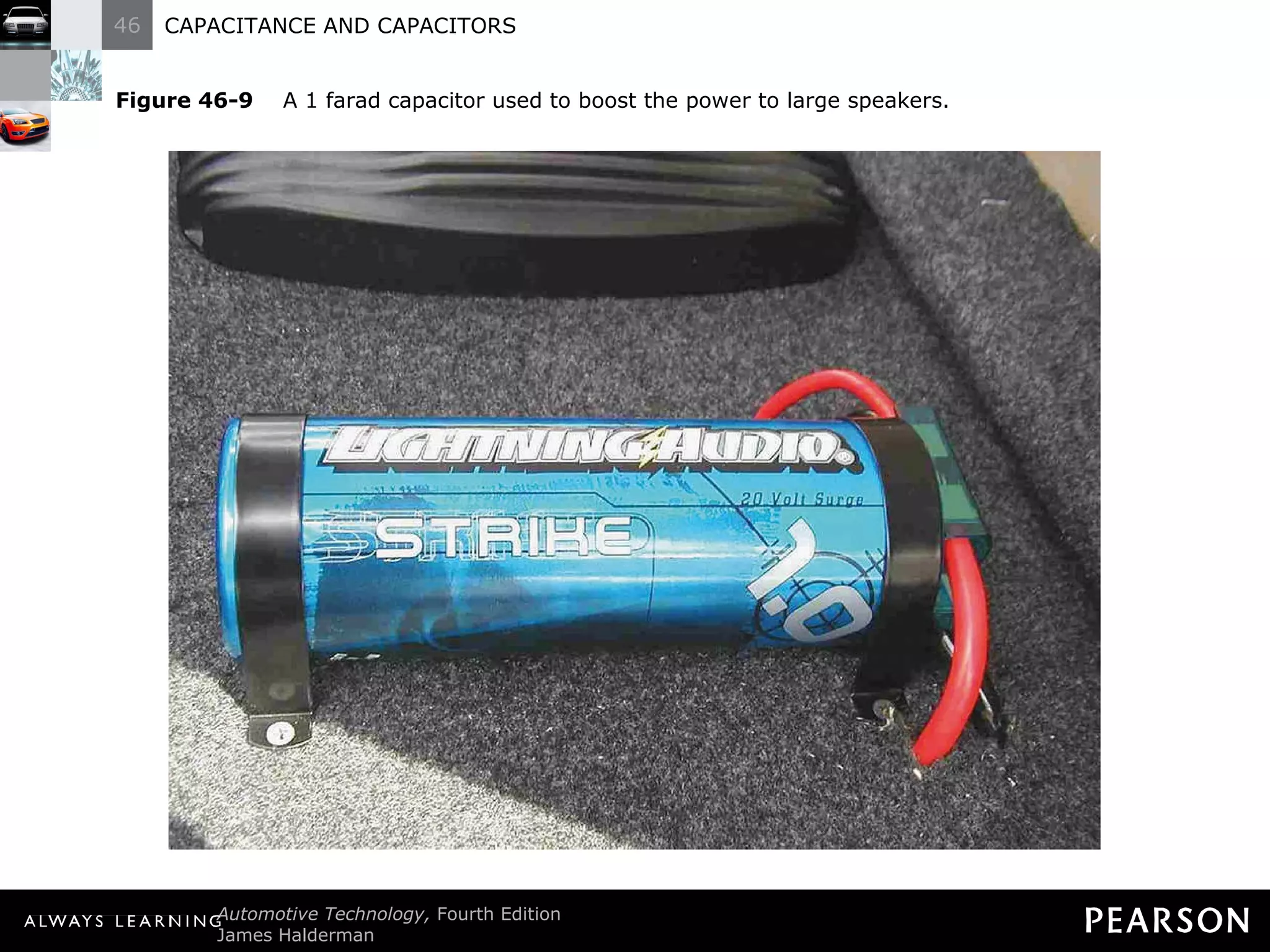
Uses for Capacitors Supplemental Power Source A capacitor can be used to supply electrical power for short bursts in an audio system to help drive the speakers
Figure 46-9   A 1 farad capacitor used to boost the power to large speakers.
Uses for Capacitors Time Circuits Capacitors are used in electronic circuits as part of a timer, to control window defoggers, interior lighting, pulse wipers, and automatic headlights
Uses for Capacitors Computer Memory In most cases, the main memory of a computer is a high-speed random-access memory (RAM)
Uses for Capacitors Computer Memory Dynamic random-access memory (DRAM) is the most commonly used type of RAM
Uses for Capacitors Computer Memory In a DRAM chip, each memory cell consists of a capacitor When a capacitor is electrically charged, it is said to store the binary digit 1, and when discharged, it represents 0
Uses for Capacitors Condenser Microphones A microphone converts sound waves into an electric signal All microphones have a diaphragm that vibrates with sound waves
Uses for Capacitors Condenser Microphones Electrical component creates an output flow of current at a frequency proportional to the sound waves A condenser microphone uses a capacitor for this purpose
CAPACITORS  IN CIRCUITS
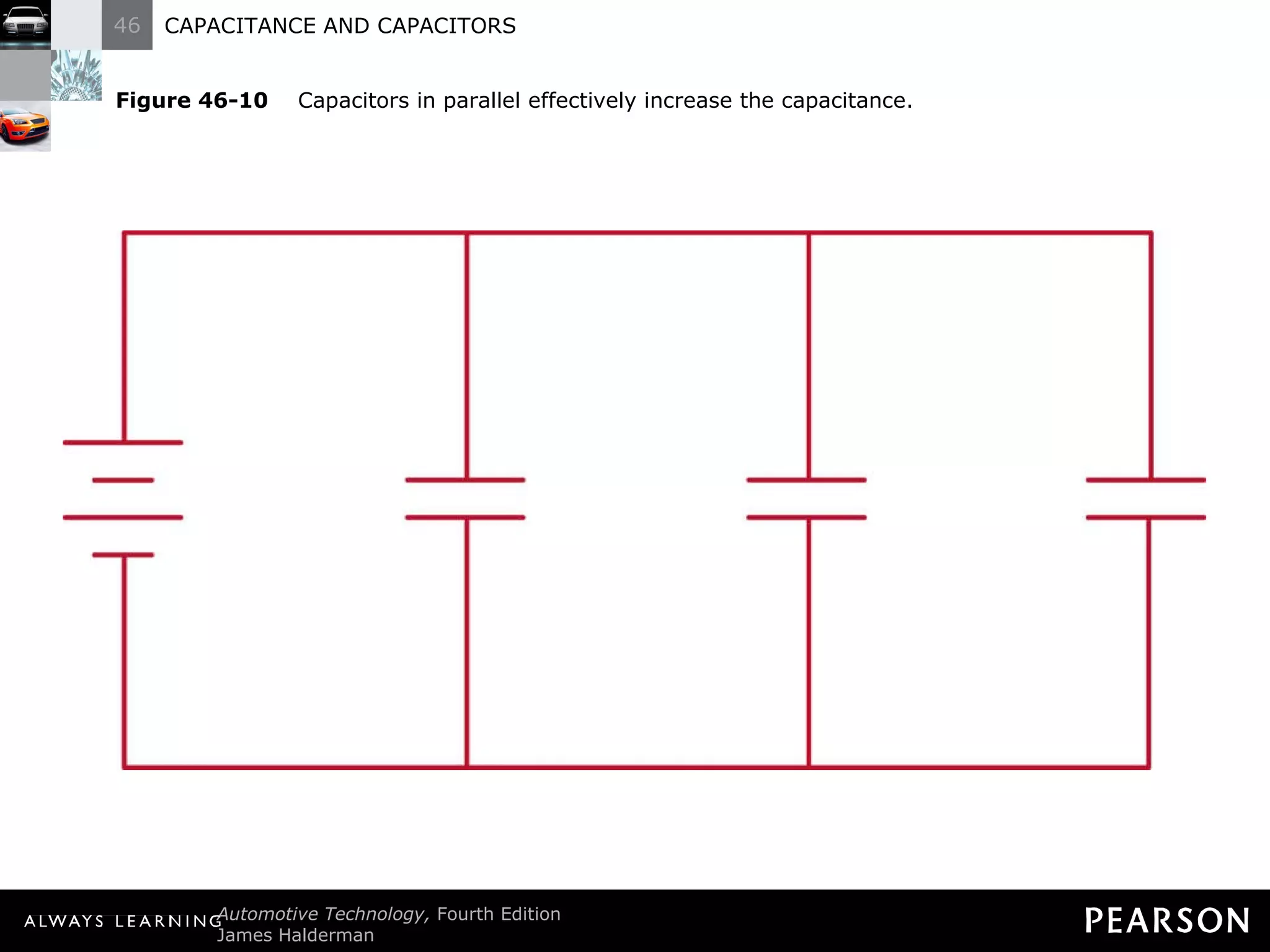
Capacitors in Circuits Capacitors in Parallel Circuits Capacitance is increased by connecting capacitors in parallel Two or more capacitors in parallel increases the plate size, making it possible to store more charge and create greater capacitance
Capacitors in Circuits Capacitors in Parallel Circuits Total capacitance is the sum of their individual values
Figure 46-10   Capacitors in parallel effectively increase the capacitance.
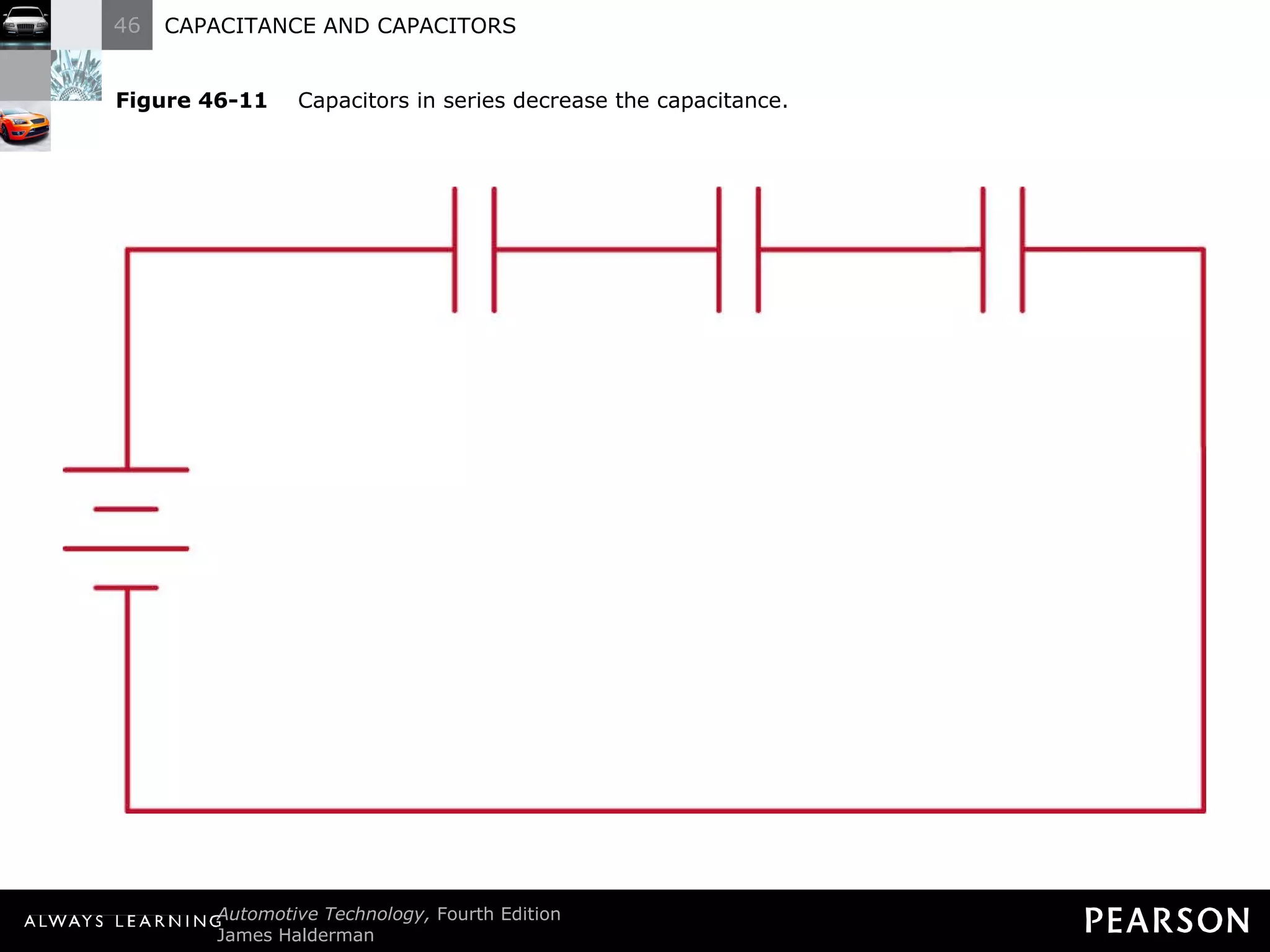
Capacitors in Circuits Capacitors in Series Circuits Capacitance can be decreased in a circuit by capacitors in series Connecting two or more capacitors in series increases the distance between the plates and thickness of the dielectric, decreasing the amount of capacitance
Capacitors in Circuits Capacitors in Series Circuits NOTE: Capacitors are often used to reduce radio interference or to improve the performance of a high-power sound system. Additional capacitance can, therefore, be added by attaching another capacitor in parallel.
Figure 46-11   Capacitors in series decrease the capacitance.
Capacitors in Circuits Suppression Capacitors Capacitors are used across the following: The primary circuit of some electronic ignition modules The output terminal of most alternators
Capacitors in Circuits Suppression Capacitors Capacitors are used across the following: The armature circuit of some electric motors
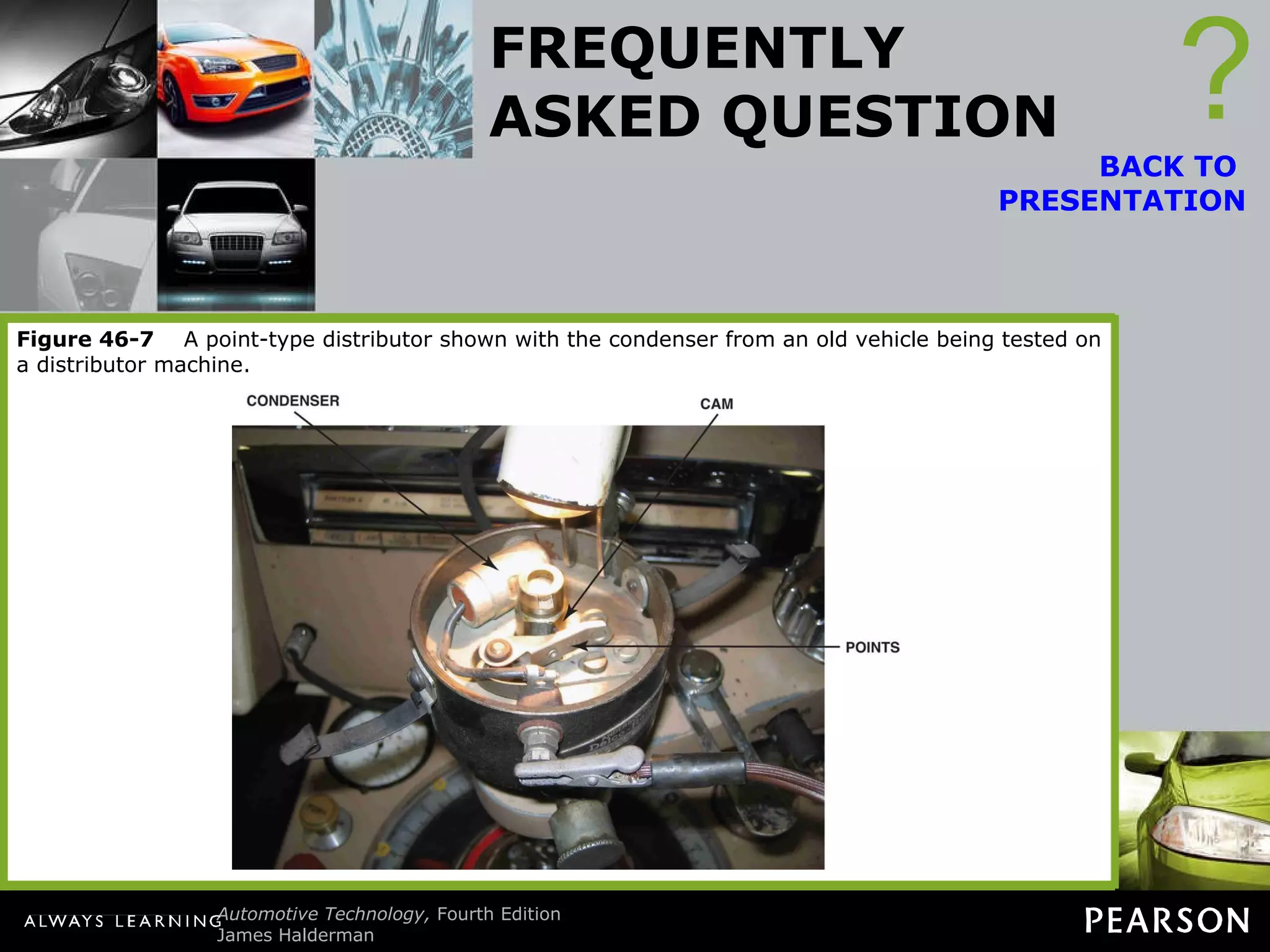
FREQUENTLY ASKED QUESTION What Are “Points and Condenser”? Points and condenser are used in point-type ignition systems. Points : A set of points uses one stationary contact and a movable contact that is opened by a cam lobe inside the ignition distributor.  ? BACK TO  PRESENTATION When the points are closed, current flows through the primary windings of the ignition coil and creates a strong magnetic field. As the engine rotates, the distributor can open the contact points, which opens the circuit to the coil. The stored magnetic field in the coil collapses and generates a high-voltage arc from the secondary winding of the coil. It is this spark that is sent to the spark plugs that ignites the air-fuel mixture inside the engine. Condenser The condenser (capacitor) is attached to the points and the case of the condenser is grounded. When the points start to open, the charge built up in the primary winding of the coil would likely start to arc across the opening points. To prevent the points from arcing and to increase how rapidly the current is turned off, the condenser stores the current temporarily. Points and condenser were used in vehicles and small gasoline engines until the mid-1970s. Figure 46-7   A point-type distributor shown with the condenser from an old vehicle being tested on a distributor machine.
Halderman ch046 lecture

  • 1.
  • 2.
    Objectives The studentshould be able to: Prepare for ASE Electrical/Electronic Systems (A6) certification test content area “A” (General Electrical/Electronic Systems). Explain capacitance. Describe how a capacitor can be used to filter electrical noise.
  • 3.
    Objectives The studentshould be able to: Describe how a capacitor can store an electrical charge. Explain how a capacitor circuit can be used as a timer circuit.
  • 4.
  • 5.
    Capacitance Definition Capacitanceis the ability of an object or surface to store an electrical charge
  • 6.
    Capacitance Definition Around1745, Ewald Christian von Kliest and Pieter van Musschenbroek independently discovered capacitance in an electric circuit using a device, now called a Leyden jar (glass jar filled with water, with a nail piercing the stopper and dipping into the water)
  • 7.
    Capacitance Definition In1747, John Bevis lined both the inside and outside of the jar with foil to create a capacitor with two conductors (the inside and outside metal foil layers) equally separated by the insulating glass
  • 8.
    Capacitance Definition NOTE:Capacitors are also called condensers. This term developed because electric charges collect, or condense, on the plates of a capacitor much like water vapor collects and condenses on a cold bottle or glass.
  • 9.
    Figure 46-1 A Leyden jar can be used to store an electrical charge.
  • 10.
  • 11.
    Capacitor Construction andOperation Construction A capacitor (also called a condenser) consists of two conductive plates with an insulating material (commonly called dielectric) between them
  • 12.
    Capacitor Construction andOperation Construction This substance is a poor conductor of electricity including air, mica, ceramic, glass, paper, plastic
  • 13.
    Capacitor Construction andOperation Construction The dielectric constant is the relative strength of a material against the flow of electrical current
  • 14.
    Capacitor Construction andOperation Construction The higher the number is, the better the insulating properties
  • 15.
    Chart 46-1 The higher the dielectric constant is, the better the insulating properties between the plates of the capacitor.
  • 16.
    Capacitor Construction andOperation Operation When a capacitor is placed in a closed circuit, the voltage source (battery) forces electrons around the circuit
  • 17.
    Capacitor Construction andOperation Operation Excess electrons collect on what becomes the negatively charged plate, while the other plate loses electrons and becomes positively charged
  • 18.
    Capacitor Construction andOperation Operation Current continues until the voltage charge across the capacitor plates and the source voltage are the same
  • 19.
    Capacitor Construction andOperation Operation The positive plate of the capacitor and the positive terminal of the battery are also at equal positive potentials
  • 20.
    Capacitor Construction andOperation Operation The circuit is in balance when there is a voltage charge across the battery terminals and an equal voltage charge across the capacitor plates
  • 21.
    Capacitor Construction andOperation Operation An electrostatic field now exists between the capacitor plates When the charged capacitor is connected to an external circuit, it discharges and both plates of the capacitor are neutral
  • 22.
    Capacitor Construction andOperation Operation The charge slowly leaks off the capacitor through the dielectric Capacitors should be treated as if charged until proven to be discharged
  • 23.
    Capacitor Construction andOperation Operation To safely discharge a capacitor, use a test light with the clip attached to a good ground, and touch the terminal with the point of the test light ?
  • 24.
    Figure 46-2 This simple capacitor, made of two plates separated by an insulating material, is called a dielectric.
  • 25.
    Figure 46-3 As the capacitor is charging, the battery forces electrons through the circuit.
  • 26.
    Figure 46-4 When the capacitor is charged, there is equal voltage across the capacitor and the battery. An electrostatic field exists between the capacitor plates. No current flows in the circuit.
  • 27.
    Figure 46-5 The capacitor is charged through one circuit (top) and discharged through another (bottom).
  • 28.
    Figure 46-6 Capacitor symbols are shown in electrical diagrams. The negative plate is often shown curved.
  • 29.
  • 30.
    Factors of CapacitanceCapacitance is governed by three factors: The surface area of the plates The distance between the plates The dielectric material
  • 31.
    Factors of CapacitanceThe larger the surface area of the plates, the greater the capacitance The closer the plates, the greater the capacitance The insulating qualities of the dielectric material also affect capacitance
  • 32.
    Factors of CapacitanceMeasurement of Capacitance Capacitance is measured in farads, named after Michael Faraday (1791–1867), an English physicist
  • 33.
    Factors of CapacitanceMeasurement of Capacitance The symbol for farads is the letter F If a charge of 1 coulomb is placed on the plates of a capacitor and the potential difference between them is 1 volt, then the capacitance is defined to be 1 farad (1 F)
  • 34.
    Factors of CapacitanceMeasurement of Capacitance A farad is an extremely large quantity of capacitance, so microfarads (0.000001 farad), or μF, are more commonly used
  • 35.
  • 36.
    Uses for CapacitorsSpike Suppression A capacitor can be used in parallel to a coil to reduce the voltage spike that occurs when the circuit is opened
  • 37.
    Uses for CapacitorsSpike Suppression The capacitor absorbs the high voltage and stops it from interfering with other electronic devices
  • 38.
    Uses for CapacitorsNoise Filtering Interference is usually due to alternating current (AC) voltage created somewhere in the vehicle
  • 39.
    Uses for CapacitorsNoise Filtering A capacitor does the following: Blocks the flow of direct current (DC) Allows alternating current (AC) to pass
  • 40.
    Figure 46-8 A capacitor blocks direct current (DC) but passes alternating current (AC). A capacitor makes a very good noise suppressor because most of the interference is AC and the capacitor will conduct this AC to ground before it can reach the radio or amplifier.
  • 41.
    Uses for CapacitorsSupplemental Power Source A capacitor can be used to supply electrical power for short bursts in an audio system to help drive the speakers
  • 42.
    Figure 46-9 A 1 farad capacitor used to boost the power to large speakers.
  • 43.
    Uses for CapacitorsTime Circuits Capacitors are used in electronic circuits as part of a timer, to control window defoggers, interior lighting, pulse wipers, and automatic headlights
  • 44.
    Uses for CapacitorsComputer Memory In most cases, the main memory of a computer is a high-speed random-access memory (RAM)
  • 45.
    Uses for CapacitorsComputer Memory Dynamic random-access memory (DRAM) is the most commonly used type of RAM
  • 46.
    Uses for CapacitorsComputer Memory In a DRAM chip, each memory cell consists of a capacitor When a capacitor is electrically charged, it is said to store the binary digit 1, and when discharged, it represents 0
  • 47.
    Uses for CapacitorsCondenser Microphones A microphone converts sound waves into an electric signal All microphones have a diaphragm that vibrates with sound waves
  • 48.
    Uses for CapacitorsCondenser Microphones Electrical component creates an output flow of current at a frequency proportional to the sound waves A condenser microphone uses a capacitor for this purpose
  • 49.
    CAPACITORS INCIRCUITS
  • 50.
    Capacitors in CircuitsCapacitors in Parallel Circuits Capacitance is increased by connecting capacitors in parallel Two or more capacitors in parallel increases the plate size, making it possible to store more charge and create greater capacitance
  • 51.
    Capacitors in CircuitsCapacitors in Parallel Circuits Total capacitance is the sum of their individual values
  • 52.
    Figure 46-10 Capacitors in parallel effectively increase the capacitance.
  • 53.
    Capacitors in CircuitsCapacitors in Series Circuits Capacitance can be decreased in a circuit by capacitors in series Connecting two or more capacitors in series increases the distance between the plates and thickness of the dielectric, decreasing the amount of capacitance
  • 54.
    Capacitors in CircuitsCapacitors in Series Circuits NOTE: Capacitors are often used to reduce radio interference or to improve the performance of a high-power sound system. Additional capacitance can, therefore, be added by attaching another capacitor in parallel.
  • 55.
    Figure 46-11 Capacitors in series decrease the capacitance.
  • 56.
    Capacitors in CircuitsSuppression Capacitors Capacitors are used across the following: The primary circuit of some electronic ignition modules The output terminal of most alternators
  • 57.
    Capacitors in CircuitsSuppression Capacitors Capacitors are used across the following: The armature circuit of some electric motors
  • 58.
    FREQUENTLY ASKED QUESTIONWhat Are “Points and Condenser”? Points and condenser are used in point-type ignition systems. Points : A set of points uses one stationary contact and a movable contact that is opened by a cam lobe inside the ignition distributor. ? BACK TO PRESENTATION When the points are closed, current flows through the primary windings of the ignition coil and creates a strong magnetic field. As the engine rotates, the distributor can open the contact points, which opens the circuit to the coil. The stored magnetic field in the coil collapses and generates a high-voltage arc from the secondary winding of the coil. It is this spark that is sent to the spark plugs that ignites the air-fuel mixture inside the engine. Condenser The condenser (capacitor) is attached to the points and the case of the condenser is grounded. When the points start to open, the charge built up in the primary winding of the coil would likely start to arc across the opening points. To prevent the points from arcing and to increase how rapidly the current is turned off, the condenser stores the current temporarily. Points and condenser were used in vehicles and small gasoline engines until the mid-1970s. Figure 46-7 A point-type distributor shown with the condenser from an old vehicle being tested on a distributor machine.

Editor's Notes

  • #10 Figure 46-1 A Leyden jar can be used to store an electrical charge.
  • #16 Chart 46-1 The higher the dielectric constant is, the better the insulating properties between the plates of the capacitor.
  • #25 Figure 46-2 This simple capacitor, made of two plates separated by an insulating material, is called a dielectric.
  • #26 Figure 46-3 As the capacitor is charging, the battery forces electrons through the circuit.
  • #27 Figure 46-4 When the capacitor is charged, there is equal voltage across the capacitor and the battery. An electrostatic field exists between the capacitor plates. No current flows in the circuit.
  • #28 Figure 46-5 The capacitor is charged through one circuit (top) and discharged through another (bottom).
  • #29 Figure 46-6 Capacitor symbols are shown in electrical diagrams. The negative plate is often shown curved.
  • #41 Figure 46-8 A capacitor blocks direct current (DC) but passes alternating current (AC). A capacitor makes a very good noise suppressor because most of the interference is AC and the capacitor will conduct this AC to ground before it can reach the radio or amplifier.
  • #43 Figure 46-9 A 1 farad capacitor used to boost the power to large speakers.
  • #53 Figure 46-10 Capacitors in parallel effectively increase the capacitance.
  • #56 Figure 46-11 Capacitors in series decrease the capacitance.