Department of Electronics & Designed by Soujanya Roy, Anish Chakraborty and Raj Sekhar Goswami
Communication Engineering
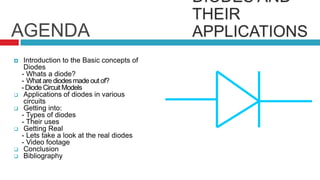
AGENDA
    Introduction to the Basic concepts of
     Diodes
    - Whats a diode?
    - What are diodes made out of?
    - Diode Circuit Models
    Applications of diodes in various
     circuits
    Getting into:
    - Types of diodes
    - Their uses
    Getting Real
    - Lets take a look at the real diodes
    - Video footage
    Conclusion
    Bibliography
Introduction- Basic Concepts

 Whats  a diode?
 - Di+Ode
 - A semiconductor device with
 two terminals allowing the
 flow of current in one direction
 only.
Introduction- Basic Concepts

              What are diodes made
              out of?
              Silicon
              Germanium
              GaAs
Introduction- Basic Concepts


              What are diodes made
                              Diamond lattice and Zinc Blende
              out of?          Structure
Introduction- Basic Concepts
 Diode
      Circuit
 Models


                Lets Browse through the three important diode circuit models
Introduction- Basic Concepts
 Diode
      Circuit
 Models
 √                 The Ideal Diode
                   Model

                The diode is designed to allow current to flow in only one
                direction. The perfect diode would be a perfect conductor in
                one direction (forward bias) and a perfect insulator in the
                other direction (reverse bias). In many situations, using the
                ideal diode approximation is acceptable.
Introduction- Basic Concepts
 Diode
      Circuit
 Models
 √               The Ideal Diode
                 with Barrier                                 +
                                                                  V
 √               Potential
                This model is more accurate than the simple ideal diode
                model because it includes the approximate barrier
                potential voltage. Remember the barrier potential
                voltage is the voltage at which appreciable current starts
                to flow.
Introduction- Basic Concepts
 Diode
      Circuit
 Models
 √
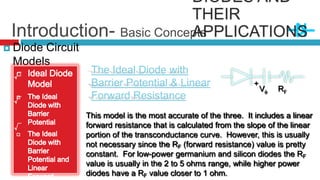
                 The Ideal Diode with
                 Barrier Potential & Linear                     +
                                                                    V   RF
 √
                 Forward Resistance
                This model is the most accurate of the three. It includes a linear
 √              forward resistance that is calculated from the slope of the linear
                portion of the transconductance curve. However, this is usually
                not necessary since the RF (forward resistance) value is pretty
                constant. For low-power germanium and silicon diodes the RF
                value is usually in the 2 to 5 ohms range, while higher power
                diodes have a RF value closer to 1 ohm.
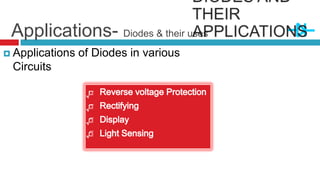
Applications- Diodes & their uses
 Applications   of Diodes in various
 Circuits
  √

                  √
  √
                  √
                  √
  √
                  √
Getting into- Diodes & their uses
 Types of Diodes and their
 applications
 √


 √                                                                   A                           K

 √ used to allow current to flow in one direction while
  Are                                                                    Schematic Symbol for a PN
                                                                         Junction Diode
  blocking current flow in the opposite direction.

                                                                          P         n
                                    Representative Structure for a
                                    PN Junction Diode
Getting into- Diodes & their uses
 Types  of Diodes and their
  applications
  √


  √
                                                           A                             K
Are specifically designed to operate under reverse breakdown   Schematic Symbol for a Zener
   √
conditions. These diodes have a very accurate and specific     Diode
reverse breakdown voltage.
Getting into- Diodes & their uses
 Types   of Diodes and their
   applications
   √


   √                                                                  A                          K
Light-emitting diodes are designed with a very large bandgap
so movement of carriers across their depletion region emits      Schematic Symbol for a Light-
   √                                                             Emitting Diode
photons of light energy. Lower bandgap LEDs (Light-Emitting
Diodes) emit infrared radiation, while LEDs with higher      The arrows in the LED
bandgap energy emit visible light.                           representation indicate
                                                                   emitted light.
Getting into- Diodes & their uses
 Types of Diodes and their
 applications
 √
 While LEDs emit light, Photodiodes are
  √
 sensitive to received light. They are
                                           A                       K
 constructed so their pn junction can be
 exposed to the outside through a clear
  √
 window or lens.
 • Photoconductive Mode                    A                       K
 • Photovoltaic Mode

                                           Schematic Symbols for
                                           Photodiodes
Getting into- Diodes & their uses
 Types of Diodes and their
 applications
 √


 √


 √
Getting into- Diodes & their uses
 Types of Diodes and their
 applications
 √


 √


 √
Getting Real- Video footage
 Letstake a look at the real
 diodes and their application in
 circuitry
 √


  √


  √
Conclusion- Summing up
 Summing up all about
 diodes…!!!
 √
  √


  √
  √


  √
Bibliography- References
 Thanks   to the sources…!!!
 √
  √
   √
   √
   √
THE END…


√
 √
 √
 √
 √

Diodes

  • 1.
    Department of Electronics& Designed by Soujanya Roy, Anish Chakraborty and Raj Sekhar Goswami Communication Engineering
  • 2.
    AGENDA  Introduction to the Basic concepts of Diodes - Whats a diode? - What are diodes made out of? - Diode Circuit Models  Applications of diodes in various circuits  Getting into: - Types of diodes - Their uses  Getting Real - Lets take a look at the real diodes - Video footage  Conclusion  Bibliography
  • 3.
    Introduction- Basic Concepts Whats a diode? - Di+Ode - A semiconductor device with two terminals allowing the flow of current in one direction only.
  • 4.
    Introduction- Basic Concepts  What are diodes made out of?  Silicon  Germanium  GaAs
  • 5.
    Introduction- Basic Concepts  What are diodes made  Diamond lattice and Zinc Blende out of? Structure
  • 6.
    Introduction- Basic Concepts Diode Circuit Models Lets Browse through the three important diode circuit models
  • 7.
    Introduction- Basic Concepts Diode Circuit Models √ The Ideal Diode Model The diode is designed to allow current to flow in only one direction. The perfect diode would be a perfect conductor in one direction (forward bias) and a perfect insulator in the other direction (reverse bias). In many situations, using the ideal diode approximation is acceptable.
  • 8.
    Introduction- Basic Concepts Diode Circuit Models √ The Ideal Diode with Barrier + V √ Potential This model is more accurate than the simple ideal diode model because it includes the approximate barrier potential voltage. Remember the barrier potential voltage is the voltage at which appreciable current starts to flow.
  • 9.
    Introduction- Basic Concepts Diode Circuit Models √ The Ideal Diode with Barrier Potential & Linear + V RF √ Forward Resistance This model is the most accurate of the three. It includes a linear √ forward resistance that is calculated from the slope of the linear portion of the transconductance curve. However, this is usually not necessary since the RF (forward resistance) value is pretty constant. For low-power germanium and silicon diodes the RF value is usually in the 2 to 5 ohms range, while higher power diodes have a RF value closer to 1 ohm.
  • 10.
    Applications- Diodes &their uses  Applications of Diodes in various Circuits √ √ √ √ √ √ √
  • 11.
    Getting into- Diodes& their uses  Types of Diodes and their applications √ √ A K √ used to allow current to flow in one direction while Are Schematic Symbol for a PN Junction Diode blocking current flow in the opposite direction. P n Representative Structure for a PN Junction Diode
  • 12.
    Getting into- Diodes& their uses  Types of Diodes and their applications √ √ A K Are specifically designed to operate under reverse breakdown Schematic Symbol for a Zener √ conditions. These diodes have a very accurate and specific Diode reverse breakdown voltage.
  • 13.
    Getting into- Diodes& their uses  Types of Diodes and their applications √ √ A K Light-emitting diodes are designed with a very large bandgap so movement of carriers across their depletion region emits Schematic Symbol for a Light- √ Emitting Diode photons of light energy. Lower bandgap LEDs (Light-Emitting Diodes) emit infrared radiation, while LEDs with higher The arrows in the LED bandgap energy emit visible light. representation indicate emitted light.
  • 14.
    Getting into- Diodes& their uses  Types of Diodes and their applications √ While LEDs emit light, Photodiodes are √ sensitive to received light. They are A K constructed so their pn junction can be exposed to the outside through a clear √ window or lens. • Photoconductive Mode A K • Photovoltaic Mode Schematic Symbols for Photodiodes
  • 15.
    Getting into- Diodes& their uses  Types of Diodes and their applications √ √ √
  • 16.
    Getting into- Diodes& their uses  Types of Diodes and their applications √ √ √
  • 17.
    Getting Real- Videofootage  Letstake a look at the real diodes and their application in circuitry √ √ √
  • 18.
    Conclusion- Summing up Summing up all about diodes…!!! √ √ √ √ √
  • 19.
    Bibliography- References  Thanks to the sources…!!! √ √ √ √ √
  • 20.